Another reord close for JSE

The Jamaica Stock Exchange all Jamaica Composite Index close at yet another record with a rise of 2,135.19 points to 302,498.35 on Monday.
The JSE Index jumped 2,198.62 points to close at 285,647.03 as NCB Financial closed at $91 with 611,333 shares changing hands. Berger Paints resumed trading with 248,769 shares changing hands as the price closed at $11.50 and Scotia Group rose to close at $52.

with todays close and NCB Financial closing with limited supply, the market could be moving away from the recent short term resistance and heading for the next at 360,000 points.

All Jamaica cracks 300,000 for first time

Jamaica Stock Exchange all Jamaica Index closes above 300,000 on Friday.

The JSE All Jamaican Composite Index surged 5,376.82 points to close above the 300,000 points level for the first time, as JMMB Group, NCB Financial and Scotia Group recorded strong gains and pushed the index to a record close at 300,363.16.
The JSE Index jumped 4,898.89 points to close at a record 273,664.81 and in the US dollar market the USD Equities Index closed at 184.36.
Come Tuesday, when trading resumes it will be interesting to see how NCB trades since the stock closed at the equivalent of $100 in Trinidad on Thursday. At the close on Friday, there were only 33,603 units on offer for the stock. A break out of NCB is likely to see the market moving decisively away from the resistance, around the 300,000 points level. On Tuesday, Berger Paints that was suspended pending the closure of the Ansa Coating mandatory buyout offer, at the end of the day there were information on the out-turn of the offer.
Trading on the main market of the Jamaica Stock Exchange finished on Friday with 22 securities changing hands, 7 advanced, 6 declined and 11 traded firm with 4,504,312 units valued at $68,391,852 compared to 94,545,441 units valued at $1,119,081,050 on Thursday. In the US dollar market 425,898 units traded for a value of US$102,239 for two securities.
Trading ended with an average of 204,741 units for an average of $3,108,721 in contrast to 4,110,671 units for an average of $48,655,698 on Thursday. The average volume and value for the month to date amounts to 2,279,320 units valued at $30,989,186 and an average of 2,498,747 units at $34,245,233, previously. In contrast, September closed with average of 283,480 units at $3,630,990 for each security traded.
IC bid-offer Indicator| At the end of trading in the main and US dollar markets, the Investor’s Choice bid-offer indicator reading shows 7 stocks with bids higher than their last selling prices and 2 with lower offers.

Big run for Jamaican stocks coming

JSE Main market showing next major resistance around the 360,000 point level on the al Jamaica Index

The current state of the Jamaican stock market in one of contrast with the main market hitting 5 days of record close and with gains of 40 percent for the year to date and Junior Market that was up 31 percent in May is now up just 14 percent.
With stability present in the forex market for the Jamaican dollar, lower interest rates being paid on money market funds and with business confidence at record high levels, funds are now moving into the main market stocks with less interest being shown in the Junior Market.
Prices in the US dollar market have come off, after the index was up 63 percent at 268.73 points in February, up from 164.50 at the start of the year, but it is only up 12 percent now with the index at 184.86 points at the close of trading on Friday.

Jamaica Main market stocks itching to break out of channel that stretches back to 2014

The Junior Market was driven up by excessive buying that drove a number of the stocks to excessive valuations which the market has been correcting for, resulting in the sharp pull back from the all-time high, even then there are some that are still overvalued based on the average valuation of other stocks. The market still has several undervalued stocks but the focus on the bigger and more liquid main market is sucking some energy from the junior ones.
Based on estimated 2017 earnings, the average PE of the junior and main markets are just over 13 times earnings. The main market has more than half of the market trading below this level. Included in the list are Berger Paints with a PE of just 5, Caribbean Cement at 6, Jamaica Broilers 7, JMMB Group at 8, Grace Kennedy, NCB Financial and Sagicor Group at 10. The market has Jamaica Producers selling at 32 times 2017 earnings and Kingston Wharves at 27 times earnings with Kingston Properties at a rich 36 times and are clearly overvalued currently. Jamaica Stock Exchange and 138 Student Living at 22 are well ahead of the market average.

Junior Market under pressure, testing support around 2,900 points.

In the Junior Market Medical Disposables is priced at 6 times earnings, General Accident 6, Caribbean Producers 7, Stationery and Office Supplies, Caribbean Cream and Main Event at 10. Just under half of Junior Market stocks are trading blow the market average with about 25 percent well above the average.
Technical reading| The main market broke through major resistance for the second time since September at 290,000 points, that has its genesis in 1992 and connecting in 2005. The market faces some short term resistance around 300,000 points which should be broken through before long ahead of moving to the next sort term resistance around 360,000 points with 505,000 on the all Jamaica Index, the next big stop. The market has been trading in a distinct upward sloping channel from mid-2014 until now and seems set to break out and move higher.
The Junior Market chart is a big contrast to that of the main market.

Wigton Wind farm should list on the JSE main market in early 2017 with a large capitalization

While the latter is clearly heading higher with new highs being created, the Junior Market index is flashing negative signals. The market has formed a head and shoulder pattern which is a negative signal and the short term 45 days moving average has broken through both the medium term 200 days moving average and longer term moving averages. The market has broken through the channel that it has been trading in since late 2015. There appear to be support around the 2,900 points level but it could go down to 2,800 points where the next support is and it will left to be seen 2,900 points will be the floor ahead of third quarter results that could change the course of the movement.
With just over 2 months for the year to end investors should start to have an eye open for major factors that could make big differences to earnings in 2018 when making investment assessment now. Some of these are, more reduction in interest rates, continued strong foreign exchange growth, low inflation, increased construction activity, increased activity in the tourism sector and of course the potential for several new listings to come to market between now and then. IC Insider.com is aware of 8 such potential listings. The list include, Wigton Wind Farm, Jamaica Public Service as a result of Government of Jamaica’s planned sale of its 20 percent share in the company, Neveast Stationery, KIW International, a relatively new business in Montego Bay and a large manufacturing business, operating out of St Catherine.

Record close for majors

The JSE All Jamaican Composite Index jumped for the third day in a row rising 2,504.83 points to close at a new record close 294,165.86 on Tuesday, helped by jump in the price of NCB Financial and Scotia Group.
The JSE Index advanced by 2,282.19 points to close at a new record close of 268,018.37, while the JSE US Equities Index advanced by 8.17 points to close at 184.98. Carreras traded at a new intraday high of $14 but ended trading down at $12.60 after trading nearly 1 million shares.
The market has broken through long term resistance of 290,000 points on the All Jamaican Composite Index but it sits just above the 300,000 points level which is a short term resistance with the market being hemmed at that level and 277,000 points on the low end. (See chart showing trading taking place within the channel)
Trading on the Jamaica Stock Exchange main market closed on Tuesday with 22 securities changing hands and one in the US d0llar market, leading 8 advancing, 11 declining and 4 trading firm. Trading volume jumped sharply to 78,668,713 units valued at $1,059,742,531 with Sagicor Real Estate Fund accounting for 76.5 million units, compared to 13,618,629 units valued at $432,506,372 trading on Monday. In the US dollar market trading accounted for 48,005 units valued at US$11,484, bringing the total trades in the markets to $1,061,223,932.
Trading ended with an average of 3,575,851 units for an average of $48,170,115 in contrast to 504,394 units for an average of $16,018,755 on Monday. The average volume for the month to date is 2,040,122 units valued at $32,094,435. In contrast, September closed with average of 283,480 units valued at $3,630,990 for each security traded.
IC bid-offer Indicator| At the end of trading in the main and US dollar markets, the Investor’s Choice bid-offer indicator reading shows a very strong 7 stocks with bids higher than their last selling prices, up from 7 on Monday and 2 with lower offers, compared to 4 on Monday.

NCB Capital stock talk

NCB Capital Markets (NCBCM) recommends that investors maintain focus on stocks of companies with diversified revenue streams by operations, geography and currency in its latest recommendations on the Jamaican stock market.
According to the brokerage house, main market companies tend to have more mature operations, stronger fundamentals and are likely to pay more attractive dividends for investors heavily dependent on cash flows. This should form the core of a moderate investor’s equity portfolio. Investors with the appropriate risk appetite should also take a closer look at some Junior Market stocks given that the potential for growth is greater than their main market counterparts. More aggressive investors should also consider taking an active approach to stock market investing by crystalizing gains on stocks that are trading above their fair value estimates, with a view to re-enter at more favourable prices in the near term.

Jamaica Broilers is a recommended buy by NCBCM

Interestingly, there are only three stocks recommended as buys, with six stocks placed on the sell list.
NCBCM recommends investors buy Jamaica Broiler with a forward price of $24, JMMB Group with a forward price of $23.80 and PanJam Investment with a forward price of $43.63.
The brokerage house is recommending selling Caribbean Cement, based on their assessment that the fair value price for the cement producer is $29.92 which is below the current price of $29.99, also on the sell list is Honey Bun, that they are saying that the PE ratio and price to book multiples for Junior Market manufacturing companies were used to derive a fair value estimate of HONBUN with a forward price of $3.70. Jamaica Producers is on the sell list as well with a forward price of $12.99 based on a price to book valuation, Mayberry Investments’ forward price is put at $3.95 and therefore a sell NCBCM says. The fair value of Scotia Group is estimated at $46.48, which is below the current price. The projected dividend yield of 3.5% is not sufficient to offset expected capital loss the NCB Financial brokerage arm says.

Scotiabank is a recommended sell by NCBCM

Stocks that are recommended as holds are Carreras based on the justified P/E and Dividend Discount Model resulted in valuation for Carreras up to $113.91 per share. Kingston Wharves forward price is $29.24, close to existing market price and Sagicor Group with fair value estimate of $34.21.
Ratings Definitions| BUY: The company has sound or improving fundamentals that should allow it to outperform the broader market over the next 12 months. The risk factors to achieving price targets are minimal.
HOLD: We believe the stock is fairly valued at the current price. The company may have issues affecting fundamentals that could take some time to resolve. The risk factors to achieving price targets are moderate. Some volatility is expected.
SELL: The stock is overpriced relative to the soundness of the company’s fundamentals and long-term prospects or the stock is fully priced.

Record fall closes week for JSE – Friday

Scotia Group dropped from at record high of $60 before nine months reuslts and fell to $45.05 after.

Investors pushed down the prices of Scotia Group from $51 to $45.05 within 2 minutes of the close and NCB Financial from $90 to $80.06, on the Jamaica Stock Exchange, knocking off around 6,000 points within 11 minutes of the close.
The sharp fall in the prices of the two stocks,  pushed an already battered All Jamaica Composite Index, down by a record 10,134.09 points to close at 276,949.36 points, and well off the intraday high of 296,779.53 points, reached at 9.50 am on September 7.
Friday’s decline is the largest in a single day, exceeding the 9,295.39 points fall on April 2004, down to 94,329.90. In percentage terms Friday’s move ranked pretty low representing 3.5 percent compared to 9 percent in 2004 fall. The JSE Market Index fell by 9,233.31 points to 252,332.20 and the JSE US dollar market index rose 0.89 points to 186.68.
The market was pulling back from short term resistance level close 300,000 points on the All Jamaica Composite Index. the market seems to have closed around a short term support level and should be consolidating next week, to again challenge the resistance level. With Scotia Group report unattractive nine months’ results, it is unlikely to deliver the punch it did when the market was making new highs during the first week in September. The market is moving within an upward moving channel,  clearly shown in the chart of the index. The odds favour the market moving within the channel for a while as investors await nine months’ results that will be the guide as to the direction of the market.
At the close of trading, 26 securities changed hands in the main market with 1 trading in the US dollar market, leading to 11 stocks advancing and 10 declining. The main market ended with 58,667,241 units valued at $128,145,103 changing hands compared to 5,966,372 units valued at $106,313,754 at the close on Thursday. Trading in the US dollar market accounted for 219,700 units valued at US$52,495 bringing the total of all trades to J$135,021,959.
IC bid-offer Indicator| At the end of trading in the main and US dollar markets, the Investor’s Choice bid-offer indicator reading shows 6 stocks with bids higher than their last selling prices and 2 with lower offers.
The main market ended trading with an average of 2,256,432 units valued at $4,928,658 for each security traded compared to an average of 284,113 units valued at $5,062,560. The average volume and value for the month to date, ended at 367,591 units with an average value of $3,438,723 compared with an average of 178,706 units with an average value of $3,303,275 on the previous trading day. The average volume and value for August ended at 184,094 units with an average value of $4,336,090.

JSE market indices tumble – Tuesday

Scotia Group dropped $2 and helped to pull the market index down on Tuesday.

The main market indices of the Jamaica Stock Exchange dropped sharply at the close on Tuesday with limited number of securities trading.
At the close, the All Jamaica Composite Index plunged 4,592.97 points to 287,374.30 and the JSE Market Index tumbled 4,184.72 points to 261,830.51.
The sharp pulled back in the market is triggered by relatively big fall in the prices of Caribbean Cement, JMMB Group, NCB Financial Group, Sagicor Real Estate Fund and Scotia Group.
Tuesday’s fall pulled the market below the critical resistance level for the All Jamaica Composite Index of 290,000 points. In the short term, how the market behave around current levels is likely to depend on the reception of the market to the release of Scotia Group’s nine months results before the week ends.
Trading in the JSE US dollar market index resulted in the index losing 3.45 points to 181.77. At the close of trading, 19 securities changed hands in the main market with 1 trading in the US dollar market, leading to 6 stocks advancing and 8 declining. The main market ended with 2,309,285 units valued at $75,635,060 changing hands compared to 4,726,576 units valued at $111,468,464 at the close on Monday. Trading in the US dollar market accounted for 70,247 units valued at US$16,047 bringing the total of all trades to J$77,705,099.
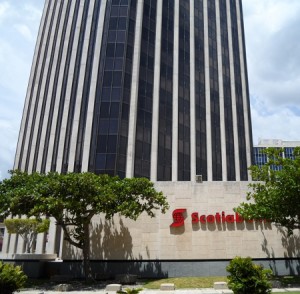
IC bid-offer Indicator| At the end of trading in the main and US dollar markets, the Investor’s Choice bid-offer indicator reading shows 4 stocks with bids higher than their last selling prices and just 1 with a lower offer.
The main market ended trading with an average of 121,541 units valued at $3,980,793 for each security traded compared to an average of 181,791 units valued at $4,287,249. The average volume and value for the month to date ended at 177,247 units with an average value of $3,342,808 compared with an average of 185,205 units with an average value of $3,263,060 on the previous trading day. The average volume and value for August ended at 184,094 units with an average value of $4,336,090.

Sharp out Noel in at Scotia Jamaica

Change at Scotia Group top slot.

Scotia Group (SGJL) announced that Jackie Sharp, President and Chief Executive Officer and Head of Caribbean Central and North, will be leaving to join her family business, effective October 31.
In August 2013, the group appointed Sharp as its first female president and CEO, effective September of that year. Sharp was also appointed a director of the SGJ and the Bank of Nova Scotia Jamaica.
As CEO it not only marked the first female to be appointed to that post but the first person who did not have an early career start in the bank to make it to the top executive post, her rise is sharp indeed, taking a mere 15 years after joining the bank. The resignation brings her career at the financial group to 20 years.

Jacqueline Sharp

According to the release from the group, Jackie Sharp joined the group in 1997 as a Management Trainee and held a number of key positions including Private Banking, Insurance, and Finance, before assuming the Country Head role, and most recently Head of Scotiabank’s Caribbean Central and North covering Jamaica, Bahamas, Cayman, Belize, British Virgin Islands and Turks and Caicos Islands.
“Jackie has made significant contributions to Scotiabank and the community over the years, achieving strong financial results while becoming one of the most respected leaders in the financial sector in Jamaica and the Caribbean”, said Brendan King, Senior Vice President, International Banking, Scotiabank. “We are very grateful for her dedication, consummate leadership and passion over many years at the Bank, and wish her well in her new endeavours as she joins her family business in Jamaica.”
In the first year of her reign Scotia Group Jamaica reported a fall of $774 million or 7 percent in net income to $10.1 billion for the year ended October 2014. Profit rose 14 profit to $11.6 billion for the 2016 year from $10.1 billion in 2015.
Scotia’s closest competitor on the other hand for the year to September 2014 enjoyed a 36 percent, or $3.1 billion increase to $11.6 billion and made profit of $14.4 billion in 2016 versus $12.3 billion in 2015 for a rise of 17.5 percent.

David Noel

Scotia results for six months to April showed profit up 14 percent to $5.7 billion while NCB grew 58 percent to $9.5 billion.
Sharp is being replaced by David Noel as President and Chief Executive Officer, and Head of the Caribbean Central and North regions. Noel joined Scotiabank in Jamaica in 2001 as Legal Counsel before moving to Canada in 2008 on a leadership development rotation in Toronto.
In 2010, he took on the role of District Vice President for East New Brunswick and Prince Edward Island. He returned to Toronto in 2012 where he worked in Global Risk Management. In 2013 he was appointed Managing Director, Caribbean East, leading the Bank’s operations in Barbados and the Eastern Caribbean. In November 2016, he was appointed Deputy Chief Executive Officer of the Scotia Group with responsibility for the subsidiary units, including retail and commercial banking, life insurance, investment management and brokerage, micro-finance and mortgages.

JSE surge to a new record on Wednesday

The main market of the Jamaica Stock Exchange claimed another record at the close of trading on Wednesday. The All Jamaica Composite Index advanced 1,319.06 points to a record close of 280,810.12 and the JSE Market Index gained 1,201.81 points to a record 255,849.82.
Trading in the US dollar market was moderate but the index rose 1.37 points to end at 178.89 as trading resulted in one security changing hands and accounted for 60,480 units valued at US$14,039.
The main market crossed over a resistance level at 273,000 points on the all Jamaica Composite index recently and have its eyes focused on 290,000, the next level to take out before the market enters open waters that seem to have no resistance level, going back to the late 1980s which suggest a major bull run ahead, supported by low interest rates, increasing profits and a growing economy.

At the close of trading on Wednesday, 23 securities changed hands in the main market and ended with 4,844,593 units valued at $284,429,479 changing hands compared to 3,871,868 units valued at $124,392,766 at the close on Tuesday. The total of all trades in both markets was to J$286,276,435 with NCB Financial Group trading over 3 million shares valued at $264 million. At the close market, leading to 7 stocks advancing and 10 declining in both markets.
IC bid-offer Indicator| At the end of trading in the main and US dollar markets, the Investor’s Choice bid-offer

NCB Financial Group traded 3m shares on Wednesday worth $264m.

indicator reading shows 2 stocks with bids higher than their last selling prices and 3 with lower offers.
The main market ended trading with an average of 210,634 units valued at $12,366,499 for each security traded compared to an average of 143,403 units valued at $4,607,139. The average volume and value for the month to date ended at $184,581 units with an average value of $4,435,127 compared with an average of 183,210 units with an average value of $4,017,686 on the previous trading day. The average volume and value for July ended at 160,668 units with an average value of $2,691,438.

NCB’s eye-popping $1,200 in 5 years

$100,000 invested in NCB would be worth $1.3 million in 5 years if price rose to $1,200 per share.

“Unless something changes, NCB Financial Group is the best buy on the Jamaica Stock Exchange and will be for the next 5 years. My exit price? $1,200!” That is a recent quote from a seasoned financial analyst.
That is astounding, for a stock that traded on the Jamaica Stock Exchange just below $90 this past week and around $95 on the Trinidad market and was selling at $19 at the start of 2015. To reach $1,200 in 5 years, would require growth in profits averaging close to 30 percent per annum and the PE ratio rising to match that growth rate. If that were to  happen it would mean that $100,000 invested now in the stock, would be worth $1,348,314 in 5 years.
How possible is that? First with interest rates receding to lower levels than they have been recently and seems poised to fall some more, PE ratios for stocks will increase. Not only will they increase but demand will increase for good quality stocks that are enjoying robust growth.
NCB delivered net profit of $14.7 billion for the nine months to June, this year, an increase of 48 percent over the prior year’s nine months profit of $9.9 billion. In the June quarter, profit grew 33 percent over 2016. Loans, the major fuel for growth in profits, increased a very strong 18 percent, year over year, in an economy that is probably growing around 2 percent in real terms.

Sagicor should be watched for strong gains over the next 5 years.

If growth were to pick up, and that seems likely, with several major projects on the drawing board to commence sooner than later, with some already started, then lending could picked up even more, boosting profit in the process.
In this regard, investors should not ignore Sagicor Group that reported profit jumping 31 percent to $5.65 billion, for the six months to June this year over 2016, with a 5 percent rise in revenues to $30.36 billion and was negatively affected by realized losses on securities that were sold. In the June quarter revenues slipped to $15.1 billion from $15.29 billion in 2016, as net investment income dropped from $5.55 billion to $4.24 billion, but net profit increased from $2.4 billion to $3.06 billion. While growth in insurance premium is important to fuel continued gains in profit, it is the ability to manage the investment funds effectively that will generate the growth that will make the stock price move.
Sagicor not only has the life assurance arm, but a commercial bank as well, health insurance and manages pension and other funds and a property development and management division.
Interestingly, these two companies are heavy dividend payers, investors stand to gain from sharply higher dividend income if the profit continue to grow close to current levels.