The JSE Junior and Main Markets retreated in 2020, due mainly to the impact of the COVID-19 on the economy and businesses. Both markets, however, began to struggle in the final quarter of 2019 as a number of new IPOs were either issued or scheduled to be issued, thereby sapping some of the liquidity from the market.
 The markets may have been due for a correction anyway, based on their history. Prior to this period, the Main Market had only risen on two other occasions equalling or exceeding six years. Surprisingly, the market went on to move higher during a period of economic turbulence, from 1978 to 1987, nine years of annual gains and again between 1996 and 2004 for another nine-year spell. On the other hand, the Junior Market, for the first time, recorded five consecutive years of increases from 2015 to 2019.
In reality, the market closed higher in each year from 2014 to 2019 for six years’ unbroken run. The JSE Main Market fell 33 percent to the low in March and the Junior Market by 37 percent. Since then, they have rebounded but not enough to take them out of the negative territory for the year.
 The number of new IPOs coming to market in the past three years pulled liquidity from the Junior Market, which depends extensively on the involvement of individual investors. In 2018 and 2019, the Junior Market under-performed the Main Market, measured by way of the market indices. In 2020, both markets were down, with the Junior Market just edging out the Main Market index with a lower decline of 21 percent versus 22.6 percent. Even though 2020 was not a great year, some investors made money by buying some stocks at rock bottom prices when many investors were dumping.
The decline in the market gives some investors breathing space from the six years’ bull market and opportunities to pick up stocks at better valuations or prices than for the period up to March 2020.
The markets have been recovering since they bottomed in March with the Junior Market up 30 percent and the Main Market 16.6 percent. There are strong signals pointing to an upward move for both markets as they transitioned from a consolidating phase when investors were assessing developments in the economy and the stock market. The Golden cross technical signal for the Junior Market points to that market heading back above the 3,000 points level within months. 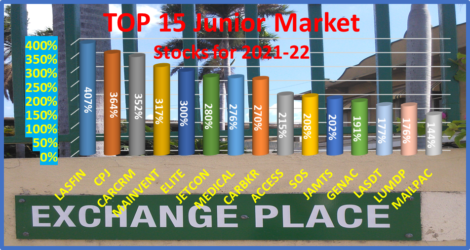 The Main Market is undergoing a bullish signal with short term moving average line crossing over the medium-term Moving Average a bullish signal. The Main Market is within an ascending channel that points to the All Jamaican index heading towards the 460,000 points range.
Market valuations are reasonable with the PE ratios based on 2020 earnings at 14.7 times for the Junior Market and 17 for the Main Market, a few stocks are priced higher than the average, with many prices well below. Based on 2021 earnings, the PE ratio is an average of 9.2 for Junior Market stocks and 14.7 for the Main Market. The large difference is an indication as to where the best values can be found for investors. Adequate liquidity can be a problem for the Junior Market and many investors need to take a longer-term view in some of these companies as it is sometimes difficult to buy or sell good volume at prevailing market prices under current market conditions.
 The local economy is currently down sharply, compared to 2019, but information released by Statin shows the economy picking up from the depressed June quarter, when major areas of the local economy were closed due to COVID-19. However, there are signs that the recovery has been picking up the pace and could move higher if the Coronavirus does not have any greater impact.
While the restrictions placed on economic and social activity has eased since the June quarter, it’s not business as usual in many areas. Investors still need to keep an eye on COVID-19 developments globally and any likely effects on the local economy. Barring any negative developments, stocks highly exposed to tourism, construction, banks and some manufacturing entities could see revenues and profits improving in 2021.
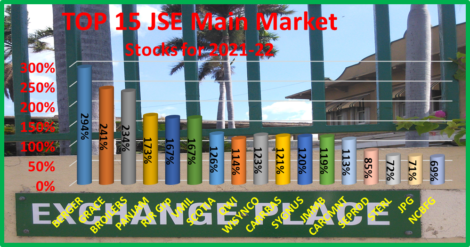
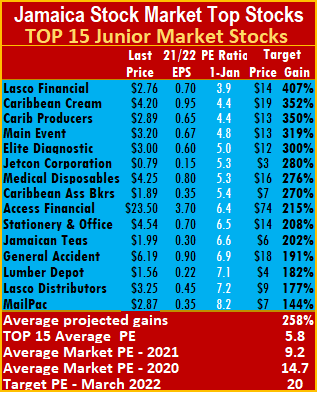
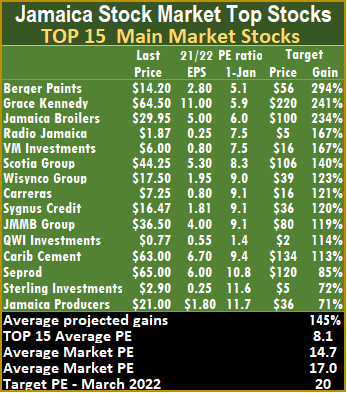
The TOP Main Market stocks’ potential gains range from 70 percent to 290 percent. The Junior Market range is 145 percent to 400 percent. Quite a number of the TOP 15 are recovery candidates. In fact, the Junior Market is filled with these, of which there are six that suffered badly from the effects COVID-19 had on their customers or in dampening demand for their products. A few in the Main Market were partially affected but not as much as some Junior Market companies.
 This year 2021, seems set to be the year of surprises as many stocks that suffered badly in 2020 could be making a major turnaround in revenues and profit, while some that may not fully recover could start showing good signs of returning to normalcy.
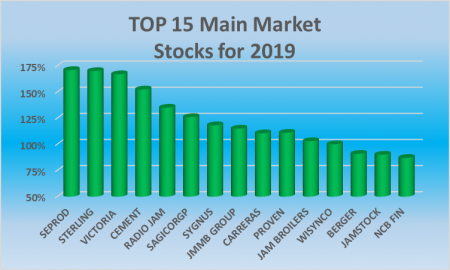
The TOP 15 Main Market stocks: Berger Paints, Grace Kennedy, Jamaica Broilers, Pan Jam Investment, Radio Jamaica, Victoria Mutual Investments, Scotia Group, QWI Investments, Wisynco Group, Carreras, Sygnus Credit Investments, JMMB Group, Caribbean Cement, Seprod and Sterling Investments.
The TOP 15 Junior Market stocks: Lasco Financial, Caribbean Producers, Caribbean Cream, Main Event, Elite Diagnostic, Jetcon, Medical Disposables, Caribbean Assurance Brokers, Access Financial, Stationery and Office Supplies, Jamaican Teas, General Accident, Lasco Distributors, Lumber Depot and MailPac.
While there are clear signs of improving economic conditions, the path for the year ahead is uncertain for a number of companies. Some that suffered badly in 2020 will be showing signs of recovery, but the timing of their return to fairly good health is unclear at this stage. Investors should be on the watch for these early signs in individual companies.
Banks suffered from the need to increase expected credit loss provisioning, but it appears that it may not be as bad as initially projected. As such, there is likely to be less provision for credit losses in 2021 for banks and other lenders.
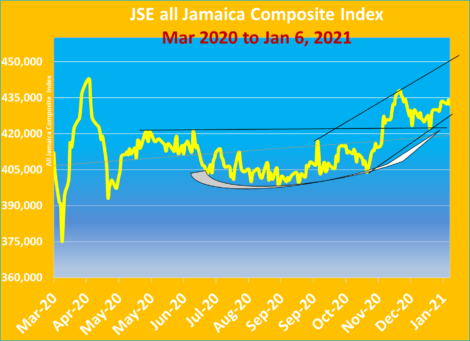
JSE Main Market on a rebound and heading to 460,000 points based on the AJ Index.
For other companies, just the fact that the second quarter lockdown of the economy last year is unlikely to be repeated will result in second quarter results in 2021 being better than last year. This would be of benefit to Caribbean Producers, Elite Diagnostic, Jetcon and Stationery and Office Supplies.
Strong growth in the construction sector favours stocks such as Berger Paints, Caribbean Cement and Lumber Depot while a rebound in the tourism sector will help boost revenues for Caribbean Producers, Grace Kennedy, Jamaica Broilers, Wisynco Group and the banks.
The financial challenges caused by the coronavirus are likely to lead to some businesses seeking to merge or dispose of a majority interest to other entities. As such, there is the possibility that a number of listed companies could acquire some of them at good prices. This is a potential development that investors should be on the alert for.

 Rebound in tourism will increase the supply of foreign exchange to the market and hopefully, lend to greater stability of the rate even as the central bank rebuilds the Net International reserves.
 Areas of the local economy that have social distancing restrictions will continue to be under pressure with reduced business activity. Areas such as live entertainment and, by extension, transportation will find it hard to recover fully in 2021.
 When technical readings for the Junior Market were going through a golden cross back in July 2019, the market rallied by more than 600 points and in 2018, the market put on 450 points after the signal was sent. How much gain will result in this round is unclear, but it could well take the market up another 600 points in a rally that could put it around 3,100 points, initially. Because the Junior Market index is a weighted one, not all stocks are going to provide the same levels of returns as such, the market move as measured by the index could vary a bit from the suggested gains.


 Improvement in profitability will convince investors that there are excellent values in this segment of the market.
 The Investors’ Choice 80:20 rule based on 40 years of data, shows more stocks rising form the bottom 10 worse performers in a year and surge into the TOP 10 the following year, while an average of 80 percent of those in the TOP 10 fail to repeat in the following year and since 2016 the average is just one.
 Jamaica will see steady growth with improvements in several areas during the year, with increased output for manufacturing, tourism, finances and other service sectors such as BPO and entertainment. The continuation of major road construction projects and many new buildings going up in the country will also aid the continuation of economic growth during the year.
 Data out of Statin indicates a 4.9 percent increased output in the manufacturing sector for the September quarter, helped by gains in PetroJam production. That is faster than the July quarter, with growth of 3.2 percent and the first quarter growth with negative 1.3 percent following a 2.4 percent increase in the December 2018 quarter. The trend is positive for the manufacturing sector and augurs well for a good increase in 2020. Continued growth in loan financing and increasing interest of companies seeking fresh long-term capital through the capital market are big positives for the business sector in 2020 and beyond. The Manufacturing sector’s use of borrowed funds, excluding cement, was consistent with 20 percent increased borrowing in 2019 and 2018.
 Growth in the construction sector will pick up, with the start of the Kingston to Port Antonio road construction and demand continues in the BPO sector that will stimulate the need for more space while adding to employment. Data out of the Bank of Jamaica shows a sharp rise in lending to the sector with an increase of 37 percent over the amount lent in 2018 and well ahead of the 27 increase in 2018 over 2017. The increase in 2019 suggests a further rise in growth in the sector, which should continue into 2020.
 The Foreign exchange market went through a number of changes as the central bank reduced the compulsory take from the market from 25 percent down to 20 percent for dealers and 15 percent for Cambios. In effect, the central bank bought no funds from the market through its weekly intervention tool and had no scheduled sale to the market. About four bouts of strong demand resulted in BOJ intervening by selling funds to the market. Notwithstanding, the interventions, the central bank ended the year with the NIR rising from US$3.005 billion at the end of December 2018 to US$3,16 billion after the NIR sank to US$2.95 billion in July.

 Caribbean Assurance Brokers is the third for 2020 and as they seek $100 million in new capital. Alliance Financial Services’ initial public offer is scheduled to come in February or early March, with the broker being JMMB Securities.
 Growth in the September quarter was pulled down to 0.6 percent as a result of a decline in the mining sector with the closure of the Alpart Alumina plant and weather-related impact that negatively affected growth in the agricultural sector.
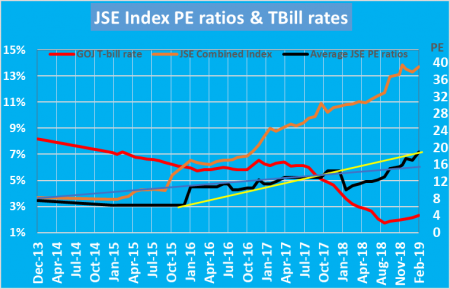
 Investors can improve return on their stock market investment by just following one critical measure, the PE ratios of stocks. Buy low PE ratio stocks and sell those that are too high relative historical norm that almost a sure recipe for making good money in the stock market.

 That could change this year, as the company raised prices late in 2018 and will now be producing all of the cement they sell, thus lowering direct selling cost. For most of 2018, the company imported cement to meet a part of its demand while they were working on upgrading the plant to meet both local and export markets. With continued growth in the economy and strong expansion in the construction sector, the company should continue to enjoy increasing revenues and profit. Cement has partially refinanced some of its US dollar debt and started to pay down the US based debt as well, thus limiting FX losses.
 Sagicor Group PE 9. The company has not delivered much in 2018 partially due to losses incurred in the write down of Barbados bonds that it holds. The company will benefit from increased revenues from the acquisition of the Scotia Group’s insurance business going forward and will also gain from investments in the local stock market as well as from the growth in the local economy and increased employment that should facilitate increased sales of life policies.