Profits fell slightly at AMG Packaging, producers of carton boxes, in the 2023 fiscal year to August to $94 million, but a close look shows the 2023 performance to be better than that for 2022, with the current year’s figures including a one off charge, plus vastly increased taxation than in the previous year.

AMG Packaging
Profit after tax declined from $105 million in the previous year, but this is after taxation climbed from $18 million to $39 million in the current year and a one off charge of $11 million, with revenues coming out at $1 billion in the current year, up from $996 million in 2022. Revenues for the fourth quarter were $230 million, down 12 percent from $257 million, management indicated that the reduction represented reduced production for one month—profit after tax ended at $19 million, down from $25 million in the previous year. The 2023 profit was declined by the abovementioned charge related to credit taken from 2017 to 2021 for payroll taxes not allowed for Junior Market companies. Had this not been the case, profit would have been higher than in the prior year, ending at $30 million instead of the lower figure reported.
In addition, taxation for the quarter was $11 million versus $5 million in the prior year, even as profit was lower. Pretax profit of $30.5 million in the final quarter would have been $41 million, excluding the one off charge versus $29.5 million, reflecting a solid 39 percent improvement and the full year $144 million compared with $123 million for an increase of 17 percent.
The company benefitted from the reversal of impairment losses and foreign exchange gains amounting to $4.5 million in the fourth quarter and $3 million for the twelve months, this compares with a loss of $5.4 million in 2022 for both the final quarter and the full year.
Even as revenues fell in the final quarter, gross profit rose to $79 million from $75 million in the previous year as the cost of sales declined 17 percent in the period from $183 million to $152 million. Gross profit jumped to $312 million from $273 million for the year to August, with cost of sales falling just 3 percent from $723 million to $700 million. Management Discussion and Analysis report stated that the reduction in manufacturing cost “was due mainly to the increase in efficiencies in our production processes.” From all indications, the new machine, installed before the start of the 2023 fiscal year, resulted in improved performance, with lower labour costs that flowed from operating one shift instead of two and reduced overtime. Working one shift would also reduce energy costs in using the machines.
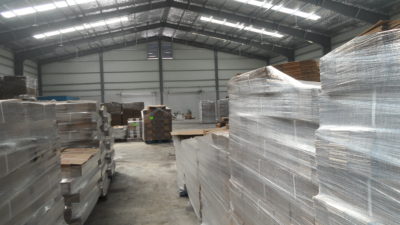
New addition to the factory
Administrative costs were well contained at $27 million for the quarter, which was similar to that of 2022, but it grew 17 percent to $111 million for the year from $95 million in the previous year. Finance cost was relatively stable, coming in just around $2 million for the quarter and $8 million for the full year versus $8.7 million in the previous year. Depreciation climbed to $11 million from $8.4 for the quarter and $43 million from $30 million last year.
The operations generated Gross cash flow of $176 million and ended with increased funds for the year at $174 million after significant changes in working capital primarily relating to a reduction in amounts tied up in inventories and paying down amounts due to creditors.
 Current assets ended the period at $590 million compared with $639 million in 2022. Trade and other receivables amount to $137 million, inventories amount to $156 million, down from $394 million in 2022 and cash and bank balances ended at $297 million. Current liabilities ended the period at $120 million. Net current assets ended the period at $469 million.
At the end of the year, shareholders’ equity amounts to $1.28 billion, up from $1.18 billion in 2022, with long term borrowings at $77 million, down from $81 million in 2022 and short term at $14 million, which is similar to the amount due at the end of 2022 fiscal year.
Earnings per share for the quarter was 4 cents and 18 cents for the year. IC Insider.com computation projects earnings of 40 cents per share for the fiscal year ending August 2024, with a PE of 6 times current year’s earnings based on the price of $2.35 the stock traded at on the Jamaica Stock Exchange Junior Market on Monday. Net asset value ended the period at $2.50, with the stock selling at a slight discount to book value.


 The company expended $489 million on investment property and $169 million on development expenditure during the year, reducing the overall cash on hand to just $90 dollars compared to $217 million in the prior year. According to the audit report, three apartment units were contracted for sale which should result in a loss of $32 million and realise $117 million in total cash, data from the audited statement suggests.

 Direct Expenses fell 33 percent in the July quarter to $204 million from $304 million in 2022 and rose 28 percent from $583 million to $748 million in 2023. Gross profit slipped 25 percent to $224 million from $298 million in the quarter and jumped 64 percent to $839 million from $511 million for the nine months.


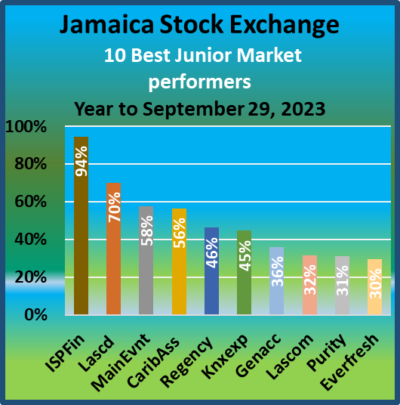 ISP Finance, a microfinancing company led the Junior Market following news that two new directors with experience in the financial service sector and who had worked with in the past in arranging deals for them were appointed to the board. There was also speculation that the majority shares could probably change hands sooner rather than later. There is also the expectation for increased lending to customers is expected to impact revenues and profit positively following a decline in the half year profit when loans jumped to nearly a billion dollars from under $800 million. Lasco Distributors profits for the fiscal year to March jumped and was followed by improved results in the June Quarter as investors rewarded the performance with s solid price movement. Main Event continued to recover from the damage to revenues and profits during the COVID, bouncing back as profit more than doubled to $216 million from $104 million for the nine months to July. Movement in Caribbean Assurance Brokers’ stock price follows profit jumping from just $4.5 million in the June 2022 half year to $18 million this year. Regency Petroleum profit fell from $51 million to $25 million for the half year but hope for improved profits drove the stock with new gas stations being opened or to be opened. General Accident migrated from the Junior Market to the Main Market on the last day of the month, with the increased stock price spurred by profit surging 195 percent to $165 million in the 2023 half year.
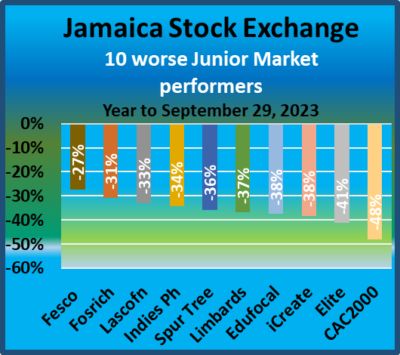 Fesco stock price declined sharply for the period even as the net profits for the June quarter were marginally higher than that of the similar 2022 period, with revenues marginally higher. The stock price pulled back from heady levels in 2022 to adjust to the earnings in the last fiscal year of just under 23 cents per share with indications that it may not significantly improve in the current fiscal year to warrant the high premium it had in 2022. Fosrich, on the other hand, had a sharp decline in profits for the second quarter and the half year but it too enjoyed a big premium in the stock price in 2022, investors readjusted their expectations by marking the price down, although both stocks got a two day bounce at the end of September that improved their performance year to date. Lasco Financial had a third less profit in the 2023 fiscal year than the prior year and reported vastly poorer results in the third quarter to June and that seemed to have encouraged more selling of the stock. Revenues and profit bounced in the third quarter for Limners and Bards but are still down year to date compared with last year and that did not help the stock that lost value during the period. Edufocal profit bounced in 2023 and may not necessarily justify the 38 percent fall in the stock price, while iCreate had totally disastrous results in the 2022 fiscal year as well as in the first half of 2023, with the company’s performance continuing to raise questions about its future. Elite and CAC 2000 suffered a reversal in fortune that is reflected in the decline in stock prices of both companies.


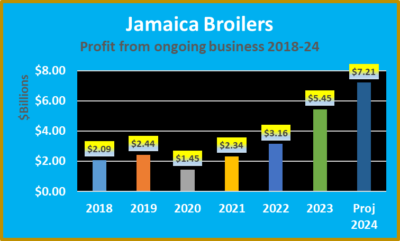 Administrative costs declined marginally from $2.98 billion to $2.92 billion in the current period, distribution costs rose four percent from $690 million to $720 million, finance costs almost doubled, moving from $320 million to $633 million, taxation moved up from $332 million to $393 million during the 2023 quarter.
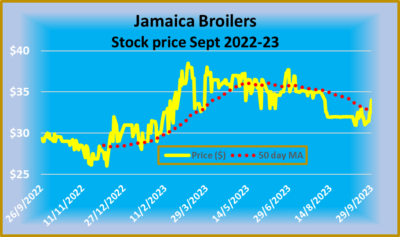 Cash inflows before working capital requirements for $3.4 billion and is up from $2.6 billion in the previous year after working capital funding rose, the group ended up with a negative cash flow of $2 billion that is up from $1 billion in the previous year.