The board of directors of Stationary & Office Supplies informed the Jamaica Stock Exchange that they will meet on Wednesday, June 21st to discuss and consider whether or not to recommend a stock split to the company’s shareholders.

SOS is likely to split stock in 2023.
According to the release, “the market value of the company’s stock has been on a consistent growth trajectory and the liquidity of the stock is also a significant consideration.”
At the last annual general meeting the CEO, Allan McDaniel stated that they were reviewing the matter of a stock split on an ongoing basis but that trading in the stock was fairly liquid as such there was no need to make the adjustment then.
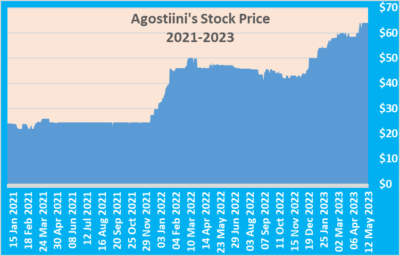
ICInsider.com gathers that the $20 was likely to be the trigger point for a split. Last week the stock traded at $24 but pulled back to $20 where it is now trading, but if history is anything to go by, the price is likely to climb in Tuesday’s trading. With profits for the current year likely to hit nearly $2 per share and around $3 in 2024, that could push the price between $30 and $40 this year and $50 to $60 next year, a split in the order of 10 could place the price closer to where Junior Market investors could find the stock reasonably priced and encourage greater trading in it.  A 10 to 1 split would lift the issued shares to just over 2.5 billion units which would be within a level that would facilitate a great deal of liquidity for a number of years, but the price could be back in the teens again in 2024. Even a 5 for 1 would result in an enhanced level of liquidity with just over 1.25 billion units in issue and push it to 16th Junior Market company in terms of the number of issued shares and 6th if a 10 to 1 split was to be approved. The prospects of profit jumping sharply in 2024, if achievable and seen by management as likely then a 10 to 1 split would seem to be the better option.
The split if approved by the directors, would require ratification by shareholders at a general meeting and that is likely to be at the company’s upcoming general meeting.
The next stock split could well come for Cargo Handlers, with thin trading currently with the price now in excess of $20. Dolphin Cove seems to be shaping for a possible spilt as well but that would be more likely down the road.
 Operating Revenues rose 11 percent from $423 million to $469 million for the year ending December 2022, while Other Operating Income generated $37 million which was down 7 percent from $40 million in 2021, resulting in total income rising 7 percent to $506 million from $463 million in 2021. Profit for the year rose 32 percent to $75 million from $57 million in the prior year, with earnings per share of 30 cents up from 21 cents in 2021.


 Sale revenues for the just completed year rose 20 percent to $2.5 billion from $2.1 billion in 2022. In the final quarter, revenues climbed 22.5 percent to $674 million from $553 million in 2022 and increased 17 percent over the $576 million in the November 2022 quarter. In contrast, revenues for the 2022 February quarter were 10 percent more than the $501 million generated in the November 2021 quarter. All in all, the 2023 fiscal year performance was well ahead of the year to February 2022, even as the year started with just $1.3 million in profit with cost of sales at 73.2 percent with the second quarter being slightly better with cost of sales down to 70.7 percent and profit improving to $7.2 million as both volume improvement and price adjustment to the output chipped in to help improve the bottom line.
 Cost of sales rose 16 percent, slower than sales in 2023, to $1.73 billion from $1.49 billion in 2022, with gross profit rising faster than revenues, a positive development with an increase of 31 percent to $593 million from $775 million in 2022. The cost of raw materials used in sales rose 16 percent to $1.17 billion, compared with a 33 percent rise in fiscal year 2022 over 2021. Milk solids, one of the primary raw materials, about 70 percent that is used in producing ice cream moved from an average of US$3,355 per ton in 2018 to US$5,067 in 2022 and is now $4,676 in 2023, down 9 percent. In 2022 the cost rose by 29 percent, these movements, coupled with exchange rate changes for the Jamaican dollar, would have pushed up the company’s production cost; also affecting cost would be a 7 percent movement in the exchange rate between the Jamaica dollar and the US dollar. If continued, falling commodity prices in 2023 will lower the cost for them and help improve profits. Also of note is that the price of crude oil is now 38 percent less than it was in 2023 at the start of June and that feeds directly into utility cost incurred in production, which was $166 million, 16 percent higher than 2022 and 19 percent more in Administration with $99 million versus $83 million in 2022.
 Gross cash flow generated $195 million from operating activities, up from just $53 million in 2022. Funds internally generated were augmented by loan inflows of $353 million and funds at the start of the year amounting to $145 million, which helped to fund additions to fixed assets of $541 million.
 The company did not have a good year, with revenues falling from $2.5 billion in 2022 to $2.27 billion even as loan income grew during the latest year. Revenues in the fourth dropped sharply to only $410 million versus $662 million in the 2022 fourth quarter. Fourth quarter profit came in slightly below the December quarter’s $31 million at $27 million on far lower revenues than the $572 million in the December quarter.

 The transaction has received regulatory approval and the due diligence process is nearing completion the company stated its release to the Trinidad and Tobago Stock Exchange. It is expected that this transaction will be finalized by the end of June 2023, and we will make a further announcement at that time.
 The company has been in an acquisition mode, acquiring 80% of the outstanding shares of Chinook Trading Canada Limited, a Canadian base consumer products business with trading operations primarily in Caribbean Region. The company states that these acquisitions are consistent with the group’s strategic objective of expansion in more business segments and greater geographical diversification.
 The company borrowed $1.17 million in 2022 but used most of the available funds on hand at the start of the year, with loans granted to borrowers absorbing $550 million in the March quarter, leaving the company with just $117 million in cash funds. In order to maintain the current profit momentum the company will need to add new loans from lenders to keep funding the expansion.