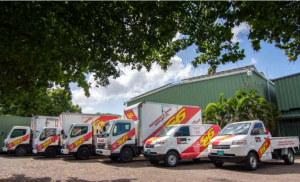
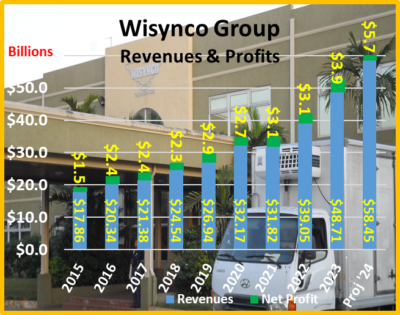
Profit jumped 21 percent at Wisynco Group to a record $4.9 billion for the year to June, this year after corporation tax, over the 2022 earnings, resulting in earnings per share of $1.31 from sales revenues that climbed 20 percent to $58.45 billion up from $48.7 billion in 2022 but after investment and other income of $697 million compared with $453 million in the prior year.

Wisynco Group’s profit rose 21% for the 2023 fiscal year.
The profit margin improved during the year, with cost of sales dropping from 66 to 65 percent, with gross profit rising faster than sales, up 27 percent to $16.9 billion from $13.25 billion.
Loss at JP Snacks, an associate, worsened during the year with a modest 4 percent rise in revenues moving from $1.65 billion to $1.72 billion, with the loss jumping from $94 million to $194 million. Wisynco wrote down their investment due to impairment by $105 million during the year.
Administrative expenses jumped 25 percent to $1.8 billion from $1.4 billion. Sales and distribution expenses increased 29 percent to $9.2 billion from $7 billion. Staff cost climbed well ahead of inflation by nearly 25 percent to $6.33 billion, with wages up 23 percent to $5 billion. Finance cost declined to $131 million from $149 million in 2023. Depreciation rose 22 percent to $1.09 billion.
The operations generated Gross cash flow of $7.6 billion, but growth in working, addition to fixed assets offset by loan inflows and increased payables and dividend payment of $1.6 billion during the year, up from $1.5 billion in 2022, resulted in net inflows of $3.5 billion of which $1.17 billion was used to purchase investments.
 Addition to fixed assets absorbed $2.4 billion during the year and includes work in progress of $1.4 billion. In 2022, addition to fixed assets was $637 million as the group increased investments in plant and machinery to expand its operation, which William Mahfood advises is targeted to expand factory and warehouse space by 60 percent to meet growing demand locally and overseas for its products.
Current assets climbed from $17.8 billion to $22.8 billion, including trade and other receivables of $5.45 billion cash and bank balances of $11.2 billion. Current liabilities ended at $8.3 billion versus $7.3 billion in 2022. Net current assets stood at $14.58 billion, up from $10.5 billion in June 2022.
At the end of June, shareholders’ equity climbed to $21 billion from $17.8 billion in 2022, long term borrowings stood at $3 billion, up from $747 million in 2022 and short term loans at $1.1 billion, up from $822 million. 2022.
Going forward, the group is set to acquire the distributorship of additional products during the year, in addition to the expansion now being undertaken to meet ongoing demand.
IC Insider.com computation projects earnings of $1.80 per share for the fiscal year ending June 2024, with a PE of just over 10 times current year’s earnings based on the price of $17 the stocks traded on Thursday morning on the Jamaica Stock Exchange Main Market.
Net asset value ended the period at $5.63, with the stock selling at 3 times book value.
The stock is one for the future. Investors may not see any notable price movement from the current level in the short term, but with the expansion now on the way and new products to be distributed, a successful future seems assured and the stock price will grow appreciably into the future.
 The 2023 full year results reflect a greater level of rebound from the declines suffered following the fallout in the economy as a result of the advent of covid-19 and, in particular, the fallout in the global market with higher input costs that flowed from supply disruptions as well as tourism sector that were still recovering during the 2023 fiscal year that ended in March.

 Loans receivable net of expected credit losses reached $2.57 billion, representing a substantial increase of $1.5 billion, a 145 percent surge from $1.05 billion as of June 2022 and is also up over the $2.27 billion at the end of March this year. Business loans accounted for 81 percent of the total loan portfolio, with personal loans accounting for the rest, the company reported. Secured loans constituted 80 percent of the portfolio, with unsecured loans making up the remainder.
 Lasco released first quarter results, in late July, with a rise in pretax profit jumping a robust 57 percent to $602 million and post-tax climbing a solid 38 percent to $448 million from a 17 percent rise in revenues to $7.3 billion from $6.3 billion.



 Trades by directors and connected parties in listed companies may speak volumes about what is currently occurring in their operations and can be a short term signal to follow. Not all trades have immediate significance, as they may be for reasons unrelated to the company’s performance, like the need for cash or reallocation of investments; regardless, investors would be well advised to take a keen interest in such actions.

 To accommodate the split, shareholders will be asked to vote on a resolution to be tabled at the company’s annual General meeting of July 25 to effect the split and will also be asked to vote to increase the number of shares to 500 billion units, with effect from July 25.

 Current assets stood at US$62 million at the end of March versus US$62.5 million at the end of June 2022 and just US$25.3 million as of March 2022. Cash and equivalents were US$4.9 million, up from US$3.9 million at the end of the 2022 fiscal year, with receivables at $18 million, virtually flat with the fiscal year end. Still, inventories slipped to US$39 million from US$40 million at the end of the fiscal year but are up over March 2022 at $30 million.