Caribbean Cement traded at $45.200 on Tuesday.
Sale revenues at Caribbean Cement rose 6.7 percent for the quarter, to $4.46 billion from $4.18 billion in 2017 and rose 7.9 percent for the year to date, to $13.2 billion from $12.25 billion in 2017.
A $464 million foreign exchange loss hit the results for the September quarter pulling the strong 44 percent increase in operating profit to $1.2 billion from $836 million, into lower net profit of $305 million than $748 million for the prior year’s period. For the nine months to September, profit fell 28 percent to $1.3 billion from $1.8 million in 2017.
Energy cost climbed by $233 million in the quarter and $342 million year to date but other operating cost declined, with the repurchase of the mill and kiln, previously leased from Trinidad Cement with only $213 million was incurred in the third quarter versus $1.1 million in 2017. For the nine months $1.57 million was incurred compared to $3.3 billion. On-the-other-hand finance cost excluding foreign exchange loss rose to $227 million up sharply from just $11 million in 2017 in the quarter and $299 million versus $4 million year to date. Depreciation and amortisation cost rose to $342 million from $132 million in 2017 and for the nine months to $808 million from $400 million in 2017. The net effect is that the company enjoyed a savings of $500 million per quarter or $2 billion per annum as a result of the buy of the lease, but virtually none of this, benefited shareholders.
Earnings per share came out at 39 cents for the quarter and $1.54 for the nine months and should end the fiscal year ending to around $3.50, as the company reverses the foreign exchange loss in the December quarter and picks up some gains, as well as increased revenues resulting from a price increase of just over 4 percent, effective on October 22.
Carib Cement could earn $5.30 in 2019.
But IC Insider.com is forecasting a jump in earnings for 2019 around $5.30 per shares, as the plant upgrades is completed and commissioned, allowing for the elimination of costly imports that negatively impacted cost in 2018 and will see them moving back into exports.
Gross cash flow brought in $849 million but growth in receivables, inventories, addition to fixed assets, loan repayment and increased payables resulted in negative total flows thus reducing the cash on hand to $468 million. For the nine months the operations brought in $2.6 billion but working capital needs and capital transactions saw cash funds reduced from $1.67 billion to $468 million.
The sharp changes in funds is due to the repurchase of equipment that was previously leased that drove fixed assets to $23 billion from $7.7 million in 2017 and borrowing to $12 billion.
Shareholders’ equity stood at $10.26 billion with borrowings at just $12 billion and net current assets ended the period was negative $1 billion.
The stock traded at $45.20 on the Jamaica Stock Exchange with a PE ratio of 13 times 2018 earnings and sits around the centre of the market valuation. the price could double in 2019. Net asset value is $12 with the stock selling at almost 4 times book value.
Going forward, the company results should be helped from the improvement in the Jamaican economy and growth that is likely to flow from the construction sector including buildings and roads and bridges as well as from increased exports. There is also focus on cost reduction with the high energy cost being the next centre of attention.
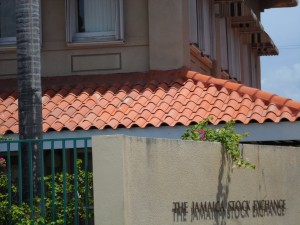 The Jamaica Stock Exchange closed a big gain on Tuesday as trading levels rose much higher than on Monday, from 34 active securities in the main and US dollar market compared to 31 on Monday.
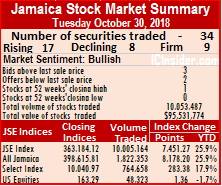 $5,289,432 and previously, 291,988 shares, valued $5,142,412. September closed, with an average of 1,022,243 shares, valued $15,752,876, for each security traded.
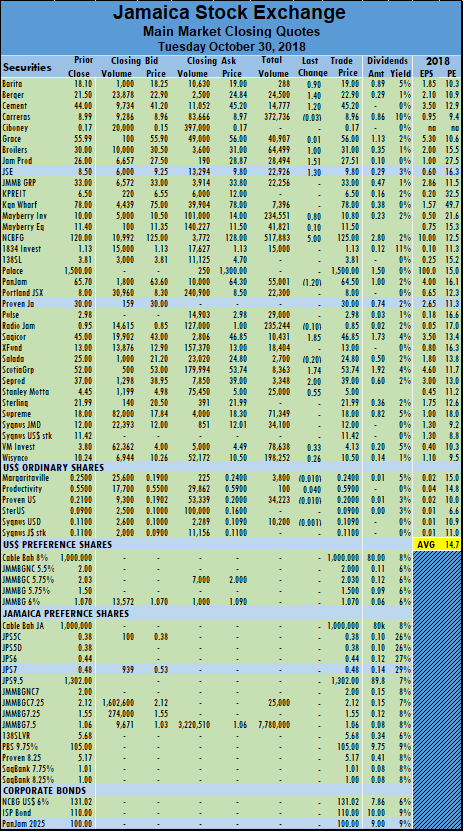 $46.85, exchanging 10,431 shares,


 $4.05, trading 61,379 units, Indies Pharma rose 10 cents and closed at $3.20 with 128,477 shares changing hands,

 National Enterprises fell 44 cents to a 52 week’s Low of $8.52, with 100 stock units changing hands and
 The Jamaica Stock Exchange closed on Monday with more decline following Friday’s big decline as trading volume decline to very low level.
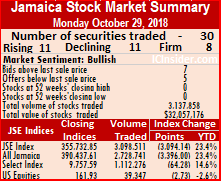
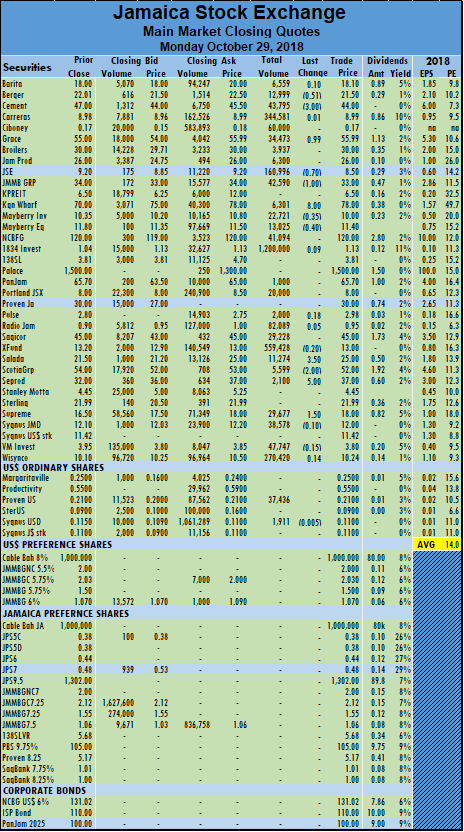 stock units, Mayberry Investments lost 35 cents and settled at $10 in trading 22,721 units, Mayberry Jamaican Equities lost 40 cents and settled at $11.40, in exchanging 13,025 units,
 The Junior Market Index lost 7.26 points to close at 3,307.46, on Monday with 26 securities trading, versus 22 on Friday. At the close 9 advanced, 9 declined and 8 remained unchanged.
 At the close of trading,
 rose 10 cents and closed at $3.10 with 126,444 shares changing hands, Jamaican Teas settled with a loss of 1 cent at $4.09, trading 25,926 shares. Jetcon Corporation ended trading 2,200 stock units with a loss of 30 cents at $3.50,

 hands,
 Volatility was the order for the Jamaican stock market for the past week as the market indices bounced around as declining stocks were plentiful as the Junior Market ended with three changes and the main market two.
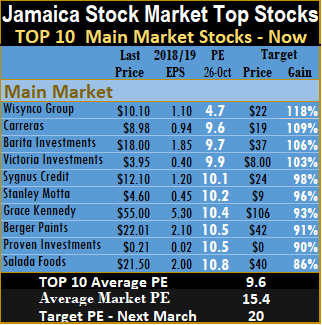
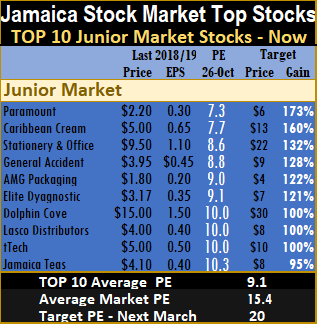 of the year, nevertheless IC insider.com downgraded full year earnings to $3.53 per share, resulting in the stock dropping out of the main market TOP 10 along with
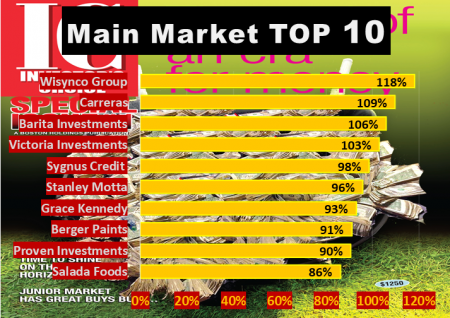 prior week.
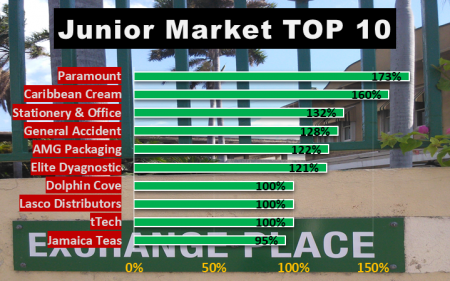 an assumed PE for each, the likely gains are determined and then ranked, with the stocks with the highest potential gains ranked first followed by the rest, in descending order. Potential values will change as stock prices fluctuate and will result in movements of the selection in and out of the lists for most weeks. Earnings per share are revised on an ongoing basis based on new information received that can result in changes in and out of the list as well.