 Fesco opened trading on the Junior Market of the Jamaica Stock exchange on Friday, trading 2.38 million shares at $1.04 up from 80 cents the share were sold to the market at.
The stock has 151,000 units on the bid at $1.04 with just 55 000 on offer at $1.06, but trading is frozen for an hour. The rise helped to push the Junior Market Index up to 3,155.07. The Main Market has climbed to 446,096.49 at 9.43 after rising to a high for the session of 446,591 points.
Fesco trades at $1.04
April 23, 2021 by
JSE main Market at 12 months high
April 19, 2021 by
 The Jamaica Stock Exchange hit the highest points on Monday Morning trading since it closed above the 442,906 points level on April 14, 2020. The Junior Market now trades at the highest level since January 31, last year with the index now at 3090.76, up from the previous high of 3,098.16 at the close of January 29 2020.
Junior Market moving much higher Main Market poised for big break out
April 18, 2021 by
“The next big Junior Market run is near” was the caption of a late December ICInsider.com post that suggested that the Junior Market Index could hit 3,100 points initially. Three months later, the market is a mere 45 points short of the 3,100 mark, a gain of 460 points or 18 percent.
 The forecast was based on technical indicators pointing to the rally. The article stated “the last time this signal was flashed, the market rose 600 points and before that 500 points.
The Junior Market of the Jamaica Stock Exchange is sending out a strong signal that a big rally is ahead once more.” The article continued, “When technical readings for the Junior Market was going through a golden cross back in July 2019, the market rallied by more than 600 points and in 2018, the market put on 450 points after the signal was sent. How much gains will result in this round, is unclear, but it could well take the market up another 600 points, in a rally that could put it around 3,100 points, initially.”
What is the golden cross? This is when the short term moving average crosses over the medium moving average and both crosses over the long term moving average. The medium term moving average has crossed over the long-term one and the short term is making its way to cross the medium one with it already cross over the long term.
With nearly four months elapsing, the technical signal is still in place and gaining in strength. Investors should expect the Junior Market Index to hit 3,500 points before long, some 440 points away, after that the next target will be a resistance area of 4,100 points.
Fundamentals of companies will lend much support to the continuation of the rally, with some companies posting record profits and some displaying strong signs of recovery. So far, interest rates currently at historically low levels are cooperating with the current rally.
 The Main Market is in the early stage of two bull signals, but it is bogged down in a narrow trading range based on closing prices, between 429,000 and 436,000 points of the All Jamaica Composite Index, with the very dominant financial sector going nowhere in the short term hobbling its growth. The market is currently steered slowly higher but it is waiting for some dynamic force to move it decisively out of the current range. A critical factor is that the market caught in a triangular formation currently, a very powerful indicator that is going to drive the Main Market sharply higher very soon. Forces seem poised to force it higher as it makes a big break following from the pent up force that the wedge is currently constraining. ICInsider.com forecasting that the market will break sharply higher soon.
In this regard, the latest news out of Caribbean Cement of record production of over 100,000 tons of cement in March is the sort of news that will lift stock prices. Additionally, Jamaica Producers that just reported buying into the Geest Shipping Line company, moved up in price last week with very little supply evident in the market, which is a recipe for move price gains.
Junior Market jumps 47% since March 2020
April 3, 2021 by
The Junior Market climbed 47 percent in just over a year since the market collapsed by just over 39 percent in March last year from the close of 2019 when the market hit a multi-year low of 2,031.79 on March 18 last year.
 At the same time, the JSE Main Market, while trading above the March 2001 low, is nowhere near the 2020 high and closed out the first quarter marginally down on the 2020 closing.
The Junior Market is up 13 percent for 2021 to the end of March, clawing back most of 21 percent of the fall in 2020 and is now just 11 percent from the close of 3,348.97 at the end of December 2019.
In 2020, the Junior and Main Markets declined, with the Junior Market just edging out the Main Market index with a lower decline of 21 percent versus 22.6 percent for the year.
One year ago, to the end of March, the Junior Market Index dropped 29 percent to 2304.14 but was down a much steeper 47 percent to March 18, at 2031.79 points on the market index. The March 2020 low was the lowest point for the Junior Market since it closed at 2,032.77 points on July 1, 2016.
The market made some recovery last year from the year’s low when it moved higher on April 14, to 2,686.90 points but drifted down after some attempts to break over 2,600 points on a sustained level and closed out 2020 at 2,643.38.
 In the meantime, the JSE Main Market failed to move higher in 2021, ending the first quarter 0.20 percent lower than the December close. It is still a bit lower than the 442,905.76 reached on the All Jamaica Composite Index after the early rebound from the 2020 low of 375,091.09 reached on March 25 last year, or the 438,045.18 reached subsequently on November 30.
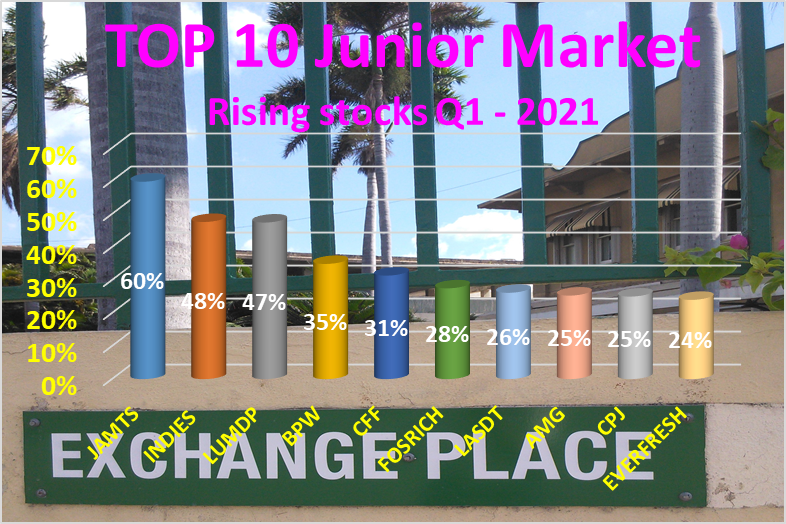
The gains of eighteen stocks in the first quarter, this year, exceed that of the average of the market and just three performed worse, including CAC 2000 with a fall of 24 percent 19 percent decline for Dolphin Cove and 16 percent in the case of Knutsford Express. Five stocks contributing to the 2021 rebound for the Junior Market are Jamaican Teas up 60 percent, Indies Pharma 48 percent, Lumber Depot 47 percent, Blue Power 35 percent, Caribbean Flavours 35 percent and Fosrich 28 percent.
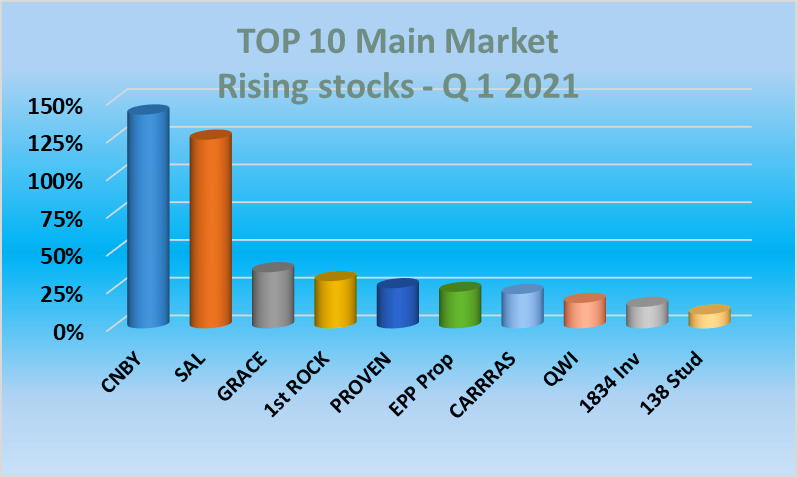 The Main Market recorded gains in 16 stocks that beat the market’s average move in 2021, with 26 falling below. Main market stocks with healthy gains are Ciboney with a stunning 142 percent rise, followed by Salada Foods with 125 percent gain aided by a 10 to one stock split, Grace Kennedy 37 percent, First Rock 31 percent and proven Investments 27 percent. Palace Amusement Company that the Covid-19 dislocation has badly hurt is the worst-performing stock with a 51 percent decline, followed by Portland JSX with a loss of 25 percent and Radio Jamaica with 22 percent. Wisynco lost 14 percent and Wigton Windfarm 13 percent.
Rising Junior Market shifts up IC TOP10
March 28, 2021 by
During the past week, the Junior Market moved decisively up, with the market index closing well above the 2,900 mark that became a barrier for weeks, surpassing the 3,000 level, but closed trading since Tuesday just a few points below and is poised to move higher in the weeks ahead. Main Market stocks remain in the consolidation zone awaiting profit results to move prices higher.
 TOP 10 stocks had a few changes during the past week, with Berger Paints back in the Main Market TOP10, replacing Sterling Investments that entered the list last week, while in the Junior Market, Caribbean Assurance Brokers returns to the TOP 10 as General Accident moved out.
This publication has stated that Junior Market TOP10 contains several companies that suffered a sharp reversal of fortunes in 2020, with recovery projected in 2021. Green shoots are showing for some with sales picking up in recent quarters, with improving profit. Some of these companies may require another quarter or two of improvement before meaningful buying starts. Main Event is one such company, reporting a profit on reduced income for the January quarter. Revenues climbed solidly in the latest quarter over the October and July quarters, but still far below the prior year’s level. 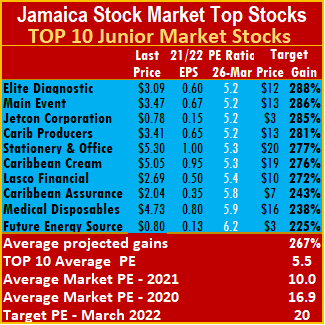
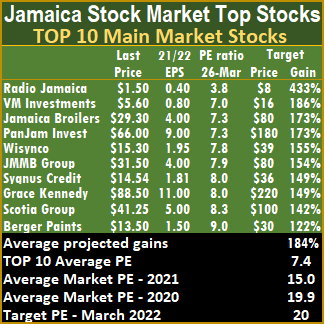 Caribbean Producers is another that will definitely benefit from pick up in the tourist trade later in the year. Expect also companies such as Knutsford Express, Express Catering and Stationery and Office Supplies to be on that list.
The Main Market has a number in the list that have put out record profits or show signs of strong earnings in 2021, with the stocks clearly undervalued; these include JMMB Group, Jamaica Broilers, Sygnus Credit Investments and Grace Kennedy that are currently in the TOP10 Main Market listing and Caribbean Cement that is just outside.
Both the Junior Market and the Main Market continue to get support from technical indicators that point to robust gains ahead. To benefit from the growth in the market to come, many investors will need to be on board at an early stage.
 This week’s focus: Future Energy Source Company Initial Public Offer of 500 million shares at 80 cents per share opens on Wednesday, with pretax earnings for the fiscal year to March this year around 7 cents per shares. The shares should be snapped up quickly by investors, with the company having long-term prospects for strong growth.
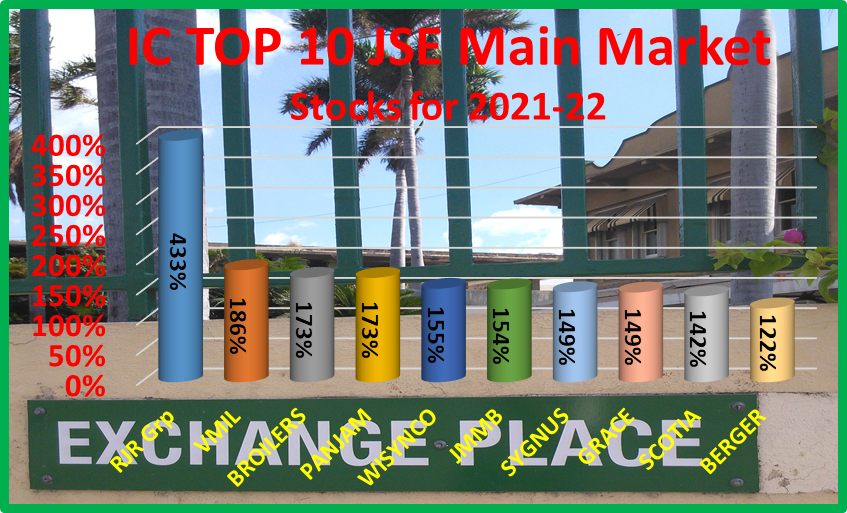
The top three stocks in the Junior Market mostly changed, with the potential to gain between 285 to 288 percent are Elite Diagnostic, followed by Main Event and Jetcon Corporation. The top three Main Market stocks with expected gains of 173 to 433 percent are Radio Jamaica, followed by VM Investments and Jamaica Broilers.
The local stock market’s targeted average PE ratio is 20 based on profits of companies reporting full year’s results, up to the second quarter of 2021. The Junior and Main markets are currently trading well below the market average, indicating strong gains ahead. The JSE Main Market ended the week, with an overall PE of 15 and the Junior Market 10, based on ICInsider.com’s projected 2021-22 earnings.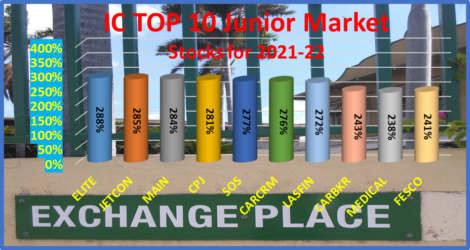 The PE ratio for the Junior Market Top 10 stocks average a mere 5.5 at just 55 percent of the market average. The Main Market TOP 10 stocks trade at a PE of 7.4 or 50 percent of the PE of that market.
The average projected gain for the Junior Market IC TOP 10 stocks is 267 percent and 184 percent for the JSE Main Market, based on 2021-22 earnings. IC TOP10 stocks are likely to deliver the best returns up to March 2022 and ranked in order of potential gains, based on likely gain for each company, taking into account the earnings and PE ratios for the current fiscal year. Expected values will change as stock prices fluctuate and result in movements in and out of the lists weekly. Revisions to earnings per share are ongoing, based on receipt of new information.
Persons who compiled this report may have an interest in securities commented on in this report.
Pulse top 2020 Jamaican stock with 243%
January 14, 2021 by
 The Jamaica Stock Market has moved from the best performing in the world in 2018 to one of the worse performing in 2020. The fall from grace had to do far less with local factors but more so with global developments. Nevertheless, Main Market listed Pulse Investments came out on top in 2020 with gains of 243 percent, followed by former Junior Market listings, Epply in the second position with 227 percent and Key Insurance with 88 percent.
Even as the markets had their worse year since 2018, the past year ended with a number of stocks recording gains, up to 243 percent for top Main Market stocks and a much lower 36 percent for the best performing Junior Market stock.  The Junior Market suffered badly, with ten stocks losing upwards of 39 percent out of a list of 33 stocks that declined for the year. The Junior Market was partially saved by two stocks, one that was listed in December 2019 and one listed in the last half of 2020. Mailpac was listed in December 2019 and rose 36 percent in 2020, followed by Tropical Battery by 28 percent as the two leading Junior Market winners. With tax losses as the only major asset of worth, Ciboney came in third and more than doubled with a rise of 118 percent. The Main Market had 32 stocks declining during the year, with losses going as high as 63 percent.
 In 2020, both of the Jamaica Stock Exchange major markets were down, with the Junior Market just edging out the Main Market index with a lower decline of 21 percent versus 22.6 percent. Even though 2020 was not a great year, some investors made money by buying stocks at rock bottom prices when many investors were dumping earlier in the year.
The JSE Main Market fell 33 percent to a yearly low in March and the Junior Market by 37 percent. Since then, they have rebounded but not enough to take them out of the year’s negative territory.
 Since bottoming in March, the Junior Market is up 30 percent and the Main Market 16.6 percent by the end of the year. There are strong signals pointing to an upward move for both markets as they transitioned from a consolidating phase when investors were assessing developments in the economy and the stock market to a more bullish state since the latter months of 2020.
Proven expanding investment foot print
January 10, 2021 by
Proven Investments signed an agreement to acquire a 50.5 percent controlling interest in Roberts Manufacturing Company, a Barbados based company, Proven announced this past week.
 The agreement is for the purchase of shares from Massy Properties (Barbados) for US$21,452,500. “The consideration includes real estate for US$1,452,500, with the rate of return on the investment put at 15 percent based on the purchase price,” Christopher Williams, CEO of Proven, advised ICInsidier.com.
“Closing is scheduled to take place 3 business days following the receipt of all regulatory and governmental confirmations, approvals, and acknowledgments, save that the closing date may not be extended beyond 30 days,” Proven further advised.
“RMCL produces a variety of margarine, shortening, soyabean oils and animal feed products, which are distributed to over 15 markets regionally and internationally.
“The proposed acquisition is one of three that Proven has been negotiating,” Williams advised ICInsidier.com. One is said to be a financial institution in the Cayman Islands that is subject to regulatory approval and will result in the group owning two companies in that country with the 100 percent owned International Financial Planning (Cayman) Limited. The other business under consideration is in the business of property rental.
“The acquisition of the majority shareholding of RMCL is aligned with PROVEN’s strategy to grow through acquisition in the real sector throughout the Caribbean and Latin American regions with a view to create value to its shareholders.” the Proven release stated.

Christopher Williams, Proven Investments CEO.
RMCL has Ansa Mc Al as the minority shareholder who manages the operations. Proven decided to invest in the manufacturing operations due to the high rate of returns on investments. Management is already in place running it and the appeal of the products to a wide cross section of customers regionally and in developed countries.
Proven generated profit attributable to shareholders of US$29.98 million for the financial year to March 2020 and is boosted by US$25 million in gains from the sale of part of their investments in Access Financial Services. The company suffered losses of nearly US$18 million on other investments and ended the year with a total comprehensive profit of US$18 million.
For the September quarter, Proven generated profits of US$3.4 million and US$4.8 million for the six months. That should compute to around 1.5 US cents per share for the year, but Williams expects this to jump to 24 US cents per share in 2022. Whether that target is achieved or not is unsure at this stage, but what is known is that the last capital raise was not all fully utilized as expansion plans slowed and would have generated a lower rate of return than if they were used in the acquisition of profitable ventures. In addition, the latest announced acquisition will add around US$3 million to annual profit or about 4 cents per share and push Earnings per share within the 20 cents range. The investment market recovered from the collapse in the March quarter and resulted in total comprehensive profit of US$17 million for the September quarter and US$27 million for the half year, thus reversing the 2020 losses in the investment market.
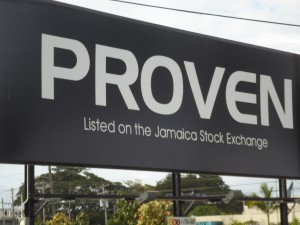
Proven Investments traded the most shares on the market.
To assist in funding acquisitions and ensuring adequate liquidity, the company has offered for sale 89,416,037 new ordinary shares to existing shareholders and the public. The company has the option to upsize the issue to a maximum of 134,124,037 shares to raise a maximum of US$30 million, assuming the Invitation is fully upsized. If fully upsized, the total number of shares in issue will be 759.43 million units.
The price to be paid per share by Existing Shareholders is 22.50 US cents or J$32.80, Key Investors 22 US cents or J$32.10 and others 23 US cents or J$33.50. All the prices are below existing market prices of 25.69 US cents and J$35.79 in the Jamaican segment of the Jamaica Stock Exchange. Acquisitions in the financial sector will provide the opportunity for cross selling products and services to clients in each company, as well as provide the opportunity for some amount of cost reduction as certain administrative and other costs can be shared within the group.
The Directors anticipate that not less than 50 percent of the Company’s annual after-tax profits will be distributed as dividends, subject to the requirement for re-investment of its profits to finance potential growth and to ensure sustained development, as well as due compliance with the solvency and liquidity criteria set by the Company’s Investment Policies.
The official closing date for the offer is January 29, 2021.
Investment 2021 – Recovery for JSE markets
January 7, 2021 by
The JSE Junior and Main Markets retreated in 2020, due mainly to the impact of the COVID-19 on the economy and businesses. Both markets, however, began to struggle in the final quarter of 2019 as a number of new IPOs were either issued or scheduled to be issued, thereby sapping some of the liquidity from the market.
 The markets may have been due for a correction anyway, based on their history. Prior to this period, the Main Market had only risen on two other occasions equalling or exceeding six years. Surprisingly, the market went on to move higher during a period of economic turbulence, from 1978 to 1987, nine years of annual gains and again between 1996 and 2004 for another nine-year spell. On the other hand, the Junior Market, for the first time, recorded five consecutive years of increases from 2015 to 2019.
In reality, the market closed higher in each year from 2014 to 2019 for six years’ unbroken run. The JSE Main Market fell 33 percent to the low in March and the Junior Market by 37 percent. Since then, they have rebounded but not enough to take them out of the negative territory for the year.
 The number of new IPOs coming to market in the past three years pulled liquidity from the Junior Market, which depends extensively on the involvement of individual investors. In 2018 and 2019, the Junior Market under-performed the Main Market, measured by way of the market indices. In 2020, both markets were down, with the Junior Market just edging out the Main Market index with a lower decline of 21 percent versus 22.6 percent. Even though 2020 was not a great year, some investors made money by buying some stocks at rock bottom prices when many investors were dumping.
The decline in the market gives some investors breathing space from the six years’ bull market and opportunities to pick up stocks at better valuations or prices than for the period up to March 2020.
The markets have been recovering since they bottomed in March with the Junior Market up 30 percent and the Main Market 16.6 percent. There are strong signals pointing to an upward move for both markets as they transitioned from a consolidating phase when investors were assessing developments in the economy and the stock market. The Golden cross technical signal for the Junior Market points to that market heading back above the 3,000 points level within months. 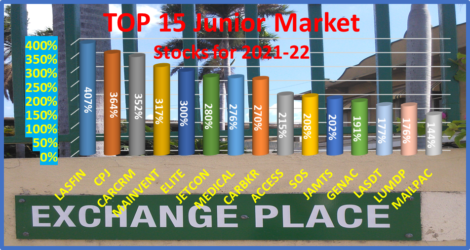 The Main Market is undergoing a bullish signal with short term moving average line crossing over the medium-term Moving Average a bullish signal. The Main Market is within an ascending channel that points to the All Jamaican index heading towards the 460,000 points range.
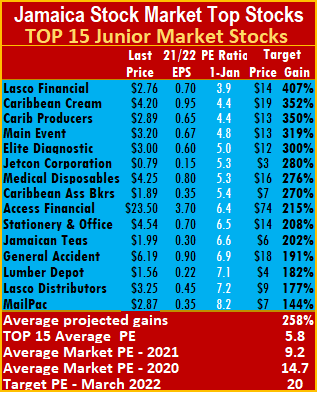
Market valuations are reasonable with the PE ratios based on 2020 earnings at 14.7 times for the Junior Market and 17 for the Main Market, a few stocks are priced higher than the average, with many prices well below. Based on 2021 earnings, the PE ratio is an average of 9.2 for Junior Market stocks and 14.7 for the Main Market. The large difference is an indication as to where the best values can be found for investors. Adequate liquidity can be a problem for the Junior Market and many investors need to take a longer-term view in some of these companies as it is sometimes difficult to buy or sell good volume at prevailing market prices under current market conditions.
 The local economy is currently down sharply, compared to 2019, but information released by Statin shows the economy picking up from the depressed June quarter, when major areas of the local economy were closed due to COVID-19. However, there are signs that the recovery has been picking up the pace and could move higher if the Coronavirus does not have any greater impact.
While the restrictions placed on economic and social activity has eased since the June quarter, it’s not business as usual in many areas. Investors still need to keep an eye on COVID-19 developments globally and any likely effects on the local economy. Barring any negative developments, stocks highly exposed to tourism, construction, banks and some manufacturing entities could see revenues and profits improving in 2021.
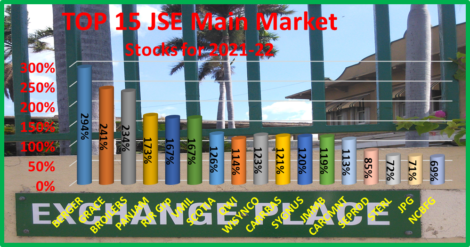
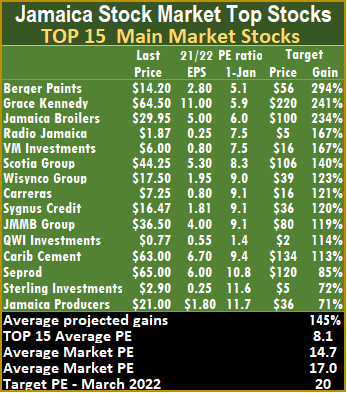
The TOP Main Market stocks’ potential gains range from 70 percent to 290 percent. The Junior Market range is 145 percent to 400 percent. Quite a number of the TOP 15 are recovery candidates. In fact, the Junior Market is filled with these, of which there are six that suffered badly from the effects COVID-19 had on their customers or in dampening demand for their products. A few in the Main Market were partially affected but not as much as some Junior Market companies.
 This year 2021, seems set to be the year of surprises as many stocks that suffered badly in 2020 could be making a major turnaround in revenues and profit, while some that may not fully recover could start showing good signs of returning to normalcy.
The TOP 15 Main Market stocks: Berger Paints, Grace Kennedy, Jamaica Broilers, Pan Jam Investment, Radio Jamaica, Victoria Mutual Investments, Scotia Group, QWI Investments, Wisynco Group, Carreras, Sygnus Credit Investments, JMMB Group, Caribbean Cement, Seprod and Sterling Investments.
The TOP 15 Junior Market stocks: Lasco Financial, Caribbean Producers, Caribbean Cream, Main Event, Elite Diagnostic, Jetcon, Medical Disposables, Caribbean Assurance Brokers, Access Financial, Stationery and Office Supplies, Jamaican Teas, General Accident, Lasco Distributors, Lumber Depot and MailPac.
While there are clear signs of improving economic conditions, the path for the year ahead is uncertain for a number of companies. Some that suffered badly in 2020 will be showing signs of recovery, but the timing of their return to fairly good health is unclear at this stage. Investors should be on the watch for these early signs in individual companies.
Banks suffered from the need to increase expected credit loss provisioning, but it appears that it may not be as bad as initially projected. As such, there is likely to be less provision for credit losses in 2021 for banks and other lenders.
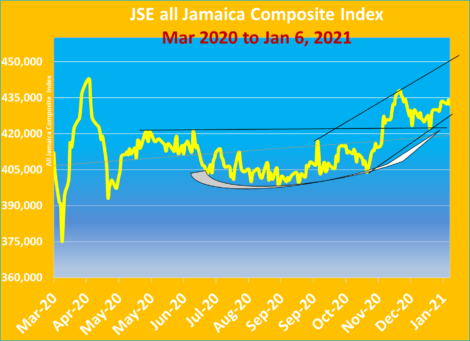
JSE Main Market on a rebound and heading to 460,000 points based on the AJ Index.
For other companies, just the fact that the second quarter lockdown of the economy last year is unlikely to be repeated will result in second quarter results in 2021 being better than last year. This would be of benefit to Caribbean Producers, Elite Diagnostic, Jetcon and Stationery and Office Supplies.
Strong growth in the construction sector favours stocks such as Berger Paints, Caribbean Cement and Lumber Depot while a rebound in the tourism sector will help boost revenues for Caribbean Producers, Grace Kennedy, Jamaica Broilers, Wisynco Group and the banks.
The financial challenges caused by the coronavirus are likely to lead to some businesses seeking to merge or dispose of a majority interest to other entities. As such, there is the possibility that a number of listed companies could acquire some of them at good prices. This is a potential development that investors should be on the alert for.
Bulls pushing JSE stocks higher
November 25, 2020 by

JSE Main market is up over 6,000 points in early Wednesday trading.
The bulls continue to prowl Wednesday on the Jamaica Stock Exchange with the All Jamaican Composite Index up to trade at 435,382.80, up 6,446.29 points after an hour of trading and is back the April 15 level.
The JSE Main Index is up 5,761.51 points to 397189.72. Junior Market Index rose moderately moving from 2,529.92 points to 2,544.20.
Grace Kennedy rose from $59.99 to $67.98, while JMMB Group is trading up at $34.90 and Sagicor Group is up to $51.51.
Over 25 years of useless circuit breaker
October 20, 2020 by
Frequent interruption to trading stocks on the Jamaica Stock Exchange caused by the Circuit Breaker rule that shuts down activity in a company’s stock for an hour is frustrating for investors once the price moves by 15 percent or more from the closing price of the previous trading session.
 Introduced by the JSE in the 1990s based on some investors’ complaints about large swings in the price movements of some stocks, the circuit breaker has not been effective in safeguarding investors’ interest by allowing information to flow to investors as to the reasons for sharp price movements. In place for more than 25 years, the mechanism serves no useful purpose, hinders trading and have not resulted in the presentation of new information for stocks so halted to justify stopping in trading.
In the past, this publication made suggestions to modify the system as it operates currently, to simplify it and allow for fewer losses in trading time for stocks subjected to the circuit breaker rule. There is no move by the JSE to implement changes since the price limit increase to 30 percent. It appears that the JSE does not seem to get it. It is better to improve what currently exists to help boost business rather than seeking other businesses.
If the rule is retained, keep it simple that all involved in the market can easily understand.
For example, if the maximum daily price movement is 30 percent, let that be the figure so that anyone can compute what it will be. There is no logic to state that prices can move by 30 percent, which happens in some cases and not in others. There should be no difference to the daily maximum price, whether it gets there in one movement or more than one. Currently, a 15 percent price movement triggers a re-computation of the maximum price of less than 30 percent. If a stock’s reference price starts the day at $10, then the day’s maximum price would be $3. Every investor can compute this. There is no reason to adjust the maximum if it trades initially at $12, with the maximum price for the day dropping to $12.65?
 The second modification to the circuit breaker rule is reducing the time that stocks are frozen. An hour break is far too long and prevents prices from moving above 15 percent within an hour of the market’s close.
If there is a need for the circuit breaker, why not break for 15 minutes instead of an hour so that trading can take place more freely. The Stock Exchange still has the power to halt trading in any stock or the market if they consider it prudent.
The Circuit Breaker rule. No stock should trade +/-15% from the close price or the effective close price at the market’s opening. The effective close price is determined whenever the closing bid is greater than the close price or whenever the closing ask is less than the close price. If the Circuit Breaker is triggered, the security will be halted for an hour to allow for the release, circulation and absorption of any relevant market news and a cool-down period while investors consider their options. After the hour, the security will be released for trading and the new reference price, which is a simple average of the trigger price and the close price, will be used to determine the trading range for the remainder of the day. The trade price that triggered the Circuit Breaker should not be +/-15% outside of the original prescribed price band. The stock will not be allowed to trade +/- 15% of the new reference price.