Will Berger jump TOP 10?

Berger Paints is one of IC Insider’s TOP 10 stocks.

The news IC insider broke a few weeks ago, have been confirmed on Friday with Ansa McAl entering an agreement to acquire the Berger Caribbean operations. What impact that will have on trading in Berger Jamaica shares this week, with the price having slipped to $17.31 at the end of trading on Friday, is unknown?
In a week when the All Jamaica composite index fell 4,089.25 points and the junior Market fell 63.94 points, no stock exited or entered the top lists. The movement of prices in recent weeks, suggest that investors can make gains by bottom fishing, when investors push some prices down. Market movement continues to be constrained by near term resistance levels acting as short term restraint to a break out from current levels for the time being.
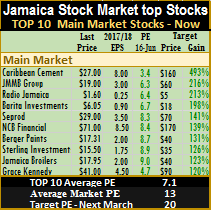
The markets offer some good opportunities for bottom fishing, with General Accident falling to a low of $2.30 during the week before rebounding to close at $2.80. Caribbean Producers seems attractively priced, with 2018 earnings as the target with the price having fallen to $3.03 with some large volumes trading around that level.
Last week, IC insider.com reported that tTech demand is building while selling has eased with limited supply being shown in the market. This week, the price inched higher to $8.55 from $7.75 at the close of the previous week. Elsewhere, NCB Financial Group is hitching for a major breakout from a wedge formation, the stock is in good demand in Trinidad with a price around J$77.
In the main market, earnings per share for Radio Jamaica have been sharply reduced to 25 cents with the latest results for the full year to March coming in below expectations. The stock remains in the TOP 10 list, with improvement expected in the current fiscal year.
The average PE ratio for the Junior Market Top stocks stands at 7.4 and 7.1 in the main market, these compare favourably with 13.4 for the overall main market and 13 for Junior Market, based on 2017 estimated earnings. Several stocks are trading below the average, and have the potential for more gains for the rest of 2017, barring major negative developments.
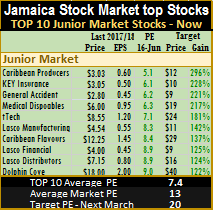
At the close of the week, IC Insider.com’s TOP 10 Junior Market stocks now trade at an average discount of 45 percent to the Junior Market average, while those in the main market are trading at a 49 percent discount, to the average of the market, leaving stocks with room for growth in the months ahead. At the end of April the reading was 35 percent discount for the juniors and 53 percent for the majors.


Main Event inadequate Q2 report

Three directors of Main Event, including the mentor who is respossible to ensure compliance with teh JSE rules.

The 2017 junior listed Main Event Entertainment, made a loss in the last six months of the 2016 fiscal year, ending the year with a profit of $56 million, down from $64 million for the six months to April.
The latest figures from the entertainment company for 2017, show a profit of $75 million for the half year and $51 million for the April quarter.
The figures reveal seasonal differences in the operation, with higher revenues and profit in the first half and lower revenues and losses or minimal profit in the second half. The Jamaica Stock Exchange rules require that seasonality in operations is to be reported on, in a listed company financial report. There is total silence on this issue in Main Event’s report, leaving investors to guess what the second half will be like, it should not take the stock exchange rules to put to this. Good investors’ relations suggest that this is absolutely needed in this situation of wide variation in the two periods. Astonishingly, a review of the company’s prospectus gives no indication of seasonality of revenues and earnings.
The directors’ report accompanying the half year results, speaks to a reduction in direct expenses due to continued investment in fleet and transportation solutions, and rental equipment and human resources. At the same time administrative cost had a big increase due mainly to increased transportation and fleet management costs. It appears that these added costs should be treated as a part of direct cost and not administrative.
Revenue in the April quarter at $319 million was flat with the 2016 out turn but the half year rose 8 percent to $652 million. The data to date show no indication that the second half year results will show much if any improvement over the outcome for 2016 except for the removal of taxes.
At the initial public offer in January the issued share capital was 240,004,000 shares and 60,001,000 shares were issued to the public, resulting in an average number of shares issued for the April quarter of 300,005,000 units but only 270 million units for the half year. The report shows the fully issued number of shares at the end of April is used in computing earnings per share (EPS) for all periods.
The effect is that the reported in the interim results are wrong and in effect understated as the number of shares used in the computation is overstated. Instead of earnings per share of 25 cents for the half year it is 27.7 cents and for the 2016 period 26.8 cents and not 21 cent. The earnings for the 2016 April quarter, is 17.2 cents and for the full 2016 fiscal year 23.5 cents.
There are clearly weaknesses in the report and its handling, but worse it is also showing weaknesses in the overall management inclusive of the directorate.
The company expended over $107 million on fixed assets, increased borrowed funds by a mere $10 million more than at the end of October with cash ending at $65 million from just $19 million at the end of October.
With the interim results ending at 28 cents per share, it is going be challenging for earnings for the full year to be much higher than 35 cents IC Insider.com is forecasting for the year to October, barring a sizable rise in revenues. It could go on to earn 50 cents for 2018, IC Insider.com’s forecast shows. At the current price of $6 on the Junior Market of the Jamaica Stock Exchange the PE ratio is 17, suggesting that the price may revolve around this level for a while.

No progress for Scotia Investments

Scotia investments (SIJL) has been in transition for a long time from their original business based substantially on repos, to one based on pool funds. In the latter half of 2016 the company showed strong signs returning to pathway of growth but the latest half year results have put that on hold, at least for the time being.
A big part of the investment banker’s problem is the strangulation the Scotia Culture has placed on clients that is driving business away. Examples of this is the length of time it takes to place stock brokerage orders and its execution, or the inability now to get statement of accounts.
The company’s half year report, shows profit of $451 million for the period ended April 2017 compared to $457 million for the prior period, in 2016 from revenues of $2.3 billion, a reduction of $64 million in the corresponding period in 2016. The net profit for the second quarter to April this year, ended at $302 million, down from $339 million for the same quarter in 2016 from revenues of $1.14 billion compared to $1.19 billion in 2016.
SIJL earned 71 cents per share in the April quarter, down from 80 cents in the 2016 period and $1.07 for the half year compared to $1.08 in 2016. At the rate of growth for the half year, it looks as if profit for the full year should hoover around the $3.19 earned in 2016.
Total Comprehensive Income for the half year amounted to $546 million, compared to $663 million reported for the same period last year and for the quarter $454 million versus $468 million.
Total revenues for the six months from pool management funds fees grew 18 percent in the half year over that of 2016 while fees from pension and portfolio management, increased year over year by 34 percent.
Net Interest Income after impairment losses for the period was $685 million, a reduction of $60 million from $745 million in the corresponding period last year.
Other Revenue, comprising fee income, securities trading gains and net foreign exchange trading income, rose by $32 million to $866 million for six month period, above the same period last year, but was down slightly for the quarter to $463 million from $481 million in the previous year’s quarter.
Operating Expenses for the 2017 half year ended at $889 million, compared to $913 million for the corresponding period last year and $385 million for the April quarter versus $395 million in 2016.
Total assets stood at $67 billion at the end of April while financial assets under administration not included in the financial statements, amount $193 billion versus $169 billion in 2016
A dividend of 45 cents per share was declared payable July 20, 2017, the same amount being paid for some time. The stock traded at $36.50 on the Jamaica Stock Exchange on Friday.

16% rise in Scotia Group Q2 profit

Scotia Group reports a 14 percent increase in profit compared to the period in 2016. The banking group added $718 million more in profit to $5.7 billion for the six months to April 2017 over 2016.
Net income for the second quarter rose 16 percent to $3.4 billion, versus $2.94 billion in the same period in 2016. Total revenues for the April quarter amounted to $16.7 billion while in 2016 the group generated revenues of $11 billion while revenues for the six months ended at $23 billion versus $21 billion.
“The positive movement was achieved through increased loan and transaction volumes across our business lines,” the Group stated in a report accompanying the results. Net interest income after impairment losses for the six month period was $12.2 billion, $399 million or 3 percent above the same period in 2016
“Net fees and commission income amounted to $4.4 billion, driven by higher transaction volumes and the growth in our credit card, merchant services, and asset management business. Insurance revenue increased by 31% given the growth in core insurance business and actuarial reserve release from changes in assumptions on valuation of the portfolios. Net gains on foreign currency activities and financial assets amounted to $1.3 billion based on trading volumes,” the Group stated.
Operating Expenses amounted to $11.1 billion for the six month period, an increase of $300 million or 3 percent compared to prior year. Salaries and staff benefit costs increased by $201 million, which was offset by lower other operating expenses of $87 million. Asset tax increased by $112 million or 12% to $1.1 billion due to the increase in the Group’s assets.
Impairment losses on loans amounted to $975 million, up $367 million from last year as higher write-offs on unsecured retail loan portfolio grew by $7 billion or 4 percent year over year, with loans after allowance for impairment losses, increasing to $164.2 billion.

Main Event flat profit before tax

Main Event Entertainment that went public with an IPO in January this year is reporting flat profit before tax and slightly lower net profit after tax of $3.3 million. Profit before tax for the year to October ended at $59.8 million com-pared to $60.3 million in 2015.
Profit after tax came in at $56.5 million versus $60 million in 2015, the out turn is lower than the $60 million the internal figures to September last year that was included in the prospectus showed. The net profit translates to earnings per share of just 23.5 cents with 240 million shares applicable at the date of the financials.
Return on average equity amounted to a strong 41 percent, with shareholders’ equity at the end of the period being $242 million.
The results emanated from a 9.5 percent rising in revenues to $1.13 billion, the growth was slowed b y a big drop in revenues from Digital Signage. With gross profit climbing 13 percent to $429 million. Expenses rose by 15.7 percent to $354 million. Revenue during the year was generated mostly by Entertainment promotion activities of $854.7 million in 2016 from $742.7 million in 2015. Audio and film contributed $189.5 million compared to $140 in 2015 and Digital signage of $88 million versus $151 million in 2015. The auditors signed off on their report on the 5th of June, an indication that all was not well with the financial reporting.
Main Event went public at $2 in January and now trades on the Junior Market of the Jamaica Stock Exchange at $6.50.

Cable Bahamas to trade at $1m each

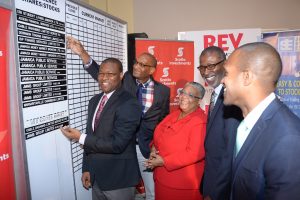
Kino Williamson (l), Head of Finance, Cable Bahamas, Scotia Investment CEO, Lissant Mitchell. Also sharing the moment (from left) are Marlene Street Forrest, Managing Director Jamaica Stock Exchange, John Gomez, COO Cable Bahamas and Dylan Coke, of Scotia Investments

The Bahamian based telecommunication group, Cable Bahamas (CBL) listed two preference shares on the Jamaica Stock Exchange (JSE) on Friday. The shares represent capital raised in Jamaica and US dollars in Jamaica by way of private placements. The stock listed on the Jamaican dollar preference section of the local market will trade with a minimum of $1 million each.
A total of J$1.9 billion was raised, comprising two preference shares at 8 percent each, amounting to US$4.9M and J$1.35 billion from a number of institutional investors arranged by Scotia Investments. The funds raised were used to launch its mobile telephony services in the Bahamas.
“Scotia Investments is pleased to have been able to support CBL in listing these bonds on the Stock Market. Being able to do a transaction like this – a preference share, listed on the JSE, for an overseas issuer – is further evidence of the depth and sophistication of Jamaica’s capital markets” said Dylan Coke, Scotia Investments, VP Organization & Capital Markets.
Cable Bahamas is a public company incorporated on September 1994 under the laws of The Bahamas and listed on the Bahamas International Securities Exchange. Subsidiaries provide cable television and related services, national and international data services, internet services, telephony and wireless, web hosting and business continuity services. The subsidiaries of the company include Cable Freeport Ltd., Caribbean Crossings Ltd., Maxil Communications Ltd., Systems Resource Group Ltd., and Be Aliv Ltd.
The group which were already providing landline telephone service, commenced Cellular phone service late in 2016 after receiving a cellular license. According to the Group’s CEO John Gomez we have around 30 percent of the mobile market with an overall market size of BH$300 million.
The company is not considering listing the ordinary shares in Jamaica at this time but are open to considering it at some point in the future, the groups’ Kino Williamson (l), Head of Finance advised IC Insider.com.


The Exuberant 10

The JSE stock traded at an outlandish $13.50 & dropped 47% since.

It is not nice to watch one’s investment lose value while others grow delivering big gains at the same time. Many investors plunge into investments that will result in just that happening, as they err and refuse to let go and reinvest, to recover their loss, from gains elsewhere.
A look back at prices in 2005, reveals shocking results of costly ill-timed investments. In June 2005, investors in a bout of excess exuberance, pushed Mayberry Investments to $8.40 from a listed price of $5.05, weeks after it listed on the Jamaica Stock Exchange, 12 years later it is still to reach back to that level. That is a huge blow to investors who held on to the shares from then.
The sad thing is that many investors who wanted to sell could not, as attempts were made to control the price from a big drop as selling started to overwhelm buying a few days after nearly 40 million shares were traded around the $7-8 level. Mayberry is an outstanding example of investors making huge errors based on inadequate information and paying dearly for it.
But Mayberry’s stock is not the only one that investors underwent a long period of suffering from, they have a number of top notch companies as their friends that that performed poorly until fairly recently. Scotia Group was pushed to $33.50 in March 2005 based on results that were not sustainable as the bank benefited by a poor decision of the Central Bank to push interest rates on CDS paying interest at elevated levels for about two to three years. The banks of course made a killing when rates fell back. Added to that, Scotia effected a stock split that sent the stock flying. Well it was not until late 2016 that the price exceeded the 2005 high. JMMB Group’s shareholders saw the price of the stock peaking at $22 in April 2004 only to see it fall away and not getting back to that level until recently this year. That is not great for a stock that is not a great dividend payer.

Grace Kennedy hit a high of $123 (Now $41 after stock split in 2016), in January 2005, it has taken nearly 12 years to recover the loss and it has still not delivered much more in gains since its full recovery.
Markets tend to repeat past behaviors, over and over but sometimes they take a break from the norm. PE ratios are the end product of investors’ perception of values for stocks. There are other measures but the PE is the most widely used. When PEs are pushed well beyond where the majority of investors thing the value ought to be, they induce added buying or selling. Investors who buy when the market has pushed valuation well above what is considered the norm, usually pay a steep price for so doing. The 2005 examples are cases in point. An accepted concept is that the PE ratio should be line with profit growth. One year’s growth cannot be used by itself but investors have to try and determine that themselves.
Most of the stocks in the IC Insider’s Exuberant 10, were pushed in 2017 by excessive enthusiasm and in some cases wrong information. Stock splits helped to fuel some of the excess as well. The attached table shows the stocks that were pushed well above their appropriate values and the levels of correction since. Some may fall even more than their latest price as they can be considered overvalued based on known earnings for the current period. A few that are not on the list could see a decent fall as well, included in this latter list are Knutsford Express and Kingston Properties.

Knutsford Express riding high

Knutsford Express last traded at $68.

Knutsford Express last traded in 2016 at $20, today its up 240 percent to $68, thanks to a combination of factors, chief amongst them is a scarcity of supply and a proposed 5 for 1 stock split.
A 33 percent rise in revenues to $203 million in the February quarter and a 63 percent rise in operating profit show the company in a pretty strong growth path.
Earnings per share closed the nine months period at $1.20 after the third quarter delivered 54 cents.
“We had a strong third quarter”, Oliver Townsend told IC Insider.com, in response to the question, “can this growth continue,” Townsend answered in the affirmative. With our Montego Bay transport hub coming on stream by June this year, we should see continued growth as the company expect increased business as a result of having the hub located at the Sangster International Airport. The convenience of persons flying in and out of the airport being able to have easy and ready access to the Knutsford facility will see more persons patronizing the service, Townsend advised this publication. Ocho Rios is to have a new hub in which meals and drinks will be sold and thus enhance customers’ experience.
“We are also going directly from Kingston to Port Antonio using smaller buses via the Junction Road, the company’s Chief Executive said.
New buses added to replace older ones will reduce operating cost. The February results got a boost of $8.5 million realized from sales of buses, helping to push net profit up 94 percent to $53.7 million. For the nine months, revenues climbed 28.5 percent to $429.7 million while net profit moved higher by 35 percent to $120 million.
Knutsford does not break out its cost into direct operating expenses, marketing and administrative and other expenses so that readers can fully glean how the company is really doing, from an operational standpoint. Data compiled by IC Insider.com show an improving level of efficiency as business expands. Net profit as a percentage of revenues climbed to 24.7 percent and is up from 20 percent in the third quarter of 2016 and ended at 22.34 percent for the nine months compared to 23.2 percent in 2016.
Depreciation charges rose 54 percent to $39 million well ahead of the growth in revenues, but the newer buses should reduce repairs and maintenance as well as the possibility that there could be fuel savings.
Knutsford generated gross cash flows of $159 million To February, up from $114 million in 2016, dividends of $24 million paid and $87 million spent of acquiring fixed assets left the company with $103 million in funds at bank or in cash. Shareholders’ Equity stands at $432 million with borrowings of just $68 million and cash and short term investments of $123 million. Current assets amounted to $180 million and current liabilities at a low $35 million.
The Company is listed on the Jamaica Stock Exchange and last traded at $68 for a PE of 25 based on estimated earnings for 2018 fiscal year’s estimated earnings of $2.75. The stock could be considered a bit pricey, with the market average at 13 times this year earning. With a 5 to 1 stock split days away, who knows what investors may do in light of the limited supply of the stock. At least profit seems to be on the rise at an attractive pace, as such investors with a long term time horizon may well enjoy gains sometime in the future, based on the growth path that the company is enjoying.

Junior at record majors surge 3,300 pts

New highs for Jamaica Broilers at $20, Berger Paints at $23.50, Supreme Ventures at $7.50 and gains in the price of Sagicor Group shares, helped push the main market all Jamaica Composite index up by 3,327.59 points to a new record.
By 10:45 AM the index hit 265,287.63 points and sits just around an important resistant point going back to mid-1992.
The junior market gained 26.86 points to trade at a new record of 3,351.29. The Junior Market sits around resistance currently. Junior Market 2016 listing, ISP Finance hit a new high of $30 with 2,421 shares trading. Key Insurance dropped to$3.05 having last traded at $3.80 previously. Lasco Financial Services fell to $4.20 with just over 1 million shares trading while Lacso Manufacturing traded just under 1 million units and now trades at $5.70.

Flash Back TOP 5

Berger Paints is one of IC Insider’s TOP 5 best performers from the initial list & exceeded the price target.

IC Insider.com first published its TOP 5 stocks, for the week ending September 9 last year. Looking back, the first set of selection is revealing.
There has been no losers in the list, 6 have more than doubled and two nearly doubled, that is a near 80 percent of strong performances. The Junior Market index is up 43 percent over the period and the All Jamaica Composite is up 29 percent for main market stocks.
First the disappointments, Grace Kennedy has hardly moved from where it entered at $41.45 while Caribbean Cement keeps on dancing up and down as the company’s management fails to properly communicate with investors as to the company’s performance, both past and future, the stock is up from the $26 but just. AMG Packaging while trading higher than the $19.20 it entered the list at, has not done much based on its underperforming profitability. The same cannot be said about Berger Paints, up from $5 to $20 on Friday, helped by strong profit increase. NCB Financial has almost doubled and still has much more room for growth. Barita Investments and JMMB Group have more than doubled in price over the period. Medical Disposables have moved to $6.50 and traded higher up from $3.55, Jetcon is up from $3.50 to $15.74, exceeding by far the $10 price tag projected, Paramount was projected to get to $37 based on the number of shares then issued, the price exceeded that level after the stock split 10 for 1, and sits just below the equivalent of $37, currently. Access Financial has more than doubled and came close recently to the IC Insider.com’s target of $48, having traded at $47.