
Guardian Gained in trading on Wednesday but the stock could benefit in the future from the take over of large blocks of shares.
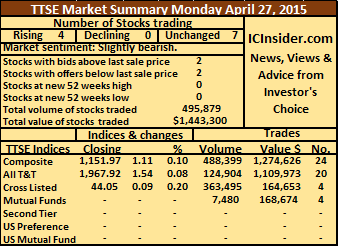
At the close of the market, the Composite Index rose 0.17 points to close at 1,153.41, the All T&T Index rose 0.34 points to close at 1,968.83 and the Cross Listed Index remained at 44.32.
Gains| Stocks increasing in price at the close are, Ansa Mcal trading 1,500 shares to close with a gain of 1 cent at $67.02, Guardian Holdings trading 1,180 shares closed with a gain of 7 cents to end at $14.26. Proven Investments and National Commercial Bank are slated to take a major stake in the ownership in Guardian that once was majority owned by Jamaica Mutual Life.
Firm Trades| Stocks closing with prices unchanged at the end of trading are, Angostura Holdings with 715 units at $13.90, Clico Investment Fund closed at $2.55 with 1,300 units, First Citizens Bank trading 1,875 shares to close at $35.78, Guardian Media trading 912 shares at $19.76, JMMB Group contributing 185,655 shares at 50 cents. Massy Holdings traded just 6 shares to close at $63.43, National Enterprises
 with 1,000 shares closed at $17.30, One Caribbean Media ended trading with 876 units at $22.30, Prestige Holdings had 662,100 units changing hands at $10 with a value of $6,621,000. Republic Bank had 2,650 shares trading with a value of $304,750 to close unchanged at $115, Scotiabank traded 5,600 units to close at $62.50 carrying a value of $350,000.
IC bid-offer Indicator| At the end of trading the Investor’s Choice bid-offer indicator had 4 stocks with the bid higher than their last selling prices and 1 stock with the offer that is lower.








I cannot understand
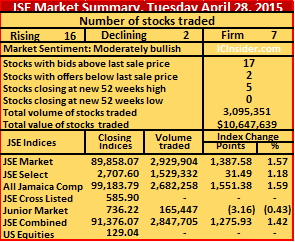
I remember the days when there were heavy trading in stocks in Jamaica, in the 1990s when the market trading data was manually compiled and the indices computed manually. Back then, it took quite a while for the final report to be issued because they had to make sure the information was correct. Now we have errors being reported daily and there is no information going out to public to correct the errors.
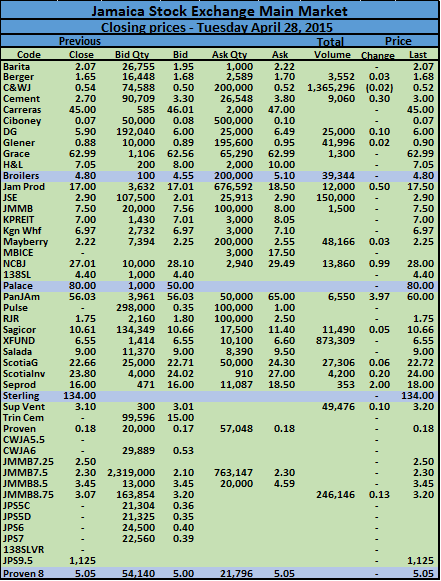
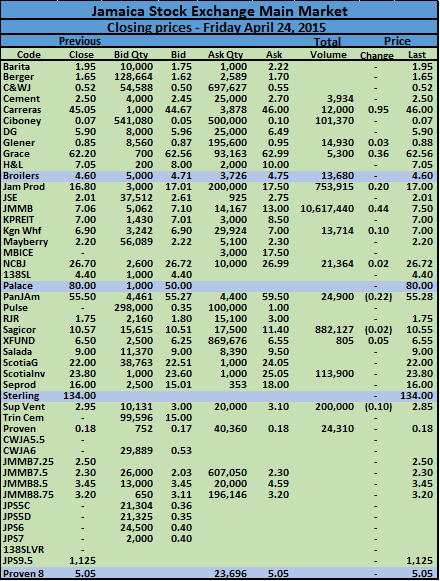
I don’t understand for example why Sterling Investment could have told shareholders in their circular reporting the allocation for rights, for them to subscribe to, that the number of shares in issue is 40 million units and that the record date for the stock split was March 8 this year, and that the notice was published on the JSE website, yet a check on the trading sheets show no change in the trading prices of the stock with the last trading price, the highs and lows still at $134 nor the amount of shares in issue.
The last time we checked, the Manager at the exchange explained that there was a computer programming problem that prevented the highs and lows from being corrected in the case of the three Lasco companies. But that was from 2013, surely they must be able to sort that out by now and certainly, they ought not to be sending false data to the public without some notation to indicate what is the correct. One has to question where is the FSC in all of this?
Recently a reader wrote of his concern about small trades which he asked his broker to avoid, here is what was said “the purchase of 200 Brow and 100 SVL: can you try to avoid such transactions by whatever means possible: deleting buy orders when only small volumes are available, deleting orders when only a small balance is remaining to be filled, etc- whatever you can do. This is retrograde step which JSE has taken and they are wrong in saying that is a global standard. I sure that it is not.”
The reader is absolutely correct. I had a case where a small amount of Cable & Wireless shares were traded, based of the various fees charged by the JSE and the brokers I ended up owing the broker although I sold the stock, that by the way is not a joke. I get the impression that the stock exchange sees investors the way the government sees tax payers, just milk them and ignore their pleas for we have the power. Whatever happened to customer friendliness or the customer is king or queen? Barbados has a system where small trades as routed through the odd lot market. Why can’t we do the same or better yet, treat orders as one trade for fee purposes when such orders are filled from many smaller amounts. Whatever the system the present one is wrong.