Jamaica’s Inflation flat May up 0.5%

inflationahead280x150Price increases in Jamaica since the start of this year is zero, measured by the All Jamaica Consumer Price Index but it increased by 0.5 percent for May over April this year, the Statistical Institute of Jamaica report shows.
Inflation since May last year is put at 4 percent and was helped by declines in the price of petroleum late in 2014, resulting in just 0.1 percent inflation in October and negative inflation from November to February.
The divisions contributing significantly to the upward movement in the index were Food and Non-Alcoholic Beverages influenced by mainly by higher prices for vegetables and starchy foods increased with a 0.5 percent increase.
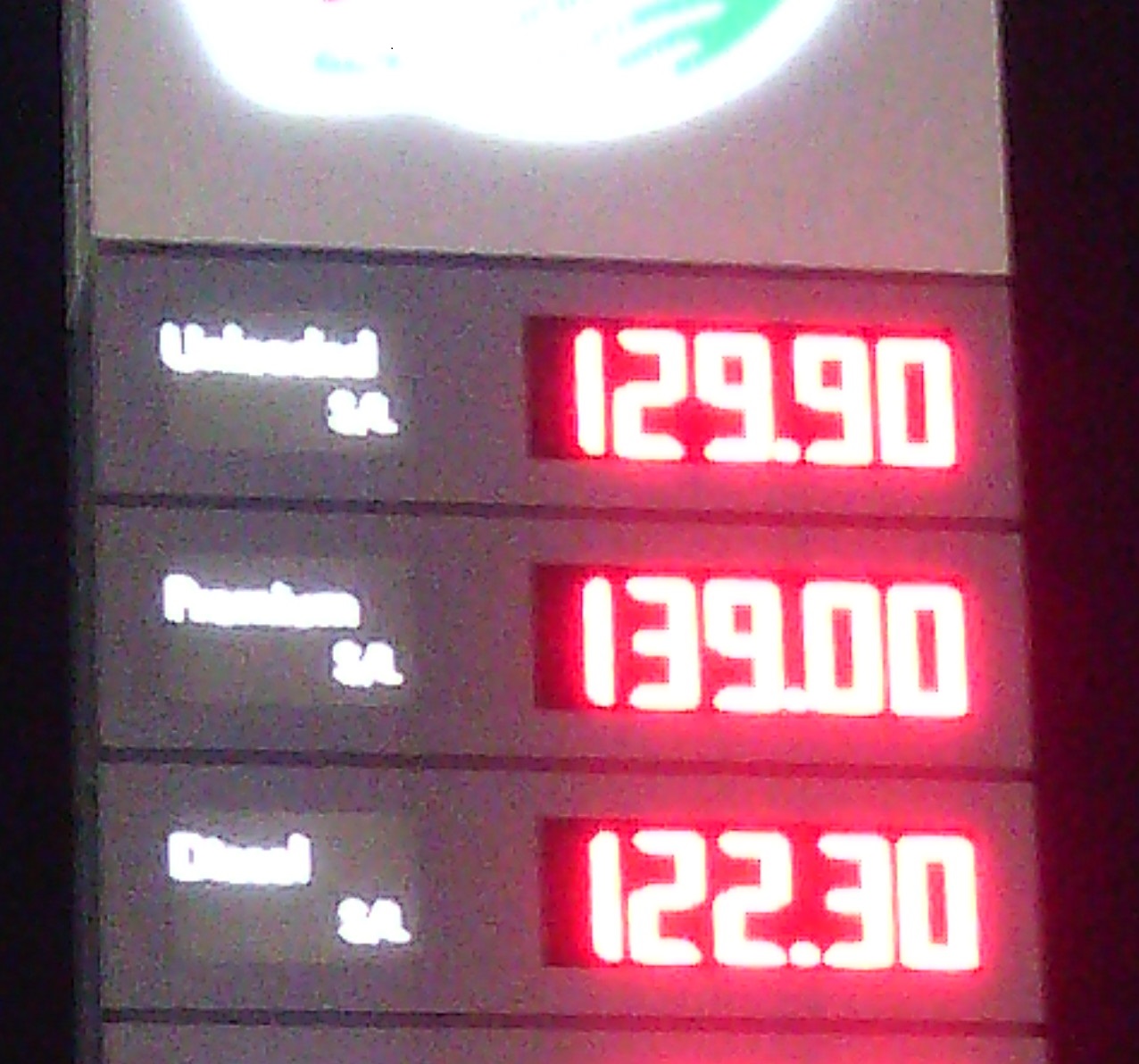
Increased fuel prices added to inflation in May

Increased fuel prices added to inflation in May

The category of Housing Water, Electricity, Gas and Other Fuels which rose by 2.1 percent helped push the overall inflation by rise in the index for the group by 0.9 percent and Transport by 0.8 percent mainly due to an increase in price of fuels.
Increased fuel prices added to inflation in May[/caption]Other divisions recording increases were: Alcoholic Beverages and Tobacco 0.7 percent Clothing and Footwear 0.2 percent, Furnishings, Household Equipment and Routine Household Maintenance 0.2 percent, Health 0.2 percent, Recreation and Culture 0.1 percent, Restaurants and Accommodation Services 0.1 percent, Miscellaneous Goods and Services 0.3 percent.
Tempering the categories with increases was a fall of 1.7 percent in the index for the group Water Supply and Miscellaneous Services Related to the Dwelling.


GOJ enjoys lower Interest cost

Jamaica's Ministry of Finance  newest office building

Jamaica’s Ministry of Finance newest office building

The payment for interest on the country’s huge national debt in April by the government of Jamaica ended at $900 million less than budgeted. The total amount paid is also less than that paid in April last year.
Interest payments amount to $7.376 billion compared with $8.168 billion budgeted and is down on the $7.875 billion paid in 2014. The expenditure saw a near $1 billion savings from the budgeted amount for local debt of $4.588 billion, compared to the budgeted sum of $4.547 billion, there was a slight increase in the cost of foreign debt to $2.788 billion, versus $2.621 billion budgeted.
The fall in the interest cost on the local debt would have occurred as a result of Treasury bill rates having fallen at the time the budget was crafted and April, with government having variable rate instruments funding its operations. The cut in the cost amounts to a large 20 percent and if the savings were to continue for the rest of the fiscal year, the savings could be around $12 billion on the amount of $63 billion allocated to pay interest on the local debt.
Overall revenues collected by government was $28.26 billion, a shade less than forecast at $28.6 billion while recurrent expenditures of $41.56 billion were under budget of $42.77 billion. The short fall in revenues is due to the absence of bauxite levy of $147 million budgeted and grants that came in at only $67 million versus $665 million in the budget.

Remittances dip in February

FX_USPoundRemittances flows into Jamaica declined for February this year, with total remittances coming up short of the inflows into the system in 2014 by a marginal decline of just $500,000 from the corresponding month last year.
Gross remittance inflows for the month amounted to US$167.8 million while net remittances were US$146.7 million, a decline of US$5 million or 3.4 percent relative to the corresponding period of 2014. The decline is the first such since December 2013.
For the first two months of the year total remittance inflows were US$334 million, representing an increase of US$7.6 million or 2.3 percent while net remittances for 2015 were US$294 million, a growth of US$4.4 million or 1.5 percent compared to the corresponding period of 2014.

Interest rates slip slightly

The lastest issue of Treasury bills saw a slight slippage in the rates investors will be getting from the government over the next three to six months.
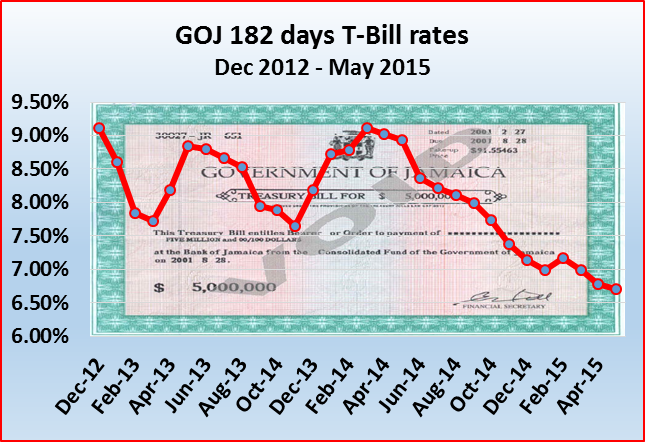
Tbill cht 20-5-15The 6 months issue of Treasury bills maturing in November this year attracted $656.586 million and yielding an average of 6.714 percent, compared with 6.787 percent in April. The the 3 months’ bills are yeilding 6.568 percent versus 6.61 percent in April, the latter auction attracted bids of $655,977,500. Both issues offered bills of $400 million each.
Rates have been sliding on Treasury bills since March last year, there was a slight uptick in the rate out turn at the February auction. The pace of decline of the rates seems to have slowed, in this auction compared with earlier declines. Bank of Jamaica will probably have to lower CD rates to induce a faster decline with inflation for the year still subdued.

BOJ may ease monetary policy

Bank of Jamaica may ease monetary policy in the context of a slower rate of depreciation of the Jamaican dollar, the precipitous fall in oil prices and with inflation expectations fallen sharply.
BOJ 3The bank stated that notwithstanding the sharp fall in inflation, expectations by the business community were above the inflation outturn at end-March 2015, as well as the Bank’s projections for the near-term. The bank went on to state that with the downward adjustment in inflation expectation, in conjunction with favourable developments in the macro financial environment, will allow the Bank to pursue an even more accommodative stance than they have done so far. Notably, developments in the international economy including a faster than projected reversal of oil prices and the timing of tightening of monetary policy in advanced economies will increasingly influence the direction of domestic monetary policy.
“For the March quarter, the Bank’s monetary policy stance remained generally accommodative while being consistent with achieving the monetary targets under the Extended Fund Facility (EFF) supported programme”, the governor reported. In particular, the Bank purchased net amounts of foreign exchange from the market and introduced a 3-month lending facility (Occasional Term Repo Operation), which enhanced liquidity assurance. In the context of the outturns for these
Macro-economic variables and the outlook for inflation over the near-term, the Bank lowered its policy rate by 25 bps to 5.50 per cent on 17 April 2015. This policy action was also consistent with declines in inflation expectations and the country’s risk premium.

Growth of possible 1% in Q1

Brian WynterReal growth in the Jamaican economy (GDP) is estimated to have increased in the March 2015 quarter between 0.0 to 1.0 percent, following two consecutive quarters of contraction, Bank of Jamaica’s governor, Brian Wynter disclosed at the bank’s quarterly press briefing today.
The estimated outturn for the quarter mainly reflected increases in tourism activity, domestic agriculture and Transport, Storage & Communication.
For Fiscal year 2015/16, real GDP is forecasted to expand between 1.0 to 2.0 percent. Agriculture, Forestry & Fishing, Hotels & Restaurants and Transport,

Agriculture is projected to contribute to growth in the quarter

Agriculture is expected to contribute in Jamaica’s growth in the second quarter

Storage & Communication are expected to be the main drivers for growth, the governor said. Wynter further stated that “it is expected that growth in the economy will be strengthened as local and international investors seize the opportunities afforded by the general improvement in confidence, low and stable inflation as well as increased external competitiveness in the context an expanding global economy. The strengthening in growth should also be supported by the continued timely implementation of critical structural reforms over the course of the Programme”.

Jamaica’s 2015 inflation remains tame

Price fallThe inflation rate, increased by a mere 0.2 percent in April 2015 while the year-to-date inflation rate for April 2015 is minus 0.5 percent, the point-to-point 4.4 percent.
Statin said the lower increase for April is due mainly to upward movements in the index for the divisions of Food and Non-Alcoholic Beverages 0.5 percent, Alcoholic Beverages and Tobacco 1.3 percent and Transport 1.1 percent. The fall in prices the group Electricity, Gas and Other Fuels’ which fell by 4.6 percent. This resulted mainly from lower fuel rates, as well as an appreciation of the Jamaican dollar.
The calendar The other divisions that recorded increases in the All Jamaica ‘All Divisions’ index were: ‘Clothing and Footwear’ 0.4 percent, ‘Furnishings, Household Equipment and Routine Household Maintenance’ 0.4 percent, ‘Health’ 0.2 percent, percent, ‘Recreation and Culture’ 0.3 percent, ‘Restaurants and Accommodation Services’ 0.2 percent, and ‘Miscellaneous Goods and Services’ 0.3 percent.

Unemployment worsens

cementblocks150x150Jamaica’s unemployment worsened in December last year compared with a year ago according to the main findings of the Labour Force Survey, conducted by the Statistical Institute of Jamaica (STATIN) between December 14 and 20, last year.
According to Statin, the Unemployment Rate for December 2014 was 14.2 percent compared to 13.4 in December 2014 leaving the Employment Rate at 85.8 percent, a fall from the 86.6 percent in December 2013.
A total of 188,100 persons were unemployed in December last year, an increase of 13,100 when compared with 175,000 in December 2013. The deterioration did not stem from less persons being employed as the number of persons in the Labour Force rose to 1,320,800, or 15,700 higher than the 1,305,100 recorded in December 2013. The Employed Labour Force for December 2014 was 1,132,700, or 2,600 more than the 1,130,100 recorded in December 2013.

At the last election his party promised jobs and more jobs but tight economic policies won't deliver them in the short term

Jamaica’s Minister of Finance. At the last election his party promised jobs & more jobs. Tight economic policies won’t deliver them in the short term

Employment in the Occupation group ‘Clerks’ increased by 9,100 persons to 110,500 in December 2014, Professionals, Senior Officials and Technicians’ also increased moving from 247,800 persons in December 2013 to 263,100 persons. Service Workers, Shop and Market Sales Workers declined from 228,800 persons to 218,400 while Elementary Occupation fell from 143,800 to 137,200.
The number of persons employed in the group ‘Manufacturing’ increased by 7,200 persons or 10 percent, while ‘Transport, Storage and Communication’ increased by 5,500 persons (7.7 percent). Agriculture, Hunting, Forestry & Fishing’ declined by 7,400 persons (3.6 percent) followed by ‘Real Estate, Renting & Business Activities’, which declined by 6,100 persons or 8.6 percent.

Treasury bill rates slide continue

Government of Jamaica Treasury bill rates, declined in the latest auction of the short-term debt instruments, opened today at the Bank of Jamaica offices. The 182 days instrument closed at its lowest level since May 2013 when it then cleared at 6.44 percent.
At today’s auction the average rate came in at 6.787 percent, down from 6.998 percent in March and the 91 days ended at 6.06 percent, a decline that is well down on the previous rate of 6.72765 percent. TB -4-15
The declines come against the background of consistently falling rates since the start of the second quarter last year, negative inflation and a cut this month in Bank of Jamaica’s CD rate, from 5.75 percent to 5.50 percent.
The implications of the fall include potential for lower lending rates down the road, stimulation of interest sensitive investments such as stocks and long term bonds and of course persons looking for income from fixed interest securities will be getting less income going forward than in the recent past.

Prices up in March down for year

inflationahead280x150The Statistical Institute of Jamaica (Statin) reports that for March 2015 that inflation rose by 0.5 percent over the February which had a fall of 0.7 percent. The calendar year-to-date inflation rate is minus 0.6 percent. This is the first increase in the index after recording four consecutive months of decline”, Statin said.
Contributing significantly to this advance in the index was a 2.9 percent increase in the index for the Housing, Water, Electricity, Gas and Other Fuels due mainly higher rates for electricity. Lower prices for vegetables and starchy foods helped in moderating the increase with a small reduction in prices.
CoffeeTrade280x150The divisions that recorded increases in prices are, ‘Alcoholic Beverages and Tobacco’ 0.3 percent, ‘Clothing and Footwear’ 0.4 percent, ‘Furnishings, Household Equipment and Routine Household Maintenance’ 0.3 percent, ‘Health’ 0.2 percent, ‘Transportation 0.7 percent, ‘Recreation and Culture’ 0.1 percent, ‘Restaurants and Accommodation Services’ 0.3 percent ‘, ‘Miscellaneous Goods and Services’ 1.3 percent, while ‘Education’, and ‘Communication’ each remained unchanged.