 The Bank of Jamaica’s 30-day Certificate of Deposit interest rate was reduced on Friday, 17 April 2015 Thursday to 5.50 percent from 5.75 percent, the central bank announced on Thursday. This is the first such reduction since February 2013, when the rate was cut by 50 basis points from 6.25 percent to 5.75 percent.
BOJ in its release stated, “this adjustment to the BOJ policy rate, reflects the Bank’s expectation that the rate of increase in consumer prices is likely to remain low in the coming year”.
“The recently announced inflation rate of 4 per cent for FY 2014/15 is the lowest in 48 years. The sharper than expected decline in inflation for the fiscal year was due in part to the fall in oil prices but also to the moderation in price increases that has resulted from fiscal consolidation and economic reforms. The impact of these changes will help to moderate inflation impulses over the medium term” the central bank concluded.
The reduction is also in line with a decline in Treasury bill rates over the past year, coupled with increased inflows of foreign exchange into the system that led to some amount of revaluation of the Jamaican dollar.
January remittances climb
 Jamaica enjoyed a record haul in remittance inflows for the month of January with US$166 million garnered in January this year, according to data from Bank of Jamaica.
The flows represent an increase of US$8 million or 5.1 percent more than the amounts collected in January 2014. The growth in remittance inflows and a contraction in outflows resulted in net remittance inflows increasing at a faster pace than total inflows, with net remittances of US$147.4 million for January 2015, an increase of US$9.5 million or 6.9 percent over January 2014.
The gain in net inflows would have been occasioned by greater stability and availability of foreign exchange locally.
30 days interest rate rise
 Interest rate increased for the latest Government of Jamaica Treasury Bills offering for April over the previous issue, in March this year, but by a relatively small amount of 0.04 percentage points.
The highest and lowest rates in the auction, suggest that investors expected rates to have eased rather than rise, with successful investors obtaining rates ranging from 6.1 percent to 6.74999 percent with an average rate 6.33979 percent, compared to the March auction with a high of 6.8 percent and a low of 6 percent and an average of 6.3 percent. Applications for $690,246,600 chased the $400,000,000 available on Wednesday, April 15 for Treasury Bills with a 30 days maturity of Friday May 15.
Jamaican economy grew 0.4% in 2014

Building under construction in Montego Bay contributed to economic growth in 2014
For the year Statin said that there was a 0.6 percent increase in the output of the Services industries while the Goods Producing industries declined by 0.1 percent. Growth last year was the second year of increased output for the economy with very moderate growth for 2013 around 0.2 percent. The figures will undergo at least two sets of revision before they are final as such the figures could be increased or reduced based on new data that may become available.
The Jamaican economy, grew by 1.6 percent in the first quarter of 2014, over the similar period in 2013. In the second quarter, growth accelerated to 1.9 percent, but a combination of drought conditions and negative impact of Chick v illness as well as closure of the oil refinery severely affected growth in the second half of the year, but more so in the third quarter. The economy declined by 1.4 percent in the third quarter of 2014 compared to the similar quarter of 2013 and growth in “the final quarter of the year resulted in 0.4 percent negative growth compared with the same period in 2013,” Statin said.
For the final quarter of 2014 the reduction in output was due mainly to a 3.9 per cent decline in the Goods Producing industries. The Services industries however, recorded an increase of 0.8 per cent, Statin stated.
GOJ should report 2015 deficit
Government of Jamaica is reporting a deficit of $39 billion on its operation to February, this year, just below the $40 billion projected and a primary surplus of $79 billion versus forecast of $83 billion.
With the budget for March this year indicating expectations for a surplus of $29 billion, the country should be seeing an overall deficit close to the $11 billion reflected in the 2014/15 budget. The primary surplus budgeted at $121 billion could end up around $116 billion unless there are extraordinary inflows or sharp cut in expenditure.
Overall revenues fell $12 billion for the 11 months while there were cuts of $9 billion in capital expenditure, wages $3 billion and interest cost almost $6 billion. PAYE delivered $3 billion more inflows than forecast and withholding tax performed better than forecast by $2.5 billion. Pulling down the revenues were Local GCT $7 billion, corporation taxes $7.5 billion.
Jamaica’s 2014 trade deficit falls

Imports of petroleum fell
Jamaica’s expenditure on merchandise imports during January to November 2014 fell by US$280 million or 5 percent to US$5,287 million when compared to the same period in 2013. Earnings from total exports fell by US$109 million or 7.5 percent to US$1.35 billion. The trade deficit a narrowed to by 4.1 percent or US$171 million to US$3.94 billion, compared to the similar 2013 period.
Major contributors to the fall in imports were declines of Mineral Fuels with a decline of US$154 million or 7.9 per cent, food declined by US$51 million or 5.8 per cent, to US$837 million. Chemicals fell by US$130 million or 18.6 per cent, lower imports of ethanol products were the primary contributor to this decline. Beverages & Tobacco decreased by US$66 million, US$4 million or 6.1 percent below the US$71 million recorded in the similar 2013 period.

Bauxite mining
Exports|Earnings from traditional exports increased up by US$19 million or 2.7 percent to US$739 million, due to increases in Mining and Quarrying but Non-Traditional domestic exports valued at US$549 million, fell 16.9 percent or US$111 million.
Remittances top $2.16b in 2014
 Remittance inflows for 2014 exceeded the amount earned by Jamaica in 2013 by US$95 million or 4.6 percent, according to data released by Jamaica’s Central Bank.
The country saw total inflows of US$2.16 billion for the January to December period. The total flows are likely to be just under the $2.2 billion estimated inflows from the tourism sector for 2014.
Net remittances for 2014 were US$1.93 billion, representing a growth of US$102 million or 5.6 percent compared to 2013 and emanated from an increase in gross inflows and a reduction of outflows.
The increase in total remittance inflows reflected an increase of US$95 million in inflows through Remittance Companies. This increase was however partly offset by a decline of US$0.5 million in inflows from the Other Remittances sub-category.
Treasury bills rates mostly fall
Interest rates are down on the latest issue of treasury bills compared with the out turn in February, for the three and six months instruments but the 28 days instrument enjoyed a slight increase compared with the rate at the February auction.
 The 182 days bill ended with an average rate of 6.99 percent and is back to the level at the January auction. The highest rate allotted for the latest issue is 7.16 percent, while $948 million chased after the amount offered.
The 91 days instrument attracted bids for $720 million and resulted in an average rate of 6.3 percent with 6.8 percent being the highest rate allotted. The average rate for the February auction came in at 6.88 percent.
The 28 days instrument attracted bids for $655 million and resulted in the average rate being 6.7278 percent with the highest rate allotted being 6.9 percent. The average rate for the February auction was 6.417 percent.
All three auctions had $400 million each on offer to the public.
5 months of deflation for Jamaica
 Jamaica is enjoying a respite in upward price movements since October last year with the price of oil on the world market having collapsed from US$100 per barrel to hover around US$50. The country had a 0.1 percent inflation in October, but declined in each of the following months, with the latest data showing February 2015 with a 0.7 percent decline in the All Jamaica ‘All Divisions’ Consumer Price Index. This followed the fall of 0.5 percent in January. Year-to-date inflation to February 2015, is -1.1 percent and since November last year the decline is 2 percent.
The Statistical Institute of Jamaica (Statin) indicated that the “main contributor to the decline, was a 3.6 percent decrease in the index for the division ‘Housing, Water, Electricity, Gas and Other Fuels’ resulting from lower rates for electricity and water. The reduction was tempered by an upward movement in the wages for carpenters, masons, plumbers, painters and electricians during the month. Also contributing to the decline was a 0.6 percent fall in ‘Food and Non-Alcoholic Beverages’, the heaviest weighted division. All other divisions recorded movements of below 0.5 percent.”
Increase were experienced by certain categories with ‘Alcoholic Beverages and Tobacco’ increasing by 0.3 percent, ‘Clothing and Footwear’ 0.2 percent, ‘Furnishings, Household Equipment and Routine Household Maintenance’ 0.3 percent ‘Health’ 0.4 percent, ‘Transport’ 0.1 percent, ‘Recreation and Culture’ 0.3 percent and ‘Miscellaneous Goods and Services’ 0.2 percent. ‘Communication’, ‘Education’ and ‘Restaurants and Accommodation Services’ recorded negligible movement for the period under review, Statin stated.
GOJ has $15 billion hole in budget

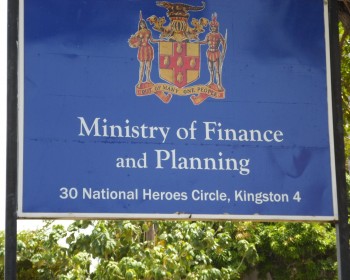
Ministry of Finance Building Kingston, ,Jamaica
Notwithstanding the good news for January, Phillips budget has a $15 billion gap between the revenues and recurrent and non-debt capital expenditure to be filled, if the government is to have another year of balanced fiscal operations. The situation can get worse if Phillips aggressive take on GCT and PAYE inflows don’t materialize. These two areas seem likely to underperform forecast, while corporate taxes could do far better that projections.
The government is projecting to collect around 5.5 percent more in revenues than for the year ending in March on the assumption that the short fall in revenues to January will be maintained at those levels. The 2014-15 budget projected revenues at $428 billion but it should end around $420 billion when the numbers are all in. the next fiscal year projection is for revenues of $448 billion. The projection for tax revenues is an increase of 7.5 percent to reach $402 billion from around $374 billion.
PAYE is to make a big jump of 13 percent to get to $76 billion from around $67 billion, for the March 2015 fiscal year. But while the government is projecting a huge increase in PAYE there is slower growth for education of tax, projected at $21 billion, up from $19 billion or 10.5 percent. Under normal circumstances education taxes should grow faster than PAYE in this fiscal year. The threshold for Income tax has been increased and would therefore mean that the PAYE would be paid on a smaller sum than for Education tax. GCT is projected to jump by $17 billion to $139 billion, a high 14 percent increase. Surprisingly, Corporation taxes are projected to enjoy no increase. That is a big surprise with a large portion of cost input this year having fallen significantly and should help improve companies bottom-line. The other element is that those lower energy cost for fuel and electricity will boost consumer spending somewhat and that will feed back into corporate profits, as such businesses should benefit in two ways.
Banking on a sharp increase in GCT and PAYE are inconsistent with an economy that projected to grow at no more than 2 percent in real terms and nominally, possibly 5-6 percent and an assumption that corporate taxes will be fall is inconsistent with the impact of the falling prices of electricity, gasoline and interest rates on profits.
Projected payments on recurrent expenditure is for $433 billion and capital expenditure of $29 billion and leaves a shortfall of $15 billion.