Inflation plunges in Jamaica


Inflation plunged 0.8 percent, the Statistical Institute of Jamaica reported for January 2026, in the process confounding forecasts for higher inflation well into 2026. The decline coincides with a seasonal pattern of low to negative inflation for the first four months of the year.  

Food category was main contributor to January’s deflation.

According to the Statistical Institute of Jamaica, the Food and Non-Alcoholic Beverages division had a decline of 2.6 percent in the index.
Point-to-point inflation rate (January 2025 – January 2026) was 3.9 percent and back below the Central Bank’s target of 4-6 percent, before Hurricane Melissa blew it briefly off course.

Jamaica’s inflation cools


Jamaica experienced a dramatic inflation spike in late 2025, driven primarily by the effects of Hurricane Melissa on reducing agricultural production and increasing prices. The Consumer Price Index rose by 2.4 percent, in November, with the pace slowing to 1.3 percent in December, as agricultural supplies slowly returned to more normal levels.

November’s 2.4 percent monthly rise was the highest since September 2013, with 2.8 percent and matched the August 2024 increase following Hurricane Beryl. Hurricane Melissa, which struck on October 28, severely disrupted agricultural production and infrastructure. Food prices surged 6.0 percent in November, with vegetables, tubers, and plantains jumping 19.1 percent, while fruits and nuts increased 8.8 percent. Inflation in this category, in December climbed at a much slower pace of 2.1 percent, with vegetables, tubers, and plantains jumping 4.5 percent, while fruits and nuts increased 5.6 percent.
By year-end, point-to-point inflation reached 4.5 percent, with food inflation accelerating to 7.1 percent year-over-year. Housing and utility costs also contributed, rising 3.5 percent annually. Despite these pressures, inflation climbed from 2.9 percent in October to 4.3 percent in November and 4.5 percent in December, remaining well within the central bank’s target range of 4-6 percent.

Jamaica’s inflation cools, signals lower interest rates


Inflation in Jamaica cooled in July, 0.30 percent, well above the 0.3 negative inflation in June and brings the last twelve months’ inflation rate to 3.3 percent, well below the Bank of Jamaica’s target of four to six percent, the Statistical Institute of Jamaica (STATIN) reported in its latest bulletin on price movements in the country.

According to Statin, the main contributor to the increase was a 0.9 percent rise in the index for the Food and Non-Alcoholic Beverages division, with the Food group rising by 0.9 percent, while the index for the Non-Alcoholic Beverages group increased by 0.4 percent.

“The increase in food was largely due to a 2.9 percent rise in the index for the class Vegetables, tubers, plantains, cooking bananas and pulses. Prices for cabbage, sweet pepper, tomato and yam increased, however, this was partly offset by lower prices for carrot, plantain and sweet potato,” Statin reported. The transport sector also contributed to the increase. The overall increase was moderated by a 0.8 percent decline in the index for the Housing, Water, Electricity, Gas and Other Fuels division.

The moderation and the continued fall in point to point inflation for two consecutive months should encourage the Bank of Jamaica to cut the Overnight interest rate, sooner than later.

Jamaica’s GDP gets 100% upgrade


The Jamaican Economy grew by 1.1 percent in the first Quarter of 2025, compared to the similar 2024 quarter. The critically important news is the sharp upward revision of the size of the local economy by Statistical Institute of Jamaica (Statin). The change arose from the adoption of new methodological updates and enhanced data sources, resulting in an average increase of 7.8 percent in the levels of the GDP from 2015 – 2023.

The change comes against the backdrop of concerns by many that the economy was growing much faster than the original official data suggested. ICInsider.com assessment of the adjustment, is that the economy is officially twice the size, as was previously thought.

This would mean that the country’s debt to GDP is now below 40 percent from just under 70 percent, as previously stated, and would, therefore, imply that there is no need for any more budgetary contraction. It would raise the per capita income well over the prior low levels of under US$8,000.

According to Statin, the quarterly GDP growth was due to increases in both the Goods and Services industries by 2.0 percent and 0.8 percent respectively. The Productive Sectors recorded increases in all the industries. Manufacturing grew 1.7 percent, the Construction industry up 1.4 percent, Mining and Quarrying by 0.7 percent, and Agriculture, Forestry and Fishing grew 3.1 percent.

Inflation spikes again in December


Prices in Jamaica rose sharply in December, last year by 1.2 percent for the month, up from 1 percent in November, with the yearly inflation coming in at 5 percent, data from the Statistical Institute of Jamaica shows. The annual increase for 2024 is well below the 6.9 for 2023 and firmly within the 4-6 percent target the country’s central bank, Bank of Jamaica is mandated to defend.


The spike in December comes ahead of the busy high demand period leading up to Christmas as well as shortages for many agricultural items emanating from loss of production caused by the passage of Hurricane Beryl in July.

“The primary contributor to this increase was a 1.9 percent increase in the index for the ‘Food and Non-Alcoholic Beverages’ division. The increase in the division’s index was chiefly influenced by a 5.5 percent upward movement in the index for the class ‘Vegetables, tubers, plantains, cooking bananas and pulses’. While higher prices were observed across all classes within the division, the increase was notable for items such as sweet pepper, sweet potato, tomato, cabbage and eggs,” Statin stated.

Jamaican workers not as scarce as thought

Jamaica’s labour market is not as tight as previously thought, according to data on the employed labour force released by the Statistical Institute of Jamaica, this week.

Jamaica’s labour market has more capacity than previously thought.

The number of persons in the labour force jumped by 109,000 since October last year to 1.486 million up from 1.378 million last year, even as persons under 15 years old are now excluded from the data.  The unemployment rate climbed to 80,700 persons for an unemployment rate of 5.4 percent compared to 57,300 or 4.2 percent last October, with 29,000 more persons employed in January this year, with a participation rate of 68.9 percent compared to 65.5 percent based on the October 2023 report.
“The changes reflect the latest international standards and approved guidelines in labour statistics proposed by the ILO, ensuring that the More data provided by the Institute remains relevant and comparable nationally and internationally,” Statin stated.
To be classified as unemployed, an individual must now meet the following three conditions: Absence of employment, Active job-seeking and Availability for work.
“Employment in this new framework is more narrowly defined as work performed for pay or profit. As a result, activities such as own-use production work, volunteer work and unpaid trainee work are now excluded,” Statin said. Persons under 15 years old are no longer included in the workforce, with the base now 15 years and over.
There were 100,700 young persons in the 15 to 24 age group who were not employed, not enrolled in educational activities or currently in training.
The number of persons outside the labour force declined to 669,400 compared to 725,000 in October last year.
While the labour force increased in 2024, the population used to compute the employment rate is down to 2.733 million in 2024 versus 2.746 million in October last year.
The reference week for the survey has moved from the last full week of the previous quarter to the first full week of the current quarter.

Jamaica’s inflation jumps in May

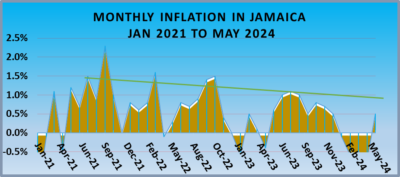
Inflation in Jamaica for May 2024 was 0.5 percent, down from 0.6 percent in May 2023 according to the Statistical Institute of Jamaica (Statin) computed All Jamaica Consumer Price Index. The five months of deflation for 2024 comes in at negative 1.3 percent.
Statin also stated the upward movement was due mainly by a 1.1 percent rise in the index for the heaviest weighted division of Food and Non-Alcoholic Beverages.
The point to point inflation fell marginally over the past 12 months to 5.2 percent, down from 5.3 percent in April and roughly at the mid-point of the target range of four to 6 percent set by the government of Jamaica for the country’s central bank to attain.
Importantly, Statin said that Food and Non-Alcoholic Beverages (3.9 percent), ‘Transport’ (9.7 percent) and ‘Housing, Water, Electricity, Gas and Other Fuels’ (3.8 percent) were the major contributor to inflation in the past 12 months.

BOJ’s policy pushes Jamaica into deflation

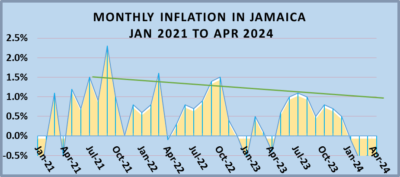
The inflation continues to moderate at a rapid pace, with the latest report out of the Statistical Institute of Jamaica reflecting a fall of 0.7 percent for April, following the decline in March 2024 of 0.5 percent bringing the year over year inflation to around 4.8 percent from 5.6 percent in March, still within the BOJ target of 4-6 percent but to the lower end of the target.
The 2024 calendar year inflation is now negative 1.9 percent and seems set to push inflation to zero by the end of summer after the months when inflation tends to rise above norms.
According to Statin, downward movement in the CPI for April was due mainly to a 2.3 per cent decline in the index for the ‘Housing, Water, Electricity, Gas and Other Fuels’ division as a result of lower electricity, water and sewage rates. Also contributing to the fall in the inflation rate was a 0.6 per cent fall in the index for the division, ‘Food and Non-Alcoholic Beverages’.
Bank of Jamaica (BOJ) based there focus wrongly on past inflation rather than currently what is happening is placing the country into dire straits as month by month inflation has cooled from several months ago and deflation is what appears to be taking place now.

Jamaica’s inflation plunges but BOJ cautious

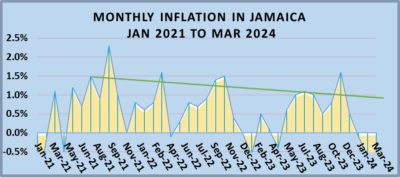
The Statistical Institute of Jamaica reported negative inflation of 0.6 percent for March, for a second consecutive month and point to point inflation of 5.6 percent to the year to date and follows and negative inflation of 0.6 percent in February and negative 0.10 in January.
With most businesses having granted healthy wage increases in 2022 and 2023, this publication does not expect there to be much wage pressure on inflation this year. With the inflation rate for the first three months of the year now at negative1.3 percent, which could climb even more in April, the increases in the summer months that usually flow from farm produces is likely to wipe out the gains in the early months but that should set the stage for the point to point to continue to trend to the lower end of BOJ’s mandate of 4 to 6 percent.
Bank of Jamaica has taken note of the inflation outturn in March 2024. According to a released by the central bank, “the 12-month point-to-point inflation (March 2023 to March 2024) was 5.6 per cent, which is within the Bank’s target range. The Bank welcomes the reduction in headline inflation, which was 0.6 percentage points lower than the 6.2 per cent point-to-point inflation rate for the period February 2023 to February 2024 and also lower than our most recent forecast”.
“The Bank notes that this is the second consecutive month of decline in headline inflation, which is a positive development, and the first time that the inflation outturn was within the Bank’s target range since October 2023.”
The bank went on to state “the analysis of the inflation numbers shows that the downward movement in the Consumer Price Index, for March 2024 was largely influenced by a 1.8 per cent decline in the index for the heaviest weighted division, Food and Non-Alcoholic Beverages. While the Bank had anticipated a decline for this division, the contraction was larger than expected and reflected reductions in the prices of some agricultural produce, such as tomato, yam, sweet potato, cabbage and carrot.”
“The Bank’s Monetary Policy Committee will continue to closely watch the inflation numbers and other incoming data over the ensuing months to assess the extent to which the current level of inflation will be sustained, before making a  determination on whether to change the Bank’s monetary policy stance’ the statement concluded.

Jamaica’s Unemployment dives to 4.2%

Jamaica’s unemployment rate dropped to a record low of 4.2 percent in October last year and is down compared with the unemployment rate at 4.5 percent in both April and July 2023, data from the Statistical Institute of Jamaica show.
The number of employed persons in October 2023, rose to 1,320,400, marginally up from 1.3151 million persons in July last year and 1.3126 million in April. The data shows that in October 2023, there were 57,300 unemployed persons in the labour force.