Treasury bill rates are continue to decline with the latest ones falling ones continuing the trend once more. Rates are down 20.6 percent on the 182 days Treasury bill notes since September last year or 165 basis points.
Rates on the latest issues of Treasury bill that were on offer on Wednesday September 16th, continued a slow decent since the start of 2015 but a much steeper decline form March last year. 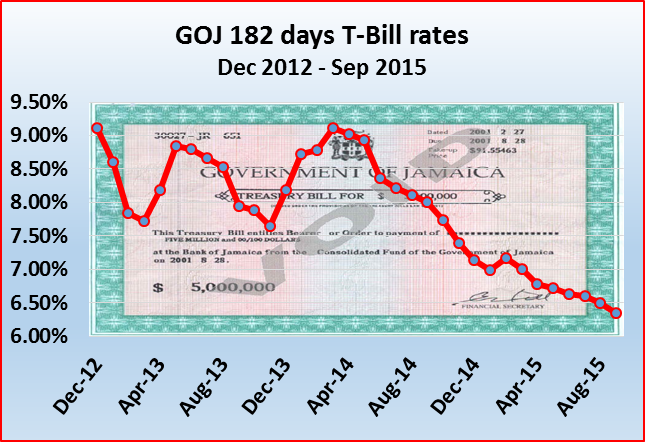 The two offerings for $400m each attracted bids for $721.8 million for the 91 days instrument and $786 million for the 182 days instrument, down from over $940 million each in August.
The 91 days instrument cleared at an average of 6.2 percent down from 6.352 percent at the August auction, with bids between 5.99 percent, to 6.3 percent being fully accepted. The 182 days yielded an average 6.35 percent down from August’s average of 6.49 percent. Bids between 6.2 to 6.4 percent, were fully allotted. Earlier, at the September 9th auction, the 28 days Treasury bill average rate came out at 6.228 percent after $707 million chased $400 million on offer.
The declines for the September issues come against the back ground of Bank of Jamaica cutting by 0.25 percent, its 30 days CD rates in August to 5.25 percent.
21% fall in Treasury bill rates in a year
IMF – J$ may still be overvalued
 The International Monetary Fund (IMF) is saying that the Jamaican dollar could be overvalued by as much as 19 percent to a moderate rate of 2.1 percent depending on the methods used. The fund also suggest that other methods show an undervaluation of up to 13 percent as well, based on the fall in the price of oil on the world market.
“Preliminary analysis based on the Fund’s EBA-lite and CGER models does not offer clear evidence ofeither over- or undervaluation, after two years of exchange rate adjustment and an important current account adjustment. Safeguarding the gains in competitiveness will be critical in an uncertain global environment. The increased flexibility in exchange rate has been instrumental in improving competitiveness and strengthening the external position. Continued exchange rate depreciation remains necessary given the ongoing inflation differential with trading partners, the risks to competitiveness from a possible upswing in oil prices, and the recent strengthening of the US dollar”, the IMF reported.
 The IMF stated, “the macroeconomic balance (MB) and the external sustainability (ES) approaches suggest that the Real effective exchange rate (REER) is undervalued (at 11.5 and 12.6 percent) while, the equilibrium real exchange rate (ERER) and the purchasing power parity (PPP) approaches point to some remaining overvaluation (of 19.4 per cent and 14.4 percent respectively). A key assumption for the MB and ES estimates is that oil prices will recover only gradually and partially from their recent decline, thereby supporting the projected improvement in the current account balance. The confidence intervals are very large for all the estimates and, statistically, zero misalignment cannot be rejected. The results of the EBA-lite methodology, which estimates the gap between the current account balance and its norm for 2015, suggest a slight overvaluation” of 2.1 percent. These overvaluation amounts would require adjustments for inflation differential between Jamaica and our main trading partners, which could mean roughly a 5 percent adjustment to the rate of exchange.
Cut the civil service – IMF message
 Debt servicing cost, wages and related expenses are two big items that have prevented the Jamaican government from performing the role of government the way they ought as money expended on the excess staffing and by and large part of the debt servicing are non-productive expenditure that divert funds from areas of need. It is therefore not surprising that the International Monetary Fund (IMF) has placed a great deal of focus on these two areas in getting the government to reform the system and move the country intro economic equilibrium. The Fund is of the view that in spite of the move to contain the wage bill by constraints and attrition, more is needed to be done to restore balance in this area.
“Public sector reform is a key pillar of the fiscal consolidation effort over the medium term. The authorities aim to reduce the wage bill from a projected 9.9 percent of GDP in fiscal year 2015/16 to 9 percent of GDP in fiscal year 2016/17. To date, much of this lower spending has been driven by nominal wage freezes, and authorities aim to secure continued moderate wage increases in the context of the ongoing wage negotiations, mindful of the trade off with other spending priorities. There is, however, a need to refocus attention on modernizing the public sector and transitioning toward a smaller and more effective civil service”, the IMF review report says.
The target is steep a cut from 9.9 to 9 percent is a 10 percent change. The wage settlement for 2015 is 4 percent and if all of that was paid in the current fiscal year it would require nominal gross domestic product to rise around 5 to 6 percent. With inflation looking very subdued and real growth not looking robust, the target is likely be a big challenge. The other issue is that even if the government were to achieve the target is, will maintaining it be sustainable long term? The government can cut the number of workers and the wage bill by divesting some services rather than lay workers off.
IMF wants more in NIR
The central bank should also continue purchasing international reserves to provide insurance against external risks , particularly since reserves fall short of the Fund’s metric for reserve adequacy, the International Monetary Funds (IMF) states in the March assessment on Jamaica performance under the fund agreement.
The external risks are related to PetroCaribe inflows and the imminent U.S. monetary tightening, the IMF said.
“There was broad agreement on the need to replace, over time, borrowed reserves with owned reserves. The results from applying the IMF metric for Assessing Reserve Adequacy show that Jamaica’s level of international reserves, at 80.4 percent of benchmark in 2015, is still significantly below the suggested adequacy range of between 100 and 150 percent, pointing to the need for continued exchange rate flexibility”, the IMF report on Jamaica stated.
bringing the amount to 100 percent of the desired level would mean bring the amount close to US$3 billion and 150 percent would take it within the US$4 billion mark.
Remittance inflows flat in May
 Total remittance inflows for Jamaica for May this year was just barely up over May 2014, increasing by less than a million dollars to end the month at US$190 million over the corresponding month last year.
Net remittance flows did better, with US$175 million realized, an increase of US$4 million or 2 percent over the corresponding period of 2014. For the first five months of 2015, total remittance inflows amounted to US$905 million, an increase of US$18 million or 2 percent over the similar 2014 period. Net remittances for the first 5 months of the year were US$812 million, an increase of US$16 million or 2 percent over the 2014 period, Bank of Jamaica reported.
US$316M import drop exports down $81m

Import of buses for JUTC added to the Jamaica’s imports to May.
The shifts in exports and imports resulted in the merchandise trade deficit falling sharply by 13.4 percent to US$1.52 billion. The deficit was US$1.76 billion in the similar 2014 period. Imports for the current 2015 period amounts to US$2.09 billion, while earnings from exports amounted to US$565 million, a fall of 12.5 percent from the previous 2014 period.
Imports for the year to May were down sharply for many of the category of goods imported. Imports of Raw Materials and Intermediate Goods amounted to US$1.124 billion, a decline of US$354 million, down 24 percent. Consumer Goods rose by 5.9 percent or US$38 million to US$684 million, Imports of Food and Beverages fell by 1 percent to US$275 million. Capital Goods excluding Motor Cars accounted for US$216 million of imports, up from US$214 million in the comparable 2014 period. ‘Other Industrial Transport Equipment’ increased by 2.4

Mining sector exports rose a bit
Major Traditional Domestic Exports were flat at US$350 million, compared to the same period in 2014. “Mining and Quarrying” grew by 4.7 percent or US$12.9 million to US$288 million during January to May 2015. ‘Bauxite’ rose by US$5.3 million or 10 percent to US$58.3 million. Agriculture earned US$9 million, compared to US$10 million earned in the January to May 2014 period.
Non-Traditional Domestic Exports earned US$193 million, 27.7 percent or US$74 million less than the similar period in 2014. All the sub-groups registered declines.
GOJ collects more spends less
 The government of Jamaica spent less on interest, capital projects and collected more tax revenues but received less grants from April to July this year.
This development resulted in the actual deficit being $8 billion less than budgeted.
Tax revenues were $3 billion more than planned and grants $1.5 billion less than expected but interest cost mainly of foreign debt resulted in savings of $4 billion while $4.3 billion less was expended on the capital projects. The critical primary surplus was $4 billion ahead of forecast of $23.7 billion.
Big drop in Business Confidence
The perception of present and future business conditions fell sharply in the latest survey conduction on behalf of Bank of Jamaica in July. Deterioration was registered in both surveys among respondents relative to the previous survey.
 Notably, the index of present business conditions fell sharply to 130.3 from 166.9 in the previous survey. The index of future business conditions declined to 135.2 from 148.3 in the previous survey.
The result for July is the worse since September 2014 at 123.6 for current conditions and August 2014 for future business conditions at 119.4. Both confidence levels have broken the upward movement by breaking the trend line going back to October 2013, a negative sign, suggesting the likelihood of further declines ahead. The negative development seems to be showing up in the performance of the local stock market which has stagnated over the 108,000 points on the all Jamaica Index, in spite of a fall in interest rates initiated by the country’s central bank.
 Notwithstanding, the declines in the recent indices of perceptions of present and future business conditions, they have displayed a general upward trend since the April 2013 survey, bank of Jamaica stated in the report. Of course that upward trend is now broken as indicated above.
The drop in the confidence levels is probably tied in with the depreciation of the Jamaican dollar in during June and July. At the start of June the exchange between the Jamaican dollar and the US was $116.13 reaching $116.98 at the end of the month and closed out July at $117.42.
Jamaica economy crawls slowly
 Real GDP is assessed to have expanded within the range of 0.5 percent to 1.5 percent for the June 2015 quarter by Bank of Jamaica, Governor of the bank, Bryan Wynter, said today.
The bank said the estimated outturn for the review quarter, “mainly reflects continued expansion in Mining & Quarrying, Hotels & Restaurants, Transport, Storage & Communication, Construction and Wholesale & Retail Trade”. There were estimated declines in Agriculture, Forestry & Fishing reflecting the impact of the intensification of dry conditions which started in the March 2015 quarter.
Given the anticipated impact of drought conditions, for FY2015/16 real GDP is forecasted to expand within the range of 1.0 per cent to 2.0 per cent. This projection is contingent on recovery in the mining and manufacturing sectors, assuming there is no recurrence of the production disruptions which occurred in the previous fiscal year. In addition, the economy is projected to continue to benefit from improvements in the business environment, consumer and business confidence as well as continued gains in external competitiveness.

New units being built at Montego Freeport in Montego Bay this year.
Repo rates hiked in Trinidad
 The central bank of Trinidad and Tobago raised the ‘Repo’ rate for a sixth consecutive time by 25 basis points to 4 ¼ percent. The Central Bank’s Monetary Policy Committee (MPC) announced on July 31st, that at its July 2015 meeting it was agreed to lift the repo rate.
The Repo rate increased by 150 basis points since September 2014, but this is still below its longer-term average, the release from the bank stated. The MPC, therefore, views the monetary policy stance as supportive to economic growth.
The MPC said it based its latest decision on three factors. The first and most influential factor was recent forward guidance by the US Fed on the start of normalization of U.S. monetary policy. The second factor was the potential for domestic core inflationary pressures to pick up over the next few months. The third factor was weaker-than-anticipated growth in the non-energy sector in the first half of 2015, this latter reason seems odd as increased rates are likely to worsen the output of the sector.
Locally, rising inflationary pressures remain a concern for the MPC. Headline inflation held steady at just over 5 ½ percent in June 2015, while core inflation slowed marginally to just below 2 percent. However, the MPC expects inflationary pressures to pick up in the remaining months of 2015 due to a number of factors:
 • Food inflation accelerated for the first time in 2015 spurred by rising input costs (specifically poultry) and falling supply associated with the outbreak of a pest in the Dominican Republic, a major source market for fruits and vegetables. In June 2015, food inflation rose to 9.7 percent. The advent of the rainy season raises the possibility of flooding and may lead to additional disruptions to domestic agricultural supply, further pushing up food inflation, which drives headline inflation.
• Consumer credit continues to grow at a fairly strong pace, increasing by 7 ½ percent in May 2015. Recently concluded public sector wage agreements are expected to lift consumer spending and inflationary pressures.
• Central Government maintained an expansionary fiscal stance in the first eight months of 2015. Capital expenditure, in particular, increased by nearly 9 ½ percent due to a pick-up in the pace of project implementation as well as the settlement of some outstanding commitments. The MPC expects public spending to ramp up in the remaining four months of fiscal 2015, boosted by higher public sector wages and ongoing capital infrastructure projects ahead of the general elections.
Despite slower -than- expected- growth in the non-energy sector in the first half of 2015, the MPC anticipates a respectable performance in the non-energy sector in the second half of 2015.
With liquidity levels falling to a daily average of $3.2 billion over the past three months (May – July 2015), the MPC agreed to continue with an aggressive programme to absorb excess liquidity and strengthen the impact of higher interest rates throughout the financial system. Commercial banks’ median prime lending rate increased to 8 ¼ percent in July 2015 from 8.00 percent in May 2015. Commercial banks are expected to further increase their interest rates in coming months.
The movement in rate is having a negative impact on the country’s stock market with prices slipping in recent weeks with few days of advancing stocks being more than declining ones and 11 trading days with the main indices being down between the August 3 and 21.