 Growth is projected to increase over the medium term, the International Monetary Funds (IMF) is projecting for Jamaica.
According to the Fund in their review of Jamaica performance under the IMF agreement “Growth for Financial year 2016/17 is revised down to 1.7 percent, largely reflecting the slower-than-expected increase in investment. Agricultural recovery is expected to contribute to a third of the real growth for the fiscal year, in addition to a recovery in manufacturing and sustained growth in BPO, tourism, and trade. Over the medium term, growth is projected to gradually rise to around 2¾ percent, as large transportation and energy infrastructure projects come to fruition and planned structural reforms raise private investor confidence and investment.”
IMF predicts 1.7% growth for Jamaica
Prices up during May in Jamaica
 Prices mostly rose in May resulting in Jamaica experiencing an inflation rate of 0.2 percent for the month over April this year with the calendar year to date figure still showing no signs of higher prices overall, with negative inflation of 1.4 percent, data from the Statistical Institute of Jamaica (STATIN) reveal.
According to STATIN, the main contributors to overall upward movement in May, were Food and Non-Alcoholic Beverages up by 0.1 percent, Housing, Water, Electricity, Gas and Other Fuels up by 0.6 percent and the Transport division advancing by 0.8 percent. The point-to-point movement, that is, inflation for the past year, is 2.1 percent.
“Mainly impacting the index for the division Food and Non-Alcoholic Beverages are increases of 0.1 percent and 0.3 percent in the index for the groups, Food and Non-Alcoholic Beverages respectively.
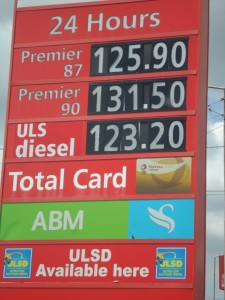
Petrol added to inflation in May
Other areas of price increase are, Alcoholic Beverages and Tobacco 0.1 percent, Clothing and Footwear 0.3 percent, Furnishings, Household Equipment and Routine Household Maintenance 0.3 percent, Health, 0.1 percent, Recreation and Culture 0.1 percent and Miscellaneous Goods and Services 0.2 percent. There were no increases for Education, Communication, Restaurants and Accommodation Services.
Bank of Jamaica cuts interest rate
BOJ sold US dollars into the system on Monday
The rate was last reduced from 5.50 percent to 5.25 on August 18, 2015.
According to the central bank “the adjustment to the signal rate reflects the Bank’s assessment that the inflation outlook for the fiscal year 2016/17 will continue to be favourable and is expected to be within the lower half of the 4.5 percent to 6.5 percent target range for the fiscal period. Although growth has been weaker than expected, macroeconomic indicators have been reflecting generally positive trends. Inflation expectations remain firmly anchored in single digits, international reserves are above adequacy levels, the current account of the balance of payments is projected to be at a sustainable level, private sector credit is expanding, market interest rates have been trending downwards and the fiscal accounts continue to be strong.”
The reduction follows falls in Treasury bill rates that are now just ahead of the pre adjusted CD rate.
TT$ drops 4.7% with US$ shortage
 Jamaica is not the only country in the Caribbean undergoing exchange rate adjustment. Trinidad and Tobago that has had a long period of steady exchange rate versus the US dollar is now seeing its currency lose value.
At least one company, National Flour Mills speak of shortage of foreign currency to do their business.
While devaluation has been commonplace for some time in Jamaica, the country’s neighbor, Trinidad and Tobago who have had seen a steady exchange rate versus the US dollar for years, at around $6.30 has now seen a near 5 percent devaluation of their currency with the rate falling from $6.32 in October last year to $6.63 currently for a devaluation of 4.7 percent against the United States currency.
The rate could slip even more, with the price of oil on the world market below US$50 a barrel starving the country that is highly dependent on oil revenues to fuel its economy, coupled with high levels of inflation over a number of years while the exchange rate remained stable.
Jamaican dollar has lost close to 5 percent in its value this year against the United States dollar, taking the exchange rate over $125 to the US even as inflation for the year to date is negative. Since the start of 2015 the local dollar has fallen from $114.66 to the current rate of $125.43 a decline of 9.4 percent and beating the rate of inflation for the same period by 8.5 percent.
T-bills spurned by investors
Investors spurned the latest issues of treasury bills with two of the four offerings for the month being heavily under subscribed and with the yields rising, albeit modestly.
 All four issues had offerings of $400 million each but while the 30 days instrument received bids of $474,943,600 and ended with a yield of 5.37 percent the same level as the previous issue, the 91 days received $508,470,400 at a yield that rose from 5.65 percent to 5.80 percent, the 181 days received just 366,081,700 with the yield rising from 5.82 percent to 5.91 percent and the nine months instrument saw just $167,987,400 and enjoyed an average yield of 6.414 percent.
The rates are slightly ahead of the Bank of Jamaica’s 30 days CD rate of 5.25 percent which has been in place since 2016. With inflation for the first four months of the year at negative 1.7 percent it seems that the central Bank’s inflation target of 5.5 percent is far too high and should be adjusted down and with it a lowering in the CD rate.
Remittances down in January
 Remittances into Jamaica for January, this year declined compared the similar month in 2015, a report on remittance flows out of the country’s central bank shows.
Gross inflow for the month was US$6 million of or 3.6 percent off the intake in January 2015 to end up at US$160 million.
Remittance outflows amounted to US$22.4 million which was 18.7 percent higher than the $19 million that went out in the 2015 period. The combination of the inflows and increased outflows resulted in net total inflows of US$138 million, representing a decrease of US$9.5 million or 6.4 percent, relative to the corresponding period of 2015. The decline is the only January that there has been a decline from since inflows fell in 2009 below the intake for January 2008.
Services employed more Jamaicans

Jamaica’s unemployment rate declined in December last year, compared with the same period in 2014, as 31,400 persons more persons obtained employment than in 2014, according to data recently released by the Statistical Institute of Jamaica (STATIN).
Persons gaining employment went mostly in the Occupational group ‘Service Workers, Shops and Market Sales Workers’ with an increase of 15.9 percent or 34,700 persons, from 218,300 in December 2014 to 253,000 in December 2015, STATIN stated in their latest report on employment in Jamaica. The group ‘Elementary Occupations’ increased by 20.6 percent from 137,100 persons in December 2014 to 165,300 persons at the end of 2015.

Construction sector employed more in late 2015.
The largest increase in the number of employed persons by Industry occurred in the groups ‘Wholesale & Retail, Repair of Motor Vehicle & Equipment’ and ‘Construction’ with an increase of 14,200 persons or 6 percent, while the group ‘Construction’ increased by 9,800 persons (12.9 percent).
Employment in the industry group ‘Agriculture, Hunting, Forestry & Fishing’ declined for the period moving from 199,600 in December 2014 to 194,000. Manufacturing suffered a decline of 5,200 persons (6.6 percent).
Unemployment edge down
 The unemployment rate for December 2015 for Jamaica edged down to 13.3 percent, a 0.9 percentage point decrease, compared to 14.2 percent in December 2014.
The number of unemployed persons decreased by 9,900, from 188,000 in December 2014, to 178,100 in December 2015, the Statistical Institute of Jamaica reported in April.
While the unemployment numbers decreased by just under 10,000 persons, more Jamaicans gained employment than the fall in the unemployed numbers. A total of 31,400 persons obtained employment in December 2015 over the similar period in 2014, resulting in 1,163,600 employed persons in the work force said by the STATIN to be 1,341,700 persons as of December 2015. In December 2014, a total of 1,132,200 residence in Jamaica were said to be employed.
Watch their money not their words
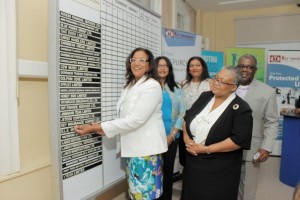
Natalia Gobin-Gunter Chairman and Deputy Managing director inserting name strip to indicate listing of Key Insurance on the junior market.
The survey findings of carried out amongst Jamaica’s business executives, show wild swings in their views on current conditions since the start of the data in 2005, while the index of future business conditions was far more predictive of actual business developments. The attached chart shows this up quite clearly. Other findings of the survey also points out that the top management of the various companies were was off the mark when it came to inflation, interest rates and the rate of exchange of the local dollar. One of the clearest measures to test what the executives say and do, is a comparison of the sentiments on business conditions and the performance of the stock market.
When it came time for the business community to put their money where their mouth is, it turned out to be vastly different from what they were saying in the Business Condition Survey. One measure of the business community’s bet on the future, is shown in the attached graph. The graph shows future expectations are is much more aligned with future business conditions than with current ones.
 What the business sector did, reflected itself in a much smoother monthly movement than what they said about the future. When it comes to money, the stock market reflects what people are doing with their money as opposed to what they say. The chart shows the movement in the all Jamaica Composite Index, plotted against the two business surveys published by the country’s central bank.
The movement of the stock market seems a better predictor of future expectations, than the surveys, as shown by the smoother movement of the stock market compared with the sentiments data. What is also true, is that the future expectations and the stock market movements are fairly closely aligned with each other.
Prices down 1.3% in Jamaica’s Q1
 Prices as measured by the consumer price index fell 0.1 percent in March 2016 according to a report released by the Statistical Institute of Jamaica. For the calendar year-to-date there was a decline in inflation of 1.3 percent.
The fall in March was mainly due to sharp fall in the prices of Food and Non-Alcoholic Beverages that fell by 0.5 percent and was influenced by lower prices for Vegetables and Starchy Foods by 2.9 percent and 3.1 percent respectively. The category of Housing, Water, Electricity, Gas and Other Fuels fell by 0.1 percent and Transport by 0.4 percent. Reduced rates for water and sewage were chiefly responsible for the movement.
At the March 2016 quarterly media briefing, Jamaica’s Central Bank projection for 12-month inflation over the next four quarters, is between 4.5 percent and 6.5 percent.