 Legislation is ready to come to parliament to make the junior market tax incentive retroactive to April 1, this year to restore the incentive to its original benefits of 100 percent tax-free status for 5 years and 50 percent of the regular tax for the second 5 years, Minister of Finance, Audley Shaw recently.
Shaw made the announcement when he delivered the keynote address at the official ground breaking of the Allegheny Petroleum and Paramount Trading joint venture lubricant factory in July to be built at 39 Waltham Park Road in Kingston.
Benefits far out weight the loss in revenues given up by the government, Shaw said. He stated that while corporate taxes were foregone, government saw increased intake from other taxes as a result of the expansion of junior market companies. He indicated that GCT intake grew by 337 percent by junior market companies, with NIS, NHT rising by 100 percent.
“Shaw went on to state that the time for fooling around is long past” we must chart a course to a better future urgently and commended the thrust Prime Minister Holness was pursuing to focussing on growth in an aggressive way. He said that “with 13,000 new hotel rooms to come on stream over the next 5 years that an avenue is being provided for additional goods for the sector to be provided by local goods producers for the sector.”
Shaw commended the joint venture partners and stated that is what he expects to see with a more economically friendly environment that should encourage local production for exports or import substitution.
Junior market legislation draft ready
NIR shoots up in July
 Net International Reserves of Jamaica shot up by US$124 million in July, to end at US$2.39 billion. The build-up has taken place over the period when bankers purchased US$100 million more than they sold, with the amount climbing to US$116 million up to the first week in August and US$124 million including Monday’s intake.
The reserves are just slightly below the amount of US$2.42 billion it was at the end of March at the 2016 peak, just before the central bank had to intervene by selling to the market with the reserves declining to a low of US$2.265 billion in June, just above the US$2.2 billion at the end of January.
With August being another month when inflows of foreign currency is high, the prospects are good for further build-up of funds in the system, before the end of the month and could place the country’s central bank in full control of the foreign exchange market in the months ahead before the next period of higher inflows starts in mid-December.
GOJ revenues grow faster than plan

Minister of Finance Audley Shaw
Revenues for the first quarter are running 11 percent or $12 billion ahead of the 2015 first quarter revenues. Recurrent spending dropped sharply by 8 percent against budget to hit $122.7 billion from a budget of $133.5 billion. The net result of the increase in revenues and reduced expenditure is a reduction in the fiscal deficit of just $7.5 billion, down by $26.8 billion projected.
Revenue in take for the two period is just over $9.2 billion or 15 percent ahead of the similar period for 2015. The primary surplus that was budgeted at $11 billion is now at $26.8 billion.
Tax revenues jumped 7.8 percent or $7.9 billion over forecast with the excess over budget flowing mainly from the following, corporation tax of $1.66 billion, PAYE $457 million, local GCT $2.4 billion, local stamp duty $680 million, education tax $300 million. GCT on imports accounted for $1.5 billion of the excess inflows while custom duty chipped in with $422 million but travel tax fell by $380 million.

Collector of Taxes office, Constant Spring, Kingston.
The increase in revenues is in keeping with a trend seen in the first 9 months of 2015 when revenues were growing well ahead of forecast.
The savings in the cost of debt servicing, plus the increased revenues above budget, translate to $11.8 billion or $47 billion over a full 12 months, should the trend continue, well in excess of the cost of the tax break agreed for personal income tax.
Crude oil falls set for more losses
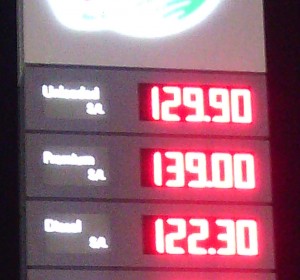
Fuel prices at the pumps in May 2015.
Excess inventories said to be near the 97-year high reached in April and increased drilling has pushed the price down to US$40 per barrel on Monday. Technical indicators point to a fall to the low, between US$35 to US$30, before too long.
Increased drilling and the rise in supplies will add more downward pressure on prices going forward, it will take a very long time for inventories to normalize. Added to this, is the pressure that investors have placed on prices, as they continue to sell oil short, at an increasing pace.
For every US$1 fall in the price, Jamaica will save approximately US$9 million per year. The fall back of oil prices will result in lower electricity and transportation cost for the majority of the region and boost companies profits.
Tourism Jamaica’s #1US$ earner

Tourism is Jamaica’s largest earner of foreign exchange.
During the period of 2008 to 2015, the three main areas of foreign exchange earnings have switched positions between themselves, but since 2012 tourism has been the number one source of inflows and is widening the gap.
Tourism brought in US$1.98 billion in 2008 and remittances US$2 billion. Remittances grew by 10 percent to US$2.2 billion in 2015 over 2008, while tourism was up 18.8 percent to US$2.4 billion. In 2015 tourism inflows grew by 6.4 percent in contrast to the 3 percent increase in remittances. In 2014 tourism inflows grew by a strong 8.7 percent over 2013.
While remittances and tourism have been growing since 2008, exports of goods have gone in the opposite direction with 2015 exports falling to US$1.27 billion versus US$2.974 billion for 2008 for a decline of 54 percent. If the growth trend in tourism inflows continue at the 2015 pace, the sector will exceed the earnings by exports of goods in 2008 by 2018.
Jamaica’s remittances up 10%
 Jamaica enjoyed a strong 10.4 percent growth amounting to US$17.2 million in net remittances in April 2016 to reach US$184 million compared to April 2015. The growth reflected an increase in gross remittance inflows buttressed by a slight contraction in remittance outflows.
Gross remittance inflows for the month were US$203 million, an increase of US$15.5 million or 8.3 percent versus the similar period last year. While the April’s increase climbed sharply over 2015, net inflows for the first 4 months of the year is up just 3.5 percent, reflecting swings in the rate of growth for various months, with January suffering a contraction of 6.4 percent and March rising by just 1.5 percent.
Net remittances for the first four months of 2016 were US$22 million or 3.5 percent above the 2015 period, to end at US$660 million, flowing from an increase in gross inflows, partially offset by an increase in outflows. Total inflows were US$740 million, an increase of US$25 million or 3.5 percent.
In 2015 total remittance inflows, amounted to US$2.23 billion or 3 percent ahead of the amount generated in 2014.
Business confidence set to recover
Business confidence levels dipped in May this year, as measured by the Bank of Jamaica Perception of Present and Future Business Conditions survey and by the stock market movements. The local stock market has since rebounded and is close to its historic peak at Mid July, an indication that business confidence levels are set to rebound when measured in the summer months.
 No new data is out from Jamaica’s central bank, of the latest levels. With the stock market having been rebounding, government fiscal program ahead of target and the Jamaica dollar settling down recently, the prospect of a rebound in survey numbers seems to be on the cards. Historical data indicate that the stock market is one of the best measure of business confidence levels, with the chart showing how closely the market index tracks the movement of future business confidence.
According to the survey findings, the perceptions of both present and future business conditions moderated compared to the record highs of the previous two surveys (see chart). Notably, the index of present business conditions fell 6 percent to 213.1 from the 226.1 attained in the previous survey. The index of future business conditions declined more slowly than the current measure by 2.6 percent from 171.5 in the previous survey to 167.1.
Both indices reflected declines in the proportion of respondents of the view that conditions were or will be “better.” In addition there were increases in the number of respondents indicating that conditions were or will be “worse.” There was, however, an increase in the proportion of respondents that indicated that conditions were or would be ‘about the same’ for both indices.
Huge increase in Government revenues
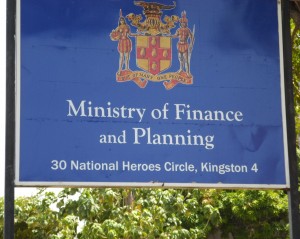 Government revenues jumped by nearly 6 percent over budget for the first two months of the fiscal year to May, while payments dropped sharply resulting in the fiscal deficit of just $4 billion for the two months, down by $11 billion projected.
Revenue in take for the two month period is just over $9.2 billion or 15 percent ahead of the similar period for 2015.
Tax revenues jumped 6 percent or $3.8 billion over forecast, flowing mainly as a result of an increase of, $530 million in withholding tax on interest, local GCT amounting $1.26 billion, stamp duty of nearly $500 million and GCT and special consumption tax on imports of $1.1 billion.
Interestingly, the increase is taking place with little input from the new taxes government implemented in May this year.
On the expenditure side, interest cost fell by $1.5 billion and normal housekeeping expenses is down by $3.4 billion while the wage bill moved up by $966 million. Capital spending was under, by $3.2 billion, with only $1.6 billion spent by May. Information, gleaned indicates that much of the under spending is due to a slow start to the fiscal year, with June spending expected to catch up.
The increase in revenues is in keeping with a trend seen in the first 9 months of 2015, when revenues were growing well ahead of forecast. Total revenues are up 21 percent or $5.9 billion ahead of the amount generated in April 2015 and 10 percent or $3.37 billion more in May this year, than for May 2015.
It early days yet, but if the trend on the revenue collection continues close to what is now being experienced, it would make it much easier for the government to meet some of the commitments they have, for 2017 onward.
Jamaica’s remittances up 7%
 Remittance inflows into Jamaica for February this year, climbed 7.3 percent to US$180 million for an increase of US$12 million compared to the corresponding month in 2015, while net remittances totalled US$161 million, representing an increase of US$12 million or 8 percent.
The expansion in net remittances for the month is a result of the increase in gross remittances, which was partially offset by a marginal expansion in remittance outflows from US$18.7 million to US$19 million.
For the two months period, total remittance inflows were US$340 million, representing an increase of US$6 million or 1.9 percent, while net remittances grew by just US$2.6 million to US$299 million after accounting for outflows moving from US$37.6 million in 2015 to US$41.3 million this year. The increase in February comes against the background of a fall in inflows of 3.6 percent in January, over the same period in 2015.
Jamaica could lose some flows from Britain, with the pound having fallen from around the 1.50 level to the US dollar for a great part of 2015, to just over 1.30 now. For 2015, according to data from Jamaica’s central bank (Bank of Jamaica), remittances from the UK amounted to US$347 million, as such this year’s fall in the pound could cut inflows from the UK by US$25 to US$30 for 2016 and as much as US$50 million in a full year, if the rate remains depressed.
No new taxes for Jamaicans
Collector of Taxes office, Constant Spring, Kingston.
Based on developments on the fiscal operations this fiscal year, it seems that government was well on the way to enjoying a bumper reaping in 2016/17 fiscal year of higher revenues and lower interest cost that seemed adequate to meet the proposed tax break of the tax free $1.5 billion.
With the first quarter revenues and expenditure in the data is confirming what I was saying and is indicating that the naysayers are far from as informed as some would want the public to believe. What the early data is suggesting is that the economy seems to be performing better than in recent past and more importantly, that there was no need for any new taxes for this fiscal year and none will be needed to fund the rest of the personal tax break to be effected in 2017/18.
The simple reason is, savings on interest cost, with lower interest rates on government debt and an 11 percent rise in revenues over the 2015 intake, equal to an 8 percent increase above budget for the current fiscal year, will translate to $46 billion in added revenues and interest savings over the planned amounts. That will be more than enough to fund the increase tax break to come and to do without the NHT special payment. But that is not all if positive economic growth continues into 2017 revenues will rise some more probably with an additional $30 billion.
What the data is showing, is that the country has been failing from lack of thinking outside familiar territory.