Treasury bill rates declined to the lowest level on record, in the latest auction of bills on Wednesday this week. Information out of the country’s central bank in March indicates that there are no records with lower rates.
Rates for the $700 million 182 days instrument on offer fell below 3 percent for the first time with the average ending at just 2.979 percent and the 91 days bill ended at an average slightly above 2.818 percent for the $700 million that was also on offer for the shorter duration.
A total of $2.56 billion chased after the amount offered for the shorter dated issue, while a total of $2.92 billion chased the amount for the longer dated issue.
In March, rates fell to 2.977 percent for the 91 days bill, as $2.54 billion went after $600 million offered and the 192 days closed at an average of 3.172 percent with $2.48 billion going after $600 million offered.
T-bill rates lowest on record – April
Deflation for Jamaica’s Q1
Prices declined for another month in Jamaica, according to data just released by the Statistical Institute of Jamaica (STATIN) but prices are still high than a year ago.
Statin stated that the All Jamaica Consumer Price Index declined for the second consecutive month as a negative 0.1 percent inflation rate was recorded for March 2018. The main contributor to this movement was the 1.0 percent fall in Food and Non-Alcoholic Beverages category, due to lower prices for agricultural produce resulting in a 4.3 percent reduction in index for the class Vegetables and Starchy Foods. Transportation recorded a decline of 0.4 percent for the period, resulting from lower fuel prices. Upward movement of a 3.2 percent in Housing, Water, Electricity, Gas and Other Fuels, primarily resulting from higher electricity, water and sewage rates help to negate the above mention declines. As at March 2018, the calendar year-to-date inflation was negative 0.2 percent and the movement in the index for the last twelve months is 3.9 percent.
Jamaica’s company taxes jump 23%
Corporate taxes continue to be a star performer for Jamaica government revenues, having increased their input by a strong 23 percent over forecast, to February.
According to the government fiscal report, businesses paid $34 billion in corporate taxes to February or just over $6 billion more than projected. In spite of that level of performance, PAYE contributed more in taxes, at $48 billion even as government raised the threshold to $1.5 billion for individuals and cutting around $25 billion in the individual tax bill.
Corporations will be making big payments in March that should hike the amount they will pay for the fiscal year to be well ahead of the February figure. The forecast at the start of the fiscal year, was for a total take of $50.6 billion compared to $46 billion for 2016. The forecast for 2018/19 is for an intake of $63.9 billion or an increase of 26 percent over the 2018 forecast. If the trend for the just concluded fiscal year holds to March, the projected increase for the new fiscal would be just around $3 billion.

Scotia Group to contribute most to 2017/18 corporate taxes
Other areas performing well above budget projections include, Travel taxes up by 12.5% to $17.5 billion, GCT on local goods and services 4.8 percent to $83 billion, Education taxes up 6 percent to $24 billion and special consumption taxes on local goods up 10 percent to $26 billion.
Listed companies will contribute around $21 billion to the corporate tax take for the just concluded fiscal year according to data taken from financial statements. The bulk of the listed companies’ contribution will come from Scotia Group with $5.7 billion, NCB Financial $5 billion, Sagicor Group $2.9 billion, Carreras just over $1 billion, Grace Kennedy around $1 billion, JPSCo and JMMB Group just under $1 billion. Other billion dollar contributors should include Desnoes and Geddes and Wray and Nephew.
PAYE out performing forecast
Collection of PAYE taxes up to February, is ahead of target by $1 billion, according to data put out by the Ministry of Finance.
This category of individual tax contributions, was projected to generate $47.3 billion but contributed $48.3 billion instead, up to February.
The out turn is quite remarkable when viewed against the out turn at the end of December when there was a shortfall of $1.24 billion. For 2018 up to February, PAYE pulled in $2.3 billion more than planned or just over $1 billion more, monthly.
The current government, raised the personal tax threshold on which no taxes are paid, to $1.5 billion over a two year period, starting in July 2016 with the first tranche, with the second portion implemented in 2017. The estimated cost for the measure was over $25 billion in the current fiscal year. The government announced increased taxes to fund the give back, but data for the last two fiscal years show revenues increasing well in excess of forecast, an indication that there was no fiscal need, to effect the tax increases that were made at the time of implementing the threshold hike. Ongoing buoyancy in government revenues would have more than compensated for taxes lost but IMF demanded the increases apparently to stave off inflationary pressures that would have arisen if the increase in take home pay was not neutralised.
BOJ holds policy rate
Bank of Jamaica maintains the policy interest rate at 2.75 percent, the central bank stated on Tuesday. The rate is paid by the central for the placement funds overnight placements with Bank of Jamaica and helps in guiding the setting of rates in the wider economy.
“This policy stance reflects the Bank’s assessment that headline inflation for the next eight quarters should remain within the target of 4 percent to 6 percent, with the risks assessed to be balanced. Over the next three quarters, inflation is expected to track close to the lower bound of the target, primarily reflecting a decline in food prices as a result of a recovery in agricultural supplies. Thereafter, headline inflation is expected to converge towards the centre of the target,” the central bank stated.

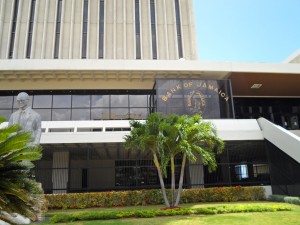
Jamaica’s Central Bank in downtown Kingston.
“The outlook for inflation continues to be underpinned by the expectation that the Government will maintain a strong fiscal performance in alignment with the fiscal rules. There remains a risk that GDP growth will be slower than anticipated given the influence of external events.”
Bank of Jamaica stated that the “decision to maintain an accommodative policy stance is aimed at supporting further credit expansion and faster GDP growth. When adjusted for expected inflation, the policy rate remains negative in real terms in a context of high liquidity in financial markets. These conditions are considered to be appropriate at this time given the weaker-than-desirable pace of credit expansion. The policy stance has supported downward adjustments to yields on medium and long-term GOJ bonds in recent times and these downward adjustments are expected to flow through to loan rates.
Jamaica’s macroeconomic indicators remain positive. Inflation expectations remain low and anchored around Bank of Jamaica’s target, international reserves are increasing, the current account of the balance of payments is low and projected to remain at sustainable levels, market interest rates are falling and fiscal performance continues to be strong.”
Sharp drop in Treasury bill rates
Interest rates on Government of Jamaica Treasury bills reached their lowest levels yet, in more than 50 years, with the March Treasury bill auction, resulting in the 42 basis point fall in the 182 days and 37.5 basis point decline in 91 days instrument.
The 91 day bills cleared at an average of 2.98 percent, down from 3.35 in February, the 182 days instrument ended at 3.17 percent, a fall from 3.593 percent from the average rate in February. The sharp fall comes against the background of negative inflation rate for the year to February. With no tax increase for 2018, the next few months could continue to see very low inflation. The current inflation data contradicts any notion that investors are getting negative interest on their funds currently.
Investors placed $2.54 billion in the auction of $600 million for the 91 days bill and $2.48 billion for the 182 days instrument for which $600 million was on offer.
The trend in the rates suggest there will be more decline ahead but the fall should be coming to an end soon.
The decline has implications for a wide array of developments in the wider economy and should herald a general fall in interest rates across the board over the coming months. Stocks, real estate investments will get a kick from the lower rates and the government is set to save billion in interest cost while the rate charge to the heavily indebted Cable and Wireless on the intercompany debt is set to fall sharply to under 6 percent when the rate is reset in May, resulting in billion dollar savings.
Deflation not inflation for 2018 so far
Jamaica for the second month for this year has shown moderation with Consumer Price Index for February 2018 decreasing by 0.1 per cent on top of a decline of a similar amount in January.
According to the Statistical Institute of Jamaica (STATIN) the February 2018 Consumer Price Index declined and resulted in the calendar year-to-date inflation rate declining by 0.2 per cent.
The decline for the month was attributed largely to two divisions, Food and Non-Alcoholic Beverages down by 0.5 percent and Housing Water, Electricity, Gas and Other Fuels down by 0.2 percent. Specifically, the movement for the division Food and Non-Alcoholic Beverages was primarily influenced by the 3 percent fall in the index for the group Vegetables and Starchy Foods. The decline in the index for the division Housing Water, Electricity, Gas and Other Fuels was as a result of the group Electricity, Gas and Other Fuels decreasing by 0.8 per cent due to lower rates for electricity. At the end of February 2018, the 12 months movement was 4.4 per cent and the fiscal year-to–date movement was 4 percent.
BOJ cuts rates again
Bank of Jamaica cuts the overnight policy interest rate by 25 basis points to 2.75 per cent effective February 2, the third reduction within three months.
The reflects the Bank’s assessment that inflation for the next eight quarters should remain within the target of 4 per cent to 6 percent and comes against the back ground of a sharp fall in Treasury bill rates last week, with sign of a fall to 3 percent before too long.
The central bank cuts the overnight rate to 3 percent in January from 3.25 percent that it was reduced to, in November last year.
The central bank stated that the “outlook for inflation reflects the expectation for continued fiscal consolidation in line with the fiscal rules. Recovery in the real economy continues to be sluggish even as projections show a modest acceleration in economic growth over the next two years. Inflation expectations remain low and broadly anchored around the Bank’s target.
One upside risk to inflation is that overheating in the US will support higher demand for Jamaica’s goods and services. Strong growth in the US may also prompt tighter monetary conditions there but the pass through of this effect to the domestic economy may be ameliorated by continued reductions in Jamaica’s sovereign risk premium.”
The Bank further stated that the “decision to lower the policy rate is aimed at supporting accelerated expansions in credit and economic output. The key macroeconomic indicators continue to reflect positive trends. International reserves continue to expand, the current account of the balance of payments is projected to remain at sustainable levels and the fiscal accounts remain strong. The persistence of excess liquidity conditions in the domestic money market also continues to signal reductions in market interest rates.”


Figures released by the Ministry of Finance, show that the operations to February, resulted in an overall surplus of almost $3 billion well above the projection of a deficit of $23 billion. The vast improvement arose from an $11 billion increase in revenues over budget, to reach $476 billion and less spending of $15 billion, with the latter benefiting from the late payment of increased salaries for the civil service. Revenues would have been far better but for tax refunds on interest that saw a reduction in inflows of more than $5 billion.