$50B surplus hikes Jamaican government spend

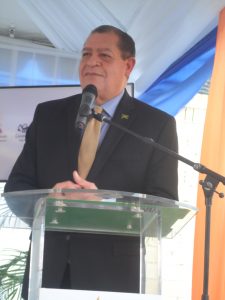
Minister of Finance Audley Shaw managed to create a huge fiscal surplus before planned increased spending in March.

Government of Jamaica would end up with a huge surplus for the 2017/18 fiscal year with revenues to February running well ahead of forecast and expenditure sharply lower than budgeted, but even with increased spending planned for March, the surplus could still be large.
Figures released by the Ministry of Finance to February showing a large surplus, the fiscal year was set to achieve a huge surplus around the $50 billion. The likelihood of this huge surplus resulted in government trying to spend as much as possible in March, to reduce the excess that has built up. One item that the government earmarked for payment to reduce the surplus funds to February, is the payment of the increase in civil servants’ salaries. Up to February, there was a shortfall of $6 billion in salary payments, which seems to represent mostly back payment for the fiscal year. Payment in March, would cut the under spending showing at the end of February to a $9 billion. The under spending includes interest cost being lower than planned that accounts for $5 billion of the under spent amounts.
In order to reduce the surplus sharply the revised estimates increased spending at $564 billion for the fiscal year, $42 billion more than the original forecast and would require spending of nearly $80 billion in March, if that were to be achieved, even with the back pay for civil servants being done in March that would be a big challenge with underspending to February with just 1 month that was left in the fiscal year, unless they were to clear up arrears of debt they have in the system.
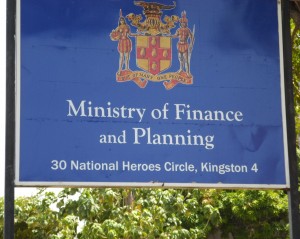
Figures released by the Ministry of Finance, show that the operations to February, resulted in an overall surplus of almost $3 billion well above the projection of a deficit of $23 billion. The vast improvement arose from an $11 billion increase in revenues over budget, to reach $476 billion and less spending of $15 billion, with the latter benefiting from the late payment of increased salaries for the civil service. Revenues would have been far better but for tax refunds on interest that saw a reduction in inflows of more than $5 billion.
The original projection was for revenues for the fiscal year to be $535 billion and expenditure of $537 billion with spending of $37 billion and revenues of $70 billion in March and that would have put the fiscal numbers into a balanced position, with the planned for a fiscal deficit in February.

Shaw’s abundance of riches

Minister of Finance Audley Shaw rolling in increased taxes.

Minister Shaw gave up $10 billion in payroll taxes last fiscal year and an estimated $13 billion again this fiscal year, but he ended up with a surplus of $11 billion for the year to March this year.
The GOJ approved increased spending in the second half of the year by $10 billion but still ended the year underspending the amounts allocated to be spent by $5 billion.
After a mere 5 months of the current fiscal year to August, the Minister of Finance has amassed a tidy $14.6 billion more than forecast for the government coffers.
According to data released by the Ministry of Finance, tax revenues are $11 billion higher than originally forecasted, thanks to 37 percent surge in corporate profit taxes, that added nearly $6 billion to the surplus, and $9 billion from indirect taxes, mainly local GCT and special consumption taxes.
Government operations (GOJ) raked in a small surplus for August, pushing the year to date surplus to $5.6 billion, after capital inflows of $11.4 billion, that was originally included in the budgeted forecast. The net position on GOJ operations, is $21.5 billion better than planned and pushed the primary surplus to $52 billion or $19.5 billion better than planned.
Interest cost ended $2 billion lower than projected and should enjoy even lower cost, going forward, with the recent cut in Treasury bill rates, by over 50 basis points.
GOJ revenues inflows have been extremely buoyant since the drop in budgeted inflows for the fiscal year to March 2015. While 2015 fiscal year came up short of budget by $16 billion with revenues at $412 billion, 2016 came in with $50 billion more than the out turn for 2015, at $456 billion and 2017 with total revenues of $514 billion, was $52 billion more than for 2016.

GOJ revenues beating estimates

Revenues for Government of Jamaica continue to outpace forecast, with the latest figures showing a 5.2 percent amounting to $17.4 billion increase over budget to December last year.
Revenues ended at $352 billion inclusive of capital inflows of $14.6 billion, compared with forecast of $334 billion. The main contributors company profit taxes and PAYE $2.4 billion each, and tax on interest, amounting to $2.8 billion. Special consumption taxes accounted for an increase of $2.3 billion, Education tax added $822 million, Stamp duties $1.3 billion and Custom Duties $1 billion. Travel and special consumption taxes and GCT on imports, cut $3.5 billion from forecast.
Capital spending is still running $5.4 billion below the target of $35 billion while other expenditure is under-spent by $3.7 billion, with wages down $5.2 billion and interest cost $3.9 billion, while other operating cost is up $4.3 billion over forecast.
The fiscal out turn, is a cut in the fiscal deficit by $26.6 billion, down to $23.7 billion.

Huge increase in Government revenues

MOFGovernment revenues jumped by nearly 6 percent over budget for the first two months of the fiscal year to May, while payments dropped sharply resulting in the fiscal deficit of just $4 billion for the two months, down by $11 billion projected.
Revenue in take for the two month period is just over $9.2 billion or 15 percent ahead of the similar period for 2015.
Tax revenues jumped 6 percent or $3.8 billion over forecast, flowing mainly as a result of an increase of, $530 million in withholding tax on interest, local GCT amounting $1.26 billion, stamp duty of nearly $500 million and GCT and special consumption tax on imports of $1.1 billion.
Interestingly, the increase is taking place with little input from the new taxes government implemented in May this year.
On the expenditure side, interest cost fell by $1.5 billion and normal housekeeping expenses is down by $3.4 billion while the wage bill moved up by $966 million. Capital spending was under, by $3.2 billion, with only $1.6 billion spent by May. Information, gleaned indicates that much of the under spending is due to a slow start to the fiscal year, with June spending expected to catch up.
The increase in revenues is in keeping with a trend seen in the first 9 months of 2015, when revenues were growing well ahead of forecast. Total revenues are up 21 percent or $5.9 billion ahead of the amount generated in April 2015 and 10 percent or $3.37 billion more in May this year, than for May 2015.
It early days yet, but if the trend on the revenue collection continues close to what is now being experienced, it would make it much easier for the government to meet some of the commitments they have, for 2017 onward.