 Employment in Jamaica jumped by 10,700 persons since the start of 2018, to 1,217,300 persons in April, and 14,700 more than the 1,202,600 recorded in April last year.
A total of 1,206,600 persons, were employed, in January 2018 this year data out of the Statistical Institute of Jamaica (Statin)shows.
The effect of the increase in the number of persons employed, is that the unemployment rate fell to 9.7 percent In April, compared to 12.2 percent in April 2017, but inched up slightly from the 9.6 percent recorded in January, this year.
“Among major occupation groups, the largest increase in the Employed Labour Force between April 2017 and April 2018 occurred in ‘Elementary Occupations’. This occupation group includes, among other jobs, car washers, street vendors and housekeepers in hotels. There were 174,900 persons employed in this occupation group in April 2018, an increase of 13,200 or 8.2 percent when compared with April 2017,” the Statin report showed.
Employment jumps 10,700 for 2018
GOJ rakes in $4 billion more taxes
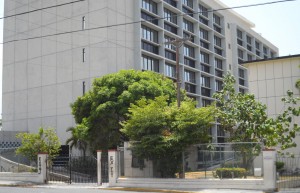
Jamaica’s Ministry of Finance newest office building
At the end of the quarter, the central government operations delivered a surplus of $6.5 billion with May and June enjoying surpluses of $4 billion and $8 billion respectively, but April suffered a deficit of $5.7 billion.
Expenditure fell $6 billion below the $128 billion projected. Interest cost ended at $25 billion or nearly $4 billion lower than planned and expenditure other than wages, came in at $3.6 billion lighter than the $48.6 budgeted. Grants received, fell $3 billion below forecast of $4 billion. The primary surplus set to end at $28.5 billion, ended instead at $31.34 billion.
Income tax collections bettered forecast by $3 billion, to reach $46 billion, while consumption taxes, rose nearly $2 billion above forecast.
Treasury bill rates plunged
 Treasury bill rates plunged at the latest auction to raise $1.4 billion for Government of Jamaica held today.
At the latest Treasury bill auction the rate on the 91 days bill declined by just over 58 basis points to just 1.9596 from to 2.544 percent at the June auction, while the 182 days instrument average rate dipped 65 basis points to 2.07 percent from 2.656 percent from the June Auction. The two offerings of $700 million each attracted a total of just over $6.2 billion up from $5.3 billion in June, an indication of continued high liquidity in the market. The latest fall in rate follows a recent 50 basis point drop in Bank of Jamaica’s (BOJ) overnight rate to 2 percent and is almost certain to trigger another cut in the BOJ overnight rate.
The continued fall in rates comes against the back ground of negative inflation of 0.3 percent for the first half of the year. The sharp fall in rates is bound to be reflected in increased demand for stocks and real estate going forward as investors seek higher returns on their investments. Technical indicators point to a big break out for local stocks starting in August and the recent fall in rates will be a critical fuel for it.
Inflation in June but deflation intact
 Jamaica recorded an increase of 0.4 percent inflation for June, leaving country still in deflation for the year to June at negative 0.3 percent and inflation for the last twelve months to 2.8 percent.
“Housing, Water, Electricity, Gas and Other Fuels, moved up by 1.2 percent, an upward movement in the rate for electricity resulted in the group ‘Electricity, Gas, and Other Fuels increasing by 2 percent.

The price of electricity helped spike inflation in June.
BOJ chops policy rate
 The overnight policy rate was chopped by an unusually large 20 percent by Bank of Jamaica (BOJ) to take effect on Thursday 28 June 2018, as local prices deflated for the year to May.
BOJ announced its decision to lower the policy rate by an above the more accepted 25 basis points by slashing the rate by 50 basis points to 2 percent. The falls also come as a result on the continued fall in June’s Treasury bill rates that had fallen just around the overnight rate and against a high level of liquidity in the financial system.
Bank of Jamaica’s decision to increase monetary policy accommodation reflects its assessment that, inflation over the June to December 2018 quarters is likely to remain below the target of 4 percent to 6 percent and that the previously projected increase in inflation towards the centre of the target in the March 2019 quarter is at risk of coming in at a lower level.
 According to the BOJ,” in March, April and May 2018, inflation fell below the lower end of the Bank’s inflation target of 4 percent to 6 percent.” Data released by Statistical Institute of Jamaica reported Jamaica as having recorded a period of deflation for the three months. BOJ also stated that “core inflation (measured by changes in the CPI excluding agriculture and fuel) has also been low, in the region of 2 percent to 3 percent. The main factors that contributed to inflation being lower than the target included a stronger-than-anticipated recovery in agricultural supplies following adverse weather shocks in 2017, lower-than-forecasted imported inflation (associated with an appreciation in the Jamaican dollar over the year to April 2018 and a reduction in the pass-through of oil prices to inflation) and weaker-than anticipated domestic demand.”
The Bank’s view on inflation for the remainder of 2018 is largely predicated on expectations for continued weak domestic demand, which is being constrained by tight fiscal policy and increased uncertainties about global trade. The assessment also reflects the expectation for agricultural food prices to remain low for longer than previously anticipated and the possibility that international oil prices could be lower than previously projected. In the medium-term, the Bank’s outlook for inflation continues to reflect a sluggish recovery in economic activity.
The decision to loosen the policy stance is aimed at fostering greater credit expansion and a faster pace of GDP growth which will support inflation returning to the target of 4 percent to 6 percent.
No Inflation in Jamaica
With 5 months having elapse for 2018 data put out by the Statistical Institute of Jamaica (STATIN) show Jamaica still having deflation of 0.7 percent, the same as in April.
According to STATIN, the All Jamaica Consumer Price Index recorded a negligible movement for May 2018, The main contributor to this movement was the 0.2 percent fall in the index for the heaviest weighted division ‘Food and Non-Alcoholic Beverages, due mainly to lower prices for agricultural produce, especially vegetables such as cabbage, carrot, sweet pepper, tomato and lettuce.
Tempering the declining items was a 0.2 per cent increase in ‘Housing, Water, Electricity, Gas and Other Fuels’, primarily resulting from higher electricity rates, offset by a reduction in water and sewage rates. May out turn brings inflation in the past twelve months to May to was 3.1 percent.
More fall in Treasury bill rates

Government of Jamaica Treasury bill sample
At the latest Treasury bill auction, the average rate on the 91 days bill declined to 2.544 percent from 2.71 percent at the May auction, while the 182 days instrument average rate dipped to an average of 2.656 percent from 2.83 percent for May. The two offerings of $700 million each, attracted a total of just over $5.3 billion, an indication of continued high liquidity in the market.
The continued fall in rates comes against the back ground of negative inflation of 0.6 percent up to April, including deflation of 0.40 percent in April.
BOJ cuts policy rate to 2.5%
Bank of Jamaica cut their overnight policy rate by 25 basis points to 2.5 percent as Treasury bills rates fell at the latest auction for $2.1 billion offered by Government of Jamaica on Wednesday.
The central bank cited a raft of reasons for the move, but two factors not mentioned is the negative 0.4 percent fall in inflation in April leading to negative inflation of 0.6 percent year to date and the further fall in Treasury bill rates at Wednesday’s auction.
At the latest Treasury bill auction the rate on the 91 days bill declined to 2.71 percent from 2.818 percent in April, while the 182 days instrument average rate ended at 2.83 percent and is down from 2.979 percent in April. The 272 days Treasury bill cleared at an average of 3.08 percent with the highest allotted yield being 3.4 percent. In the three offerings of $700 million each attracted a total of just over $7 billion, an indication of the high liquidity in the market.
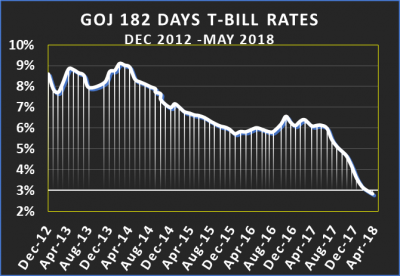 The central bank stated that “the risks to the inflation forecast are assessed to be skewed to the downside. The major downside risks to inflation include weaker than anticipated domestic demand conditions and slower than anticipated global economic growth stemming from geo-political tensions and protectionist policies. One upside risk to inflation is higher than anticipated commodity prices, particularly the price of crude oil. The risk of adverse weather may also cause domestic agricultural prices to rise faster than anticipated”.
“Bank of Jamaica’s decision to maintain an accommodative policy stance is aimed at supporting further credit expansion and faster GDP growth. When adjusted for expected inflation, the policy rate remains negative in real terms in a context of high liquidity in financial markets.

Interest rates are falling and will drive stocks higher in 2018.
These conditions are considered to be appropriate at this time given the weaker-than-desirable pace of credit expansion.”
“This decision is made against the background of positive macroeconomic indicators. Net international reserves are increasing and the current account of the balance of payments, while projected to widen, will remain at sustainable levels. Market interest rates are at record lows and falling and fiscal performance continues to be strong.”
The fall in the overnight rate translates to a 9 percent rise in stock market prices, but rates seem likely to decline some more before settling off before the year ends and stocks should enjoy more gains as a results.
Jamaica’s inflation drops 0.4% in April
Data from the Statistical Institute of Jamaica reveals another month of falling prices for Jamaica with a decline of 0.4 percent in April.
April fall, follows negative 0.1 percent in February and March and no change in January. inflation for 2018 is now negative 0.6 percent and would reduce inflation over the past twelve months to 3.5 percent.
In April Statin stated that the main contributor to the deflation in March was a 1 percent fall in Food and Non-Alcoholic Beverages category, due to lower prices for agricultural produce resulting in a 4.3 percent reduction in index for the class Vegetables and Starchy Foods and Transportation also recorded a decline.
23,000 more Jamaicans employed
More Jamaicans continue to gain employment as the economic growth gathers pace with 22,600 persons added to the employment list, an increase of 1.9 percent more persons being employed over the year to January.
The increased number of employed persons, lifted the employed in January 2018 to 1,206,600, up from 1,184,000 employed in January 2017.
Over the period, male employment increased by a mere 1,900 persons over the twelve month period to reach 664,200 in January 2018 while female employment increased by 20,700 or 4 percent to 542,400.
According to the Statistical Institute of Jamaica, the unemployment rate fell to 9.6 percent at the start of the year and is down sharply from 12.7 percent in January 2017. The lower rate of unemployment came as a result of decline in the total number of persons in the labour force and the increase in employment. In October last year the unemployment rate fell to 10.4 percent.