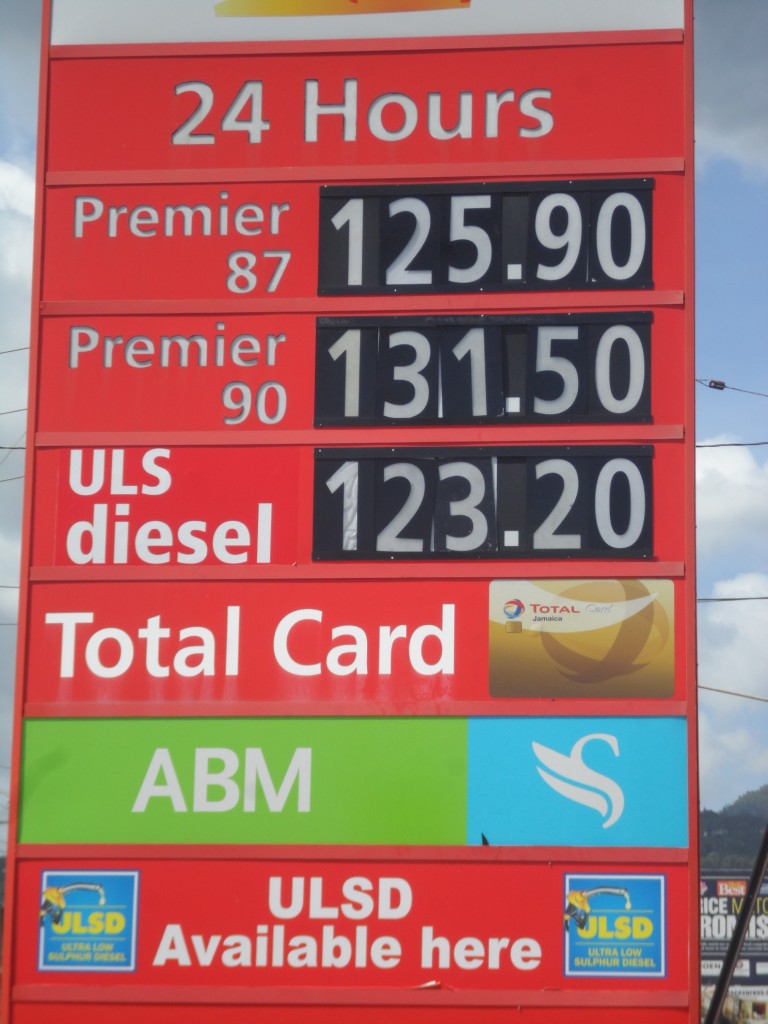
 The price of crude oil on the world market sank to US$48.49 in early morning trading, the lowest levels since October 2017. The price peaked at US$76.10 in early October this year.
The trend suggests that the price will go even lower with increasing supplies said to be coming from production in the USA and concerns that the global economy is slowing and would use less oil.
The change in price has significance for the Caribbean region that are mostly net importers of oil, as well as Trinidad and Tobago who are producers of oil, and will earn far less income from the lower price. For Jamaica, it is likely to tame inflation as it did in November, when the country recorded zero inflation. It will also make the Bank of Jamaica’s inflation target of 4 to 6 percent targeting for the current fiscal year that the Country’s Central bank states was set by the Minister of Finance and the Public Service in September 2017, far more challenging than it was before.
If the price remains below the US$50 mark for a prolong period, then Jamaica could save somewhere in the region of US$$300 million per annum and that could positively affect the exchange rate, for the local currency.
No inflation
 Fall in the price of fuel and appreciation of the Jamaica dollar helped in pushing inflation down in November with data out of Statistical Institute of Jamaica (STATIN) showing zero inflation.
According to Statin, the result was influenced by a 0.3 percent increase in the index for the division Food and Non-Alcoholic Beverages. This was as a result of higher prices for vegetables, starchy foods and fruits but was tempered by a 0.8 percent decline in the division Housing, Water, Electricity, Gas and Other Fuels due mainly to reduced rates for electricity despite the increased rates for water and sewage. The Transport division declined by 0.7 percent as a result of a decrease in the price for petrol. The calendar year-to-date inflation was 3.5 percent while the movement in the index for the fiscal year-to-date was 3.8 percent and the movement for the past 12 months comes out at 4.1 percent.
Treasury bill rates inched higher
Bids for Treasury bills for three offerings for the government of Jamaica that were auctioned on November 15 in the amounts of $700 million each resulted in modest increase in two and a slight decline in another.
 The auction attracted $826,712,000 for the 91 days issue, $1,097,475,700 for the 182 days bill and $1.997 billion for the 283 issue. The bills attracted in less amounts than the previous auction in October by $895 million and $1.4 billion each for the other two issues.
Average Yield ended at 1.95181 percent for the 91 days instrument, up from 1.786 percent in October. The 182 days Treasury bill inched up to 1.98594 percent from 1.954 percent but the 283 instrument, slipped modestly, to 2.05676 percent from 2.064 percent.
Inflation moderates in October
Prices in Jamaica increased in October but at a slightly slower pace than in September according to the Statistical Institute of Jamaica (STATIN) in a release today.
“The All Jamaica Consumer Price Index for October recorded an inflation rate of 0.7 percent”, the report from Statin said, down from 1.1 percent in September. The movement in the October CPI was influenced by a 1.7 percent increase, for Food and Non-Alcoholic Beverages. Prices for vegetables and starchy foods resulting in the group Food moving upwards by 1.8 percent. The Transport division increased by 0.5 percent as a result of an increase in the price for petrol and air travel.
The increases were tempered by a 1.3 percent decline in the division Housing, Water, Electricity, Gas and Other Fuels due mainly to reduced rates for electricity despite the increased rates for water and sewage, the Statin report stated. The index

Crude price in sharp fall coupled with J$ appreciation to create negative inflation ahead.
for the group Electricity, Gas and Other Fuels fell by 2.5 percent while, the group Water Supply and Miscellaneous Services Related to Dwelling advanced by 0.5 percent.
The calendar year-to-date inflation was 3.5 percent while the movement in the index for the fiscal year-to-date was 3.8 percent with inflation over the last 12 months being 4.7 percent.
The higher inflation rate came as a result of the rate of exchange of the Jamaican dollar sliding from around $125 to one US dollar in May to a low of $137.95, that would have helped to push up the prices of imported items and petroleum and spiked inflation that ran at a negative rate up to May. Since October when the survey would have been done, the rate of exchange for the Jamaican dollar appreciated J$132.17 to the US dollar and since then appreciated further to J$126.58 to the US dollar and seems set to enjoy further appreciation.
Early Xmas present for Jamaicans

Imports of fuel fell in 2016
The price of West Texas Crude oil is now down to 55.73 per barrel for the first time in almost a year. The price was at US$55.33 at the start of November last year and started to climb sharply after December to hit US$71 by mid-May this year and just over US$76.40 at the beginning of October before it started a steep decent to today’s level. The technical chart suggest that it could go lower still with excess supplies on the world market and slowing demand.
The cut in price has several implications for Jamaica that is a big importer of the product. It could mean savings in
 Foreign exchange around US$40 million per month at the current price. It will ease consumers cost as prices of petrol and electricity fall, but government will collect less taxes from petrol and GCT from JPS bills.
The fall also has implications for Bank of Jamaica with their inflation targeting, pitched extremely high originally at more than 4 percent and revised recently down to 3.5 percent on the low end for the fiscal year to March 2019. Those targets seem off as the fall in the price of oil coupled with the sharp revaluation of the local dollar is set to push the country through another round of deflation once more.
Business confidence rising again
Corporate executives Perception of Present and Future Business Conditions increases in the latest survey done on behalf of Jamaica’ central bank for September this year.
The Present Business Conditions Index increased to 106.6, up from 100.8 recorded in the previous survey in July. The Future  Business Conditions Index also increased to end at 128.2 relative to 122.7 in the previous survey in July. The increase in the Present Business Conditions Index reflected a rise in the number of respondents of the view that conditions are “better, ”the report from Bank of Jamaica stated. The out turn for the Future Business Conditions Index mainly reflected a decrease in the proportion of respondents who believe that conditions will be “worse.”
Future Business Conditions fell from a peak of 155.1 in October 2016, but fell since then and has bounced around quite a bit. The recent decline seems to have coincided with the slippage in the exchange rate of the Jamaican dollar.
Lowest unemployment for Jamaica
 Jamaica’s unemployment dropped to the lowest on record at 8.4 percent in July 2018, down from July 2017 when the rate was 11.3 percent. The previous lowest unemployed rate was 8.6 percent reached on October 2007 before the country economy went into contraction.
Importantly, 1,226,400 persons were employed in July this year, an increase of 12,800 above the number recorded in July 2017. Helping with the sharp reduction in the rate of employment, was a simultaneous reduction in the number of persons in the labour force to 1,338,200 persons, a decrease of 2.2 percent compared to July 2017, Statin stated in their release of the data.
The male labour force, of 723,600 persons in July 2018 decreased by 1.5 percent relative to July 2017 while the female labour force decreased by 3 percent to 614,600 persons. The number of males employed increased by 5,900 to 681,800 while female employment increased by 6,900 to 544,600.

Construction saw increased employment.
The number of unemployed persons declined by 27.7 percent to 111,800 persons in July 2018, compared to July 2017. The number of unemployed males decreased by 28.6 percent to 41,800, while unemployed females decreased by 27.2 percent to 70,000. Unemployed youth, aged 14 to 24 years, decreased by 14,600 persons to 45,200 in July 2018.
Trinidad economy mending

Down town Port of Spain, Trinidad.
The economy of Trinidad and Tobago is exhibiting signs of economic recovery according to reports out of the country’s central bank.
According to the bank, “activity in the energy sector continued to pick up in the second quarter of 2018. Natural gas production benefitted from implementation of the Juniper project with positive spillovers to methanol output. Recent data show a reversal of the trend of falling cement sales, but it is too early to tell whether this represents the start of a recovery in construction and in the non-energy sector as a whole. Meanwhile, price pressures stayed well contained, with headline inflation registering 1.1 percent in August 2018.”
“Lending to the private sector continued to grow in 2018, reaching 7.1 percent in July (year on year), reflecting mainly loans for refinancing and debt consolidation, with credit to businesses rising by a more modest 2.7 percent. Over the first half of the year, there was a 1.2 percent decline in the interest spread of commercial banks, the result of a simultaneous decrease in the average lending rate alongside a rise in the average deposit rate.”
The central further stated that, “in the third quarter, following the increase in the Central Bank’s repo rate in June, there is initial evidence of transmission to other rates—with announcements by some banks, of increases in their prime lending rates as well as higher term deposit rates.”

Trinidad Cement
“There was a temporary spike in excess reserves of commercial banks at the Central Bank in July-August in the context of widespread investor interest in a public sector bond arrangement. The Central Bank’s removal of the 2 per cent secondary reserve requirement on banks’ deposit liabilities in August also boosted liquidity. This action was in keeping with the Bank’s objective to progressively rely on more market-based policy measures, including open market operations.”
“In its deliberations, the Monetary Policy Committee (MPC) took note of the domestic situation, including the growth that remained concentrated in the energy sector, the low inflation numbers and the gradual transmission of the June 2018 repo rate increase. The Committee also observed the ongoing normalization of monetary policy in the US and wider trade and growth developments. Taking all factors into consideration, the MPC decided to maintain the repo rate at 5 percent.”
Jamaica US interest rate tango
 Interest rates and the direction in which they are heading have important messages for investors as they indicate the changes that may take place in various investments.
In short, rising rates mean that fixed assets will decrease in value while falling rates will result in fixed assets value increasing, assuming all other elements remain fairly static. Jamaica has seen a long period of excessive interest rates and bouts when the rates fell below the rate of inflation by a wide margin. When real interest rates were excessively low as in the 1983 to 1984 period and 1991 to 1993, the local dollar came under major pressure and lost much of its value. When the rates went excessively high between 1993 to 2004 it resulted in major dislocation and mayhem in the economy. The latter was the period when the financial system collapsed. After 2005, real interest rates were mostly positive against the United States rates. This period was one of the more stable for the value of the local dollar even when there were some periods when the currency lost value due to real negative interest rates. Treasury bill rates are now below 2 percent, it is likely to provide negative returns for some investors and with rates in the United States rising, this position is unlikely to remain at these low levels for too long.
Many investors are focusing currently on extracting attractive gains from the local stock market and real estate investments, this may stave off increased interest in US dollar investments for a while. The chart shows that there need not be a huge premium for local Treasury bill rates over those in the US, see the period on the chart from 2005 on wards.
With interest rates at current low levels, investors have been revaluing stocks by increasing the Price Earnings ratio they are prepared to pay for them. The trend in interest rates locally is worth watching to see where they could be in 2019 and what if any impact they may have on asset values going forward.
NIR steady despite BOJ sales
 Jamaica’s Net International Reserves slipped by just US$32 million in September according to data just released by the country’s central bank – Bank Of Jamaica ( BOJ).
According to BOJ the NIR stood at US$3.027 billion at the end of September down marginally from US$3.027 billion at the end of August. Reserves amounts to just over 19 weeks of Goods & Services Imports, the central bank states.
The change comes against the back ground of sale of US$41 million in B-FXITT weekly auction of foreign currency.