Barbados tourism recovering not there yet

Barbados received 39,284 stopovers visitors in January 2022, well up from the coronavirus ravaged January 2021 when the country attracted just 3,547 stopover arrivals but the 2021 numbers still lagged the performance in January 2019 of the 69,496 stopovers by 43.5 percent, data from Tourismanalytics.com reveals.
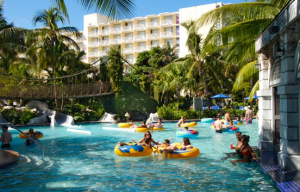
Tourism recovery

The January 2022 arrivals were little changed from the 39,356 stopovers received in December 2021.
According to Tourismanalytics.com, Barbados Statistical Service reported that Barbados Barbados received 15,718 landed cruise visitors in January 2022. Barbados reopened its ports to cruise ships in April 2021.
The country received 144,833 stopovers in 2021, just 20.3 percent of the 712,946 stopovers received in 2019 the Barbados Statistical Service is reported to have said. Barbados imposed a mandatory 14-day quarantine on all visitor arrivals as of March 22, 2020, which remained in place until November 24, 2021. Barbados consequently received 3,547 stopover arrivals in January 2021.
Remittances inched higher for Jamaica

Following historical record haul in remittances to Jamaica, the country saw a modest 1.4 percent growth in total remittance inflows for the first month of 2022 compared to January 2021 as a total of US$244.4 million entered the financial system, data recently released by the country’s central bank show.
In January 2021 inflows jumped nearly 33 percent from US$181.5 million. In 2021 inflows for January was the second lowest month of the year, following February that brought in US$236 million. In 2021 remittance inflows grew by US$592 million to US$3.5 billion.
The USA provided the largest amount of inflows accounting for 70.3 percent, up from 69.8 percent in January 2021. The UK contributed 11.1 percent, followed by Canada and the Cayman Islands, with 9 percent and 5.7 percent respectively, the Bank of Jamaica report indicated.

Bank of Jamaica inflation response worsened

Inflation in Jamaica is getting better, not worse, contrary to the recent statement by the Bank of Jamaica, to the contrary in justifying a steep hike in overnight deposit interest rates by 1.5 percent to 4 percent starting on Monday.

BOJ hikes overnight rate.

Yes, the point to point inflation rate moved up to 9.7 percent, giving the impression that inflation is getting out of hand, but that number does not tell the true story. The 4 percent interest rate will help savers get a more realistic rate on their savings.
The bank really had no significant new information that they did have when rates were raised between September and December, last year. If anything, the new information indicates clearly that inflation is moderating not worsening.
What are the facts? In January and February, last year inflation was negative 1.6 and 0.1 percent respectively and jumped to 1.1 percent in March while slipping to 0.5 percent in April, for a negative year to date inflation then, of 1.1 percent. Between May and September when BOJ moved rates up by 100 basis points inflation was the worse for the year at 1.32 percent per month or annualized 16 percent that is well up from 0.48 percent per month or 5.76 percent. The high rate of inflation suggests the bank should have moved earlier to raise rates than in September.
Inflation since the first interest rate move in September, is running at 0.6 percent per month or 7.2 percent per annum just slightly above the BOJ range of 4-6 percent. The average for the last three months is running at an average of 0.47 percent or 5.64 percent annualized, well below the 16 percent per annum for the period indicated above.
Negative inflation in January 2021 was due to a steep decline in the prices of vegetables and tubers a development that was not sustainable, as such the underlying inflation was more likely positive than negative as such the 0.6 percent increase in January this year is not out of line and is better than the December rate of 0.8 percent. The question to be answered is what can justify a sharp interest rate increase to tame much more moderate inflation over the past three months compared to when the rates were initially raised in September and on two other occasions last year by much smaller amounts that that starting on Monday?

Time for Byles to go

In the 1990s, the then government of Jamaica appointed a failed central banker in an African country as governor of Bank of Jamaica in combination with a failed Minster of Finance they collectively destroyed the Jamaican economy and the financial sector by maintaining stiflingly high interest rates that have set back this country for decades.  
Now that the country is recovering from those calamitous years, the country employed what is in effect a retired non practicing economist as head of the central bank. No major country in the world has placed such a person as head of their central bank.
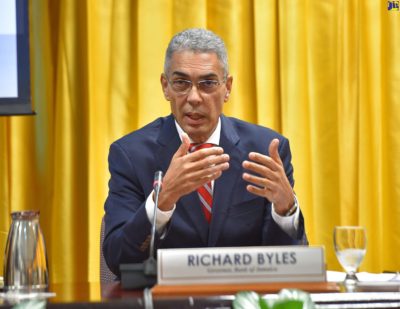
In a letter to the Minister of Finance around April last year Byles advised the MOF why rates had to be kept at levels well below inflation. According, to the central bank that was to facilitate growth and any increase, would trim the growth level quite a bit.
In reality, GOJ was the major beneficiary of the low interest rates and lenders to banks were subsidizing the goverment by getting little interest on their money.
This publication had repeated disagreed with the BOJ policy of abnormally low interest rates as having disastrous consequences for the economy. The chickens are now rooting and the central bank is panicking with the latest measured knee-jerk 1.5 percent in its overnight rate to 4 percent.
Up to June last year Bank of Jamaica (BOJ) held the policy interest rate unchanged at 0.50 percent per annum. According to the Central Bank, the decisions taken then by Bank of Jamaica are aimed at ensuring that the annual increase in the prices of consumer goods and services remains within the Bank’s inflation target of 4 to 6 percent.
The decision to hold the policy rate unchanged was made by a unanimous vote by the Bank’s Monetary Policy Committee (The Committee/MPC). This decision was based on the MPC’s assessment that, despite recent increases in international commodity prices, the existing stance of monetary policy remains appropriate to support inflation within the target range over the next two years. The Bank’s accommodative monetary policy posture is also aimed at supporting a recovery in economic activity in Jamaica.
Something seems to have blinded the eyes of the MPC who met again in August but only move rates by a huge 100 basis point then and now 1.5 percent. All talk of growth has completely gone from the justification for keeping rates well below inflation.
The message seems clear, the central bankers and the MPC are clueless as to what they are dealing with.

Bank of Jamaica jacks up interest rate 1.5%

Bank of Jamaica (BOJ) jacks up its policy interest rate offered to deposit-taking institutions on overnight placements by 150 basis points to 4 percent per annum, effective 21 February 2022 and brings to four the number of increases implemented since September 2021.

BOJ interest cuts overnight rate.

According to a release from BOJ the bank also decided to pursue stronger measures to contain Jamaican dollar liquidity expansion and to maintain stability in the foreign exchange market. Finally, consistent with meeting its inflation target sustainably in the medium term, the MPC agreed to consider maintaining or expanding its suite of policy measures at subsequent policy meetings. This position is subject to inflation, inflation expectations and other macroeconomic data evolving as projected.
In general, monetary policy decisions taken by Bank of Jamaica are aimed at ensuring that the annual increase in the prices of consumer goods and services (i.e. inflation) remains within the Bank’s inflation target of 4 percent to 6 percent, the bank stated.

Jamaica’s remittances hit US$3.5B in 2021

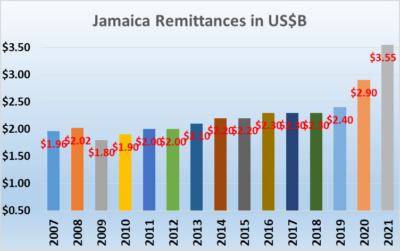
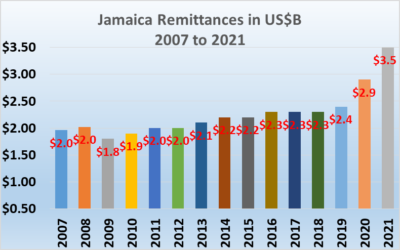
Total remittance inflows for December last year rose 6.7 percent to US$321.6 million compared to US$301 million generated in 2020 as total inflows for 2021 ended at $3.5 billion an increase of 20.4 percent or $600 million more than the $2.9 billion in 2020 bank of Jamaica report shows.
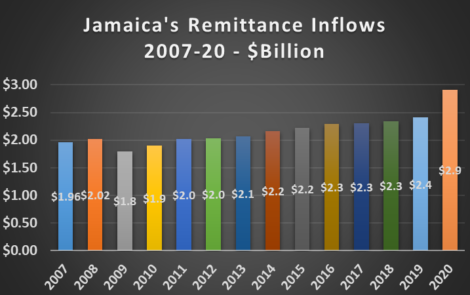
Total inflows are up by $1.09 billion over the inflows of $2.4 billion in 2020. The growth in the last two years has been the best since going back to 2007. The rate of increase in the last seven months of 2021 grew at an average of 9.5 percent over the same period in 2020 an indication that growth in 2022 is unlikely to be the average of 20.4 percent for 2021 or the 20.8 percent in 2020 over 2019. If the rate falls to say seven percent which is slightly above the increase in last year’s December total inflows would be in the order of $3.75 billion or $250 million more than for 2021.

Remittances on track to exceed US$3.5B

Remittances inflows to Jamaica surged to US$3.18 billion for the first 11 months of 2021 after pulling in US$274.5 million in November, an increase of 15.6 percent or US$37 million over the comparative period in 2020, data out of the Bank of Jamaica shows.
The performance for November puts the total intake for 2021 above the US$2.9 billion hauled in for January to December 2020. The outturn for 2021 seems set to exceed $3.5 billion for the year when the final numbers are tallied for December.
Based on the performance to date and the consistency of the monthly increase the 2021 inflows seem set to exceed by $1.1 billion the inflows of US$2.406 billion the country received in 2019 and just over $600 million more than the total for over 2020.
Data show Jamaica receiving around $2 billion more inflows in the last two years over and above the trend up to 2019. Between 2007 and 2019 inflows grew around US$1 00 million per annum, with no growth in inflows in 2015, 2017 and 2018. The increase in 2020 and 2021 broke the trend of low growth experienced since 2007.
Persons within the financial sector attribute the increased flows to a number of factors including many Jamaica who lives abroad buying real estate and contributing to the building boom in Jamaica others are of the view that the transfer of funds by the government’s fiscal stimulus to individuals, primarily in the United States is also a big contributor.

Jamaica’s interest rates holding for now

Zero inflation in December and prospects that low to negative inflation for the first four months of 2022 might have checked the move by the Bank of Jamaica to further engineer further increase in interest rates at this time.
At its latest Bank of Jamaica certificate of deposit (CD) auction, in the amount of $11 billion that was auctioned last Wednesday, January 4, the yield held, for the 30 day instrument, remaining the same as the out turn at the December 29 auction, at 4.13 percent, marginally lower than the rate in mid October.
Bids amounting to $21.53 billion were received covering 85 applications. There were 49 successful Bids with rates ranging between 4 and 4.2 percent. The highest bid was 5.5 percent for $1 million that was not successful.
Bank of Jamaica reduced the amount of CDS to $36.5 billion that is down from $46.5 billion at the peak late last year in mid-October, with the average rate at 4.17 percent.

Jamaica’s NIR jumps $104m in December

One signal of the health of a country’s international trade can be viewed from the performance of its net international reserves, based on this, the Jamaican economy could be in a pretty decent shape.
Jamaica has seen a bounce in remittances in the country climbing from just $2.4 billion in 2019 to $2.9 billion in 2020 and is expected to touch US$3.6 billion last year. In addition, tourism inflows have bounced back well in 2021, with preliminary data indicating that in December last year arrivals could be down 24 percent against that of 2019 before the disruptions in 2020 started, with all of 2021 down 45 percent on 2019. Bank of Jamaica reported that the country’s net international reserves rose US$104 million in December over November 2021 to close the year at $$4 billion and is up from US$3.1 billion at the end of 2020.

Jamaican economy looking good for investment in 2022


Things are setting up nicely in the investment world for 2022, following two somewhat lousy years for the JSE Main Market that fell 22.6 percent in 2020 and rose a mere two percent in 2021, but technical reading is not very positive in the short term, but that is likely to change in the second half. The opposite is true for the Junior Market that is caught in a triangular formation that suggests a big break higher to take the market into record territory and most likely over the 4,000 index mark.
The genesis of such optimism is ro0ted in a number of positive developments in the wider economy and for some individual companies. Results of companies for the 2021 third quarter were some of the best seen for some time, with many doing better than in 2019, before the advent of the Covid19 that resulted in dislocation pressured the bottom line of many and for some opportunities that helped the topline and the bottom line.
Those developments bode well for profits and stock prices in 2022 when the economy is expected to recover from the sharp decline in 2020. Remittances for 2021 are expected to be over US$600 million more than for the record $2.9 billion intakes in 2020 and the tourism industry is expected to be back at 2019 levels or close to it but is expected to far exceed that in 2020 all things being equal. More growth is expected from exports and the BPO sector, accordingly, the country should see significant additional foreign exchange inflows in 2022 than at any time in its history. Bear in mind that the signal of how well the country is doing in international trade, the net international reserves rose US$104 million in December over November to close the year at $$4 billion and is up fromUS$3.1 billion at the end of 2020. The early signal of tourism performance shows December 2021 behind a similar period in 2019 by just 24 percent compared to a fall of 45 percent for all of 2021 versus 2019.

Unemployment will dip further in 2022 as most of the economy is expected back to near normal operations that will add to the spending power of Jamaicans and help to lift revenues.
In the financial sector, profits were on the mend and bankers are lending again with good growth taking place in the loan portfolio of some financial institutions.

Tourism expected end 2022 close to that of 2019

In 2021 banks and financial institutions with a few exceptions were pressured with the majority ending the year with a fall in price. These institutions will benefit from the rise in interest rates that will result in increased net interest income. The JSE financial index, a measure of the performance sector in 2020 down 6.5 percent for the year. The star performer was by far the Junior Market with gains of 30 percent with five stocks gaining between 95 and 266 percent.
In the second half of the year, inflation raised its head and the Bank of Jamaica hiked interest rates in response, so far there are no visible effects on the stock market, even as higher interest rates tend to negatively affect stock prices.
On the fiscal side, revenues for 2021 were healthy bettering the 2020/21 fiscal year b some distance. The effect is that the fiscal deficit should return to the 90 percent range again during 2022. Fiscal year 2022/23 should be much better and there could be some tax relief granted. It could be reduced GCT or an increase in the tax threshold. But it should stir the government into doing a comprehensive tax reform thus eliminating many of the minor tax categories. Whether there is tax relief or not, what is clear is that there will be no new taxes for the coming fiscal year.
In our 2021, ICInsider.com stated the period ahead, “seems set to be the year of surprises as many stocks that suffered badly in 2020 could be making a major turnaround in revenues and profit, while some that may not fully recover could start showing good signs of returning to normalcy.” That is exactly what happened during the year with strong gains from the likes of Caribbean Producers, Express Catering, Main Event, Medical Disposables, Radio Jamaica, Stationery and Office Supplies and Dolphin Cove, all of which suffered major setbacks in 2020.
The economy is clearly on the mend but there are still lingering concerns with the inability to seriously reduce the spread worldwide as well as in Jamaica. The latest Omicron strain is an example that we may not be out of the woods as yet. The ongoing vaccination of the population in Jamaica although not going as fast as planned continues apace and could support general positive expectations for the near term.
Importantly, PE ratios are rising as investor demand pushes values up as selling wanes at the end of 2021, the average PE ratio of the Junior Market suggests a 60 percent rise for the market while the Main Market is put at just 20 percent, with companies in the latter at a greater stage of developments than the former.
The country should see a full recovery from the important tourism sector during 2022 and this publication expects greater flows of foreign exchange with tourism back to normal and remittances holding close to the trend of 2021.

Coming soon – Junior Market could jump 60% in 2022