 Remittance inflows to Jamaica hit a record for January, with total inflows of US$255.5 million this year following an increase of US$9.5 million or 3.9 percent in total of US$246 million in 2024.
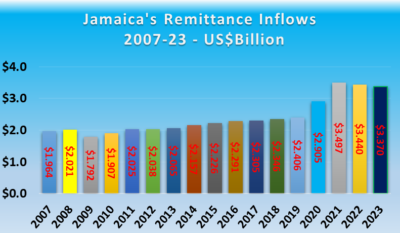
The previous best January for inflows was in 2023, when total inflows amounted to US$248.6 million, data released by Jamaica’s Central Bank show. Remittance inflows to Jamaica in 2024 amounted to US$3.358 billion.
 The moderately improved inflows pushed the year to date performance above 2023 with a marginal increase to $499.6 million from $499 million.
 For the 11 months to November 2023, remittance inflows to the country amounted to US$3.064 billion, a decline of 1.6 percent compared to 2022 for the same period. The decline is just US$50 million short of the US$3.114 billion for the same period in 2022. The full 2023 outcome could fall short of US$3.4 billion based on the trend for the year to date and would be down on the US$3.44 billion that obtained in 2022.
 Remittance inflows to Jamaica in August slipped by 5.9 percent or US$18 million, the worst monthly decline for 2023, with total inflows of US$289, down from US$307 in August 2022, data out of the Bank of Jamaica show. The decline beats the 5.8 percent decline in April, with a slippage then of US$17 million.

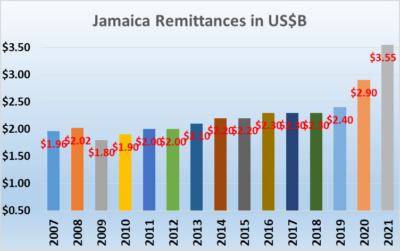 The performance for November puts the total intake for 2021 above the US$2.9 billion hauled in for January to December 2020. The outturn for 2021 seems set to exceed $3.5 billion for the year when the final numbers are tallied for December.
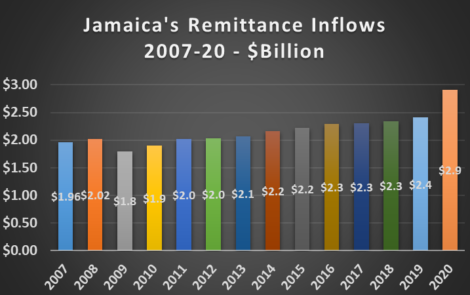
 This year’s performance is important as it was in May 2020 that the big upsurge in inflows commenced, with May 2020 inflows rising by 15.7 percent over 2019 inflows, bettering the decline recorded in March and April last year to the same months in 2019. For the year to date, total remittance inflows are up an incredible 42 percent over 2020 to reach US$1.4 billion for the five months period from US$987 million in 2020.
 Total remittance inflows for February rose 27 percent to US$236 million from US$186 million in 2020.