 Ciboney has just released another disappointing set of results for the nine months to February this year, with cash funds erosion continuing with $7.8 million being burnt from a year ago, as the company reported a loss of $2.8 million in the third quarter and $6.2 million in the nine months period. The above numbers may not appear large, but when viewed against revenue and foreign exchange gains of only $770,000 for the year to February and cost of $7 million then a better picture of things is seen.
Minority shareholders in Ciboney should demand that the directors restore the lost value in the company since 2013. At the end of February 2013 Ciboney cash and investments was $31.6 million today it nowhere close, as cost and poor investment decisions eroded it, it never had to be that way. In 2013, the company got an offer to merge with KIW International and turn the combined entity into an investment company with a proposal to go to the market in 2016 to raise funds for expansion and modernization of the KIW complex, in light of what is seen as increased business to come from port activities in Kingston. The matter was discussed formally with the Cibnoey’s board, but there were no further response from them although they did indicate that they would need to advertise the company for sale to comply with government’s divestment requirements.
 Rules on mergers and takeovers of the Jamaica Stock Exchange suggest that the directors may have personally breached them. Relevant extracts from the rules state “At no time after a bona fide offer has been communicated to the Board of an offeree company or after it has reasonably come within the contemplation of the Board of an offeree company that a bona fide offer is likely to be forthcoming, shall any action be taken by the Board of the offeree company in relation to the affairs of the company, without the approval in general meeting of the shareholders of the offeree company, which could effectively result in any bona fide offer being frustrated or in the shareholders of the offeree company being denied an opportunity to decide on its merits.”
“A Board, so approached, is entitled to be satisfied that the offeror company is, or will be, in a position to implement the offer in full. When any firm intention to make an offer is notified to a Board from a serious source (irrespective of whether the Board views the offer favourably or otherwise), shareholders must be informed without delay by press notice.”
A few questions flow, especially in light of the near wiping out of the company’s cash. Why was there no formal response and why weren’t minority shareholders advised of the proposal? Recently other entities have made offers to Ciboney but minority shareholders have not been advised of them. Did the Ciboney board seek independent outside advise on the offer?
The proposal made to Ciboney included the following, Ciboney which is listed on the JSE has been recording losses consistently for years (with accumulated losses of $417 million). KIW which was once listed has been making small profit for the last three years to 2012 and appears to recording an increase in its 2013 fiscal year. The combination of both entities could result in positive profit, helping to restore greater level of interest in the stock and boost the KIW shareholders’ value as well.
KIW is proposing that both entities consider merging with a plan to raising fresh capital in 2016. A crude calculation shows that the company is worth approximately $150m, of this amount Finsac shares are worth $90m and the minority $60m. The Finsac debt could therefore be satisfied by the transfer of the property to them and by cancelling the shares or transferring them to minority shareholders.
KIW has about 3 ½ acres of land, a few investments in unit trust and stocks. There are buildings on the property which are rented presently providing rental income.
The facilities which is located close to the port, stands to benefit from expected surge in port activities that are planned for with the expansion of both Kingston Wharves and the Port Authority’s port.
Currently, the company is debt free and has about $14 million in cash and investments. The property is on the books at a value of $55 million but would be valued up to $105m.
If the above proposal was implemented, the combined entities would be worth approximately $115 million with the KIW shareholders having the majority of the shares. It could generate approximately $20 million in revenue in year 1 and profits of around $10m, not taking into account the impact of any new capital that may be raised.
Since that proposal was sent, Ciboney has lost $24 million in value while KIW has increased theirs to by around $30 million not factoring any increased value for the property that may have accrued since 2013. So Ciboney’s minority shareholders have lost out on improving their value by $40 million and as high as $100 million in increased value.
The question is with cash fast disappearing what will be the future of Ciboney without any viable offer to purchase the land owned by the company?
The Ciboney waste
AMG profit jumps 65%
 Revenues at AMG Packaging rose by only 4 percent for the February 2016 quarter to $157 million up from a decline of 1 percent in the first quarter and for the six months an increase of 1.7 percent to $308 million.
Profit for the quarter out performed revenues by a wide margin, jumping 43 percent to $23 million although the company incurred $10.5 million in startup cost for the tissue operations in the quarter and $16.4 million for the six months, pulling profit down to a 65 percent increase to $52 million.
Earnings per stock came in at 23 cents for the quarter and 51 cents for the six months with IC Insider projecting that excluding the cost for the tissue operation earnings per share should hit $1.35 for the full year. The stock last traded on The Jamaica Stock Exchange at $13.
The results showed gross profit climbing 56 percent to $55 million for the quarter and 53 percent to $106.7 million for the six months as gross profit margin climbed by 35.5 percent for the quarter from 23.6 percent in 2015 and to 35 percent for the six months from 23 percent in 2015.
Increases in administrative and other none manufacturing cost were well contained with an overall increase of only $4 million for the half year.
Information gleaned is that the tissue operation has high profit margins, this augurs well for the company going forward once the new operation which have been tested is up and running at optimal levels for a while. While management speaks to the plan to commence production in the third quarter it will be the 206/17 fiscal year that should add to revenues and profit.
AMG is currently, engaged in the production of cardboard boxes for packaging and is embarking on an expansion into tissue paper processing.
Cost hurts Lasco Distributors’ profit
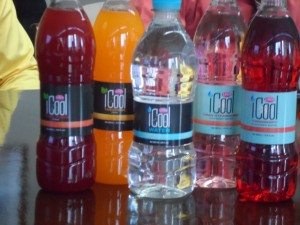
Lasco’s ICool drinks.
Revenues for the nine months ended at $10.9 billion, 36 percent higher than in 2014 while revenues for the quarter were up 36.4 percent to S4 billion. Profit after taxation came in at $213 million and is up from $193 million in 2014, mainly driven by growth in new business.
Gross profit grew by only 20 percent for the quarter to $644 million and 23 percent for the year to December to $1.77 billion as profit margin declined. Gross profit margin slipped sharply from 19 percent in the December 2014 quarter to 16 percent in 2015 and for the nine months, gross margin ended at 16 percent from 18 percent in 2014.
Other operating income, inclusive commissions from principals and interest on investments generated $82.5 million, an increase of 19 percent compared to the prior year’s $69 million for the nine months and was up 47 percent for the quarter to $53 million.

Lasco’s products
Total assets at the end of the period stood at $7 billion, an increase of S2.5 billion or 54 percent over prior year. Growth was driven mainly by increased inventory of $950 million arising from new business lines and capital expenditure of $550 million relating to the warehouse expansion. Receivable balances grew by 25 percent over prior year to close at S2.7 billion, while Payable balances grew by 81 percent to $3.4 billion. Short term Investments, Cash and bank balances at the end of the period were $1.076 billion up from $600 million. Shareholders’ equity stood at S3.4 billion, or 26 percent growth and the return on equity for the nine-month period was 27 percent compared to 22 percent in the same period last year.
IC Insider’s forecast is for per share earnings of 27 cents after tax for the March 2015 fiscal year and 50 cents for 2016 from ongoing operations. The stock last traded at $5 on the junior market of Jamaica Stock Exchange, with a PE of 18.5 times 2016 earnings but 10 times 2017 estimated earnings. The likelihood of a large settlement for the claim against Pfizer could enhance the attractiveness of the stock.
2 new BUY RATED stocks
 Jetcon Corporation and ISP Finance have been added to the IC Insider BUY RATED list. The list continues to sport selections that have some room to grow before they reach the stage of maturing. Some have reached levels that look like they may be close to the top and stay there for a while and the may be just be rated hold than BUY RATED at this stage of the market’s rally in Jamaica.
The Trinidad based companies appear to be saddled by the effects of the recession on their performance.
There are now a few that were previously listed as BUY RATED have moved to Watch, as these stocks are likely to be market underperformers. If these are already owned then investors may want to hold on a little longer, buying into them now, while such a move could be profitable such investment may not be the smartest move at this time. At this stage of the Jamaican market it has become more challenging to continue to back some of the strong performers to date, as their valuation has risen and future gains will most likely come from gain in profit, unless the market revalues the PE ratios higher, a factor that is expected with lower interest rates likely in the months to follow.
Knutsford Express has been to Market Watch as it close to our target price of $24 at this time and while there is more growth to come with increased frequency slated for the north coast routes, increased profits going forward could slow considerably from recent strong gains. 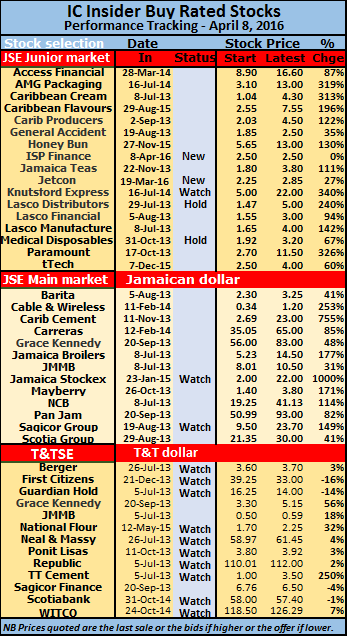 Sagicor Group has done well since we selected it, with an increase close to 150 percent plus dividends, the immediate future looks like the gains are going to slow compared to the growth since the start of 2015. In past bull market, investors gave it a big premium over the rest of the market. That is not so now, but could change as the current bull market continues it run.
Lasco Distributors that was moved to a hold is now back to a buy, since the price has pulled back to $5, the company will benefit from taking over the overseas distribution of all of the manufacturing company products. The inflows expected from the lawsuit with Pfizer should add to the company’s value when the courts agree the amount, which management puts at more than US$300 million.
AMG Packaging, Caribbean Cream and Paramount are all up more than 300 percent but expansion into new products should give revenues and profit a kick in the not too distant future for AMG and Paramount. Caribbean Cream full year results are due shortly and should exceed 55 cents per share as the company benefited from sharp drop in raw material cost.
Jamaica Stock Exchange is now a Watch as it seems close to fairly valued currently, but dividend yield could well push it higher. In addition, of note is that while trading levels have improved they are still well off from historical highs, so there could still be much more gains ahead later on.
Trinidad is in recession and the results of companies are showing it with pressure on profit particularly for companies that earn the bulk of their income in the twin island state. As a result prices have been declining for many of the companies on the Trinidad market with a few exceptions. With the exception of Trinidad Cement that is undervalued, a hold has been placed on Trinidad based listed stocks for the time being but investors should wait for TCL to settle before buying.
Purity hopes for a better 2016

Consolidated Bakeries with their Purity brand.
Importantly, the final quarter delivered 11 percent more revenues than in 2014 to reach $200 million up from $180 million. Profit margin slipped in the December quarter, to 32.93 percent from 33.94 percent in the September quarter, helping to depress profit. Finance cost of $888,000 in the September quarter jumped to $3.6 million in the December quarter while selling and distribution cost fell in the quarter by $7.5 million compared to the September quarter but administrative cost rose by $2 million over the above period.
Based on the improved revenue gain in the December quarter and the fact that 2015 had some one-off cost, IC Insider is forecasting 18 cents per share for 2016. The stock last traded on the Jamaica Stock Exchange at $1.21 and would place the PE based on IC Insider’s 2016 estimate at 6.7.
Responding to the results Management released detailed report on developments that led to the 2015 performance, we are “pleased to report that increased marketing efforts, company reorganization and our decision to strategically focus on products with growth potential have yielded encouraging results.”
“Our process began in earnest in 2013, resulting in a considerable growth in sales, despite having been met with strong competition. Our activities over the last few years were focused on strengthening our positions and building sustainable growth, which were substantiated by the growth we witnessed of 30 percent and 9 percent in 2013 over 2012 and 2014 over 2013, respectively. Continuing the growth incline, in 2015, the company registered an overall growth of 3 percent, but witnessed double digit growth in some key product areas. Furthermore, during the last quarter of 2015, sales grew by 11 percent over the same period in 2014.”

Easter buns should lift sales and profit in the March 2016 quarter.
“The deletion of certain SKUs from our system came with a one-off cost of $21m to revenues. The addition of technical personnel, reorganization of staff and increased sales staff to service our accounts aggressively positioned our brand in the market place, but resulted in additional staff costs. We also doubled our spending on advertising and promotions from $8.5m to $16.8m, which in 2015, was a strategy utilized to strengthen the brand platform for future growth. Additionally, we continued to spend on fleet and trucks, spending $19 million on motor vehicles. These additions, plus the cost associated with machinery acquisitions accounted for most of the increased cost for travelling and motor vehicle expenses. Delays in new equipment installation and in the introduction of new products also impacted our revenues and cost of goods sold.”
“Although profits declined for the above stated reasons, our capital base remains strong with total equity of $533 million as at December 31, 2015. Our current assets exceed our current liabilities by $128 million, or by more than 140 percent. Our cash and investment position stood at $118 million at the end of 2015. We continued to maintain 38 percent of those cash and cash equivalents in US currency to hedge against depreciation of the Jamaican dollar, particularly as we continue to roll out more capital expansion. Last year, our capital expenditure totalled $52 million, up from $32 million the year before. Our strong cash position also enables us to easily cover debt payments, such as the $22 million portion of long-term debt due in 2016. Additionally, the company’s gross margin improved from 34.2 percent in 2014 to 35 percent last year.”
JSE to consider a dividend
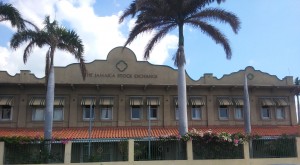 The Jamaica Stock Exchange (JSE) has advised that the Board of Directors will meet on April 19, 2016 to consider the payment of an interim dividend.
In December last year, the company made a second dividend payment of 47 cents per share on December 30, to shareholders on record as at December 23 following a payment in July of 53 cents per share which brought the total pay-out to $1 per share for a total $140 million. Last year’s dividends provided a staggering 63.7 percent yield based on the 2014 closing price of $1.57. With the price of the stock in the $20 range in 2016, the yield is bound to drop dramatically to around 10 percent or less. The stock last traded on Wednesday on the Jamaica Stock Exchange at $19.55.
The company reported earnings for 2015 of $1.25 per share or $175 million, up from only $3 million in 2014. JSE had the best quarter in March with revenues of $259 million and profit of $87 million after tax. The 2016 first quarter seems set to better that of the 2015 first quarter with a big $110 million income from trading a block of Desnoes & Geddes shares almost equal to the estimated $120 million hauled in from the block of Scotia Group shares that was transferred from the Canadian parent to a Caribbean based one.

Marlene Street Forrest – General Manager of the JSE
What should help boost the first quarter results is added business undertaken by the exchange particularly, the registrar services, for handling of the repo business and increased stock market activity in 2016 over the first quarter of 2015. Last year, for the first quarter, regular trading was $4.9 billion while for 2016 its $6.44 billion, for a 31 percent increase. The JSE also engineered increases in fees charged for some of it services.
Lower profits at Guardian
 Guardian Holdings reported lower profit for 2015 of TT$335 million or $1.14 per share compared to TT$341 million or $1.47 per share. While the bottom-line was lower in 2015 profit from continuing operations were higher at $334 million versus $303 million.
Insurance premium income rose to $5.17 billion from $5.03 billion while net profits from insurance activities jumped to TT$662 million from $490 million. Investment income was flat at $772 million but gains from investment securities dropped from $86 million to just $6 million. Expenses were held tightly with operating expenses rising 6.3 percent to $962 million while finance cost rose 8 percent to $141 million.
Guardian has assets of TTS22.18 billion at the end of 2015 with financial assets and loans of $16.624 billion. Borrowed funds amount to $2.15 billion and equity capital ended at $2.73 billion.
The stock last traded on the Trinidad Stock Exchange at $13.80 for a PE just below 10 times earnings. IC Insider considers the stock to be undervalued but with the Trinidad’s economy in recession and with the bulk of Guardian business emanating in that country it will be difficult for revenues to rise in a meaningful manner and deliver consistent increased profits.
Guardian Holdings is primarily involved in the business of life insurance, investments and general insurance with operations throughout the Caribbean. In 2015, National Commercial Bank agreed subject to regulatory approval acquire just under 30 percent of the issued shares from a group of shareholders.
Juniors down majors up – Wednesday
Trading on the Jamaican Stock Exchange resulted small gains in the early morning session on Wednesday for the main market but the junior stocks declined overall.
 After 90 minutes of the market’s opening, ISP Finance which listed today traded at $2.25 with 250 shares while Jetcon Corporation that listed last week Thursday. traded at $2.70 with 14,000 shares. Lasco Manufacturing traded 1,621,865 shares at $3.80 and Proven Investments traded 2,521,850 shares at 19 US cents.
Only 30 securities, accounting for 4,868,739 shares changed hands as 8 stocks gained and 12 declined.
The indices enjoyed moderate gains in the main market after suffering modest declines earlier in the session with the all Jamaica Composite Index rising 151.61 points to 170,699.03, the JSE Market Index gaining 135.67 points to 153,677.05 the JSE combined index ending with a loss of 205.56 points to 162,036.89 but the junior market index fell 36.34 points to 1,897.11.
JMMB undervalued as profit slips
JMMB Group posted net profit of $1.73 billion and earnings per share of $1.04 for the nine months period ended December 2015. JMMB reported lower profit in the December Quarter of 32 cents per share versus 46 cents in 2014 and $1.04 for the nine months compared to $1.08.
 The December quarter profit of $519 million is the lowest of the three quarters to date as the group saw increased net interest income but lower gains on securities trading of $714 million versus $942 in the 2014 quarter and Foreign exchange margins from cambio trading of $227 million versus $248 million. Year to date these two categories are up on the prior year’s nine months. JMMB reported profit of $743 million in the 2014 December quarter, 43 percent more than in 2015.
Operating revenues after accounting for interest cost grew 9.2 percent to $8.5 billion, with gains on securities trading, foreign exchange trading, and commission income increasing of 12.8 percent, 16.4 percent and 29.8 percent respectively but with net interest income growing by just $126 million or just 3 percent. “These were driven largely by volume increases and taking advantage of market opportunities mainly in Jamaica” the JMMB directors’ reported stated.
JMMB management reported to shareholders that “the merchant bank in Jamaica contributed net profits of $330 million, an increase of 40 percent over the prior period. The bank’s loan portfolio grew by 32.4 percent from March 2015, with a non-performing loans ratio of 1.7 percent. The operations in the Dominican Republic continue to produce positive results with the Puesto De Bolsa contributing net profits of J$160 million for the period. The full range of services are being rolled out in the Dominican Republic which includes money market mutual funds and the newly acquired savings and loan bank, Banco Rio de Ahorro Y Credito JMMB Bank S.A. (JMMB Bank). The Group also obtained approval from the Regulatory authority in December 2015, as a new licensee, to administer Pension Funds in the Dominican Republic. The directors stated in their release with the quarterly. In Trinidad and Tobago, the Group’s operations continue to move in a positive trajectory, contributing $186.9 million for the period.
The asset base of the JMMB Group increased by $7 billion or 3.3 percent for the period, moving from $217.7 billion at March 2015 to J$225 billion.”
The Group’s managed funds increased by 60 percent to J$65 billion compared to $40.7 billion for the prior year.
JMMB should earn profits around $1.40 per share for the fiscal year that ends March this year, but recent results suggest that growth is reaching maturation levels and management will need to put in lots of effort to rev up business while keeping cost under control. While management indicates that the operation in Trinidad continues to be impacted positively, concerns must exit with the recession in that country, that is placing pressure on corporate profits. New acquisition in Dominican Republic could enhance operations in that country and contribute to increase profits in 2016/17. With the stock price hovering at $10 in Jamaica, the PE of the stock is around 7.5 which make for a good entry point for investors who may want to invest for a few years.
NCB sold off big block of £ – Tuesday
NCB sold off £14m on Tuesday.
Trading resulted in the Jamaican dollar gaining value against the US dollar on Tuesday but falling against the Pound and the Canadian. The market ended with dealers buying the equivalent of US$38,374,952 and selling US$59,515,111, in contrast to US$55,938,398 purchased and US$42,243,409 sold on Monday.
 In US dollars trading, dealers bought US$35,361,406 compared to US$52,402,992 on Monday, with the buying rate for the US dollar falling 15 cents to $121.31. A total of US$38,036,432 was sold versus US$40,586,538 on Monday as the selling rate fell 1 cent to end at $122.02. The Canadian dollar buying rate lost 22 cents to end at $88.16 with dealers buying C$1,087,597 and selling C$817,857, at an average rate that rose 47 cents to $91.29. The rate for buying the British Pound dropped $1.46 to $169.43 for the purchase of £1,474,724, while £14,483,014 was sold, the rate rose 49 cents to $173.53. At the end of trading, the selling rate for Euro, fell by 63 cents to close at J$135.54, from Monday’s rate, according to data from Bank of Jamaica, while dealers purchased the European common currency at J$132.88 for a fall of 65 cents on Monday’s rate.
 The US dollar equivalent of other currencies traded, amounts to US$163,481 being bought, while US$269,070 was sold.
Highs & Lows| Notable changes to the highest and lowest rates the currencies traded at on Tuesday are, a fall of $1.20 in the lowest selling rate of the Canadian dollar to close at $85 and a fall of $2 in the lowest selling rate of the British Pound that landed at $165.