
Jamaica Broilers
The financial year to April 2017 was a good one for Jamaica Broilers Group, with attractive revenue and profit growth. For the full year, profit after tax attributed to the company’s shareholders rose 28 percent to $2.23 billion from $1.74 billion in 2016.
Sales revenues grew 15.3 percent to $44.44 billion for the year from $38.52 billion in 2016. The group enjoyed a 17% increase in revenues in the fourth quarter to $12.32 billion up from $10.52 in 2016 but profit but rose from $900 million to $1 billion at a slower pace than the growth in revenue.
A fall in the pace of growth in gross profit was a major factor in the slower growth in the last quarter as direct cost rose limiting gross profit to a rise of 13 percent to $3.57 billion in the quarter from $3.16 billion in 2016.
Segment results showed the Jamaican segment generating revenues of $31.96 billion up from $28.4 billion but segment results fell from $3.6 billion to $2.87 billion. Revenues for the US based operations grew to $10.86 billion from 8.8 billion and generated segment profit of $1.3 billion compared to $1 billion in 2016. Other Caribbean Countries generated revenues from third parties of $1.6 billion up from $1.3 billion in 2016 and contributed $944 million to profit up from $254 million in 2016.
While some Jamaican companies are by passing cheap borrowed funds for expansion purposes, Jamaica Broilers with equity capital of $14.4 billion has $7.7 billion in debt. The group holds $2.76 billion in cash with loan receivable of $2.55 billion of which $500 million is due within 12 months. Cash flow from operations is attractive at approximately $3 billion for 2017. During the past year $749 million was expended on the acquisition of fixed assets compared to $800 million in 2016 and the group paid dividends of $420 million for the 2017 fiscal year, up from $311 million in the prior period.
Forecast for 2018 is for EPS of $2.60, up from $1.85 for 2017. The stock closed on the Jamaica Stock Exchange on Friday at $18 at 10 times 2017 earnings but 7 times 2018 earnings compared to an average of the main market of 13.7. IC Insider.com rates the stock a buy for growth and income.

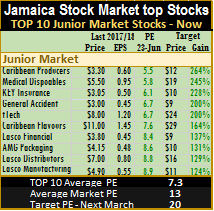 Thursday, with attempts to trade at $7.40 on Friday thwarted by the circuit breaker rules. The trade was cancelled after the market closed.
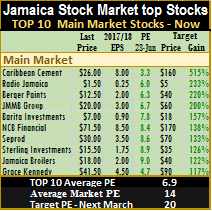 Several stocks are trading below these averages, and have potential for more gains in the months ahead, barring major negative developments.

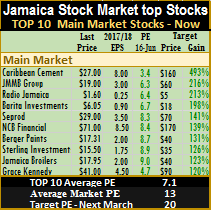 The markets offer some good opportunities for bottom fishing, with
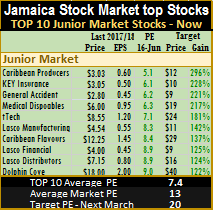 favourably with 13.4 for the overall main market and 13 for Junior Market, based on 2017 estimated earnings. Several stocks are trading below the average, and have the potential for more gains for the rest of 2017, barring major negative developments.
 Shuffling of stocks in the TOP 10 list was quite pronounced this past week with two companies exiting and entering each list.
 TOP 10 list as a result, while
 In a number of cases, the TOP stocks will need to deliver results in the upcoming quarter in order to send a message that the potential they have will be manifested.

 The week’s movement continue to be constrained by near term resistance levels which could be acting as short term restraint to a break out from current levels.

 In the main market, decline in the prices of Seprod down to $30 and Sterling Investments to $15.50 moved them into the top list and replaced Berger Paints and Scotia Group that maintained their prices and are now some distance from the top list.
 The history of the Top stock performance indicates that, it takes a few months for most of the stocks to reach potential targeted prices as they tend not to be the stocks favoured by a large segment of investors, in the short term.


 In the main market,
 Top spots with good potential gains ahead.

 In the Junior Market, Lasco Distributors returned to the top list and CAC 2000 entered for the first time and Berger was replaced in the main market by Salada Foods with the price having fallen to $6.50.
 IC Insider.com’s TOP 10 Junior Market stocks continue to trade at an average discount of just under 37 percent to the Junior Market average, those in the main market are trading at a 53 percent discount, to the average of the market, leaving several stocks with room for growth for the rest of the year.