IC TOP 10 buffeted by market consolidation

Both the Junior and Main Market continue to consolidate ahead of a bullish period to come, as trading activities were calmer during the past week on the Jamaican Stock Exchange after a surge in prices towards the end of November. There were no major price movements this past week, but the price of Grace Kennedy pulled back from $67 to close at $64 at the end of the week while JMMB Group moved up to $35 from $34 last week.

Wisynco squeezes back into ICInsider TOP 10.

Fontana closed trading $5.35 and that was enough to move it out of the IC TOP 10. Honey Bun, with its earnings now based on the fiscal year ending September 2021 replaced Fontana. Stanley Motta is out of the Main Market TOP 10, with the stock rising to $5.35 and replaced by Wisynco Group, in at tenth position.
Profit after tax at Honey Bun, rose a healthy 76 percent to $54 million from $31 million in the fourth quarter over the similar period in 2019, bettering the 21 percent rise in the June quarter, to $20.4 million from $16.7 million. For the year to September, profit increased just 6.6 percent to $167 million from $156 million in 2019, from sale revenues that rose 15.5 percent for the quarter, to $432 million from $374 million but rose 8.5 percent for the year, to $1.675 billion from $1.544 billion in 2019. Earnings projection for the 2021 fiscal year is 55 cents, up from 35 cents for 2020 giving the stock a PE of 10.
Wisynco Group’s performance was on a roll, with revenues up 27.5 percent in the nine months to March this year, and 24 percent in the March quarter, but gross profit margin slipped in the March quarter while rising Administration and other expenses squeezed profits even more. Sales dipped slightly in the June and September quarters, but the September 2019 quarter, includes sales of $503 million from a discontinued operation, leaving flat sales from ongoing operations. Net Profits Attributable to Stockholders from continuing operations was $851 million or 23 cents per stock unit compared to $932 million or 25 cents per stock unit for the corresponding period of the prior year. Revenues for the quarter from continuing operations of $8.1 billion fell 6.1 percent from $8.6 billion in the 2019 quarter. The company expects to have lower energy costs with the successfully commissioning of the Cogeneration plant in July 2020, with the company seeing a positive contribution from the implementation through reduced energy costs.
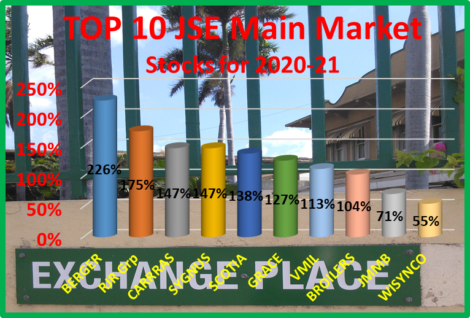
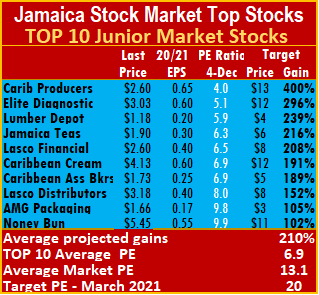
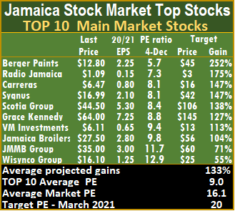
The top three stocks in the Junior Market with the potential to gain between 239 to 400 percent by March 2021 are Caribbean Producers, followed by Elite Diagnostic and Limber Depot. With expected gains of 147 to 252 percent, the top three Main Market stocks are, Berger Paints followed by Radio Jamaica, Carreras and Sygnus Credit Investments tied for the third position.
The local stock market’s targeted average PE ratio is 20 based on profits of companies reporting full year’s results, from now to the second quarter in 2021. The Junior and Main markets are currently trading well below the market average, indicating the potential gains ahead. The JSE Main Market ended the week, with an overall PE of 16.1 and the Junior Market 13.1, based on ICInsider.com’s projected 2020-21 earnings. The PE ratio for the Junior Market Top 10 stocks average a mere 6.9 at just 53 percent of the market average. The Main Market TOP 10 stocks trade at a PE of 9 or 56 percent of the PE of that market.
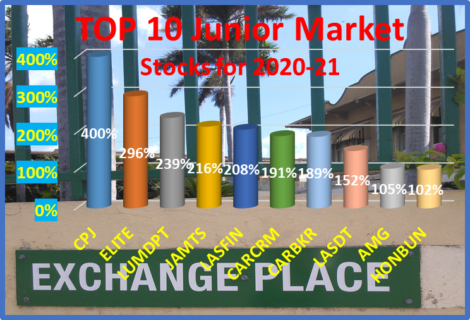
The average projected gain for the Junior Market IC TOP 10 stocks is 210 percent and 133 percent for the JSE Main Market, based on 2020-21 earnings. IC TOP 10 stocks are likely to deliver the best returns up to March 2021 and ranked in order of potential gains, based on likely gain for each company, taking into account the earnings and PE ratios for the current fiscal year.  Expected values will change as stock prices fluctuate and result in movements in and out of the lists weekly. Revisions to earnings per share are ongoing, based on receipt of new information.

Persons who compiled this report may have an interest in securities commented on in this report.


Q4 profit jumps 76% for Honey Bun

The Easter bounce in earnings never happened for Honey Bun with sales in the March quarter up 13 percent and the June quarter down 7 percent, but fourth quarter sales compensated for the June fall out, increasing a strong 15.5 percent.

Rising profit at Honey Bun

Profit after tax in the fourth quarter rose a healthy 76 percent to $54 million from $31 million in 2019, bettering the 21 percent rise in the June quarter, to $20.4 million from $16.7 million. For the year to September, profit increased just 6.6 percent to $167 million from $156 million in 2019.
Sale revenues rose 15.5 percent for the quarter, to $432 million from $374 million but rose 8.5 percent for the year, to $1.675 billion from $1.544 billion in 2019. The company manufactures and distributes baked products in Jamaica and overseas, with overseas revenue less than 10 percent of gross sales revenue.
Historical profit performance has not been exhibited a predictable pattern, partly due to expansion related cost. Profit jumped sharply in 2016 from 2015 but dipped in 2017 and again in 2018 but rose in 2019 as a recent expansion allowed for increased sales, with the latest period continuing to reflect growth but muted by the COVID 19 dislocations.

One Honey Bun’s Products.

Notwithstanding the profit performance that may present a chequered path, the company has one of the best management teams of Junior Market companies to build-out the capacity for continued growth in revenues and increased efficiency.
Gross profit margin moved up from 46 percent in 2017 and has been consistent at 48 percent since 2018 and resulted in gross profit rising nine percent to $799 million from $745 million.
Administrative and other expenses rose just one percent to $295 million, while depreciation charges relating to administrative expenses increased 28 percent to $48 million. Selling and distribution expenses rose 17 percent to $292 million from $250 million in 2019.
The company employed an average of two hundred and seven workers during the year, up from one hundred and eighty in the 2019 period costing $428 million compared to $406 million in 2019.
Finance cost was negligible at just over $1 million for the year.
Earnings per share came out at 35 cents for the fiscal year. The stock traded at $4.83 on the Junior Market of the Jamaica Stock Exchange at a PE ratio of 14 times earnings. ICInsider.com is forecasting 55 cents per share for 2021 at a PE of 9 times. Net asset value is $1.85, with the stock selling at 2.6 book value. The company paid a dividend of 8 cents d 20uring the year.
Gross cash flow brought in $260 million but increased working capital reduced the amount marginally to $253 million and payment of dividends amounting to $38 million acquisition of fixed assets amounting to $119 million and the payment of $27 million in taxation left $98.5 million to be added to funds on hand at the start of the year. Current assets ended at $444 million, including inventories of $71 million, receivables of $73 million, cash and bank balances of $297 million. Current liabilities stood at $148 million. At the end of the year, shareholders’ equity stood at $870 billion, with borrowings at just $26 million.

Big gains for some IC TOP 10 stocks

During the past week, Grace Kennedy was the top 10 best performer rising 16 percent to 67 percent, followed by Caribbean Producers 12 percent gain to close the week at $2.63, during a period when stocks continue their climb higher to their highest level since early-April on the Jamaican Stock Exchange Main Market in the past week.

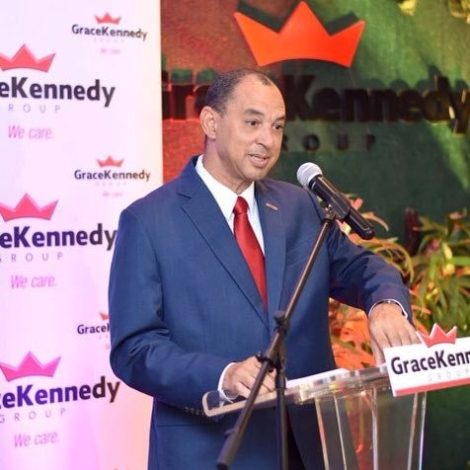
Grace Kennedy gained 16% for the week.

The Junior Market continues to fight in continuing to build on the gains in recent weeks, with moves in both markets confirming the bullish signal technical indicators been flashing.
The movement in the markets resulted in Stanley Motta coming into the Main Market IC TOP 10, replacing Jamaica Producers. The Junior Market Top 10 remained without any new movement in and out, but Jamaican Teas started trading ex split on Friday and closed at $2.05, down from last weeks’ adjusted closing price of $2.23.
This week’s focus: 2020 is now drawing to a close and should lead investors to start the focus on 2021 and some companies that could deliver superior returns. Many of the companies that suffered badly from reduced sales could be some that should be on the investors’ list. Access Financial, Caribbean Producers, Express Catering, Elite Diagnostic, Lasco Financial, NCB Financial are some that could enjoy above-average recovery and then there are entities such as Grace Kennedy, Carib Cement, Berger Paints and Lumber Depot that should get added push from continued buoyancy in the construction sector.
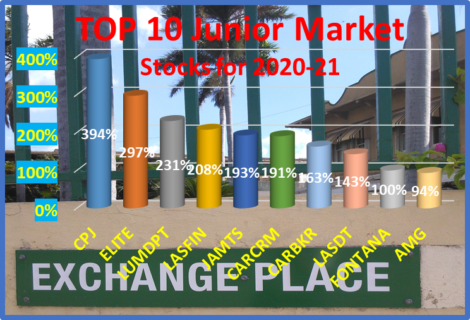
The top three stocks in the Junior Market with the potential to gain between 231 to 394 percent by March 2021 are Caribbean Producers, followed by Elite Diagnostic and Limber Depot. With expected gains of 149 to 260 percent, the top three Main Market stocks are, Berger Paints followed by Radio Jamaica and Carreras in the third position.
The local stock market’s targeted average PE ratio is 20based on profits of companies reporting full year’s results, from now to the second quarter in 2021. The Junior and Main markets are currently trading well below the market average, indicating the potential gains ahead. The JSE Main Market ended the week, with an overall PE of 15.5, The Junior Market 13.3, based on ICInsider.com’s projected 2020-21 earnings. The PE ratio for the Junior Market Top 10 stocks average a mere 7.2 at just 54 percent to the average of the Junior Market. The Main Market TOP 10 stocks trade at a PE of 9 or 58 percent of the PE of that market.
The average projected gain for the Junior Market IC TOP 10 stocks is 201 percent and 132 percent down from140 percent last week for the JSE Main Market, based on 2020-21 earnings, indicating greater likely gains for Junior Market stocks than the Main Market.
IC TOP 10 stocks are likely to deliver the best returns up to March 2021 and ranked in order of potential gains, based on likely gain for each company, taking into account the earnings and PE ratios for the current fiscal year.  Expected values will change as stock prices fluctuate and result in movements in and out of the lists weekly. Revisions to earnings per share are ongoing, based on receipt of new information.

Persons who compiled this report may have an interest in securities commented on in this report.
 

Berger Paints Q3 profit surges

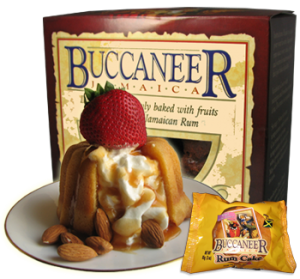
Profit before taxation soared an outstanding 524 percent for Berger Paints for the third quarter, but that was insufficient to wipe out the losses incurred in the first and second quarters, amounting to $63 million.  

Berger Paints Q3 profit jumps.

For the quarter ended September 2020, the company recorded a profit before tax of $58 million, up from $9 million for the corresponding quarter in 2019.
Taxation climbed 700 percent for the quarter from a loss of $1.8 million to $14.7 million for the quarter but dropped by 162 percent for the year from $10 million to a credit of $6 million. Net profit came in at $43 million for the quarter, a 481 percent jump over the comparative quarter’s figure of $7.4 million.
Profit after tax dropped 151 percent from $40 million to a loss of $20 million for the nine months period after-tax, losing $26 million, for the nine months to September, compared to a profit of $50 billion at the end of September 2019. Heading into the traditional festive season, Berger will be hoping to close out the fiscal year on a high note with a strong increase in the final quarter profit.
Revenue improved by eight percent for the quarter from $534 million to $574 million but fell nine percent from $1.63 billion to $1.49 billion for the nine months to September.
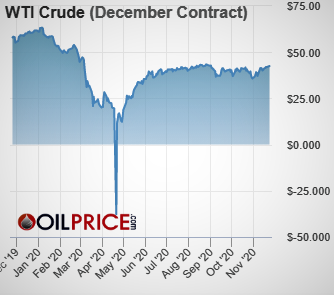
Direct Manufacturing expenses fell by 29.7 percent for both the quarter and the year to date, recorded at $304 million and was down 26 percent to $763 million respectively. Gross profit jumped 103 percent for the quarter from $150 million to $304 million and increased 20 percent for the year to date from $609 million to $732 million, with gross profit margins of 53 percent for the quarter, up from just 28 percent in 2019 and 49 percent for the 2020 nine months, up from 37 percent in 2019. The input in paint production is heavily based on petrochemicals as such a fall in the price of oil on the world market would result in reduced production cost for the company.
Depreciation jumped 78 percent for the quarter to $20 million and a 58 percent increase to $45 million for the year. Other operating expenses declined 8 percent for the quarter from $118 million to $108 million and saw a 25 percent rise for the year from $262 million to $327 million. Other income for the quarter stood at $7.2 million for the quarter up from just $182,000 and at $7.7 million for the year to date from $54,000 in 2019.
The company implemented new information technology last year, which the company claims are working well. “The recently deployed Enterprise Resource Planning (ERP) system has settled and has been providing Management with key insights to allow for a deeper appreciation of the business drivers and, with that, quicker decision making. Although a relatively new deployment, it is already contributing value to the business,” the Chairman, Adam N. Sabga, remarked in a statement accompanying the quarterly.
Net cash inflows generated cash of $21 million, but a reduction in amounts due to payables and fellow subsidiaries resulted in cash from operating activities was an outflow of $190 million and capital spend and loan payments increased cash outflows to $263 million. Current assets stood at $1.37 million inclusive of Inventories of $509 million, Receivables of $443 million and cash and bank balances of $306 million.  Current liabilities tallied $572 million inclusive of $126 million due to the immediate parent company and $369 million to fellow subsidiaries. At the end of September, shareholder’s equity stood at $1.1 billion.
Earnings per share came in at 20 cents for the quarter and a loss of 10 cents for the nine months to September and ICInsider.com projects full-year earnings of $2.25 per share with a rise to $2.80 in 2021.
The stock is currently trading at $11.85 on the Main Market of the Jamaica Stock Exchange with a PE ratio of 5.3 times 2020 earnings.

Price movements bring change to IC TOP 10

Stocks rose to their highest level since mid-April on the Jamaican Stock Exchange Main Market in the past week, during the past week the Junior Market traded at the highest level in seven weeks, with moves in both markets confirming the bullish signal technical indicators been flashing for weeks.
The movement in the markets resulted in shifts in the IC TOP 10. In the Junior Market Top 10, Access Financial dropped out after a week with the price moving from $20.02 to $22 while AMG Packaging moving in to sit in ninth position. Jamaican Teas shareholders approved a three for one stock split leading the stock up to $6.70 from $5.50. Eppley lost its Main Market TOP 10 position with the price moving up from $18.97 to $20.02  and is replaced by Jamaica Producers.
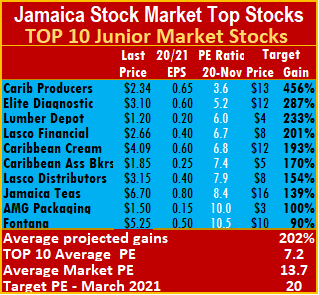
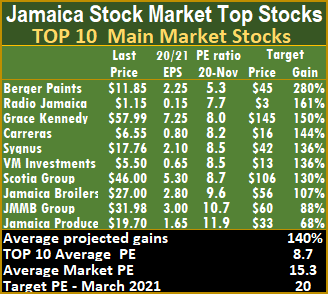
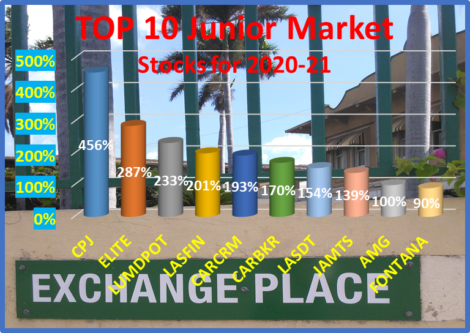
The top three stocks in the Junior Market with the potential to gain between 233 to 456 percent by March 2021are Caribbean Producers, followed by Elite Diagnostic and Limber Depot. With expected gains of 150 to 280 percent, the top three Main Market stocks are Berger Paints, followed by Radio Jamaica and Grace Kennedy in the third position.
The local stock market’s targeted average PE ratio is 20 based on profits of companies reporting full year’s results, from now to the second quarter in 2021. The Junior and Main markets are currently trading well below the market average, indicating the potential gains ahead. The JSE Main Market ended the week, with an overall PE of 15.3 and the Junior Market 13.7, based on ICInsider.com’s projected 2020-21 earnings. The average PE ratio of the Junior Market has been slowly rising, with better profit opportunities than the Main Market and narrowing the gap. The PE ratio for the Junior Market Top 10 stocks average a mere 7.2 at just 53 percent to the average of the Junior Market. The Main Market TOP 10 stocks trade at a PE of 8.7 or 57 percent of the PE of that market.
The average projected gain for the Junior Market IC TOP 10 stocks is 202 percent and 140 percent for the JSE Main Market, based on 2020-21 earnings, indicating greater gains are likely in the Junior Market than the Main Market.
IC TOP 10 stocks are likely to deliver the best returns up to March 2021 and ranked in order of potential gains, based on likely gain for each company, taking into account the earnings and PE ratios for the current fiscal year.  Expected values will change as stock prices fluctuate and result in movements in and out of the lists weekly. Revisions to earnings per share are ongoing, based on receipt of new information.

Persons who compiled this report may have an interest in securities commented on in this report.

Seprod’s sugar closure sweetens profit

Seprod’s costly journey into a new difficult area of sugar manufacturing resulted in billion-dollar losses for the group. That management chooses to take on the worse performing and most difficult sugar operation in Jamaica raises some fundamental questions about corporate decision making, but then sometimes experience teaches wisdom.
After shedding the above loss-making business, profit from continuing operations surged 351 percent to $1.3 billion for the September quarter, up from just $285 million in 2019, but the jump benefited from $780 million, generated from other operating income, with $762 million of it being gains realized on the sale of a property.
Without the additional boost from the property sale, profit from continuing operations would stand at $551 million for the quarter, an increase of 94 percent, and $1.8 billion for the nine months to September, an increase of 52 percent. Earnings per share came out at $1.75 for the quarter and $3.38 for the nine months to September but would stand at 75 cents for the quarter and $2.41 for the year to date when adjusted for the one-off gain.
Revenue saw a sharp increase of 23 percent for the quarter to $10.1 billion from $8.2 billion and more moderate growth of 16 percent for the nine months to September to $28.7 billion from $24.5 billion in 2019.
Direct Expenses grew 12 percent for the quarter from $5.3 billion in 2019 to just under $6 billion in 2019, and 15 percent for the year-to-date from $15.8 billion to $18.1 billion. Gross profit margin increased to 41 percent for the quarter from 35.2 in 2019 and 37 percent for the nine-month period from 36.4 percent. Gross profit (GOP) jumped 42 percent for the September quarter moving from $2.9 billion in 2019 to $4.1 billion in 2020. GOP increased 17 percent to $18 billion from $15.8 billion for the nine months to September in 2019.
The Manufacturing segment generated revenues from third parties of $7.26 billion, up from $6.7 billion in 2019 while, Distribution accounted for revenues of $21.4 billion in 2020 and $18 billion in 2019. Segment results for the Manufacturing amounted to $2.47 billion in 2020 from $2 billion in 2019, while Distribution contributed $1.36 billion from just $684 million in 2019.
Despite a 52 percent increase in administrative and other operating expenses from $2.1 billion to $3.3 billion, profit before finance and other costs grew by 159 percent for the period from $651 million to $1.7 billion.

Some of Seprod”s products.

Loss from discontinued sugar manufacturing operations contributed to a loss of $31 million for the September quarter and $47 million for nine months. Total comprehensive income stood at $1.3 billion for the quarter, up from a loss of $124 million, and $2.6 billion for the nine months to September, up from $470 million in 2019.
Gross cash flow from operating activities stood at $4 billion, and working capital pulled the amount down to $2 billion. Dividend payment of $367 million and acquisition of property net and loan receipts of $1 billion saw net funds for the period increasing $1.6 billion to end at $3 billion. At the end of September, shareholders’ equity stood at $16.5 billion, while $14 billion was due from borrowings. Current assets ended the period at $17 billion including, Inventories of $6 billion, receivables $7 billion and cash and bank balances of $3 billion, while Current Liabilities stood at $9.6 billion with current loan liability amounting to $3.6 billion.
The stock is currently trading at $60.75 on the Main Market of the Jamaica Stock Exchange. With the most profitable period being the December quarter, IC Insider.com is forecasting earnings of $4 per share for a PE of 15.2 based on 2020 earnings.
The group is involved in the Manufacturing and Distribution of various household goods for the local and overseas markets, including cereals, flour, milk, cooking oil, margarine, to name a few. the stock has moved up in price since the results, historically, it has delivered some of the best returns for investors in the local market over several years. It’s a good long term investment.

Shake up of IC TOP 10

A raft of company results was unleased on the Jamaican Stock Exchange, resulting in changes to the IC TOP 10. Some companies have not yet recovered sufficiently from the fall out following the COVID-19 outbreak earlier this year.

Fontana Waterloo Square Branch just after it was opened in October 2019.

Entering the Junior Markets Top10 are Access Financial and Fontana. Moving out are General Accident and Stationery and Office Supplies, both of which reported lower than expected profits for the September quarter and year to date. NCB Financial dropped out of the Main Market TOP 10 with full-year earnings coming in at $8.01 as the group stepped up the provisioning of expected credit losses. Eppley moved into the spot left vacant by NCB.
The Main Market closed the past week with notable gains in the market index while the Junior Market slipped modestly at the end of the week. Signals in the market continue to point to higher prices ahead. The Junior Market is currently signaling a big surge starting in December as short-term moving averages cross over longer-term ones to confirm a strong rally ahead. The move in the Main Market continues the move gradually higher ahead of the year-end and is in keeping with bullish signs that points to more gains ahead.
This week’s focus: Fontana had a 21 percent increase in revenues for the quarter ending September to $1.11 billion, over $921 million in the 2019 corresponding quarter. Gross profit also increased 25 percent to $395 million above $316 million generated in the September 2019 quarter. Administrative selling and other expenses grew modestly by 4.5 percent from $296 million to $310 million, even as the company benefited from economies of scale with the Waterloo Square location. Net profits increased to $45 million, a 146 percent improvement from the $18 million recorded in the prior year, with foreign exchange losses adding $27 million to finance cost in the 2020 quarter. The company is on target to earn 50 cents per share for the current financial year ending June 2021.
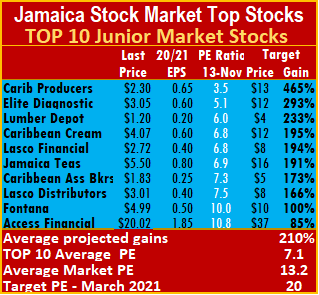
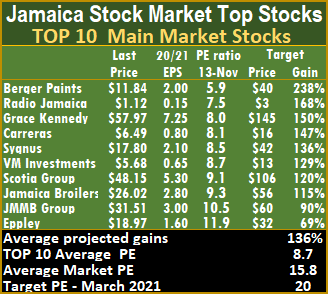
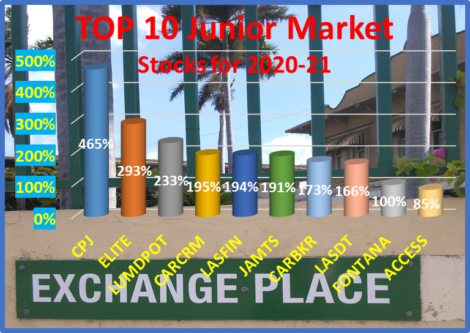
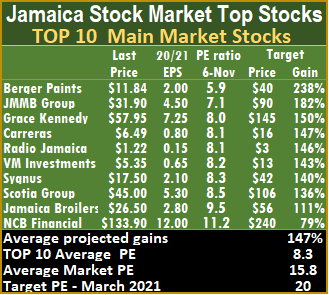
The top three stocks in Junior Market remain as they were this past week, with the potential to gain between 233 to 465 percent by March 2021. Caribbean Producers heads the list, followed by Elite Diagnostic and Limber Depot. The focus on all three is on the 2021 fiscal year profit, projected to recover from reduced profit for the 2020 financial year. With expected gains of 168 to 238 percent, the top three Main Market stocks are now, Berger Paints followed by JMMB Group and Radio Jamaica in the third position.
The local stock market’s targeted average PE ratio is 20 based on the profits of companies reporting full year’s results from now to the second quarter in 2021. The Junior and Main markets are currently trading well below the market average, indicating the potential gains ahead. The JSE Main Market ended the week, with an overall PE of 15.8 and the Junior Market 13.2, based on ICInsider.com’s projected 2020-21 earnings. The average PE ratio of the Junior Market has been slowly rising, with better profit opportunities than the Main Market and narrowing the gap. The PE ratio for the Junior Market Top 10 stocks average a mere 7.1 at just 54 percent to the Junior Market average. The Main Market TOP 10 stocks trade at a PE of 8.7 or 55 percent of the PE of that market.
The average projected gain for the Junior Market IC TOP 10 stocks is 210 percent and 136 percent for the JSE Main Market, based on 2020-21 earnings, indicating greater gains are likely in the Junior Market than the Main Market.
IC TOP 10 stocks are likely to deliver the best returns up to March 2021 and ranked in order of potential gains, based on likely gain for each company, taking into account the earnings and PE ratios for the current fiscal year.  Expected values will change as stock prices fluctuate and result in movements in and out of the lists weekly. Revisions to earnings per share are ongoing, based on receipt of new information.

Persons who compiled this report may have an interest in securities commented on in this report.

Q3 profit rises 33% at Grace Kennedy

Grace Kennedy continues to enjoy a phenomenal year, with profit attributed to the company’s shareholders, rising 33 percent to $1.68 billion for the September quarter, from $1.26 billion for the 2019 third quarter and 35 percent for the nine months to September to $4.4 billion from $3.27 billion the corresponding period in 2019.

Don Wehby CEO of Grace

Taxation more than doubled in both periods, but profit before tax grew 49 percent in the third quarter to $2.8 billion and 51.5 percent to $7.3 billion for the nine-months.
Total comprehensive income increased by 5 percent for the three-month period to $2.2 billion but dropped by 37 percent for the nine months to September, from $9.2 billion to $5.8 billion.
The group had one of the best years for growth in revenues so far, with a rise of 16 percent for the quarter to $29.6 billion, from $25.5 billion in 2019 and up 12 percent $86 billion from $77 billion for the nine months. The previous best revenue performance was back in 2009 with a full-year increase of 19.7 percent and then 2015, with an increase of 12.6 percent, thereafter growth declined annually to 2019. Revenues grew 10.7 percent in 2016, 5.5 percent in 2017, 4.8 percent in 2018 and just 5.7 percent in 2019. According to the Managing Director Don Wehby, “the strong growth in revenues was fueled by the food division and particular international food business.”
Contributing to the 2020 growth is added revenue brought in with the acquisition of the majority shares in Key Insurance helping to drive revenue for the Insurance segment by 28 percent over 2019 to garner $7.7 billion. Food and trading segment continues to account for the lion’s share of the revenue tallying $68 billion for the nine months period, an 11 percent increase over 2019. Revenue for the Banking segment increased just 3 percent to $4.7 billion while Money Transfer grew 12 percent to $6.5 billion.

Grace Kennedy new headquarters in downtown Kingston

Expenses inclusive of net impairment losses increased 16 percent to $27.5 billion for the quarter and 12 percent to $81 billion for the year to date over the corresponding periods. While separating direct cost from the administrative cost in their audited accounts, Grace continues to short change investors by lumping all costs together in their interim reports.
Net Cash generating operations brought in $9.7 billion. Total assets grew by eight percent to $168 billion with growth in investment securities and receivables but a decline in inventories. At the end of September, shareholders’ equity stood at $56.5 billion and borrowings at $25 billion.
Profit for the quarter equates to Earnings per share of $1.69 and $4.47 for the nine months and should exceed $6.50 for the full year. The stock last traded at $58 on the Main Market of the Jamaica Stock Exchange with a PE ratio of 9 times 2020 earnings.

Mailpac Q3 profit surges 129%

MailPac Group (MGL) continues to enjoy increasing strong profit growth despite the current pandemic, with revenue jumping 58 percent in the September quarter over the 2019 quarter and profit more than doubling.

Mailpac dominated trading on Thursday with 84% of the total volume of the market on Tuesday.

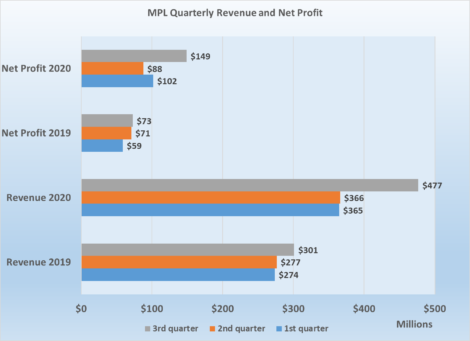
The company recorded net profit of $149 million for the quarter, a solid 129 percent jump from the $65 million the operation recorded for the September 2019 quarter. For the year-to-date, there was an even more sizeable growth of 150 percent, moving from $203 million in 2019 to $339 at the end of September 2020.
Revenues grew 58 percent over the September 2019 quarter, from $301 million to $477 million, and grew a stunning 30 percent over the June 2020 quarter with revenues of $366 million. For the year to September, revenues rose to $1.2 billion, 42 percent more than the $851 million recorded at the end of September 2019.
Gross profit rose to 50 percent from 44 percent in the June quarter but fell to 48 percent for the nine months compared to 52 percent in 2019.
Direct expenses jumped 57 percent from $150 million for the September 2019 quarter to $236 million for the September 2020 quarter and 15 percent over the June 2020 quarter. For the year to date, the expenses climbed by 52 percent from $410 million in 2019 to $623 million in 2020. Gross profit stood at $240 million for the quarter ending September 2020, up from $150 million in 2019 and $584 million for the year to date versus $442 million in 2019.
Administrative, selling and promotion expenses increased 22 percent over the second quarter and slipped two percent from the September 2019 quarterly figure of $86 million to $84 million. The Executive Chairman attributes the increase in expenses in the third quarter over the second quarter to its expanding operations, the partnership with PriceSmart presumably one such notable factor.

For the nine months to September, selling and promotion expenses amount to $30 million, up from $29 million in 2019, while administrative and general expenses dropped to $199 million, from $218 million in 2019. Overall, these expenses were down seven percent from $246 in 2019 to $228 million at the end of September 2020. The effect, operating profit, rose a strong 140 percent over the comparative quarter to $157 million from $65 million in 2019 and an 82 percent increase for the nine-month period, moving from $195 million to $356 million.
Finance costs rose for the quarter from $352,000 in 2019 to $11 million in 2020, while the nine months to September ended at $31 million from $3 million for 2019.

Mailpac CEO Khary Robinson.

Gross cash flow brought in $346 million but MGL recorded trade and other payables increase of $127 million, spent $12 million on the acquisition of fixed assets and paid $225 million in dividends to end with cash and equivalents of $309 million at the end of September. Shareholders’ equity stood at $467 million. Current assets ended the period at $369 million and Current liabilities at $185 million.
Earnings per share came out at 6 cents for the quarter and 14 cents to September. IC Insider.com is forecasting Mailpac will end the year at 20 cents per share for PE of 11 times earnings and they should go on to earn 33 cents in 2021.
At the IPO, the company projected a profit of $317 million in 2020, while IC Insider.com projected $356 and 14 cents per share. The nine months’ results are just below our full year’s forecast.
The stock is priced below the average of the Junior Market of 12 and offers strong upside potential. The strong current growth continues the trend since 2017, when revenues grew 12.2 percent, 25.7 percent in 2018 and 28.8 percent for the first half of 2019. The company offers a convenient way to shop and far less costly than traditional ways. Listing on the stock exchange provides greater credibility that augurs well for increased business. MGL provides clients with physical addresses in Miami, Florida, where they can receive all goods purchased are flown to Jamaica. The company clears all goods and delivers them to the customers at their homes or for collection.
On the negative side, the main asset owned is the brand and technology that drives the business. Other entities could break into the market and squeeze profit margin longer term.
Coming off a robust third quarter, MGL is entering what is normally the busiest time of the year for the company that should continue the solid growth experienced in 2020 so far.
The stock currently trades at $2.13 on the Junior Market of the Jamaica Stock Exchange. The company paid an interim dividend of 5 cents per share in July 2020 and 5 cents per share in October and more is expected, with the company promising at the time of the IPO that the Directors intend to pursue a dividend policy that projects an annual dividend of up to 75 percent of net profits available for distribution.

Stationery & Office back in IC TOP 10

Stationery and Office Supplies returns to the Junior Market IC TOP 10 list for the first time since February last year as the stock price dropped to $4.55 and replaced Medical Disposables that reported a loss in the half-year, resulted in the downgrading of full year’s earnings and potential stock price movement.

Stationery & Office Supplies Head quarters

Medical Disposables earnings per share are now projected at 30 cents for the current year and 85 cents for the succeeding year and put the PE ratio at 14 times current-year earnings. As indicated last week, Lasco Financial was set to be a big winner for the past week, after the company reported outstanding second-quarter profit. The stock rose 23 percent to close the week at $2.60 after trading as high as $2.75 in the week. The price should move higher going forward, with likely earnings around 40 cents per share for the current fiscal year and a PE ratio of 6.5.
Signals in the market continue to point to higher prices ahead. The Junior Market is currently signaling a big surge in a few weeks as short-term moving averages cross over longer-term ones to confirm a strong rally ahead. The big move in the Main market seems a few months away, but signs are that the market should continue to move gradually higher ahead of the year-end.
This week’s focus: Grace Kennedy continues to enjoy a phenomenal year, with profit attributed to the company’s shareholders, rising 33 percent to $1.68 billion in the September quarter, from $1.26 billion for the third quarter in the previous year and grew 35 percent for the nine months to September, to just $4.4 billion from $3.27 billion the corresponding period in 2019. Taxation more than doubled in both periods, but profit before tax grew 49 percent in the third quarter to $2.79 billion and for the nine-months, it rose 51.5 percent to $7.3 billion. Earnings per share are $1.69 for the quarter and $4.47 for the nine months and should exceed $6 for the full year.
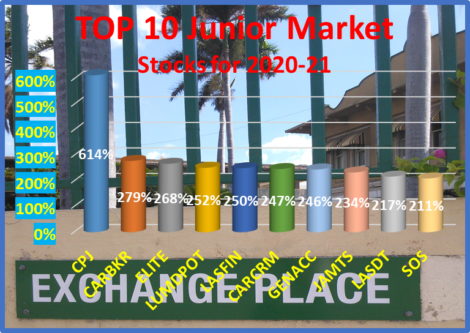
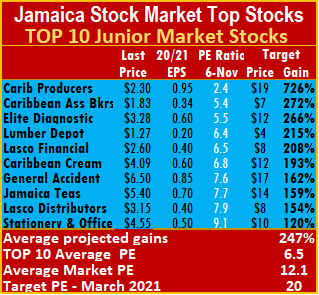
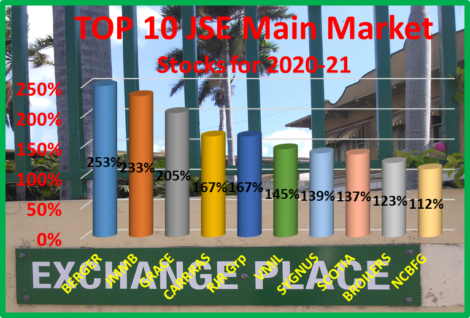
The top three stocks in Junior Market remain as they were this past week, with the potential to gain between 272 to 726 percent by March 2021. Caribbean Producers heads the list, followed by Caribbean Assurance Brokers and elite Diagnostic. The focus on all three is on the 2021 fiscal year profit, projected to recover from reduced profit for the 2020 financial year. With expected gains of 150 to 238 percent, the top three Main Market stocks are now, Berger Paints followed by JMMB Group and Grace Kennedy in the third position.
The local stock market’s targeted average PE ratio is 20 based on the profits of companies reporting full year’s results from now to the second quarter in 2021. The Junior and Main markets are currently trading well below the market average, indicating the potential gains ahead. The JSE Main Market ended the week, with an overall PE of 15.8 and the Junior Market 12.1, based on ICInsider.com’s projected 2020-21 earnings. The average PE ratio of the Junior Market has been slowly rising, with better profit opportunities than the Main Market and narrowing the gap. The PE ratio for the Junior Market Top 10 stocks average a mere 6.5 at just 54 percent to the average of the Junior Market. The Main Market TOP 10 stocks trade at a PE of 8.3 or 52 percent of the PE of that market.
The average projected gain for the Junior Market IC TOP 10 stocks is 247 percent, and 147 percent for the JSE Main Market, based on 2020-21 earnings, indicating potentially greater gains in the Junior Market than the Main Market.
IC TOP 10 stocks are likely to deliver the best returns up to March 2021 and ranked in order of potential gains, based on likely gain for each company, taking into account the earnings and PE ratios for the current fiscal year.  Expected values will change as stock prices fluctuate and result in movements in and out of the lists for most weeks. Revisions to earnings per share are ongoing, based on receipt of new information.

Persons who compiled this report may have an interest in securities commented on in this report.