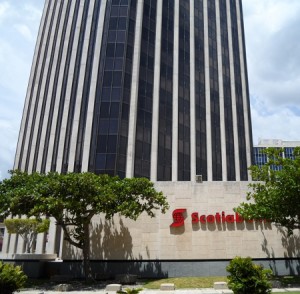
Scotia Group to delist from JSE


Scotia Group, after listing on the Jamaica Stock Exchange since 1967, is now slated to be taken private at a buyout price of $61.50, the Group announced today.  
The group reports that, based on the unanimous recommendation of a committee of independent directors of the board of directors of SGJL, it has entered into a definitive arrangement agreement with its majority shareholder, Scotiabank Caribbean Holdings Limited to take SGJL private whereby, among other things, all of the issued and outstanding shares of SGJL that SCHL does not currently own will be repurchased for $61.50 in cash per share, subject to court approval as well as the approval of SGJL’s minority shareholders.  

Scotia Group released results for the year to April, with profit of $5.96 billion, up from $5 billion last year for the April quarter and $10 billion for the year to date, versus $9.2 billion in 2025. Earnings per share came in at $1.92 for the latest quarter and $3.24 for the year to date. The offer price is only 8 times the current year’s earnings, which undervalues the shares. There was also an announcement of a dividend of 45 cents per share to be paid in July.
Profit explosion at Transjamaican


Profit surged a solid 46 percent at Jamaica’s premier toll operators –Transjamaican Highway to US$13.2 million, for the quarter to March this year, compared to US$9.1 million in 2025. The vastly improved profit performance flowed from revenues that jumped an almost incredible 29 percent to US$29 million, from US$22.5 million for the 2025 first quarter.

Management indicated that “increased commuter traffic across the network was one area that contributed to the growth in revenues.

While revenues were climbing sharply, helped by US$3.5 million earned from the Mandeville leg of the highway, which came on stream during the period, costs remained subdued, with a 9 percent rise to US$12.3 million from $11.3 million in 2025. Taxation rose from US$3 million to US$3.55 million.

The company reported earnings per share of 0.0106 US cents, equivalent to 16.74 Jamaican cents per share, which puts the full year earnings at 67 Jamaican cents for the year. At this level of earnings, the stock is priced around 11 times current year’s profit.

Following the end of the quarter, a dividend of US$13 million, equivalent to all the profit generated in the quarter, was paid in April, an increase of 30 percent over US$10 million paid in the first half of 2025.

Omni Industries shows promise but..


Omni Industries, the first company listed on the Junior Market of the Jamaica Stock Exchange in 2024, reported results for the nine months to September, with the first full quarter after the IPO offer in May. The result for the quarter is promising, with pre-tax profit moving from $32 million to $38 million and after tax from $24 million to $38 million with the listing resulting in no taxes payable for another 5 years on profits, since listing on the Junior Market.
 

For the 9 months to September, earnings before tax amounted to $184 million and after the provision of $38 million corporate profit tax, ended with a net profit of $146 million. Based on the average number of shares outstanding, earnings per share ended at 6 cents instead of the 10.4 cents reported by the company and 1.5 cents for the September quarter instead of the reported 2.7 cents per share that was based on the 1.4 billion shares instead of approximately 2.375 billion units. For the year to December the company used the same number of shares as they used for the September results to compute per share earnings and provided no EP for 2023. Instead of EPS of a loss of 1.8 cents for the December quarter and 8.6 cents for the full year, earnings per share are actually a loss of 1-.4 cents for the last quarter with 2023 being 7 cents and 5 cents for the full year with 2023 being 6.7 cents.
The performance achieved with the Gross profit margin climbing is probably the most telling feature of the results if it is sustainable. Margins surged in the third quarter from 37 percent in 2023 to more than 50 percent in 2024, pushing the nine months to September to 47.4 percent from 37.5 percent in 2023. Unfortunately, this performance was not carried into the final quarter in December with the margin dropping to 38 percent down from 45 percent in 2023 and helped in plunging the company into a loss in the final 0224 quarter of $25 million versus a loss before tax in 2023 of $21 million, with the full year profit coming in at $135 million before tax versus $180 million in 2023.
Revenues declined by 12 percent to $427.5 million for the three months to September 2024, compared to $488 million in the same period in 2023. Revenues declined marginally, to $1.51 billion for the nine months in 2024 from $1.57 billion in 2023. The decline is “largely attributed  to adverse weather conditions, including Hurricane Beryl in early July and ongoing heavy rains impacting the island. Additionally, a cement shortage has affected the construction industry, which directly impacted our revenue streams,” the company managing director, Patrick Kumst informed shareholders in his commentary on the results.

Administrative costs rose by a third from $60 million to $80.4 million for the quarter and up 43 percent from $162 million to $230 million for the nine months. Selling expenses jumped by 30 percent for the quarter to $33.5 million from $26 million in 2023 and for the year to September, it increased by 16 percent to $111.5 million from $70 million in 2023. For the reporting quarter factory expenses rose by 10 percent to $56 million, from $51 million and increased by 9 percent to $163 million for the nine months to September from $150 million in the 2023 period.

The managing director went on to state, “this rise in administrative costs was primarily due to higher professional fees, marketing, and other expenses related to our IPO. Selling expenses year‐to‐date were driven mainly by haulage and export-related costs, while the 9 percent increase in factory expenses resulted from increased repair and maintenance costs. With our ongoing strategic retooling and new equipment acquisitions, we anticipate a reduction and improved optimization of these expenses in the near term. Finance costs for the quarter totalled $9.8 million, reflecting a 20 percent decrease compared to the same period in 2023. Year‐to‐date finance costs amounted to $29 million, a 32 percent reduction from the prior year. This decrease primarily stems from the company’s proactive debt reduction efforts, resulting in lower interest expenses for the period.”
“Retooling process has commenced, and the additional capital raised post‐IPO will be utilized to acquire further equipment. Currently, we are in the negotiation phase with suppliers, and one machine has already been commissioned as of September 2024.”
The operations generated gross cash flows of $211 million, with increased working capital consuming it, leaving a cash deficit of $153 million before capital spend of $67 million. After accounting for $239 million from the IPO the company ended with a cash flow deficit of $50 million and a reduction of funds on hand to $62 million. Loans net of new funding amounting to $40 million were repaid and a dividend of $24 million was paid out before the IPO.
Current assets ended the period at $1.2 billion, including trade and other receivables of $469 million, inventories of $661 million cash and bank balances of $61 million. Current liabilities amount to $432 million. Net current assets ended the period at $513 million.
The company ended with Shareholders’ equity of $946 million and long term borrowings at $312 million and no short term loans. Net asset value ended the period at $0.38 with the stock selling at 2.8 times book value, compared to the Junior Market average of 1.8.
Another error in the quarterly report is that the share capital is still being stated as $20.09 million in the statement of changes in equity but that has been increased by $250 million new shares that were issued in the IPO, as such the caption headed share capital should reflect the change but it is not. The company should seek the advice of a knowledgeable accountant to get the presentation and computation right as they clearly don’t have that in house.

Scotia a Xmas of goodies in 2025 & beyond

Scotia Group delivered a respectable 17 percent jump in profit to shareholders in the just concluded fiscal year to October. Investors drove the price up a solid 34 percent for the year to date, in addition to dividends amounting to $1.70 as revenues climbed 15.8 percent to $69 billion from $59.6 billion in the October quarter, with profit after tax rising to $20.15 billion from $17.2 billion in 2023. For the October quarter, profit rose a solid 32 percent to $6.16 billion from $4.67 billion in 2023.


The group paid dividends amounting to $5.1 billion during the fiscal year versus $4.2 billion in 2023 a payout ratio of roughly 25 percent of the annual profit. A dividend of 45 cents per share has been declared for payment in January 2025.
Total revenues rose 16.2 percent for the October quarter to $18.4 billion from $15.84 billion in 2023.
B growth in loans the main propeller of increasing profits, climbed 16 percent for the year to $312.76 billion but rose at an annual rate of 22 percent in the second half and 29 percent in the final quarter. With lower interest rates expected in 2025, the demand for loans could grow even faster than in the final quarter, subject to demand and management’s decision to take on increased risk.
Interest Income rose 14.5 percent in the last quarter to $12.64 billion from $11 billion in 2023 and for the year it moved up 18.4 percent to $59.7 billion from $48.34 billion in 2023.
Net interest income rose 15.4 percent to $12 billion in the last quarter of this year, from $10.57 billion in the prior year and for the full year, it jumped 17.4 percent to $46.3 billion from $39.46 billion in the previous year. Net fee and Commission income went from $1.8 billion in the $2.1 billion in October 2024 quarter and increased 17.2 percent from $6.74 billion in the half year in 2023 to $7.23 billion in the current year.
Other income amounted to just $158.6 million in the October 2024 quarter, up from $67 million in the previous year and for the fiscal year, rose 25.5 percent to $661 million from $527 million. Insurance premium income jumped 51 percent to $1 billion for the latest quarter, up from $673 billion in the prior year and for the year to October grew 26 percent from $2.79 billion in 2023 to $3.5 billion.
Net foreign currency activities generated revenues of $2.48 billion up 9.5 percent from $2.27 billion in the comparative period in 2023 and for the year, revenues rose 6.4 percent of $9.3 Billion versus $8.75 billion in 2023.
Credit impairment losses jumped sharply by 71 percent to $1.26 billion in the October quarter from $740 million last year and for the fiscal year, it climbed 73.5 percent to $4.16 billion from $2.4 billion in 2023.
Segment results show third party revenues for Corporate and Commercial banking increasing 11.3 percent to $15.8 billion, with revenues of $14.2 billion in 2023. Net segment results surged 24 percent to $13.7 billion over $11.1 billion in 2023. Treasury segment generated revenues of $15.75 billion up 24 percent from $12.68 billion in 2023 with a profit of $4.86 billion in 2024 up 36 percent compared with $3.57 billion in the previous year. Investment Management Services generated a 1.7 percent growth in revenues of $3.14 billion and net results that rose just 2 percent to $1.77 billion in 2024, with revenues of $3.1 billion in 2023 and net results of $1.73 billion. Insurance Services accounted for revenues of $4.76 billion, up 13 percent over $4.2 billion in 2023 and net results of $4.8 billion up by 24 percent compared with 2023, with revenues of $4.2 billion and profit of $3.9 billion.

Staff cost fell 10 percent in the last quarter to $2.92 billion from $3.24 billion in 2023 and rose 6.3 percent to $11.8 billion in the current year from $11.1 billion last year. Other operating expenses rose 4.2 percent to $3.1 billion in the quarter from $2.99 billion in 2023 and increased 4.6 percent in the year to $13.24 billion from $12.66 billion in the prior year. Tax on assets rose 13 percent to $1.55 from $1.376 billion in 2023. Taxation rose 16 percent to $9.55 billion, for the year from $8.2 billion in 2023.

Customer deposits grew by 7 percent to $479 billion. Shareholders’ equity ended the period at $138.5 billion, up from $126.5 billion at the end of October 2023.
Earnings per share for the quarter amounts to $1.98 and $6.48 for the year. IC Insider.com projects earnings of $9 per share for the 2025 fiscal year, with a PE of 5.8 times the current year’s earnings based on the price of $52 the stock traded at on the Jamaica Stock Exchange. Net asset value ended the period at $44.50 with the stock selling at a low 1.15 times book value.
Scotia Group has the ICInsider.com Buy Rated seal of approval.

Main Event leads in latest quarterly profit

The vast majority of listed companies have now released earnings for the period ending in December or January, recently showing various degrees of success and some failures. Results during the past week, a number of results were released to the Jamaica Stock Exchange.

Main Event revenues growing nicely profit stalls.

The star performer was Main Event posting a 211 percent rise in revenues to $627 million from just $202 million in 2022 and generating a 390 percent rise in profit to $120 million from a loss of $41 million in 2022, with earning per share of 39 cents for the January first quarter showing and seeming poised to earn $1.80 for the year.
Blue Power reported an increase in revenues year over year, with a profit of $13 million compared with a profit of $9 million for the third quarter to January 2022. For the nine months, revenues rose 82 percent to $633 million from $347 million in 2022 with profit slipping from $204 million to $29 million, with earnings per share a mere 5 cents. The 2022 results included gain on sale of Investment property amounting to $346 million. For the January quarter revenues amounted to $194 million up from $135 million with a profit of $13 million up from $9 million in 2022.
CAC 2000 reported reduced revenues of $128 million for the first quarter to January from $222 million in 2022 and a loss of $52 million down from a loss of $32 million in 2022. Management stated that the results was affected by “delays in delivery of goods due to longer lead and delivery times.”
Fosrich released full year results to December, with profit jumping to $325 million from $199 million in 2021 as revenues climbed a solid 43.4 percent to $3.37 billion and delivered earnings per share of just 6 cents and placing the stock in a seriously overvalued position. The company recorded a $61 million loss in the final quarter with revenues rising 19.5 percent in the quarter to $795 million from $665 million in 2021, with the September quarterly growth being higher at 31 percent.
Dolla Financial posted increased profit of $280 million or 18 cents per share from revenues of $746 million up 115 percent from profit of $130 million in 2021, with revenues up 90 percent on the $395 million in 2021. The company should go on to earn 40 cents in 2023. In the earning call, Trevene Mckenzie, the Chief Financial Officer stated that they expected first quarter revenues to come in around $250 million with profit rising at least 50 percent year over year. The company also indicates that they plan to open a second branch in Guyana in Berbice town, in the second quarter.

Limners and Bards delivered disappointing first quarter results of just $7 million, down from $66 million in 2022 as revenues dropped sharply by 44 percent to $248 million from $443 million. The fall came from the Production segment, with revenues down from $58 million from $140 million with segment profit down from $62 million to $29 million while Media segment revenues dipped to $135 million from $243 million with segment fell from $35 million to $18 million while Agency was relatively steady with revenues came in at $54 million with profit of $44 million from $60 million in revenues in 2022 and profit of $46 million.
Lumber Depot suffered 7 percent decline in revenues for the January quarter with $373 million in the 2023 period versus $400 million in 2022 and profit of $29 million, a fall of 19 percent from $36 million in 2022, while revenues for the nine months to January 2023 amounts to $1.15 billion, marginally below $1.16 million garnered in 2022 and profit of $107 million in 2023 down 25 percent from $143 million in 2022.
TransJamaican Highway reported a US$7 million loss for 2022, but only after accounting for a net loss of $14 million on the acquisition of a subsidiary, which compares with a profit of US$4 million in 2021 from revenues of $53 million, with improved traffic delivering a record US$65 million in revenues in 2022. Without the exceptional loss, profit for 2022 would have been US$6.7 million or earnings per share amounting to 0.0006 US cents or 9 cents Jamaican.

First quarter profits surge 39%

Profit in the first quarter of this year surged 39 percent over the same period in 2021 for all listed companies on the Jamaica Stock Exchange, data released by the companies show a 21 percent increase in revenues.
The final numbers include results of Guardian Holdings, Massy Holdings two companies with primary listings in Trinidad as well as the recently listed Dolla Financial. Excluding results for the two Trinidad based companies, profit rose 49 percent for the rest, from a 26 percent rise in revenues.
Profits exclude exceptional one off items and do not include other comprehensive income. NCB Financial Group, JMMB Group and Scotia Group suffered major unrealized losses in their investment portfolio as a result of increased interest rates in 2022 while the two Mayberry companies saw a major reversal of investment losses incurred in 2021. The investment losses for the banking groups are shown in other comprehensive income and if included reduces the strong operating profit substantially.
Contributing to the strong rise in overall profit are companies that suffered losses or sharply reduced profits in the 2021 period and are recovering in 2022 from an economy that was mired in restrictions on trade within the local economy.
The results to date show the educational sector with just two companies growing by 1,880 percent but with a mere $12 million in profit, with revenues that grew 155 percent to $107 million. Medical & Pharmaceutical revenues rose a strong 30 percent to $1.43 billion with profits climbing 80 percent to $167 million. The  Restaurant sector’s profit rose 100 percent to $342,000, up from a loss of $184 million in 2021 as revenues rose 240 percent to $691 million. Banking profit is up 104 percent to $12.5 billion, from a 33 percent rise in revenues to $116 billion, with all the gains in profit flowing from NCB.
One of the more outstanding segments was Financial Services, with 20 companies delivering a 30 percent revenue increase to $57 billion and a 46 percent rise in after tax profit to $16.3 billion. Distribution revenues climbed 29 percent to $33.6 billion and profit rose 52 percent to $2.3 billion from just $1.5 billion last year.
Conglomerates were disappointing, with no growth in profits of $5.8 billion from a 13 percent rise in revenues to $113 billion and Manufacturing managed a 22 percent rise in profit to $4.8 billion from a 23 percent increase in revenues to $55 billion from $45 billion in 2021.
Media with just two entities delivered revenues of $1.75 billion up a mere 4 percent year over year but grew profit an attractive 68 percent to $152 million.

Revenues for the Insurance group rose just 3 percent to $86 billion and delivered a 17 percent increase in profits to $8.2 billion.
Revenues for Entertainment companies rose 23 percent to $13.5 billion with profit rising 130 percent to $1 billion with Supreme Ventures dominating with profit jumping 68 percent to $996 million.
Real Estate saw a 20 percent drop in profit from a 54 percent rise in revenues to $3.46 billion delivering a profit of $1.27 billion.
The Transportation sector saw a 71 percent increase in revenues at $10.6 billion delivering a 38 percent increase in profit to $1 billion.

SVL Q3 revenues loss exceeds $800M

Revenues popped 22 percent to $19.3 billion for the nine months, up from $15.94 billion for the gaming company Supreme Ventures, but revenues were virtually flat third quarter with sales of $6.3 billion versus $6.266 billion in 2020.  ICinsider.com computation suggests the revenue loss could be around $800 million, but there are suggestions the loss could be twice that amount.

Profit after tax for the nine months slipped marginally from $1.55 billion to $1.54 billion, but third quarter profit plunged 48 percent from $596 million in 2020 down to $311 million. Earnings per share ended at 57.7 cents and 11.8 cents for the quarter.
Lockdown during the quarter due to the spread of Covid19 resulted in reduced revenues and lower profit, Executive Chairman Gary Peart advised ICInsider.com. Taxation ate up $673 million for the year to date versus $725 million in 2020 and for the 2021 third quarter, $186 million, down from $246 million in 2020.
Direct cost rose 15 percent year over year to September to $25.2 billion, from $21.94 billion in 2020 and down just two percent for the latest quarter to $7.99 billion as gross profit was constant at 79 percent in all periods, leaving profit margins at 21 percent and translating to an increase of 9 percent to $6.54 billion in the September 2021 period, from $6 billion in 2020 and a decline of 3 percent for the quarter to $2.17 billion.
The Lotteries segment reported Gaming income of $14.4 billion and delivered segment results of $2.3 billion, for an increase of $388 million or 2.8 percent, over that of 2020, but the results for the third quarter show a revenue loss of $800 million compared to the June quarter and seems directly related to the no movement days instituted during the period. Segment results declined $626 million or 21.5 percent year over year and were down 17 percent in the quarter from $907 million to $743 million.
The Sports Betting reported segment profit of $509 million from gaming income of $8.5 billion, an increase of 62 percent over 2020. “The growth is due significantly to the attractiveness of the offers and flexibility to game, enhanced with the use of the mobile platforms and support of the eCommerce platform”, Peart advised investors. Revenues were flat in the third quarter over the June 2021 quarter. PIN codes sales declined marginally, from $8.6 billion to $8.53 billion, while reporting segment results of $139 million and was virtually flat in the third quarter over the second quarter.
Selling, general and administrative expenses rose 23 percent for the nine months to $4.48 billion and 24 percent for the quarter to $1.6 billion. The stock last traded on the Jamaica Stock Exchange at $18 at a PE of 20 times earnings.

Mailpac Q3 profit surges 129%

MailPac Group (MGL) continues to enjoy increasing strong profit growth despite the current pandemic, with revenue jumping 58 percent in the September quarter over the 2019 quarter and profit more than doubling.

Mailpac dominated trading on Thursday with 84% of the total volume of the market on Tuesday.

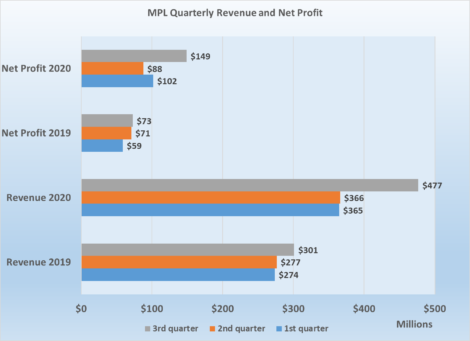
The company recorded net profit of $149 million for the quarter, a solid 129 percent jump from the $65 million the operation recorded for the September 2019 quarter. For the year-to-date, there was an even more sizeable growth of 150 percent, moving from $203 million in 2019 to $339 at the end of September 2020.
Revenues grew 58 percent over the September 2019 quarter, from $301 million to $477 million, and grew a stunning 30 percent over the June 2020 quarter with revenues of $366 million. For the year to September, revenues rose to $1.2 billion, 42 percent more than the $851 million recorded at the end of September 2019.
Gross profit rose to 50 percent from 44 percent in the June quarter but fell to 48 percent for the nine months compared to 52 percent in 2019.
Direct expenses jumped 57 percent from $150 million for the September 2019 quarter to $236 million for the September 2020 quarter and 15 percent over the June 2020 quarter. For the year to date, the expenses climbed by 52 percent from $410 million in 2019 to $623 million in 2020. Gross profit stood at $240 million for the quarter ending September 2020, up from $150 million in 2019 and $584 million for the year to date versus $442 million in 2019.
Administrative, selling and promotion expenses increased 22 percent over the second quarter and slipped two percent from the September 2019 quarterly figure of $86 million to $84 million. The Executive Chairman attributes the increase in expenses in the third quarter over the second quarter to its expanding operations, the partnership with PriceSmart presumably one such notable factor.

For the nine months to September, selling and promotion expenses amount to $30 million, up from $29 million in 2019, while administrative and general expenses dropped to $199 million, from $218 million in 2019. Overall, these expenses were down seven percent from $246 in 2019 to $228 million at the end of September 2020. The effect, operating profit, rose a strong 140 percent over the comparative quarter to $157 million from $65 million in 2019 and an 82 percent increase for the nine-month period, moving from $195 million to $356 million.
Finance costs rose for the quarter from $352,000 in 2019 to $11 million in 2020, while the nine months to September ended at $31 million from $3 million for 2019.

Mailpac CEO Khary Robinson.

Gross cash flow brought in $346 million but MGL recorded trade and other payables increase of $127 million, spent $12 million on the acquisition of fixed assets and paid $225 million in dividends to end with cash and equivalents of $309 million at the end of September. Shareholders’ equity stood at $467 million. Current assets ended the period at $369 million and Current liabilities at $185 million.
Earnings per share came out at 6 cents for the quarter and 14 cents to September. IC Insider.com is forecasting Mailpac will end the year at 20 cents per share for PE of 11 times earnings and they should go on to earn 33 cents in 2021.
At the IPO, the company projected a profit of $317 million in 2020, while IC Insider.com projected $356 and 14 cents per share. The nine months’ results are just below our full year’s forecast.
The stock is priced below the average of the Junior Market of 12 and offers strong upside potential. The strong current growth continues the trend since 2017, when revenues grew 12.2 percent, 25.7 percent in 2018 and 28.8 percent for the first half of 2019. The company offers a convenient way to shop and far less costly than traditional ways. Listing on the stock exchange provides greater credibility that augurs well for increased business. MGL provides clients with physical addresses in Miami, Florida, where they can receive all goods purchased are flown to Jamaica. The company clears all goods and delivers them to the customers at their homes or for collection.
On the negative side, the main asset owned is the brand and technology that drives the business. Other entities could break into the market and squeeze profit margin longer term.
Coming off a robust third quarter, MGL is entering what is normally the busiest time of the year for the company that should continue the solid growth experienced in 2020 so far.
The stock currently trades at $2.13 on the Junior Market of the Jamaica Stock Exchange. The company paid an interim dividend of 5 cents per share in July 2020 and 5 cents per share in October and more is expected, with the company promising at the time of the IPO that the Directors intend to pursue a dividend policy that projects an annual dividend of up to 75 percent of net profits available for distribution.

Carib economies pressure T&T companies

First_Citizensbuilding150x150Trinidadian companies are facing challenging times, the recent fall in the price of oil and gas on the world market has not made things any easier, in fact it is likely to make it worse.
Even before the collapse of energy prices profits of Trinidadian companies were pressured with little or just moderate growth. The challenges are not only in energy. Inflation in the twin island state has been running at high levels for some time with the latest figures showing 8 percent at the same time the country’s currency remained stable during the period of high price gains. While a lot of the increase was in the food category, it nevertheless would feed somewhat into general prices. While efficiencies could compensate for the higher prices, it seems unlikely with employment reaching very low levels placing pressure on labour cost as some businesses find it difficult to get persons to employ.
Against this back ground, it is not surprising that of 4 companies reporting for the December quarter, all show virtually profits.
First Citizens Bank could only turn a 2.8 percent growth in assets since December 2013 and 3.5 percent increase in loans into a 2 percent increase in profit after tax of TT$178 million from net revenues that were up to $430 from $428 million in 2013. Assets grew by 6.2 percent over September last year and loans are up 5.2 percent for the same period.
Expenses were flat at $210 million for the quarter. Earnings per share ended at 71 cents. For 2013 fiscal year, the bank earned $2.49. The stock price is now at $35.75 for a PE ratio of 14.
Massy LogoMassy Holdings reported a 20.6 percent jump in revenue but profit after tax rose only 6.5 percent to TT$144, that is well down on the 23 percent in the final fiscal quarter, to September last year.
Jamaica contributed less profits than in 2013 and so did Guyana but Barbados and Eastern Caribbean reported higher profits while T&T was flat and Columbia recorded profit. The business was acquired after the December quarter in 2013.
Segment profit before saw growth in Automotive and Industrial Equipment increasing by 30 percent, Integrated Retail gaining 8.8 percent, Insurance up by 14.8 percent, Energy and Industrial Gases fell 6 percent, Information, Technology and Communications declined 37.6 percent and Other Investments down 14 percent. The largest contributors to revenues and profits are Automotive and Industrial Equipment, Integrated Retail, Energy and Industrial Gases and other investments.
Earnings per share for the quarter amounts to $1.47 versus $1.39 in 2013, for the full year to September 2014, the company reported $5.69. Earnings should end around $6 for 2015. The stock price closed on Friday at $63.64, having peaked at $69.60 last year. The PE of the stock is around 11.
RepublicBanklogo150x150Republic Bank could not turn its 3.7 percent growth in assets into more than a 2 percent increase in after tax profit for the December quarter last year over the prior year even as loans grew by 9 percent over the same period. Net income grew by 4.5 percent to TT$899 million but operating expenses climbed a large 12 percent thus negating the increase in net revenues. The banking group saw a sharp reduction in the tax payable from$118 million to $97 million leaving $297 million for shareholders versus $291 million in 2013. The lower tax rate is partially due to a reduction in pretax profit from $423 million down to $408 million.
Earnings per share for the quarter ended at $1.84 versus $1.80 in the prior year and for the full year to September Republic reported $7.39 per share. The stock peaked at $122.05 last year, and has since retreated to close at $118.59 and looks set to decline some more. The stock carries a PE of 16.
Agostini’s reported profit of TT$27 million for the first quarter to December 2014 from revenues of TT$408 million compared with profit of $27 million from revenues of $378 million in the 2013 period. For the year to September 2014 revenues came in at $1.36 billion resulting on full year’s profit of $80.5 million. Earnings per share for the quart was 46 cents and $1.36 for the full year. The stock last traded at $17.60 at a PE of 13. Agostini’s is involved in pharmaceutical, personal care, food and construction product distribution.

Dolphin Cove Profit up 14%

Dolphin Cove’s profit for the September quarter, rose 14 percent to $109 million and for the nine months to September, its up a strong 25 percent to $397 million. Cost generally rose slightly faster than revenues, but that did not impair the results by much.
DCL fn -9-14 dataDirect cost 16 percent for the quarter and 18 percent year to date, administrative and other costs were up 18 percent for quarter, but was in line with revenues, at 15 percent for the nine months, to September. Margins were held for the quarter and rose for the nine months period. Revenues climbed 16 percent for the quarter, and 15 percent year to date. At the end of the financial year to December, earnings should be just over $1.20, for this major tourist attraction.
Attendant with the growth in profit, the company increase the amount paid out in dividend in 2014 over 2013.