 The Junior Market of the Jamaica Stock Exchange just inched higher at the close of trading on Monday with the Junior Market Index rising a mere 0.38 points to close at 3,113.66.
The market closed with 25 securities changing hands, resulting in an exchange of 1,343,967 units valued at $5,105,838 compared to 1,109,020 units valued at $4,743,095 on Friday from trading in 26 stocks.
Market activities, saw the prices of 8 securities rising, 7 falling and 10 remaining unchanged. Lasco Manufacturing traded at an intraday 52 weeks’ low of $2.95 but closed at $3.05.
Trading ended with an average of 53,759 units for an average of $204,233 in contrast to 42,655 units for an average of $182,427 on Friday. The average volume and value for the month to date amounts to 204,672 units at a value of $1,149,992, versus 221,591 units at a value of $1,256,019, previously. November, ended with an average of 190,475 units valued at $653,358 for each security traded.
IC bid-offer Indicator| At the end of trading, the Investor’s Choice bid-offer indicator reading shows 8 stocks ended with higher bids than their last selling price and 6 with lower offers.
At the close of the day’s activity, Access Financial closed at $50.50, trading 100 shares, AMG Packaging ended at $1.70, after 90,000 stock units were traded, Blue Power concluded trading of 12,926 units with a loss of 13 cents at $6.20, Cargo Handlers settled 10 cents higher at $15, with an exchange of 6,060 shares, Caribbean Cream ended trading of 6,600 shares at $5.40. Caribbean Producers finished trading 208,181 units, with a loss of 10 cents at $5.30, Derrimon Trading ended with a loss of 2 cents at $2.55, trading 236,354  shares, Eppley settled at $9, with 1,765 units changing hands, Express Catering ended trading 36,313 shares with a loss of 10 cents at $7.50. FosRich Group traded 6 cents higher at $3.85, with an exchange of 45,100 shares, Everything Fresh gained 3 cents in trading 132,000 shares to close at $1.30, Honey Bun ended at $3.50, with an exchange of 17,196 units, Indies Pharma traded 14,760 shares and added 6 cents to close at $3.20, Jamaican Teas settled at $3.70, with an exchange of 4,434 shares, Jetcon Corporation ended trading 17,400 stock units at $3. Key Insurance traded 30,823 units at $4, Knutsford Express closed $1.50 higher at $11.50, with an exchange of 34,985 shares, Lasco Distributors ended with a loss of 15 cents at $3.75, trading 254,188 shares, Lasco Financial concluded trading 1,400 stock units with a loss of 90 cents down to $4. Lasco Manufacturing finished 3 cents higher at $3.05, with 101,942 units after trading at a low of $2.95, Main Event settled with a loss of 60 cents at $5.90, with 19,374 shares changing hands, Medical Disposables ended trading of 10,445 shares, with a rise of 10 cents to close at $6.50, SSL Venture Capital traded 47,156 shares and ended at $2, Stationery and Office finished trading with 12,314 stock units with a rise of 40 cents to $8.50 and tTech ended at $5.19, as 2,151 shares were traded.
Prices of securities trading for the day are those at which the last trade took place.
Relative stability descends on IC Top 10
 The volatility in the Jamaican stock market seems to have ended with the closure of the very popular Fontana IPO.
The main market rose towards the end of the week while the junior market declines have slowed sharply. IC Insider.com expects the usual Christmas rally to take hold and drive prices higher, ahead of 2019.
The attractively underpriced Fontana would be a sure pick for the TOP 10 list but it seems unlikely to be listed before January.
Lasco Financial came re-entered the TOP 10 last week is out having risen from $4.15 to $4.90 at week end. Replacing it is Jamaican Teas that could get a boost from gains in their equity 
 portfolio. In the main market TOP 10, Sagicor Group that came into the list this past week, is now out and is replaced by Sterling Investments that fell in price at the end of the week to $4 from $4.49 the week before.
The main market closed the week with the overall PE remains at 15.7, the PE of the Junior Market remains at 15.8. The PE ratio for Junior Market Top 10 stocks average 8.8 and the main market PE is now 9.8. The top Junior Market stocks are selling at a discount of 13 percent to those of the main market stocks even as the overall average PE for both markets are almost equal. This is an indication that there may be more gains to be had from these Junior market stocks than those in the main market.
The TOP 10 stocks now trade at an average discount of 44 percent to the average for the Junior Market Top stocks but it’s a third of what the average PE for the year is likely to be of 20 times earnings. The main market stocks trade at a discount of 37 percent to the overall market.
TOP 10 stocks are likely to deliver the best returns within a 12 months period. Stocks are selected based on projected earnings for each company’s current fiscal year. Based on an assumed PE 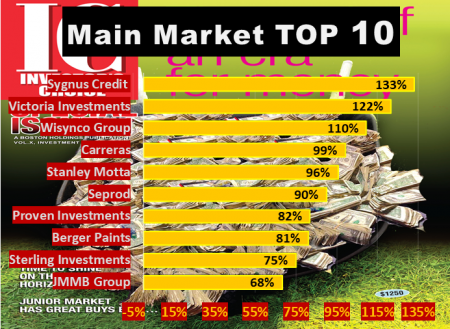 for each, the likely gains are determined and then ranked, with the stocks with the highest potential gains ranked first followed by the rest, in descending order. Potential values will change as stock prices fluctuate and will result in movements of the selection in and out of the lists for most weeks. Earnings per share are revised on an ongoing basis based on new information received that can result in changes in and out of the list as well.
No inflation
 Fall in the price of fuel and appreciation of the Jamaica dollar helped in pushing inflation down in November with data out of Statistical Institute of Jamaica (STATIN) showing zero inflation.
According to Statin, the result was influenced by a 0.3 percent increase in the index for the division Food and Non-Alcoholic Beverages. This was as a result of higher prices for vegetables, starchy foods and fruits but was tempered by a 0.8 percent decline in the division Housing, Water, Electricity, Gas and Other Fuels due mainly to reduced rates for electricity despite the increased rates for water and sewage. The Transport division declined by 0.7 percent as a result of a decrease in the price for petrol. The calendar year-to-date inflation was 3.5 percent while the movement in the index for the fiscal year-to-date was 3.8 percent and the movement for the past 12 months comes out at 4.1 percent.
Barita proposes $15.50 rights issue
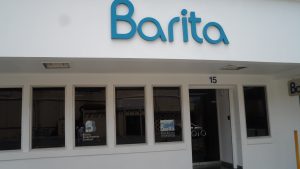 The directors of Barita Investments on December 13, passed a resolution for a Rights Issue of 10 shares for each 17 owned at the record date, to take effect in early January which if taken fully will results in 258 million new shares and bring the capital issued to 707 million units.
The board resolution states:- The Board approves the issue of 258,064,516 ordinary shares (in this resolution “New Ordinary Shares”) part of the authorised capital, the same to be offered to the holders of Ordinary Stock Units by way of a Non-Renounceable Rights Issue on the following terms:
(i) Offer Price of J$15.50 per New Ordinary Share. (ii) Offer to Stockholders of the Company as at a Record Date of December 31, 2018. (iii) Offer to Open on January 8, 2019
(iv) Last date for splitting to be January 15, 2019. (v) Offer to Close on January 22, 2019 for acceptance by Existing Ordinary Stockholders/Renouncees
(vi) Offer to Close on January 25, 2019 for acceptance by applicants for Excess Shares (not taken up by Allottees under the Letter of Provisional Allotment).
2. The Directors are hereby authorized to dispose of all such New Ordinary Shares not taken up by Allottees on terms and conditions as the Directors may consider expedient in their absolute discretion, in consultation with the Arranger for the Rights Issue, Sagicor Investments. BIL further advised that the share ratio allocation for the Rights Issue will be as follows: Ten (10) additional shares for every seventeen (17) shares owned by existing stockholders of Ordinary Shares in Barita Investments.
Apart from a rights issue, the above resolution speaks to the last date for splitting being January 15, which raises the question if a stock is to be considered as well.
Barita stocks that trades on the Jamaica Stock exchange at $33.45 on Friday and is up 346 percent for the year to date.
Scotia hikes dividend

David Noel new Scotia Group’s CEO.
Scotia Group delivered below par performance in that final quarter of the 2018 fiscal year, with profit falling to just $1.6 billion from $3.36 billion in 2017.
The quarterly results, however, is not an indication for what can be expected for the 2019 fiscal year as one time fall in revenues and in some cases, expenses are unlikely to be reflected for the full year to come. In keeping with expected pick up in profit the banking group hiked their dividend from the usual 48 cents per share to 51 cents in their latest announcement. Based on Scotia’s long held policy, when dividends are raised it is usually an indication that future dividend payments will continue at the elevated level for the ensuing period. Investors in the stock can therefore look forward to at least $2.04 cents for all of 2019. That will be a return on the latest stock price of $54.01 of 3.8 percent. Dividends paid in 2018 amounted to $1.92 per share. The total amount of dividends to be paid in January will be $1.59 billion which is alomost all the profit reported for teh quarter. The dividend will be paid on January 18, 2019, with the ex-dividend date set for December 24.
The stock exchange needs radical overhauling
 The Jamaica Stock Exchange is thriving with many investors making good money from their investments in the stocks on the market and companies raising fresh capital as a result of the attractiveness of the capital market. But the growth in the market belies some deep concerns and failures in the system.
The reality is that the capital market is in a state that is far from healthy and those in authority are no moving to fix it. It is difficult to understand why.
An example is that some directors think they can override the Company’s Act and do things that they are not empowered to do. An example is that the directors of GWest Corporation in their wisdom decided that a resolution passed at a general meeting prior to going to the public was only to be partially disclosed to potential shareholders. The stock exchange sees nothing wrong with the lack of disclosure which amounts a variation in the terms of the contract. “So public” was the information, that not even the company’s auditors who reported on the financial statements, months after the public issue, included the information of the resolution that was to give rise to the issue of preference shares, in the audited accounts.
In October, just under 92 million Seprod shares were offered to the public for purchase. Some of the shares were reserved for then existing shareholders of Seprod. Subsequent to the closure of the issue, NCB Capital Markets, the brokers that handled the issue announced that all applications for Reserve Shares in the offer were fully allocated. Several shareholders of Seprod found that they did not get their full allocation and contacted NCB, it was then that they seem to have discovered errors made at the stock exchange.
On November 8, NCB Capital Markets “advises and due to the large number of subscribers for the Offer, the process is taking longer than anticipated.” NCB Capital Markets advised that it is in the process of reconciling the applications and verifying payments received and has requested approval to provide the Basis of Allotment on Monday, November 12, 2018. The broker advised the Stock Exchange on the date promised, that in addition to the full allocation of reserve shares, subscribers from the general public will receive up to the first 5,000 units for which they applied, with the balance greater than 5,000 units allocated approximately 16.56 percent. Subsequent to the allocation

The Jamaica Stock Exchnage subsidiary
announcement, IC Insider.com gathers that investors from the general public who attempted to sell their shares after being allocated, had the Seprod shares in their accounts blocked, so they could not be traded. No one thought it prudent to advise them that the shares were blocked. This publication is seeing an increasing practice where persons in control take unilateral action to alter contractual arrangements. Someone or entity made a big mistake in not computing the allocation correctly in the first place. Information IC Insider.com has, clearly points to the error being made by the Stock Exchange subsidiary. Having done the allocation and credited investors, accounts and refunded excess funds, the Stock Exchange in the view of this publication has no authority to vary a concluded contract. Investors on November 26, were informed that the public got the first 5,000 shares and 16.25 percent of the excess. The letter from the Jamaica Central Securities Depository stated that “ we advise that initially, allocations had been calculated and posted to accounts, however, we detected a glitch in processing that resulted in shares of some clients being incorrectly allocated. Steps were taken to make the necessary adjustments that also included a change in the pro-rated percentage initially published from 15.56 percent to 16.25 percent. When an organization with the prestige of the Jamaica Stock Exchange fowls up matters, one expects that they would handle the matter in a professional manner and absorb the cost, and not opening themselves up to potential law suits.
The Stock Exchange has done the same illegal thing by blocking investors account from trading, as usual the Stock Exchange did not a have the decency to communicate with the investors about that matter. The sad thing is that they wanted the TRN numbers, but the reason they want it is spurious at best. It was just needed to try and clarify that more than one account that seem to belong to one person actually is so. But there is nothing in law that requires them to make such demands and worse the investors have no agreement with the JSE to provide such information as a condition of opening an account. Sadly, the JSE don’t need TRN to sort out limited liability companies, as the Company Office of Jamaica gives each company a unique number that can be used for that purpose. That the Stock Exchange is acting in questionable manner should not be surprising as one or maybe more of their dealer members, have wantonly breached agreements that they have with clients, refusing to comply with the contractual terms.
The Jamaica Stock Exchange release relating to an article IC Insider.com published in connection with the Seprod share allocation states: “The JSE wishes to advise the public that the article published on ICInsider.com on Friday, November 23, 2018 entitled”, “Seprod stock allocation fowl up to cost JSE” incorrectly stated that the JSE was expected to absorb a loss in respect of the recent allocation of Seprod shares.
“The JSE advises that the JSE Group (The Jamaica Stock Exchange and its subsidiary, the Jamaica Central Securities Depository (JCSD) did not suffer any loss in relation to the foregoing.
“There was a delay in the final allotment of the Shares, but this was not due to any malfunction of our systems. We further advise that the allotment of the Shares was successfully completed, as communicated by the JCSD to the relevant investors.
“We wish to underscore that we continue to work tirelessly to maintain the confidence of participants in the market as we deliver our services to our valued customers,” states JSE.
The Stock Exchange may be “trying to work tirelessly to maintain the confidence of participants in the market,” but there are a plenty that they need to speedily do to convince the public that they are seriously tackling the many issues that require sorting out to enhance its reputation. The problems and inadequacies of the present trading platform is just one of them that has lasted far to long. Then there are errors in the trading report. Currently, delisted securities are still showing up in the reports and Eppley 7.5% preference shares for example that has been recently listed is being reported in the ordinary share section rather than in the preference share section where it belongs.
On November 1, the trading report shows the All Jamaica Composite Index of the main market closing at 396,907.46 but the report for the 2nd of November the Index was said to have closed at 387,739.58 with a rise of 832.12 but that was not possible. On the 5th of November the index was said to fall by 5,472.20 to close at 392,267.38. To date the erroneous information is still on the Stock Exchange website.
The Stock Exchange in its wisdom continues with the circuit breaker that serves no useful purpose. Not only does it have no useful purpose it is making a mockery of the exchange but they seem to have their heads in the sad oblivious as to what is going on around them. Take an example Barita Investments traded at $60 recently but the trade was cancelled as it breached the circuit breaker rules daily limitation, yet it is still being carried as the 52 weeks’ high price. That of course makes no sense, but this is just one of similar errors showing up all over. The stupidity of the circuit breaker is that stocks are frozen for an hour and if a stock breaches the level at a minute after 12 in a day it cannot trade again for the balance of the day. If there is need for it why not have the breaks for 15 or 20 minutes so that trading can take place fairly freely. After all the Stock Exchange still has the power to halt trading in a stock or the market if they consider it prudent to do so. The reality is that the Stock Exchange is not handling what they now have to mange and they want to go into new trading areas that is not really in demand.
Big bounce for JSE stocks on Friday

Barita climbs to a new closing high of $33.45 on Friday.
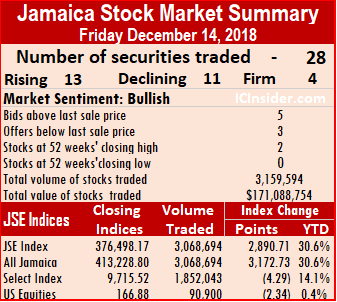
At the close of the market, the All Jamaican Composite Index climbed 3,172.73 points to 413,228.80 and the JSE Index advanced by 2,890.71 points to end at 376,498.17.
Trading ended with 3,068,694 units valued at $164,573,042 changing hands, compared with 5,840,821 units valued at over $422,371,897 on Thursday. A total of 28 securities changed hands in the main and US dollar markets, with prices of 13 rising, 11 declining and 4 remaining unchanged compared to 29 securities trading on Thursday. At the end of trading two stocks ended at record closing highs.
At the close, an average of 113,655 units valued at over $6,095,298 traded, in contrast to 224,647 units valued at $16,245,073 on Thursday. The average volume and value for the month to date, amounts to 123,423 units with a value of $4,686,819, compared to 124,399 units with a value of $4,530,322,
 previously. November closed, with an average of 405,528 valued at $7,755,942, for each security traded.
NCB Financial led trading for the second consecutive day with 743,620 units in accounting for 24.2 percent of the day’s volume, followed by Sagicor Real Estate Fund with 462,923 units or 15 percent of the overall volume and Sagicor Group with 400,607 units and 13 percent of the day’s volume.
IC bid-offer Indicator|The Investor’s Choice bid-offer indicator reading shows 5 stocks ending with bids higher than the last selling prices and 3 closing with lower offers.
In main market activity, Barita Investments climbed $1.45 and ended at a all-time closing high of $33.45, with an exchange of 17,698 shares, Berger Paints dipped $2.50 to close at $22, with just 2,500 stock units changing hands, Caribbean Cement fell $1.05 to close at $42.95, with 67,450 shares traded, Jamaica Broilers rose 50 cents in trading 38,920 stock units at $29.50, Jamaica Producers finished trading 114,650 units with a fall of
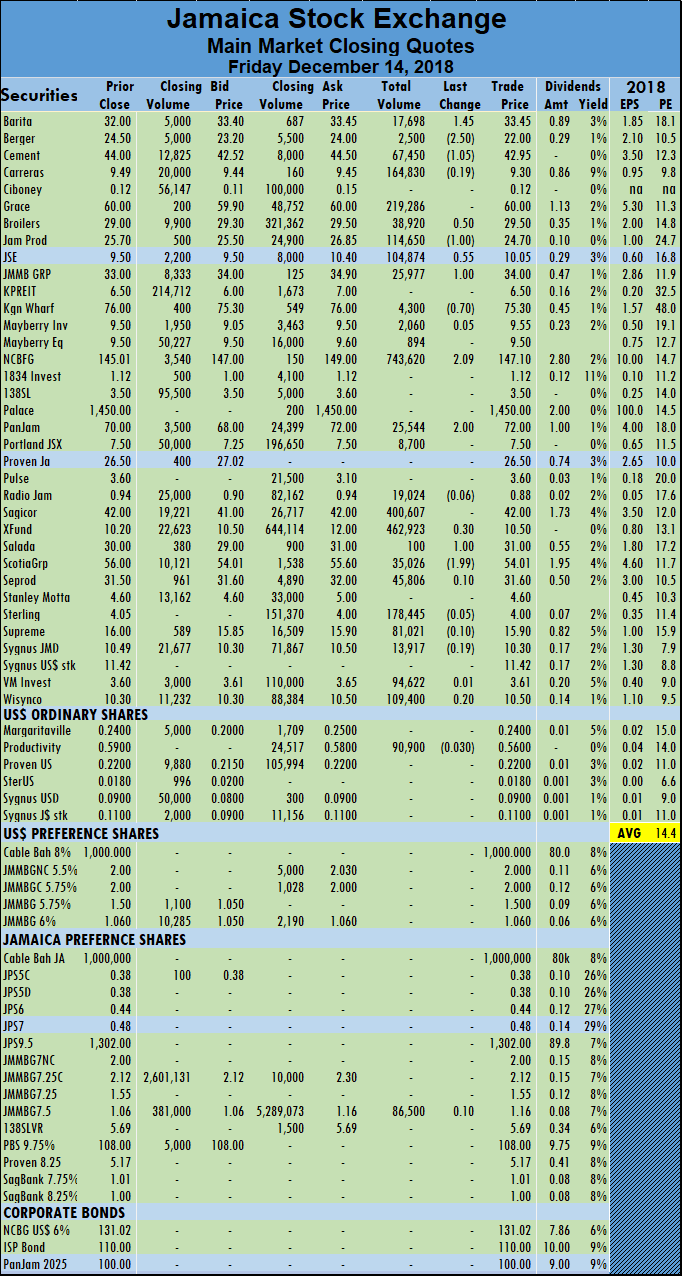 $1 to close at $24.70, Jamaica Stock Exchange rose 55 cents to close at $10.05, in trading 104,874 shares, JMMB Group added $1 in trading 25,977 shares to close at $34. Kingston Wharves finished at $75.30, after falling by 70 cents in trading 4,300 stock units, NCB Financial Group rose $2.09 in ending trading of 743,620 shares at $147.10, PanJam Investment rose $2 to close at $72, with an exchange of 25,544 stock units, Sagicor Real Estate Fund rose 30 cents to close at $10.50, with 462,923 shares changing hands, Salada Foods gained $1 and ended trading of just 100 stock units at a record close of $31 and Scotia Group dropped $1.99 in trading 35,026 units to close at $54.01.
Trading in the US dollar market amounted to 90,900 units valued at over $50,904 with Productivity Business being the sole stock trading as the price ended trading with a loss of 3 cents to end at 56 US cents. The JSE USD Equities Index declined by 2.34 points to close at 166.88.
Junior Market dips again

Knutsford Express traded at a 52 weeks’ low on Friday.
Trading on the Junior Market of the Jamaica Stock Exchange remained low on Friday from the elevated levels on Thursday but the number of securities traded jumped close to 25 percent.
The market closed with 26 securities changing hands, resulting in an exchange of 1,109,020 units valued at $4,743,095 compared to 601,551 units valued at $2,159,980 on Thursday from trading in 21 stocks. Knutsford Express traded at a 52 weeks’ low of $10, at the close of the market while GWest Corporation traded at an intraday all-time low of $1.24.
Market activities, saw the prices of 10 securities rising, 8 falling and 8 remaining unchanged. The Junior Market Index fell 8.16 points to close at 3,113.28.
Trading ended with an average of 42,655 units for an average of $182,427 in contrast to 28,645 units for an average of $102,856 on Thursday. The average volume and value for the month to date amounts to 221,591 units at a value of $1,256,019, versus 245,207 units at a value of $1,397,711, previously. November, ended with an average of 190,475 units valued at $653,358 for each security traded.
IC bid-offer Indicator| At the end of trading, the Investor’s Choice bid-offer indicator reading shows 5 stocks ended with higher bids than their last selling price and 3 with lower offers.
At the close of the day’s activity,Access Financial closed $3 higher at $50.50, with 152 shares changing hands, Blue Power concluded trading with 46,114 units and climbed 33 cents to $6.33, Cargo Handlers settled with a loss of 10 cents at $14.90, with 1,298 shares trading, Caribbean Cream ended trading 700 shares and rose 15 cents higher to $5.40, Caribbean Producers traded 14,300 units and rose 5 cents to $5.40. Consolidated Bakeries closed at $2, with an exchange of 1,165 shares, Derrimon Trading ended 2 cents higher at $2.57, with 83,315 shares changing hands, Elite Diagnostic finished with a loss of 13 cents at $2.87, with 8,354 stock units trading, Eppley settled at $9, with an exchange of 2,735 units. Everything Fresh gained 6 cents in trading 43,069 shares to close at $1.27, Express Catering ended trading with a loss of 10 cents at $7.60, with 17,210 shares, FosRich Group traded 81,570 shares at $3.79, General Accident finished trading 10 cents higher at $3.40, with an exchange of 16,380 shares, GWest Corporation closed at $1.30, in swapping 27,701 stock units. Honey Bun ended with a loss of 30 cents at $3.50, with 898 units changing hands, Indies Pharma traded 12,300 shares and added 4 cents  to close at $3.14, Jetcon Corporation ended trading 24,100 stock units with a loss of 15 cents to close at $3, Knutsford Express closed with a loss of 50 cents at $10, in trading 3,996 shares, Lasco Distributors ended at $3.90, with an exchange of 78,050 shares. Lasco Financial concluded trading of 233,319 stock units, at $4.90, Lasco Manufacturing finished trading with a loss of 10 cents at $3.02, with 52,011 units, Main Event settled at 50 cents higher at $6.50, after 6,698 shares traded, Medical Disposables ended trading of 80,000 shares, to end at $6.40, SSL Venture Capital traded 98,000 shares and rose 18 cents to end at $2 and Stationery and Office finished trading 29,949 stock units with a loss of 45 cents to $8.10. In the junior market preference segment, Eppley ended trading 145,636 shares at $6.
Prices of securities trading for the day are those at which the last trade took place.
Republic knocks TTSE index – Friday

Republic Bank
Trinidad & Tobago Stock Exchange market activity on Friday ended with the All T&T Index dropping 17.50 points as Republic Financial Holdings traded as low as $100 and ended with an average fall in price of $5.43 to inflict serious one day damage to the index.
At close of the market, the Composite Index declined 0.87 points to 1,292.45, the All T&T Index lost 17.50 points to 1,675.41, while the Cross Listed Index remained unchanged to close at 122.97.
Trading ended with 13 securities changing hands, the same as on Thursday. Market activity led to 4 securities advancing, 3 declining and 6 remaining unchanged on a day when the volume a value of trading increased above Thursday’s levels. Trading ended with 113,059 shares at a value of $1,694,615 compared to 56,112 shares at a value of $1,242,837 on Thursday.
IC bid-offer Indicator| The Investor’s Choice bid-offer ended with 3 stock with bids higher than the last selling price and 4 with lower offers.
Stocks closing with gains| First Citizens gained 15 cents and settled at $33.15, after exchanging 564 shares, National Flour increased by 1 cent and completed trading 34,395 units at $1.65, Trinidad & Tobago NGL ended with a gain 3 cents and settled at $29.24, after exchanging 1,474 shares and West Indian  Tobacco finished 33 cents higher and completed trading 3,206 units at $95.40.
Stocks closing with Losses| Mora Ven Holdings traded 3,000 shares after falling 48 cents to end at a closing 52 weeks’ low of $12, Republic Financial Holdings shares fell 6 cents and ended at $107, after trading as low as $101 in exchanging 540 shares and Scotiabank closed with a loss of 25 cents and completed trading 165 units at $64.41.
Stocks closing firm| Clico Investments ended at $20.20, with 54,175 stock units changing hands, Grace Kennedy ended at $3.05, with 262 stock units changing hands, Guardian Holdings completed trading 2,333 units, at $17, JMMB Group closed at $1.77, after exchanging 9,700 shares, One Caribbean Media ended at $10.50, after exchanging 1,935 shares and Prestige Holdings completed trading of 4,310 units at $7.50.
Prices of securities trading for the day are those at which the last trade took place.
Strong food & insurance sales gains at Grace

Grace new HQ close to the end of construction in downtown Kingston
Grace Kennedy reported net profit attributable to shareholders of $3.26 billion for the year to September compared with $3.3 billion in 2017 on strong gains in Food and Insurance segments. For the September quarter, the group earnings of $1.06 billion was realized, down from $1.5 billion.
The current quarter’s result is negatively impacted by one off expenses.
Segment results show declines in the Money transfer business with segment results down to $2.34 billion from $2.46 billion in 2017. Banking was flat with results of $401 million but both Insurance and Food trading recorded healthy increases. Food reported $1.35 billion in 2017 and climbed a strong 12.5 percent to $1.52 billion and Insurance jumped a robust 22.7 percent from $508 million to $734 million.
When adjusted for non-recurring gains in 2017 and one-time expenses of $236 million in the September 2018 quarter, profit for the nine months would have been greater by approximately $600 million.
For the nine-months, the Company revenues rose 7 percent to $73.8 billion but climbed a healthier 11 percent to $25.46 billion for the September quarter, over the same period in 2017. Group Chief Financial Officer, Frank James, informed IC Insider.com that the savings from the rationalisation exercise will generate savings considerable higher than the cost, due partially to some former employees being retired and not incurring separation cost.
Operating cost rose faster than revenues, with an increase of 13 percent to $24.6 billion for the

Group Chief Executive Officer, Don Wehby.
Shareholders’ equity increased of $3.2 billion to $48.4 billion over 2017. Loans receivables remained flat at $26.4 billion compared to $26.58 billion in September 2017 and is down from $27.55 billion at the end of 2017. At the end of the period total assets increased $7.3 billion to $137 billion since September in 2017 and liabilities rose by a smaller $3 billion to $86.44 billion.
In speaking to the recent performance, Group Chief Executive Officer, Don Wehby, affirmed, “The Company is investing strategically for future growth and efficiency to achieve this objective. We are seeing a 12.6 percent increase in profit over prior period, with the one-off adjustments, and we expect continued growth based on our strategy.”
Since 2018, the Group embarked on a programme which aims to improve its return on investment and shareholder value. The process involves a review of its overall organizational design, cost structure, and business processes at all levels resulting in restructuring which affected a number of positions in August. In expounding further Wehby stated, “Although the restructuring costs of $236 million impacted the quarter’s performance, I am confident that the Company will realize the benefits of this in subsequent periods.”
Grace pays an interim dividend of 50 cents per stock unit on December 13, bringing dividends to date to $1.35 per stock unit of more than $1.3 billion.
Wehby and the group’s chairman Gordon Shirley in their report to shareholders stated that Grace Kennedy anticipates continued growth for the fourth quarter, subsequent to the quarterly report the group announced changes in their Florida distribution with an investment in the company that manufactures it patties that will take over Graces distribution and warehousing in that area. The new arrangement will mean less cost and more profits for Grace.
IC Insider.com projects earnings is $4.80 for the current fiscal year to December and $6 for 2019. The stock is listed on the Jamaica Stock Exchange and trades at $60 for a PE of 12.5 times current year’s estimated earnings versus an average for the market in the region of 15, with a premium of a mere 20 percent above net book value per share and seems undervalued, currently. The stock looks like a good long term investment.