Bulls just watching but taking no action while stocks are setting up for a big explosion.
The cut in Bank of Jamaica’s overnight policy rate, by 25 basis points to 2.5 percent and further decline in short term Treasury bill rates on Wednesday, are big shot in the arm for Jamaican stocks.
With a 15 percent fall in BOJ’s policy rate in 2018 so far, stocks are lagging behind, with an increase of just 6.6 percent for the Junior Market and 4 percent for the main market. The accompanying chart shows the fall in Treasury bill rates being far greater than the rise of the All Jamaica Composite Index, an indication of a lot more upside for stocks based on the downward movement of interest rates.
Investors seem to be focusing more on profits in valuing stocks than on interest rates so far. That will change. The fall in the overnight rate, translates to a 9 percent rise in stock market prices, but rates seem likely to decline some more before settling off providing more ammunition for more gains in stock prices.
 The latest Treasury bill auction also points to falling rates, with the 91 days bill declining to 2.71 percent from 2.818 percent in April, while the 182 days instrument average rate ended at 2.83 percent, from 2.979 percent in April. The 272 days Treasury bill cleared at an average of 3.08 percent with the highest allotted yield being 3.4 percent. In The three offerings of $700 million each, attracted a total of just over $7 billion, an indication of the high liquidity in the market that will have a positive impact on stock prices.
With the fall in interest rates, the PE of money is at the high end 40 times income and using corporate bond 12 times, but the PE ratio should be more tied to Treasury Bill rates and that PE is now in 30 range but stocks are mostly in the low teens and below.
Stocks have not been helped by some of the 2018 first quarter results, coming in a period when the market traditionally goes into a recess until late early summer.
 While profits for a number of companies may not have been electric for the 2018 first quarter and prices have not moved much except in a few cases, a look behind orders indicates that supply for a number of stocks is very limited. Stationery and Office Supplies have just two offers at the close of Wednesday, with less than 10,500 share on offer. Access Financial, Barita, Berger, PanJam Investment, Salada Foods to name some, have very limited supplies and others could follow suit in a short while, most investors don’t seem to be paying much attention to the tsunami that is on the way that will see prices move sharply higher.

 The Jamaican dollar has been trading within a band of J$125 to 130 to the US dollar, a situation Wynter sees as likely to be the norm for sometime to come. Wynter who was speaking at special briefing on Friday, indicated that Jamaicans had better start getting used to this new development as there is enough foreign currency available in the system. A development which he things the new foreign exchange auction B-Fxitt, that the central bank manages has helped to foster with much more transparency in the market aided by market intelligence by both buyers and sellers as well as the central bank. But the new B-Fxitt is not the only factor at play. Not only that, according to the governor even as the bank cut the compulsory take form dealers by 10 percentage points, BOJ has not suffered lower intake as a result of increased flows, some of which Wynter attributes to the selling of US dollars by locals to go into more profitable form of local investments. Government’s tight fiscal discipline has gone a long way to creating and environment of stability within the economy and among the business sector.
 So where is the stock market in all of this? The junior market is up 8 percent year to date, but main market stocks have just crawled a mere 3 percent, the latter wont being performing so poorly much longer. This short term chart shows two channels that the market is trading within. The market is trading closer to the upper resistance line shown in red. The lower blue line has been steering the market slightly side wards with an upward bias. A very important feature, which is not shown in the attached chart, is an extremely bullish formation shown on a longer term chart. That chart shows the market now caught up in a wedge formation with the top being around 335,000 points using the all Jamaica Composite index. With the recent market moves, it appears that the wedge is going to give way and herald a huge rise upwards in the market and that in going to happen within a few weeks, probably after first quarter results are released starting in late April.
 The Jamaica Stock Exchange hit a new record within 1 minute of today’s opening with the JSE All Jamaican Composite Index jumping 4,576.37 points to 327,071.44 and the JSE Index climbing 4,169.59 points to a record 297,999.05.



 Junior market stocks performed better than main market stocks in 2017 but that performance does not show in the gains in the market indices of both markets.
 A 43 percent fall in the price of the heavily weighted,

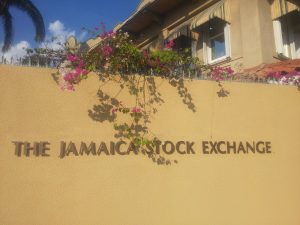
 The Jamaica Stock Exchange main market is trading in record territory just after opening on Friday morning.
 The stock market continued its upward trajectory in 2017. Year to date, market performance has been significantly stronger than 2016 with the Main Market Index returning 32.94 percent as at August 2017 compared to 6.43 percent for the corresponding period last year.