 Remittance inflows to Jamaica increased by US$7.5 million or 2.6 percent to US$295.5 million in April this year, from US$288 million in 2024. Inflows for April this year are the second highest monthly flows for the year so far, following March with US$302.4 million, which grew by 1.8 percent over the 2024 period.
Remittances increased in all four months of 2025, contributing to inflows for January to April 2025 of US$1.118 billion, an increase of 3 percent over the US$1.085 billion in the first four months of 2024.
 The change comes against the backdrop of concerns by many that the economy was growing much faster than the original official data suggested. ICInsider.com assessment of the adjustment, is that the economy is officially twice the size, as was previously thought.
 Passengers traffic passing through Sangster International Airport in Montego Bay during June this year fell by 8,500, a fall of 1.9 percent, with 438,900 incoming and outgoing passengers compared to 447,400 in June 2024.
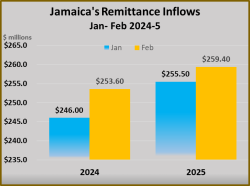 with an increased 2.3 percent or US$6.7 to US$259 million in February, up from US$254 million last year, a continuation from January that enjoyed an increase of 3.9 percent, data out of Bank of Jamaica show.
 According to the company, preliminary data of terminal passenger traffic showed a 7.7 percent decline for March 2025, resulting in 40,000 fewer incoming and outgoing passengers, with 482,600 passengers passing through the airport, compared with 522,800 in March 2024. The much smaller Norman Manley International Airport had a 7.7 percent increase of 10,000 passengers to 139,200 from 129,300 in 2023.
 Remittance inflows to Jamaica hit a record for January, with total inflows of US$255.5 million this year following an increase of US$9.5 million or 3.9 percent in total of US$246 million in 2024
 Despite the fall in December last year, remittance inflows into Jamaica continue to be resilient with just a 0.4 percent slippage to US$3.357 billion, compared to the inflows of US$3.37 billion in 2023. Inflows for 2024 are the lowest in four years but remain well above the U$2.98 billion inflows in 2020, the year of a major surge that pushed the amount just under the $3 billion mark it has been at since that year.
