Scotia a Xmas of goodies in 2025 & beyond

Scotia Group delivered a respectable 17 percent jump in profit to shareholders in the just concluded fiscal year to October. Investors drove the price up a solid 34 percent for the year to date, in addition to dividends amounting to $1.70 as revenues climbed 15.8 percent to $69 billion from $59.6 billion in the October quarter, with profit after tax rising to $20.15 billion from $17.2 billion in 2023. For the October quarter, profit rose a solid 32 percent to $6.16 billion from $4.67 billion in 2023.


The group paid dividends amounting to $5.1 billion during the fiscal year versus $4.2 billion in 2023 a payout ratio of roughly 25 percent of the annual profit. A dividend of 45 cents per share has been declared for payment in January 2025.
Total revenues rose 16.2 percent for the October quarter to $18.4 billion from $15.84 billion in 2023.
B growth in loans the main propeller of increasing profits, climbed 16 percent for the year to $312.76 billion but rose at an annual rate of 22 percent in the second half and 29 percent in the final quarter. With lower interest rates expected in 2025, the demand for loans could grow even faster than in the final quarter, subject to demand and management’s decision to take on increased risk.
Interest Income rose 14.5 percent in the last quarter to $12.64 billion from $11 billion in 2023 and for the year it moved up 18.4 percent to $59.7 billion from $48.34 billion in 2023.
Net interest income rose 15.4 percent to $12 billion in the last quarter of this year, from $10.57 billion in the prior year and for the full year, it jumped 17.4 percent to $46.3 billion from $39.46 billion in the previous year. Net fee and Commission income went from $1.8 billion in the $2.1 billion in October 2024 quarter and increased 17.2 percent from $6.74 billion in the half year in 2023 to $7.23 billion in the current year.
Other income amounted to just $158.6 million in the October 2024 quarter, up from $67 million in the previous year and for the fiscal year, rose 25.5 percent to $661 million from $527 million. Insurance premium income jumped 51 percent to $1 billion for the latest quarter, up from $673 billion in the prior year and for the year to October grew 26 percent from $2.79 billion in 2023 to $3.5 billion.
Net foreign currency activities generated revenues of $2.48 billion up 9.5 percent from $2.27 billion in the comparative period in 2023 and for the year, revenues rose 6.4 percent of $9.3 Billion versus $8.75 billion in 2023.
Credit impairment losses jumped sharply by 71 percent to $1.26 billion in the October quarter from $740 million last year and for the fiscal year, it climbed 73.5 percent to $4.16 billion from $2.4 billion in 2023.
Segment results show third party revenues for Corporate and Commercial banking increasing 11.3 percent to $15.8 billion, with revenues of $14.2 billion in 2023. Net segment results surged 24 percent to $13.7 billion over $11.1 billion in 2023. Treasury segment generated revenues of $15.75 billion up 24 percent from $12.68 billion in 2023 with a profit of $4.86 billion in 2024 up 36 percent compared with $3.57 billion in the previous year. Investment Management Services generated a 1.7 percent growth in revenues of $3.14 billion and net results that rose just 2 percent to $1.77 billion in 2024, with revenues of $3.1 billion in 2023 and net results of $1.73 billion. Insurance Services accounted for revenues of $4.76 billion, up 13 percent over $4.2 billion in 2023 and net results of $4.8 billion up by 24 percent compared with 2023, with revenues of $4.2 billion and profit of $3.9 billion.
Staff cost fell 10 percent in the last quarter to $2.92 billion from $3.24 billion in 2023 and rose 6.3 percent to $11.8 billion in the current year from $11.1 billion last year. Other operating expenses rose 4.2 percent to $3.1 billion in the quarter from $2.99 billion in 2023 and increased 4.6 percent in the year to $13.24 billion from $12.66 billion in the prior year. Tax on assets rose 13 percent to $1.55 from $1.376 billion in 2023. Taxation rose 16 percent to $9.55 billion, for the year from $8.2 billion in 2023.
Customer deposits grew by 7 percent to $479 billion. Shareholders’ equity ended the period at $138.5 billion, up from $126.5 billion at the end of October 2023.
Earnings per share for the quarter amounts to $1.98 and $6.48 for the year. IC Insider.com projects earnings of $9 per share for the 2025 fiscal year, with a PE of 5.8 times the current year’s earnings based on the price of $52 the stock traded at on the Jamaica Stock Exchange. Net asset value ended the period at $44.50 with the stock selling at a low 1.15 times book value.
Scotia Group has the ICInsider.com Buy Rated seal of approval.

Berger surges into healthy Q1 profit

There is a huge about-turn in profit at Berger Paints with $48 million generated in the first quarter of March 2024 compared with a loss of $35 million in the first quarter of 2023, following a 7.6 percent climb in sales to $772 million from $718 million in 2023.
Cost control and reduction in some cases played a major role in the turnaround in the operations, with the company reporting a small loss for the fiscal year 2022 and a much bigger $218 million loss in 2023 after a tax credit of $37 million.
The most major development is a sharp fall in the cost of material used in the production to facilitate sales with a drop to 43 percent from 57 percent with costs of $330 million in the latest quarter down from $407 million in 2023, a fall of 19 percent while other manufacturing costs coming in 12 percent lower to $14 million.
Staff cost rose 12 percent to $154 million from $138 million in 2023 while Other operating expenses jumped 17 percent to $212 million from $180 million in 2023. Depreciation rose 16 percent to $22 million from $19 million in 2023, with fixed assets net of depreciation jumping to $480 million from $289 million at the end of March 2023.
The operations generated Gross cash flow brought in $80 million, netting out at $69 million after working capital and capital spending.

.

Current assets ended the period at $1.7 billion inclusive of trade and other receivables of $595 million, cash and bank balances of $224 million. Inventories were reduced by $200 million to $800 over the twelve months to March this year and receivables by $170 million over the same period to $600 million.
Current liabilities ended the period at $1.17 billion. Net current assets ended at $500 million.
At the end of March, shareholders’ equity amounts to $1.1 billion with little borrowings.
Earnings per share for the quarter was 23 cents. IC Insider.com computation projects earnings of $1.60 per share for the fiscal year ending December 2023, with a PE of 3.4 times the current year’s earnings based on the price of $5.50 the stock traded at on the Jamaica Stock Exchange Main Market. Net asset value ended the period at $5.12 with the stock selling at a mere 7 percent over book value.

Lasco Distributors profit surge

Lasco Distributors stock rose 85 percent since the middle of April but profit results released since then show strong full year results to March, with an increase of 33 percent to 39 cents per share, followed by impressive first quarter numbers almost guaranteeing another big rise in the price over the next several months.
Lasco released first quarter results, in late July, with a rise in pretax profit jumping a robust 57 percent to $602 million and post-tax climbing a solid 38 percent to $448 million from a 17 percent rise in revenues to $7.3 billion from $6.3 billion.

The company generated other income of $68.6 million, surging 142 percent from $28 4 million in 2022, but unrealized investments gains fell from $58 million to $13 million, pushing total comprehensive income to $460 million, 20 percent up from $383 million in 2022.
The cost of goods sold rose at a much slower pace than revenues at 15 percent to $5.98 billion from $5.18 billion. Gross profit jumped well in excess of the rise in revenues, with a 25 percent climb to $1.34 billion from $1.07 billion in 2022.
Administrative and other expenses rose 12 percent to $806 million from $718 million in 2022. Depreciation charge fell from $38.7 million to $31.5 million in the latest quarter, there was virtually no interest cost with borrowings having been repaid.
The quarterly result is continuing” the performance of the prior year, delivering growth in all key segments” John Dasilva, Managing Director, stated in his report to shareholders, and went on to state, “the company continues to invest in consumer focused marketing initiatives while increasing its distribution and product availability across all channels”, in his report accompanying the quarterly.
The operations, generated $484 million of Gross cash flow and $814 million after working capital movements and ended with $748 million, with net cash inflows that swell the funds on hand to $3 billion.
Current assets ended the period at $11 billion, which was similar in 2022. Trade and other receivables amount to $3.6 million, with short term investments, cash and bank balances closing at $3.6 million, while inventories amount to $3.76 billion and receivables $3.6 billion. While receivables were close to the June 2022 and fiscal year end numbers, inventories fell by $700 million from the March year end balance. Current liabilities ended the period at $4.6 Billion. Net current assets ended the period at $6.5 billion up from $5 billion at the end of June 2022.

Lasco Distributors profit rises

At the end of June, shareholders’ equity amounts to $8.9 billion, up from $7.36 billion at the close of June 2022.
Earnings per share for the quarter was 13 cents, up from 9 cents in 2022. IC Insider.com computations project earnings of 65 cents per share for the fiscal year ending March 2024, with a PE of just 6 times current year’s earnings based on the price of $3.86 the stock traded at recently on the Jamaica Stock Exchange Junior Market. Net asset value ended the period at $2.53 with the stock selling at 1.5 times book value.
The company paid a dividend of 10 cents in July 2023, a payout ratio of roughly 26 percent of the 2023 annual profit.
Investors were underrating the stock earlier the year, selling it well below an appropriate valuation of a mere 8 times the nine months results of 27 cents per share when the stock traded at a low of $2.09 in April and close to that price for most of the month. Although the stock has nearly doubled, it is selling at just 10 times 2023 earnings and well below the 2024 earnings of 65 cents, which makes the stock a solid buy for the medium term investment.
Currently selling outnumbers buying interest but with rapidly improving results that will not last forever and patient investors will win in the end.

Profit returns for Caribbean Cream

Following a torrid 2022 fiscal year, with a loss before taxation of $13.7 million, Caribbean Cream delivered a much better performance in the fiscal year to February this year, with pretax profit of $41.8 million and $27 million after accounting for $14.7 million for taxes, up from a $9 million loss in 2022 in a year that finance cost almost doubled to $66 million from $34 million in 2022, from increased borrowings.
Sale revenues for the just completed year rose 20 percent to $2.5 billion from $2.1 billion in 2022. In the final quarter, revenues climbed 22.5 percent to $674 million from $553 million in 2022 and increased 17 percent over the $576 million in the November 2022 quarter. In contrast, revenues for the 2022 February quarter were 10 percent more than the $501 million generated in the November 2021 quarter. All in all, the 2023 fiscal year performance was well ahead of the year to February 2022, even as the year started with just $1.3 million in profit with cost of sales at 73.2 percent with the second quarter being slightly better with cost of sales down to 70.7 percent and profit improving to $7.2 million as both volume improvement and price adjustment to the output chipped in to help improve the bottom line.
Kremi, as the company is known, has had a checkered history with Profit meandering from 2015 to 2023. (See Chart)
Since 2020 the company has faced increased input costs that squeezed profit margin. In the latest fiscal year, cost of sales dropped to 64 percent in the final quarter compared to 69 percent for the year and 71 percent for the nine months to November. The jump in revenues in the fourth quarter over the November quarter would have helped to improve the margin, but it appears that raw material costs fell compared with the earlier months of the fiscal year. In 2022 cost of sales was 71.6 percent and 66.6 percent in 2021.
Cost of sales rose 16 percent, slower than sales in 2023, to $1.73 billion from $1.49 billion in 2022, with gross profit rising faster than revenues, a positive development with an increase of 31 percent to $593 million from $775 million in 2022. The cost of raw materials used in sales rose 16 percent to $1.17 billion, compared with a 33 percent rise in fiscal year 2022 over 2021. Milk solids, one of the primary raw materials, about 70 percent that is used in producing ice cream moved from an average of US$3,355 per ton in 2018 to US$5,067 in 2022 and is now $4,676 in 2023, down 9 percent. In 2022 the cost rose by 29 percent, these movements, coupled with exchange rate changes for the Jamaican dollar, would have pushed up the company’s production cost; also affecting cost would be a 7 percent movement in the exchange rate between the Jamaica dollar and the US dollar. If continued, falling commodity prices in 2023 will lower the cost for them and help improve profits. Also of note is that the price of crude oil is now 38 percent less than it was in 2023 at the start of June and that feeds directly into utility cost incurred in production, which was $166 million, 16 percent higher than 2022 and 19 percent more in Administration with $99 million versus $83 million in 2022.

Administrative expenses rose 17 percent to $598 million from $512 the previous year. Marketing and sales expenses increased by 18 percent to $72 million from $61 million in 2022 and depreciation came in at $100 million, marginally down from $102 million in 2022. Some $930 million is tied up in construction in progress at the end of the fiscal year and will result in the charge rising appreciably in the 2024 fiscal year when those assets are transferred to fixed assets but will reduce the actual taxation payable as capital allowances in the first year, will reduce the actual tax liability that will be payable. Finance cost jumped 91 percent to $66 million from $34.5 million in 2022, but a significant portion of the loans have interest rates capped and will not result in increases in the current period.
Gross cash flow generated $195 million from operating activities, up from just $53 million in 2022. Funds internally generated were augmented by loan inflows of $353 million and funds at the start of the year amounting to $145 million, which helped to fund additions to fixed assets of $541 million.

The total Current assets ended the year at $535 million inclusive of trade and other receivables of $157 million, cash and bank balances of $67 million, down from $146 million in 2022. Current liabilities ended at $389 million, up from $313 million and net current assets ended the period at $167 million, down from $212 million in 2022.
At the end of December, shareholders’ equity stood at $826 million, with long term borrowings at $920 million, up from $603 million in 2022 and short term at $107 million against $67 million in 2022. The increased borrowing helped to fund additions to fixed assets amounting to $542 million during the year, of which $490 million is construction in progress.
Earnings per share came out at just 7 cents for the year, with a steep PE of 45.7, but earnings for the current year are expected to jump well over that for 2023. IC Insider.com forecasts a considerable increase of 90 cents per share for the fiscal year ending February 2024, with a PE of 3.6 times the current year’s earnings based on the price of $3.20 the stock traded at on the Jamaica Stock Exchange Junior Market and a net asset of $2.18.
The company did not pay a dividend in 2022 but 6.94 cents in 2021.
The company may have faltered over the last two years, but it has shown in the past that it can recover. Additionally, it is not going away anytime soon. It will recover lost ground as they invest in its manufacturing operations to generate cost reductions, greater efficiency, and improved profit. The first quarter results due by July should show the first signs of this robustness as the company reports a significant profit improvement over the 2022 first quarter and a better than the 2023 February quarter.
What should investors do? Investors should buy the stock that is selling well below potential as investors reacted negatively to poor results reported in 2022 before the release of the 2023 results.

169% surge in profit at SOS

Stationery and Office Supplies (SOS) enjoyed a blow year in 2022, with earnings hitting a record high, after profits jumped 169 percent before tax to $284 million and $257 million after tax from a 55 percent jump in revenues to $1.75 billion from $1.12 billion in 2021. SOS benefitted from one time income from a Gain on disposal of property, plant and equipment of $30 which was partially offset by unusually large impairment losses of $11.5 million.
Income tax on the year’s profit amounts to $27 million compared with a tax credit of $1 million in 2021. Net profit in 2021 was $107 million but gross profit jumped 59 percent from $574 million in 2021 to $912 million for 2022, as gross profit margin slipped during the year to 47.8 percent from 49 percent in 2021.

Administrative and general expenses rose 25 percent to $399 million from $320 million in 2021. Selling and promotional costs rose 64 percent to $132 million from $80 million in the prior year, Impairment loss on financial assets jumped 698 percent to $11.5 million up from $1.4 million and Depreciation and amortisation costs rose 13.7 percent to $30 million up from $26.4 million. There were cost savings during the year with Loss on foreign exchange falling 85 percent to $1.2 million from $8 million in 2021 and Finance costs dropping 22 percent to $8.7 million from $11 million in 2021 as loans were partially repaid.

Allan McDaniels CEO of SOS

Gross cash flow during the year brought in $336 million, which was used to fund increased working capital needs of $84 million, capital expenditure amounting to $50 million, loan repayment of $49 million and dividend payment of $45 million, leaving $97 million to add to cash funds.
At the end of the year, shareholders’ equity grew to $1.1 billion with long term borrowings at $67 million and short term at $43 million. Current assets ended the period at $737 million inclusive of trade and other receivables of $200 million versus $124 million in the prior year. Cash and bank balances rose to $132 million from $34 million in the previous year and inventories climbed to $369 million up from $296 million in 2021. Current liabilities ended at $181 million and resulted in Net current assets of $556 million.
Earnings per share came out at $1.03 cents for the year up from 43 cents in 2021. IC Insider.com forecasts $2 per share for the current fiscal year, with a PE of 7.3 times the current year’s earnings down from 14.5 based on 2021 results, compared with 11.3 for the market based 2023 earnings at $14.50 the stock traded at on Friday on the Jamaica Stock Exchange Junior Market.

Stationery & Office Supplies hit a record high on Friday.

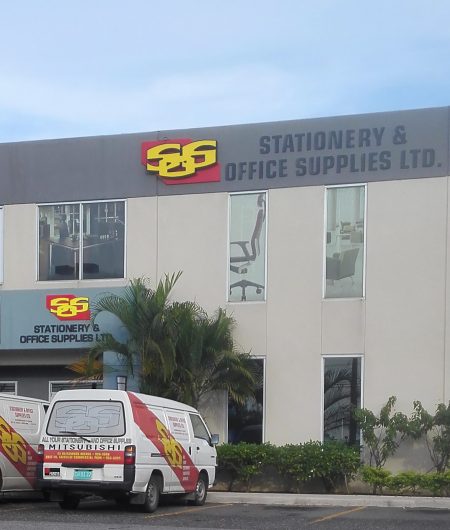
Stationary & Office Supplies – Montego Bay office.

Of note is a 37 percent increase in fourth quarter revenues, which was at a slower pace than the 63 percent increase for the nine months to September and a 45 percent rise in the 4th quarter of 2021, suggesting that the pace for 2023 should be strong, but most likely slower than that of 2022.  The pace in 2023 will be helped by a deal struck with a company in Trinidad to cross sell products as well as the possibility that other deals may be struck with others.
SEEK division produced receipts and other ruled books as well as graph paper for the first time in June last year, using machinery that was purchased from the former operators, they will enjoy increased production for the entire year in 2023 compared with approximately six months in 2022 and contributed $43 million to gross profit for 2022.
With improving profits and shrinking supplies outside of the TOP 10 shareholders, who control 91 percent of the issued shares, the stock is setting up for a stock split that cannot be far off and when given will catapult the stock price upwards.
Going forward, with the Jamaican economy recovering and now growing, the stage is being set for SOS to continue to grow at an attractive pace for a while and deliver above average returns for investors in cash dividends and stock price gains.

Q2 profit climbs 26% at Lasco Financial

Profit climbed a respectable 26 percent for the September 2022 quarter to $74 million from $59 million in 2021, for Lasco Financial Services, with the six months’ profits climbing 17 percent to $157 million over the $134 million garnered in 2021. 
The improvement in profit arose from a 12.5 percent rise in income to $623 million for its second quarter to September against income of $554 million in the 2021 second quarter. Importantly, the performance of the September quarter exceeds that for the June quarter, when revenues came in at $564 million with profits of $56 million, suggesting that growth of revenues and profitability could be accelerating quarter over quarter and not only year over year.
For the half year, revenues rose just 3.7 percent to $1.188 billion from $1.145 billion for the six months in 2021.
For the 2022 September, quarter expenses excluding finance costs rose 11 percent to $469 million from $424 million in 2021 as administrative and other expenses climbed 18 percent to $324 million from $275 million in the 2021 September quarter and selling and promotional expenses declined from $150 million in the September 2021 quarter to $145 million in 2022. For the six months, total expenses increased by just 5 percent, from $857 million to $900 million. Administrative expenses increased 7 percent to $592 million from $555 million in 2021, Management reported that the increase is “in line with the expansion of services and growth in staff.” Selling and Promotional expenses rose marginally to $307 million from $302 million for the same period.
Finance costs fell from $46 million to $28 million in the September 2022 quarter and from $93 million for the September 2021 half year to $55 million in 2022. Taxation more than doubled from $25 million to $52 million in the September quarter and increased from $61 million in the six months to September 2021 to $76 million in 2022.
Earnings per share came in at 5.8 cents for the September 2022 quarter and 12.3 cents for the half year. With the December quarter usually generating the largest income and profit, ICInsider.com projects earnings of 50 cents for the year ending March 2023 and 90 cents per share for 2024. The outcome could be even better if the loan portfolio that was nearly $2 billion in 2019 grows back fast enough from the $812 million net of loan losses it fell to in March this year. Based on the earnings per share, the company’s stock trades at a PE of just 5.4 compared to an average of 12.6 for the Junior Market and just three times 2023 earnings, based on the closing price of $2.72 on Friday making the stock a strong buy.

Lasco Financial profit dropped 39% in 2018 Q2.

The company moved to expand its loan portfolio. Management points to a reduction in cash resulting from an “increase in loan disbursements as we make a push to expand our portfolio and market share”, management states in the commentary to shareholders.
Shareholders equity stood at $2.1 billion at the end of September this year, up from $1.84 billion at the end of September 2021, while borrowed funds amount to $1.5 billion, down from $1.64 billion at the end of September last year. Loans and receivables rose to $1.5 billion from $1.4 billion in September last year and cash and cash at bank and short term deposit amount to $1.64 billion versus $1.7 billion in 2021.
During the six months, $278 million in cash was provided from operating activities compared to $376 million in 2021, after $523 million was used in investing and financing activities cash and bank balance fell $244 million and reduced cash and cash equivalent to $722 million from $897 million in 2021.