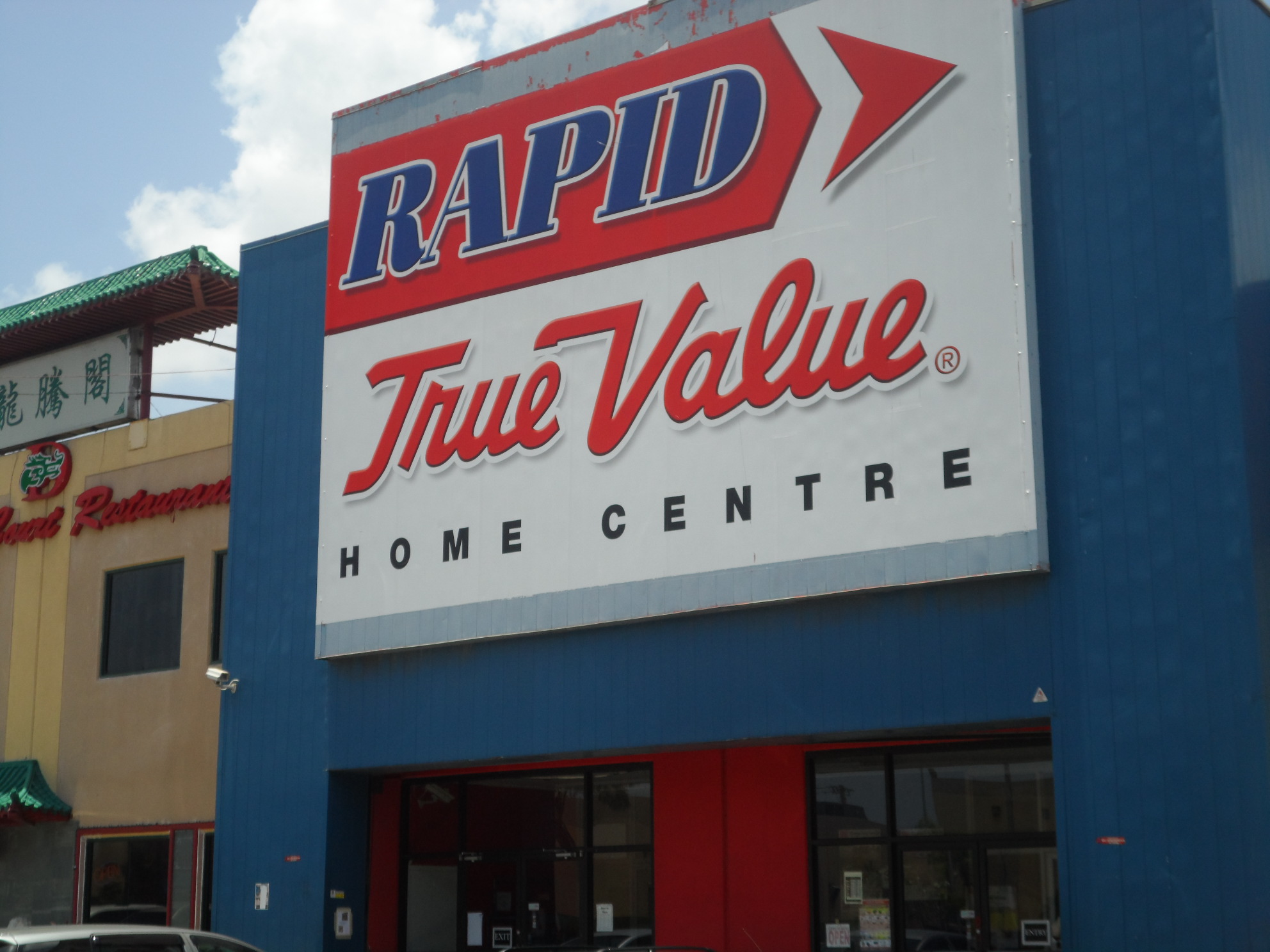
 Grace Kennedy is advising that the terms to dispose of their holdings in Hardware and Lumber (H&L) include a maximum price of J$18.50 per ordinary share subject to conditions and with completion anticipated by the end of July.
The above price is just around book value at the end of March this year and would give Grace Kennedy who owns 58.1 percent of the 80.842 million shares in issue, $845 million.
Don Wehby CEO of Grace indicated that the agreement is conditional and stated that “GraceKennedy is looking forward to the conclusion of the transaction in a timely manner and will communicate further as soon as it is finalized.” He reiterated that Grace Kennedy’s decision to sell its shares in H&L was a strategic one, having regard to its core strategy of expansion in the foods and financial services sectors. He added, “We feel very positive about the continued growth of H&L under the prospective new owners who have signalled that they are excited about the possibilities for the future”.
H&L currently comprises two separate divisions – Rapid True Value local supplier of hardware and home improvement products, and the Agro Grace business, local wholesaler and retailer of agricultural products.
There are currently 10 Rapid True Value outlets across Jamaica, along with six Agro Grace Retail Centres. The company is headquartered at 697 Spanish Town Road in Kingston.
 Greystone Equity Partners Inc. the proposed purchaser is a Caribbean based and Caribbean focused private equity firm with a stated strong commitment to the Caribbean.
H&L reported profit in 2014 of $217 million or $2.69 per share. Profit after tax for the three-month ended March, 2015 was $34.5 million, 14.5 percent less than the $40.4 million for the same period last year and earnings of 43 cents per stock unit, compared to 50 cents for the comparative period in 2014 after revenues fell 4.5 percent to $1.73 billion.
$18.50 per share max price for H&L
Undervalued Caribbean Flavours
 The company seems poised to hit earnings of 65 cents per share for the June 2015 financial year, making it attractive for some short-term gains with the current price of $2.09 at a PE ratio of 3 times earnings, having earned 19 cents per share for the quarter and 43 cents for the nine months, to March 2015.
Caribbean Flavours & Fragrances enjoyed a moderate increase of 16 percent in profit for the March 2015 quarter over the similar period in 2014. The increase was helped by an improvement in gross profit margin that moved from 39.6 percent to 44 percent. Profit came in at $17.3 million for the quarter versus $15 million in the similar period in 2014. For the nine months to March, profit declined slightly from $39.7 million in 2014 to $38.9 million.
Sales were up moderately in the quarter from $62.8 million in 2014 to $67 million. For the nine months to March sales grew 11.7 percent to $210.6 million from $188.6 million but cost of sales rose faster than the growth in revenues from $111.7 million to $133.5 million in the nine months or 18.75 percent. Administrative cost increased 21 percent in the quarter, and just 2 percent for the nine months, vastly better than the high double-digit increase in the prior year. The return on average equity an attractive 33.5 percent per annum. The negative is that for its small size there is limited growth from existing operations.
The balance sheet is in a healthy state with equity of $195 million or $2.17 per share. There are no borrowed funds while current assets is $210 million versus payables of only $16 million.
The principal activity of the company is the manufacture of and distribution of flavours mainly for the beverage, baking and confectionery industries. The company also sells food colouring and fragrances.The stock is listed on the Jamaica Stock Exchange junior market and is recommended as a buy by IC Insider.
Treasury bill rates fall
 At the latest auction for the issue of Treasury bills held today, rates on the 28 days, the 91 days and 182 days bills declined from ay auction, continuing the decent starting March last year.
The latest rate on the 91 days instrument is now at 6.48 down from 6.57 percent at the May auction and the 182 days is now at 6.63 percent, a fall from 6.7 percent. The 28 days instrument ended with a rate of 6.23 percent down from 6.27 percent in May. The rates are far off from the BOJ CD rate of 5.25 percent.
A total of $1.2 billion was available for the public to bid on, split equally between the three issues. The 28 days offering attracted $475 million the 91 days attracted $602 million and the 182 days instrument attracted $828 million. With the interest rates on some of the Jamaican government’s bonds tied to Treasury bill rates, the latest development of lower rates will mean lower cost for the variable rate bonds.
With inflation looking as if it could end 2015 around 3.5 percent Bank of Jamaica may have to intervene by lowering the CD rate to speed up the fall in Treasury bill rates.
Falling prices dominate with 15 down
Carreras dominated with $64.8M in value
TheJSE Market Index lost just 3.39 points to 96,596.51, the JSE All Jamaican Composite index fell 3.79 points to close at 108,907.87 and the JSE combined index gained 28.63 points to end at 99,293.77.
IC bid-offer Indicator| At the end of trading, in the main and junior markets, the Investor’s Choice bid-offer indicator shows 19 stocks with bids higher than
 their last selling prices and 7 with offers that were lower, an indication that the number of stocks likely to gain on Wednesday should outnumber the ones declining.
In trading, Cable & Wireless put on 2 cents with 431,297 units changing hands to close at 46 cents. Caribbean Cement rose 1 cent while trading 121,350 shares at $5, Carreras gained 28 cents in trading 1,341,078 to end at $48.35, with NCB Capital Market s being the main broker selling and Sagicor Investments the main broker buying. Grace Kennedy suffered a decline by 40 cents with 8,919 shares changing hands at $63.50, Hardware & Lumber traded 50,000 shares at $18, with just one trade. Jamaica Broilers slipped 30 cents with 23,654 shares trading to close at $5.20, followed by Kingston Wharves that fell 15 cents to $6.40 with only 725 units trading,
 National Commercial Bank traded 528,170 units to close at $29.46 down from the last traded on Monday of $30, as the price slipped 54 cents. Sagicor Group fell 30 cents to $12.30 with 94,210 shares changing hands. The price of Sagicor Real Estate Fund rose 10 cents, with 42,375 shares changing hands, to end at $7.70. Scotia Investments fell 72 cents as 25,291 shares traded to close at $26.28 and Proven Investments traded 595,502 shares at 21 US cents, down from 21.05 US cents on Monday, after 467,745 units were traded in the morning session, at 22 US cents.
Profit may not be far off at C&W
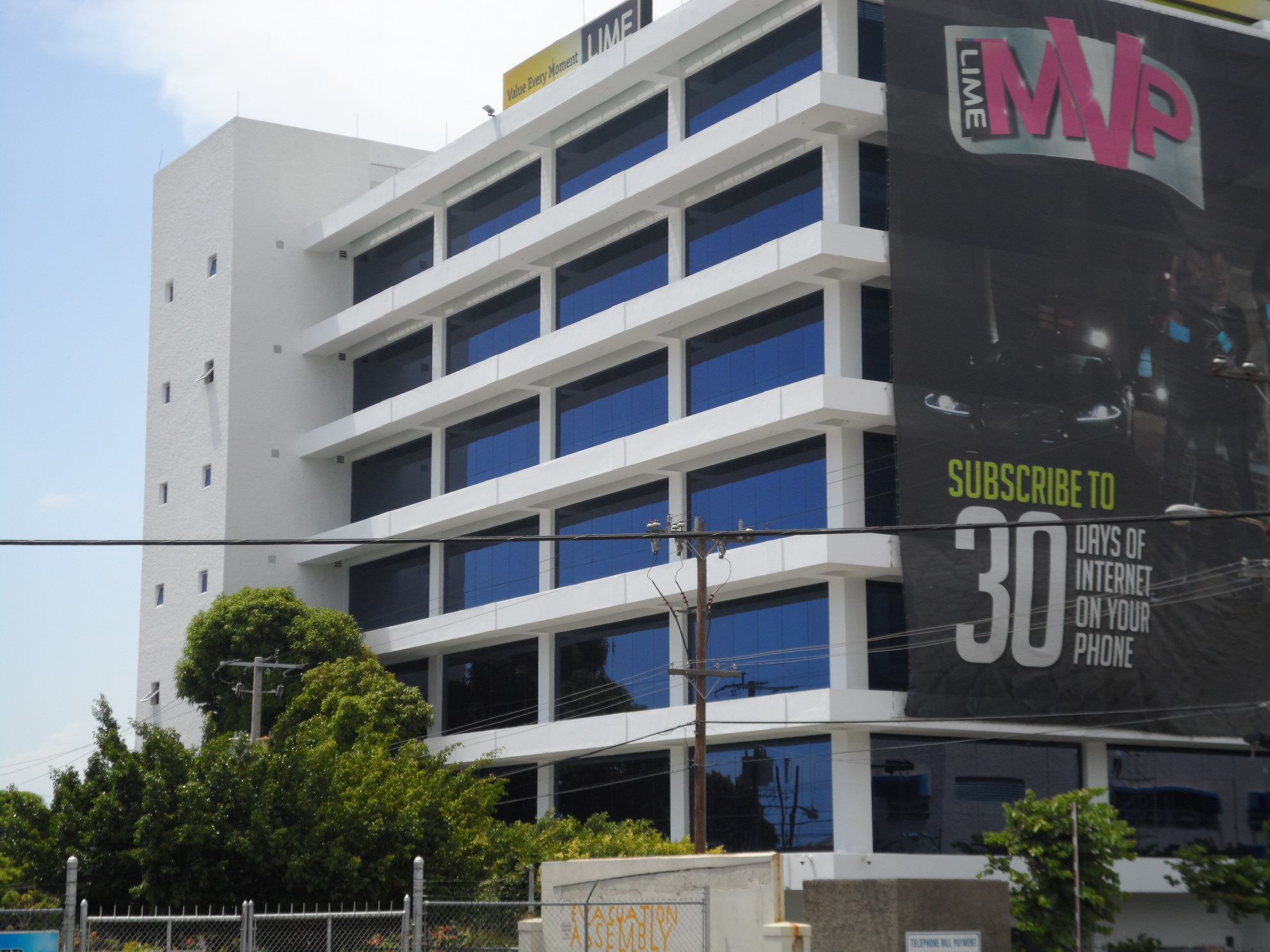
Cable & Wireless HQ
During the financial year Cable & Wireless added more than 107,000 mobile subscribers bringing the total to 820,500, according to the annual report of CW Communications (CWC) the parent company of Cable & Wireless. The cellular customer base has just about doubled since March 2012. At the end of December last year, C&W stated then that the cell customer base grew 18 percent, year to date to 813,000. C&W is said to have grown the cell customers by approximately 80,000 for the year to March 2013 and for the 12 months to March 2014 by 165,000.
Growth in cell customers increased mobile market share to 28 percent, based on customer who used their handset within the last three months according to the parent company, and probably more, based on all their customers with credit balances on handsets. The subscriber base of its main rival Digicel Jamaica, is said to hover around two million, but in all possibility, the number is under 2 million with the growth in C&W numbers over the last four years.
The increased subscriber base rocketed the mobile segment to incontrovertibly become the leading segment for the company. Mobile revenues earned $8.7 billion up 30 percent year on year; fixed voice remained flat at $6.5 billion, managed services at $3.6 billion was 25 percent higher than in 2014 and broadband & video at $2.7 billion compares to $2.3 billion or 17 percent increase year on year.
Some $4.5 billion of the exceptional charge relates directly to the flow acquisition. How much income will flow into C&W Jamaica from that operation is unknown at this time, but it should mean at least reduced cost for C&W from its existing operation. Revenues should continue to grow with the mobile customers added last year, generating income for the full year rather than part thereof, as occurred in the years of acquisition. The company should continue to add more customers in the current year as it goes after increased market share, particularly in the cellular market. The numbers suggest that the company could well return to profitability this year, based on the above savings and potential growth in revenues.
NCB rating up

NCB gained $1.01 to close at a new 41/2 years’ high of $31.01
S&P raised its long-term issuer credit rating on NCBJ to ‘B’ from ‘B-‘. It also affirmed its short-term ‘B’ issuer credit rating on the bank. “The upgrade follows the same rating action on Jamaica’s sovereign debt, reflecting the country meeting its fiscal targets in the past two years, which has led to improved fiscal credibility and stabilized its debt trajectory. NCBJ’s ‘b+’ SACP remains unchanged,” stated S&P in a notice on June 4.
S&P views NCBJ’s business position as “strong” with a moderate risk position, funding as “average,” and liquidity as “adequate.”
“Given NCBJ’s exposure to sovereign debt, its ratings remain constrained by those on the sovereign. This is reflected in the bank’s ‘b+’ SACP and ‘B/B’ ratings. We will also monitor the bank’s performance and the potential improvements in its credit fundamentals as a result of relatively better economic prospects in the country. Also, in our view, NCBJ is still a highly systemic important financial institution in Jamaica,” added S&P.
Big pay day for JSE shareholders
 The Jamaica Stock Exchange (JSE) will pay out $74.33 million in the form of a dividend in July. The company listed 140.250 million ordinary shares on the exchange in 2013 is making its first dividend payment since listing.
JSE board of directors met on Monday and declared the payment of a dividend of fifty-three cents (53 cents) per share unit, payable on July 10 to shareholders on record as at June 26, 2015. The stock will trade ex dividend on June 24, 2015.
The share closed 2014 at $1.57 and gained 237.58 since the start of 2015, helped considerably by a jump in profit in the first quarter from a loss of $2 million to $87 million. A pick up in stock market activities also helped in driving demand for the stock as investors saw higher income and profit flowing in future quarters. The JSE reported a very small profit of $3 million for the year ended December last year. The dividend enjoys a yield of 33.75 percent based on the price at the end of last year and 10.5 percent based on the price last Friday and 9.2 percent based on Tuesday’s closing price of $5.75.
Access almost private again

Proven upped its stake in Access in May, leaving few shares in the public’s hands.
On May 18, Proven acquired an additional 1,249,608 shares in Access Investments, thereby increasing its interest to 49.72 percent. In December last year, Proven bought 135,339,271 units in the financial micro lender when it picked up most of the shares held by Mayberry at the time, at a price of $9. in the latest audited report for Proven, Access is listed as a subsidiary of Proven. Normally, owning less than 50 percent plus one share in a company would result in a company being a subsidiary and less down to 20 percent, would qualify as an associate.
The stock has been trading recently at $17 each, with Access having reported improved results for the March quarter increasing by 72 percent to $157.6 million, up from $79 million in 2014. Marcus James in March this year transferred his 112,421,260 units to a company representing 41.6 percent of the issued shares leaving just under 9 percent in the public’s hands.
Digicel capex US$650m for 2015
 Digicel Group should spend US$650 million on capital expenditure this financial year ending June 2015, based on its build out of cell towers in Myanmar, according to Fitch rating agency.
As a consequence of the heavy capital expenditure, the rating agency expects negative free cash flow for the Digicel group into 2016. Its capital expenditure is forecast to increase 17 percent more than a year ago then attenuate in 2016.
“[Its] as a result of network expansion and upgrades, including cable networks as well as a tower project in Myanmar. Capex is likely to decline to US$500 million in FY2016 and towards US$400 million in FY2017 as expansionary projects are largely completed,” stated US based Fitch rating on Digicel’s performance.
The telecom’s earnings remain stable despite weak growth in Jamaica but financial projections were not disclosed for the privately held company. Digicel generated “stable operating results” in the first nine months of fiscal 2015 (FY2015), ending on March 31, 2015, and Fitch expects this trend to continue over the medium term.
“During the period, the company’s constant-currency-based revenue posted stable growth of 5 percent with a solid EBITDA margin of 41.4 percent, which was a modest decline from 42.8 percent a year ago. (Fitch’s EBITDA calculation includes staff costs related to share options.),” stated Fitch. “This was mainly driven by increasing data revenue supporting average revenue per user, and steady growth in Papua New Guinea (PNG), Trinidad & Tobago, and the Other Markets segment….PNG continues to grow strongly, offsetting weak growth in other major countries of operation, such as Jamaica and Haiti.”
Its total subscriber base hovers at 13.8 million as of December 2014 from 13.4 million a year ago.
“FY2014 dividend payment was high at US$690 million, mainly due to the special dividend payment of US$650 million,” stated Fitch. “In the absence of sizable dividends, Fitch expects free cashflow to turn positive from FY2017.”
Proven Investments defying gravity
 Dr Omar Davies will have found that his investments in Proven ordinary shares is working far better than funds placed in Credit Union, the latter seems to be his preferred choice for the placing of funds it would appear, based on a response he gave a few years ago to a reporter.
Davies and his other political colleagues would have seen their investment in the company done exceedingly well with the stock now trading at 21 US cents, well above the low of 7.5 US cents it traded at in December 2012. With the stock at a PE around 48 times ongoing earnings and well above any other stocks on the exchange, are investors pricing the stock right?
What is value?|There of course is a fallacious argument that the value is what willing buyers and sellers are prepared to pay, that may well be so, but if it based on unrealistic assumptions, the buyer may find that they over paid. What are investors paying a heavy premium for? It is not growth, for the company has not grown from increased profits after paying dividends, it not growth in profits since there is no growth in ongoing earnings since 2012, and it is not consistency of earnings either. The net asset value has not grown in the 2015 fiscal year over 2014 with net value of $32 million before new issued shares is adjusted for. The amount is lower than the $33 million in 2012 and $35.78 million in 2013, while this year’s operating profit is down on that of 2013 at $4.16 million and $3.3 in 2012.
Proven just reported full year results showing a profit of US$5.9 million or 1.5 US cents per share, up on the earnings in 2014 of $3.78 million or 1.28 cents per share. On the surface, that seems great and would put the PE at 14, and based on the local market valuation, it’s a bit high but not extremely so, with stock prices having grown an average of 30 percent in value for 2015, raising the PE of most stocks.

Hugh Hart Chairman of Proven Investments
During the year, Proven enjoyed strong growth in revenues but cost jumped sharply as well, with net interest income more than doubling to $7.65 million from $3.2 million in 2014. Overall net income grew from $8.6 million to $11.38 million, operating expenses moved from $3.6 million to $8.28 million, including loan impairment that jumped to $442,000 from just $45,000 in 2014. Operating profit before preference dividend of $1.5 million (2014: $969,000) amounts to $3.1 million down form $5 million in 2014.
The acquisition of the First Global Financial’s portfolio and the Access shares, incurred cost of $169,313 which is expensed is unlikely to recur in 2015, unless there are other take overs in the works, as such the net operating profit from ongoing operations would have been somewhat higher than the figure mentioned above but still leave the stock seriously overvalued, for a company that is not growing operating profit on a consistent basis year to year.
Going forward, the acquisition of Access Financial Services contributed profit of US$1.2 million to the group’s profit and could end up around $4-5 million for the full year which would swell earnings considerably for the group for the year ending March next year. Proven raised US$30 million in fresh capital after the year end pushing the share capital to 551 million units, these funds will generate added income and profit and the group is looking at possible acquisitions, with shares in Guardian Holdings in Trinidad high on the list. Investors can look forward of profits hitting $7 million mark with earnings around 1.3 cents per share or somewhat more depending how the fresh capital is deployed. Regardless, earnings per share from ongoing operations would be up from the low level of 2015, but would still leave the value of the stock around 16 times earnings, more than 3 times that of National Commercial Bank.