Imports & exports down to June

Petroleum imports help cut trade deficit to June

Petroleum imports help cut trade deficit to June

Jamaica continues to see gains from the fall in the price of petroleum on the world market but the country is not yet seeing the improvement in exports that is expected from the economic measures being pursued by the country. Thanks to a sharp drop in the country’s oil bill the trade deficit drop sharply by 11 percent in the first six months of this year.The merchandise trade deficit for January to June 2015 stood at US$1.9 billion, a fall of 10.9 percent compared to US$2.13 billion recorded in 2014. Imports decreased by 11 percent or US$316 million to US$2.55 billion. Total exports fell 11.4 percent or US$85 million to US$655 million compared to the similar 2014 period.
Traditional domestic exports during the 2015 review period grew 3.6 percent over 2014 to US$407 million, while Non-Traditional exports earned declined by a large 29.4 percent or US$92 million to US$220 million in 2015.

Import of buses for JUTC added to the Jamaica's imports to June.

Import of buses for JUTC added to the Jamaica’s imports to June.

The reduction in imports “was as a result of significantly lower imports of crude oil and processed fuels, primarily Bunker C grade fuel oil, gasoline, Automotive Diesel Oil, Propane and Butane”, the Statistical Institute of Jamaica said.
Excluding motor cars there was an increase in Consumer Goods of 8.7 percent or US$67 million to US$839 million during January to June 2015 compared to the same period in 2014. Expenditure on Capital Goods accounted for US$273 million of imports, up from US$256 million in 2014.

Jamaica ekes out 0.6% growth in Q2

The Mining sector grew the most in Q2

The Mining sector grew the most in Q2

Jamaica’s economy increased by 0.6 percent in the second quarter this year, over the similar quarter of 2014 in real terms an represents an improvement over the performance in the first quarter over that of 2014.
This growth in the June quarter was attributed to improved performance in both the Goods Producing industries and Services industries of 0.8 percent and 0.5 percent respectively, the Statistical Institute of Jamaica (STATIN) said in its report on the economy release at the end of September.
“During the first quarter this year, the Jamaican economy grew by 0.4 percent when compared to the similar quarter of 2014. This growth was due mainly to a 0.6 percent increase in the Services industries” Statin said when they released the first quarter numbers in July. The reports are preliminary as Statin will revise them when more data becomes available.
According to Statin “all industries within the Goods Producing industries recorded higher levels of output: Agriculture, Forestry and Fishing (0.3 percent), Mining and Quarrying (4.1 percent) Manufacturing (0.2 percent) and Construction (0.9 percent).
Agriculture was negatively affected by drought conditions

Agriculture was negatively affected by drought conditions

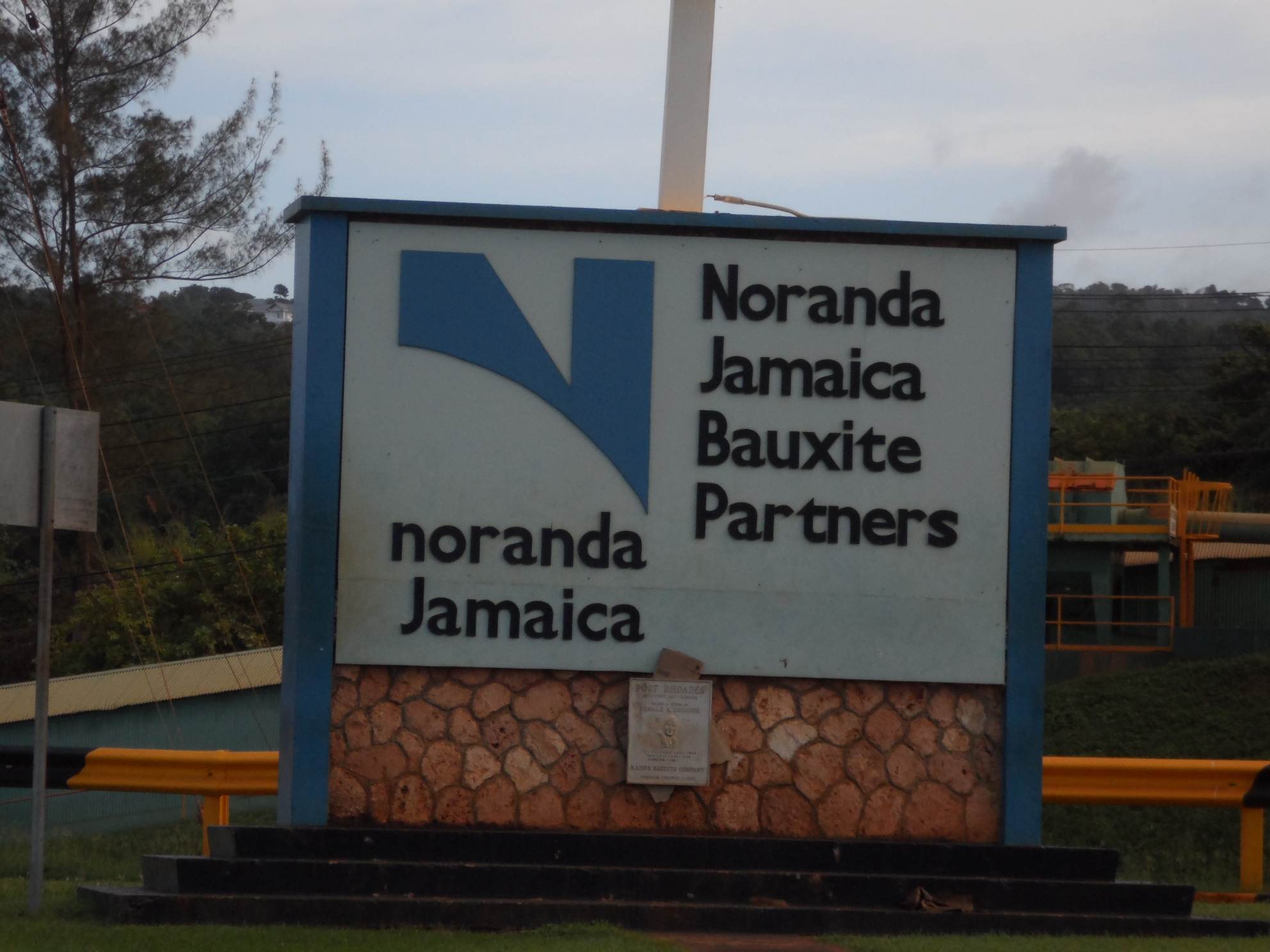
The performance of the Agriculture, Forestry and Fishing industry was constrained by drought conditions which continued to affect the island. The Mining and Quarrying industry benefited from higher production levels at the alumina plants. Increased output from the Manufacturing industry was due largely to higher production levels from the Food, Beverages and Tobacco group. Growth in the Construction industry was due mainly to increased activities in civil engineering”.
“The Services industries recorded higher levels of output with the exception of the Producers of Government Services industry which declined by 0.2 percent. Increased output was recorded for: Electricity & Water Supply (0.7 percent), Hotels and Restaurants (1.4 percent), Transport, Storage and Communication (1.4 percent), Wholesale and Retail Trade; Repairs; Installation of Machinery and Equipment (0.3 percent), Finance and Insurance Services (0.4 percent), Real Estate, Renting and Business Activities (0.5 percent) and Other Services (0.5 percent).The Hotels & Restaurants industry was positively impacted by higher tourist arrivals from two of the main markets; the United States of America (USA) and Europe. Growth in Electricity & Water Supply was tempered by drought conditions which affected water production during the review period. Compared with the first quarter of 2015, the economy grew by 1.5 percent. This was largely attributed to an increase in the Goods Producing industries (2.8 percent) and the Services industries (1.1 percent)” the report stated.

Real estate to get a boost

JNBS HWTThe real estate industry is set to get a boost as Jamaica National Building Society is set to announce a lowering mortgage rates, IC Insider.com has been reliably informed. The announcement could come as early as next week IC Insider.com has learnt.
Details were not available, but from indications it could result in the current flagship rate of 9.5 percent dropping to 8.5 percent. The move will be a welcomed for the society’s borrowers and will act as a stimulus to the housing market that has seen increased building cost as a result of the falling value of the Jamaican dollar pushing the cost of housing upwards. The decline will come against the background of lowering of repo rates by the country’s central bank and a continuous lowering of Treasury bill rates since early 2014.
The move by Jamaica National is expected to see other long term lenders following the JN lead and should result in an all round fall in borrowing cost for mortgages.

Food prices push inflation in August

‘Vegetables and Starchy Foods’ had the strongest impact on the division moving up by 8.5%

‘Vegetables and Starchy Foods’ had the strongest impact on the division moving up by 8.5%

Sharp price movement in the prices for Vegetables and Starchy Foods’ had a major impact on inflation in August with an increase of 0.8 percent resulting in Inflation climbing 3.5 percent since August last year to August this year and by 2.2 percent, for 2015 to August, the Statistical Institute of Jamaica (STATIN) reported.
‘Food and Non-Alcoholic Beverages’ recorded the highest movement for the month of 2.1 percent. ‘Vegetables and Starchy Foods’ had the strongest impact on the division moving up by 8.5 percent as drought conditions persisted in the growing areas. The upward overall movement was, however, tempered by declines of 2.3 percent and 0.5 percent in the divisions ‘Housing, Water, Electricity, Gas and Other Fuels’ and ‘Transport’ due to lower petrol prices and reduction in air fares.
Other divisions that recorded increases are: ‘Alcoholic Beverages and Tobacco’ 0.2 percent, ‘Clothing and Footwear’ 0.3 percent, ‘Furnishings, Household Equipment and Routine Household Maintenance’ 0.2 percent, ‘Health’ 0.1 percent, ‘Recreation and Culture’ 0.4 percent, ‘Miscellaneous Goods and Services’ 1.3 percent, while ‘Restaurants and Accommodation Services’ recorded a 0.2 percent increase. ‘Education’ and ‘Communication’ remained unchanged.

21% fall in Treasury bill rates in a year

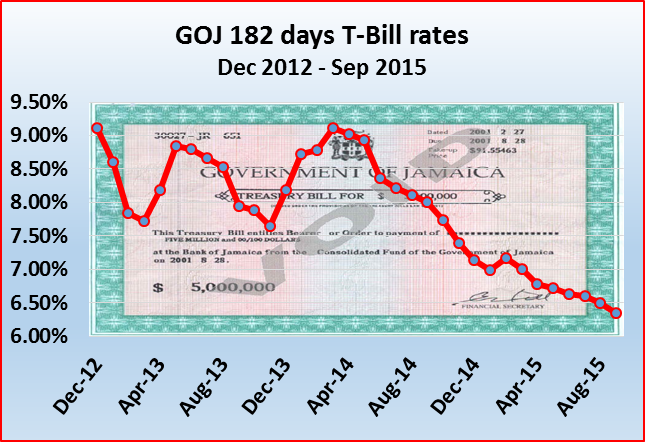
Treasury bill rates are continue to decline with the latest ones falling ones continuing the trend once more. Rates are down 20.6 percent on the 182 days Treasury bill notes since September last year or 165 basis points.
Rates on the latest issues of Treasury bill that were on offer on Wednesday September 16th, continued a slow decent since the start of 2015 but a much steeper decline form March last year. Tbill mnt 16-9-15The two offerings for $400m each attracted bids for $721.8 million for the 91 days instrument and $786 million for the 182 days instrument, down from over $940 million each in August.
The 91 days instrument cleared at an average of 6.2 percent down from 6.352 percent at the August auction, with bids between 5.99 percent, to 6.3 percent being fully accepted. The 182 days yielded an average 6.35 percent down from August’s average of 6.49 percent. Bids between 6.2 to 6.4 percent, were fully allotted. Earlier, at the September 9th auction, the 28 days Treasury bill average rate came out at 6.228 percent after $707 million chased $400 million on offer.
The declines for the September issues come against the back ground of Bank of Jamaica cutting by 0.25 percent, its 30 days CD rates in August to 5.25 percent.

IMF – J$ may still be overvalued

1000frontThe International Monetary Fund (IMF) is saying that the Jamaican dollar could be overvalued by as much as 19 percent to a moderate rate of 2.1 percent depending on the methods used. The fund also suggest that other methods show an undervaluation of up to 13 percent as well, based on the fall in the price of oil on the world market.
“Preliminary analysis based on the Fund’s EBA-lite and CGER models does not offer clear evidence ofeither over- or undervaluation, after two years of exchange rate adjustment and an important current account adjustment. Safeguarding the gains in competitiveness will be critical in an uncertain global environment. The increased flexibility in exchange rate has been instrumental in improving competitiveness and strengthening the external position. Continued exchange rate depreciation remains necessary given the ongoing inflation differential with trading partners, the risks to competitiveness from a possible upswing in oil prices, and the recent strengthening of the US dollar”, the IMF reported.
IMFThe IMF stated, “the macroeconomic balance (MB) and the external sustainability (ES) approaches suggest that the Real effective exchange rate (REER) is undervalued (at 11.5 and 12.6 percent) while, the equilibrium real exchange rate (ERER) and the purchasing power parity (PPP) approaches point to some remaining overvaluation (of 19.4 per cent and 14.4 percent respectively). A key assumption for the MB and ES estimates is that oil prices will recover only gradually and partially from their recent decline, thereby supporting the projected improvement in the current account balance. The confidence intervals are very large for all the estimates and, statistically, zero misalignment cannot be rejected. The results of the EBA-lite methodology, which estimates the gap between the current account balance and its norm for 2015, suggest a slight overvaluation” of 2.1 percent. These overvaluation amounts would require adjustments for inflation differential between Jamaica and our main trading partners, which could mean roughly a 5 percent adjustment to the rate of exchange.

Cut the civil service – IMF message

IMF buildingDebt servicing cost, wages and related expenses are two big items that have prevented the Jamaican government from performing the role of government the way they ought as money expended on the excess staffing and by and large part of the debt servicing are non-productive expenditure that divert funds from areas of need. It is therefore not surprising that the International Monetary Fund (IMF) has placed a great deal of focus on these two areas in getting the government to reform the system and move the country intro economic equilibrium. The Fund is of the view that in spite of the move to contain the wage bill by constraints and attrition, more is needed to be done to restore balance in this area.
“Public sector reform is a key pillar of the fiscal consolidation effort over the medium term. The authorities aim to reduce the wage bill from a projected 9.9 percent of GDP in fiscal year 2015/16 to 9 percent of GDP in fiscal year 2016/17. To date, much of this lower spending has been driven by nominal wage freezes, and authorities aim to secure continued moderate wage increases in the context of the ongoing wage negotiations, mindful of the trade off with other spending priorities. There is, however, a need to refocus attention on modernizing the public sector and transitioning toward a smaller and more effective civil service”, the IMF review report says.
The target is steep a cut from 9.9 to 9 percent is a 10 percent change. The wage settlement for 2015 is 4 percent and if all of that was paid in the current fiscal year it would require nominal gross domestic product to rise around 5 to 6 percent. With inflation looking very subdued and real growth not looking robust, the target is likely be a big challenge. The other issue is that even if the government were to achieve the target is, will maintaining it be sustainable long term? The government can cut the number of workers and the wage bill by divesting some services rather than lay workers off.

IMF wants more in NIR

IMFThe central bank should also continue purchasing international reserves to provide insurance against external risks , particularly since reserves fall short of the Fund’s metric for reserve adequacy, the International Monetary Funds (IMF) states in the March assessment on Jamaica performance under the fund agreement.
The external risks are related to PetroCaribe inflows and the imminent U.S. monetary tightening, the IMF said.
“There was broad agreement on the need to replace, over time, borrowed reserves with owned reserves. The results from applying the IMF metric for Assessing Reserve Adequacy show that Jamaica’s level of international reserves, at 80.4 percent of benchmark in 2015, is still significantly below the suggested adequacy range of between 100 and 150 percent, pointing to the need for continued exchange rate flexibility”, the IMF report on Jamaica stated.
bringing the amount to 100 percent of the desired level would mean bring the amount close to US$3 billion and 150 percent would take it within the US$4 billion mark.

Massive BOJ FX sale on Thursday

BOJ 3 Bank of Jamaica intervention into the foreign exchange market pushed trading well over the US$100 million market on Thursday, that did not stop the local currency form declining, as it moved even closer to $120 to the US dollar. The selling rate for the Jamaican dollar moved up by 3 cents on Thursday, meanwhile the highest rate fell to $123.26 on Thursday from J$124.12 on Wednesday.
Purchases by dealers of foreign currencies on saw buying of the equivalent of US$124,150,664 in stark contrast to US$26,434,145 on Wednesday, while they sold the equivalent of US$118,010,252, previously US$32,677,054.
In US dollar trading , dealers bought US$121,494,099 compared to US$23,310,357 on Wednesday. The buying rate for the US dollar is up 76 cents to $118.44 and US$116,060,844 was sold versus US$31,118,844 on Wednesday, the selling rate rose 3 cents to close at $118.62.FX sum 10-9-15 The Canadian dollar buying rate rose 11 cents to $86.97, with dealers buying C$990,249 and selling C$713,506, at an average rate that climbed 72 cents to $89.81. The rate for buying the British Pound gained 80 cents to $179.58 for the purchase of £1,220,729, while £784,302 was sold, at an average rate that rose 31 cents to end at $182.58. At the end of trading, it took J$132.43 to purchase the Euro, a fall of 3 cents from Wednesday’s rate, according to data from Bank of Jamaica, while dealers purchased the European common currency at J$129.45, a decline from Wednesday’s rate of 35 cents. Other currencies bought, amounted to the equivalent of US$78,385, while the equivalent of US$201,993 was sold.
Highs & Lows| The highest and lowest rates for trading the US dollar all declined on Thursday. The highest buying rate dropped $1.70 to $117.60, FX H&L 10-9-15the lowest buying rate fell 67 cents to $96.19, the highest selling rate lost 86 cents to end at $123.26 and the lowest selling rate dived $19.15 to $96.15. The highest buying rate for the Canadian dollar climbed 50 cents to $91, the lowest buying rate is up 66 cents to $71.63 and highest selling rate fell 50 cents to end at $92.50, the lowest selling rate added $1.30 to end at $86.30. The highest buying rate for the British Pound, climbed 50 cents to $183.20, the lowest buying rate jumped 87 cents to $147.28, the highest selling rate dropped $1.83 to $186.92 and the lowest selling rate remained unchanged at $176.

JSE trading resumes

Trading on the Jamaica Stock Exchange that was suspended resumed at 3pm is will close at 3:30PM, since resumption a big block of Gleaner shares that was hanging over the market traded at $1.90 with 19 million units changing hands. Jamaica Producers also traded 171,230 units at $18.