Treasury-bill rates fall again

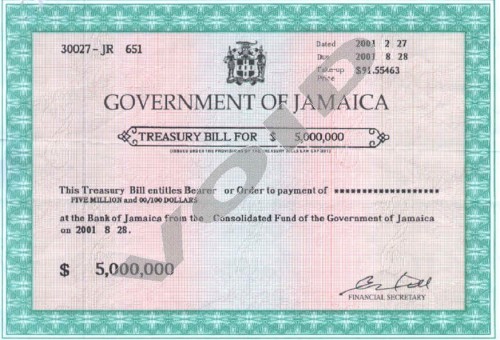
Government of Jamaica Treasury bill sample

Government of Jamaica Treasury bill sample

The amount of funds trying to find a home over the next 3 months, jumped sharply to $903,521,900 from September’s $641,904,600, chasing after the $400 million 91 days Treasury bills offered for October.
The Treasury bill for the period Friday, October 24 to mature on Friday, January 23 next year, attracted an average yield of 7.336 percent, down from 7.46952 percent, at the September auction. At the August auction the average rate out turn was 7.46767 percent. The yield for July was an average of 7.63643 percent, for the June issue 7.65893 percent and 8.2 percent in May, for the Treasury bill of same duration.
The offer of 182 days duration, maturing on April 24 next year, generates an average interest rate yield of 7.73187 percent, a decline from 7.99887 percent, at the September auction, 8.11578 percent, in August, 8.21982 percent at the July’s auction and 8.36502 percent for the June issue, of the same duration. At the May Treasury bill auction, the rate came out at 8.932 percent.

Jamaica’s inflation jumps 2.1%

inflationahead280x150Jamaica’s inflation rate for September jumped 2.1 percent, over August 2014. The sharp upward movement was impacted by 4 percent increase in the category Transport which recorded the highest movement, mainly as a result of an increase in the cost of bus fares in the Greater Kingston Metropolitan Area.
A 3.9 percent increase for Education, due to a rise in the cost of tuition fees, at the beginning of the new school year, was another main contributor to the hike. Food and Non-Alcoholic Beverages recorded an upward movement of 2.9 percent. This was mainly attributable to the lingering impact of drought conditions island-wide, which resulted in a shortage in supply of some agricultural produce and consequently higher prices, the statistical Institute of Jamaica said in a release accompany the data.
Inflation for the year to September is now at 7.1 percent. Going forward, the fall in the price of oil to US$80 barrel, revaluation of the Jamaican dollar and improved rain fall that should result in increased farms produce, should help to ease the inflation rate, in the months ahead.

BNS & NCB in grand US$ sell off on Friday

Scotia hq 25 9-14 Authorized Dealers sold much more foreign currency that they bought on Friday. Bank of Nova Scotia (BNS) and National Commercial Bank (NCB) were big net sellers of the US dollar, the second consecutive day of a big net sell off by dealers. BNS was the largest net seller, with US$4.58 million bought to US$15.26 million sold, followed by NCB buying US$4.13 million and selling US$12.6 million. On Thursday BNS bought US$7.33 million and sold US$14.23 million while National Commercial Bank, was buying US$2.67 million and selling US$5.54 million.
The Jamaican dollar slipped slightly against the US dollar, but appreciated against the Pound and the Canadian dollar, in Friday’s forex trading. Authorized dealers purchased the equivalent of US$49,065,272 versus US$27,673,332 on Thursday. The equivalent of US$60,366,852 was sold, compared with US$42,183,198 on Thursday.
FX sum 10-10-14In US dollar trading, dealers bought US$43,058,325 compared to US$25,657,012 on Thursday. The buying rate for the US dollar was up 6 cents to $112.29 and US$56,237,305 was sold versus US$40,190,794 on Thursday, the selling rate rose 3 cents to $112.65. The Canadian dollar buying rate, climbed 53 cents to $99.51 with dealers buying C$2,347,380 and selling C$2,099,384 at an average selling rate that declined 63 cents, to $100.49. The rate for buying the British Pound is up by 82 cents to $179.22, for the purchase of £1,814,232, while £918,229 was sold, at $180.70, down 73 cents. Other currencies bought, amounted to the equivalent of US$1,031,148, while selling was for the equivalent of US$783,955.
FXHL 10-10-14Highs & Lows| The highest buying rate for the US dollar, closed 10 cents lower, at $112.75, the lowest buying and the highest selling rates, were unchanged at $91.85 and $117.70 respectively, the lowest selling rate dropped $2.18 to $91.85. The highest buying rate for the Canadian dollar remained at $101, the lowest buying rate rose 83 cents to $80.26, the highest selling rate fell 46 cents to $103.54. The lowest selling rate closed down 10 cents to $96.20. The highest buying rate for the British Pound, increased by 55 cents to $182, the lowest buying rate was unchanged at $144.96. The highest selling rate, dropped $1.23 to $185.65 and the lowest selling rate rose $1.15 to $175.80.

Jamaica’s remittance inflows grow

FX_USPoundRemittance inflows into Jamaica, this year, continue to grow, with an increase of US$50 million or 5.6 percent in net remittances for the six months to June, over the same period in 2013, to reach US$949 million, according to information released by the country’s central bank.
“Total remittance inflows were US$1.06 billion, an increase of US$35 million while outflows declined compared with the 2013 period,” the Bank of Jamaica report states. Net remittances for June 2014, were US$154 million, an increase of US$8 million or 5.4 percent over the corresponding period of 2013, resulting from an increase in gross remittance inflows and a contraction in outflows. Gross remittance inflows for the month were US$168 million, an increase of US$2.3 million or just 1.4 percent relative to the corresponding month of 2013.
For June, total Remittance Outflows amounted to $15 million a reduction from the $20 million in June 2013 and for the six months, $106 million and $121 million in 2013.

NIR up in September

NIR_YELLOW280x150Bank of Jamaica paid back US$30 million to the International Monetary Fund (IMF) during September, but the Net International Reserves (NIR) climbed from US$2.12 billion at the end of August to US$2.2 billion at the end of September, an increase of US$79 million.
Gross reserves amounts to $2.72 billion compared with $2.67 billion at the end of August.Estimated Official Gross Reserves represent 27.17 weeks of Goods Imports at the end of September, up from 26.68 weeks, in August and 19.52 weeks of Goods and Services Imports, an increase over the 19.17 weeks in August.
The reserves place the central bank in a good position to intervene in the foreign exchange market during the rest of the year, if they so desire. Importantly, it gives them the physiological advantage to keep speculators guessing as to their next move, now that the rate of the Jamaican dollar has been gaining, against the US dollar, since they had a major intervention, in the market on July 10.
Interestingly, the months of high demand and low supply commencing September, should end by Mid December has so far seen no serious dip in supply and no large demands, allowing the local dollar to appreciate. There are some indications that financial institutions who went long in their holdings of foreign exchange, have been offloading, with the absence of any serious overhang of demand that cannot be satisfied.
It does appear that the central bank will be adding to its holdings of foreign currency, as investors reduce their holdings, with the winter months not far away, a period when supply is usually higher than demand.

J$ revalues against 3 main currencies

JamaicanMoney280x150In today’s world people are so busy, they don’t have time to smell and admire the beauty of the roses, around them. Busy as we are, things are happening under our very eyes and feet, and many don’t even know it. Generally, we are headline people, the details we leave for another time.
Jamaicans have been so caught up with concern of the effect of the sliding dollar Jamaican dollar against the US dollar and the impact on their lives, they have not been paying attention to the details of what is taking place in the overall currency market.
Internationally, there have been lots of movements in major world currencies this year. The Pound lost 4 percent, the Canadian 5 percent and the Japanese yen 4 percent against the US dollar so far this year. The local currency has had moderate revaluation against the US dollar since hitting a low of $112.87 in July and is now at $112.64 as of Friday. But the revaluation against the Canadian since its low of 107.55 on July 9 up to Friday when it closed at $100.80 to the Canadian is much larger at 6 percent and the revaluation against the British pound is even more, with the Pound declining from $193.50 on July 16 to $180.17 on Friday Oct 3, a gain of nearly 7 percent for the Jamaican dollar. Based on the flows of these two currencies, where inflows are always more than sales the revaluation against them could well be greater than these numbers show, if normal market forces were to prevail.
USdollarStacks600x250At the end 2013 the US dollar was selling for $106.38, the Canadian for $99.22 and the Pound at $175.84, to the Jamaican dollar. The end result is that the Jamaican dollar, has hardly lost value against the Canadian so far and the Pound is down around 2.5 percent for the year to date, but Jamaican dollar has devalued 6 percent versus the US dollar, this year so far.
Factors that could play out going forward. The tight fiscal discipline that the Jamaican government has to adhere to, is squeezing excesses out of the system and reducing demand for foreign exchange. The Bank of Jamaica’s large intervention in July, seems to have removed the overhang of demand for US dollar from the system. The expected high demand, low inflow period from September to mid-December is not reflecting the usual pattern of past years, allowing some revaluation to take place. The stability is encouraging portfolio shifts out of foreign exchange holdings, back into Jamaican dollar, as investors see a long period of stability to at least late next year. The rise in US dollar, is one reason why the devaluation of the Jamaican dollar versus the Pound and Canadian dollar, have been very moderate so far, this year. The US dollar rise is reducing the cost of oil, the price has fallen a bit this year from a peak of US$105, and is now at $89, having spent March to July over $95, the forecast is for lower prices as the US dollar gets stronger, with economic activity in the US picking up steam. Lower oil prices, mean less costly import of the commodity for Jamaica. The final scenario is how much change will Bank of Jamaica allow in the local currency?

A big NCB sell off of US dollars

NCB Nkgn -2014 Jamaica’s National Commercial Bank bought US$4,366,621, at an average rate of J$112.31 to the USA dollar, on Friday, but sold US$17,178,604 at an average of J$112.66, the second time within a week, that the country’s dominant bank, was featuring heavily in the market. Last week Friday, National Commercial Bank bought US$20,408,481, at an average rate of $112.70 and sold only US$8,911,292 at $112.75. On Monday, this week Firstcaribbean Bank had a net sell off of US$6 million. The net sales come at a time when the beleaguered Jamaican dollar has been making slow gains, against the US dollar, having peaked at $112.87, on July 25.
FX sum 3-10-14In Friday’s forex trading, outflows exceeded inflows by nearly US$12 million. Authorized dealers purchased the equivalent of US$37,912,992 versus US$26,488,326 on Thursday, the equivalent of US$49,474,851 was sold compared with US$26,902,239 on Thursday.
In US dollar trading, dealers bought US$33,871,010 compared to US$22,597,931 on Thursday. The buying rate for the US dollar climbed 8 cents to $112.33 and US$46,851,454 was sold versus US$24,072,019 on Thursday, the selling rate inched down 1 cent to $112.64. The Canadian dollar buying rate, dropped $2.31 to $97.85 with dealers buying C$647,386 and selling C$431,934 at an average selling rate that rose 11 cents, to $100.80. The rate for buying the British Pound dropped 36 cents to $178.72, for the purchase of £1,641,087, while £971,922 was sold, at $180.17, down $1.69. Other currencies bought, amounted to the equivalent of US$867,036, while selling was for the equivalent of US$682,206.
FXHL 3-10-14Highs & Lows| The highest buying rate for the US dollar, closed with a loss of 15 cents at $112.80, the lowest buying rate was unchanged at $91.85, the highest selling rate rose $3.70 to $117.70 and the lowest selling rate fell back $16.34 to $93.66. The highest buying rate for the Canadian dollar fell 50 cents to $100.50, the lowest buying rate rose 30 cents to $80.10, the highest selling rate increased 46 cents to $103.50. The lowest selling rate dropped 15 cents to $96. The highest buying rate for the British Pound, dropped 25 cents to $182.05, the lowest buying rate fell 53 cents to $145.67. The highest selling rate jumped $2.58 to $188.48 and the lowest selling rate eased $3.40 to $174.60.

Sterling Investments listing set for October

Sterling logoSterling Investments Limited, (“SIL”) a St. Lucia registered investment company, is slated to be listed on the Jamaica Stock Exchange, on October 13. No shares will be offered to the public, but may be purchased after they are listed.
In 2013, the company generated income of $70 million and comprehensive profit of $56.7 million, including $11 million from unrealised gain on investments. For the six months to June this year, income amounted to $25.7 million plus gain on sale of investments of $2.8 million and $25 million in Forex gains resulting in profit of $34 million, for the half year. SIL generates interest income from securities owned and capital gains realized from increases in the price of the securities.
The company began operation in December 2012 and enjoyed growth in in total assets, to reach $492 million at the end of 2013, and net assets of $440 million, with a loan of $31.5 million. At the end of June this year, total assets climbed to $737 million, with net assets of $554 million and loans of $171 million. “Over 92 percent of SIL’s assets are invested in US dollar fixed income assets, comprising, Non-Investment Grade Corporate bonds 37 percent, Investment Grade Corporate bonds 29 percent, Municipal Bonds 26 percent and Private Equity 8 percent” the company reported at an investment forum used to introduce the proposed listing.
“Over the last 18-months, SIL’s net book value per share has grown by 38 percent after fees and distributions. This rate of return has been influenced by favourable movement in bond prices over the review period and movement in the Jamaican dollar. The average coupon rate on the securities in SIL’s portfolio in June 2014 was 8.34 percent per annum, while the average yield to maturity was 8.36 percent per annum,” management said. The company, however, uses leveraging which can boost the net income per share above the actual interest income, if all goes well. The total number of issued ordinary shares is 4,014,547 units giving a net asset value of $138 per share at the end of June.
“For the year 2013 a total of J$7.9 million was paid in dividends or J$2.96 per share for a dividend yield of approximately 3 percent, the Company pays dividends twice yearly,” Sterling said.
The directors of the company are, Derek Jones (Chairman), lawyer and former partner of Myers Fletcher, Michael Bernard, former CEO of Carreras, Maxim Rochester, former PriceWaterhouse partner and Charles Ross, CEO of Sterling.
The number of shares are very limited, and should result in a stock that is illiquid. With the return of stability to the local currency and the level of buoyancy now seen in the daily flows, at a time when inflows tend to be inadequate to meet supply, suggest that earnings going forward will not benefit much from local exchange rate slippage, on this basis earnings per share should normalise to around $45-50 million per annum, around $13 per share, not making for an attractive buy, unless one expects major movement in the local exchange rate, going forward.

GOJ tax revenue continues to lag

Rev ser cntreGovernment of Jamaica’s tax revenues for August, fell below target, resulting in a shortfall of $2.56 billion at the end of July, climbing to $5.9 billion at the end of August. Payments were also less than planned, with underspending of $7.69 billion at the end of July, climbing to $10.26 billion to August.
The fiscal deficit came in at $27.2 billion versus a budgeted $31.6 billion, $4.4 billion over projection. At the end of July, the deficit was $18 billion or $5 billion ahead of plan.
Revenue shortfall was experienced in Company tax collection, $2.2 billion lower than the $8.8 billion forecast and is slightly worse than the $1.9 billion shortage to July. Tax on interest which was ahead at $1.6 billion is now up by $1.9 billion. Local GCT fell short, $3.5 billion to August, worse than the $1.6 billion shortfall to July. GCT and SCT on imports fell short 900 million at the end of July and $1.2 at the end of August with SCT on target to August, up a bit from the $445 million shortfall at the end of July.
Spending on capital, budgeted at $14.8 billion has had only $9.5 billion spent so far in 2014.

Jamaica’s Economy grows 1.8% in Q2

Agriculture was the star performer in Jamaica's growth in the second quarter

Agriculture was the star performer in Jamaica’s growth in the second quarter

The Jamaican economy grew by 1.8 percent in the second quarter of 2014, compared to the similar quarter of 2013, the Statistical Institute of Jamaica (Statin) reported. The second quarter growth rate, is slightly better than the 1.6 percent growth in this year’s first quarter.
The Statin report goes on to state, this performance reflects an improvement of 6.3 percent in the Goods Producing industries and a 0.5 percent increase in the Services industries.In the June quarter, Agriculture, Forestry & Fishing grew 16.6 percent, Manufacture 4.1 percent and Construction 1.2 percent. Mining & Quarrying industry declined by 0.4 percent.
Manufacture benefited from a 111.9 percent increase in the production of sugar and a 26.1 percent growth in petroleum refining. Higher output levels in Construction resulted mainly from an increase in expenditure on road work activities, including the continued work on the North-South leg of Highway 2000. Lower production levels in the Mining &Quarrying industry was due to a fall in alumina production, resulting from the stoppage of activities at one of the alumina refining plant. However, crude bauxite production increased by 13.3 percent.
Increased output was recorded for all industries within the Services industries with the exception of the Producers of Government Services, down 0.2 percent and Electricity & Water Supply, down 1.6 percent. Higher output levels were recorded for; Hotels & Restaurants 2.3 percent, Other Services 1.1 percent, Transport, Storage & Communication 1 percent, Real Estate, Renting & Business Activities 0.6 percent. The sharp jump in sugar production in the second which is not in line with increased production with the overall 2014 sugar crop, meant that growth in the first quarter would have been negatively affected by a late take off of the cane crop in 2014 which benefited the second quarter.