 Three months after Caribbean Cement Company announced its 2020 record cement production of 940,000 metric tons results, approximately 78,000 per month, the company recently reports the production of more than 100,000 metric tonnes of cement in a month in March. It marks the highest monthly production in recent history, the company reported.
“The trend for this quarter is of a higher average than that of the past ten years and is in response to domestic market demand”, a release from the company stated.
In 2020, the company had sales of $20 billion, up 13 percent from $17.8 billion in 2019, with a profit of $3.2 billion, up from $1.9 billion. In the first quarter of 2020, revenues grew by two percent to $4.5 billion, but profit fell to $453 million from $1.1 billion in 2019. In the 2020 first quarter, there was a loss on foreign exchange of $282 million. The company reduced most of its foreign currency exposure. As such there should be minimal exchange losses in the 2021 first quarter.
The company reported sales of $5.77 billion in the September quarter sales were approximately 270,000 tons and in December 2020, quarter sales was around 310,000 resulting in revenues of $6.6 billion.
ICInsider.com estimate revenues to be slightly ahead of the December quarter and has upgraded projections of revenues to $26 billion for 2021 with a net profit of $7.2 billion for EPS of $8.50, up from $6.70 previously.
Cement production is one of many bright spots in the Jamaican economy in 2020 and the current year. The companies shares are listed on the Jamaica Stock Exchange and last traded at $73 with a PE of 8.6 times 2021 earnings and a projected stock price of $160 by early 2022.
Cement production surges with big Q1 profit
Jamaica’s unemployment drops again
 Jamaica’s unemployment rate has dropped from 10.7 percent in October last year to 8.9 percent in January this year, which is 1.5 percentage points higher than the rate in January 2020, data from the Statistical Institute of Jamaica shows.
According to the body charged with gather and reporting on Jamaica’s economic data, there were 1,194,800 employed persons at the time of the survey, 74,300 or 5.9 percent fewer persons compared to January 2020. “The largest decline in employment by occupation was among ‘Service Workers and Shop and Market Sales Workers’, while the industry with the largest decline in employment was ‘Accommodation and Food Service Activities,” Statin said.
Jamaica’s 2020 trade gap narrowed sharply
Jamaica spent US$1.7 billion less on imports in 2020 than in 2019 but still imported a staggering US$4.71 billion in goods during the year, at the same time, the country’s exports fell $427 million or 26.4 percent to $1.22 billion, a release by the Statistical Institute of Jamaica (STATIN) shows.

Oil drilling offshore
Mining exports fell by $288 million for the year, accounting for almost all of $293 million in the decline in traditional exports. Total Non-Traditional exports fell 9.3 percent or by $59 million to $568 million as the category Mineral Fuels etcetera fell by 26 percent or $77 million to $220 million from $297 million in 2019. This category involves mostly the sale of fuel to aircrafts and ships leaving Jamaica and exports of lubricants.
Interestingly, both imports and exports declined by 26.4 percent for the year as imports fell by 26.4 percent from US$6.4 billion in 2019. STATIN states that the decline in imports was largely due to lower imports of ‘Fuel and Lubricants’ and ‘Raw Materials and Intermediate Goods’, which fell by 48.8 percent and 17.1 percent, respectively.
“The decline in total exports was mainly influenced by a reduction in the export of Alumina which fell by 39.8 per cent and “Mineral Fuels” by 36.1 percent,” the release stated.

Consolidated Bakeries Miss Birdie Easter bun.
While the data shows some disappointing areas other than mining and Mineral Fuels, etcetera, there are a number of bright spots on the non-traditional front. Food exports climbed 12 or by $22 million to $207 million, with yams increasing by 24 percent and adding $7 million to end at $37 million. The category of Breads, Biscuits, Buns, Cakes etc., grew 13.8 percent to $25 million while sauces climbed a strong 24 percent to $30 million. Other Food Exports grew by 23 percent to $33 million and other domestic exports jumped 151 percent to $9 million.
Another acquisition for Proven
Proven Investments has entered into a definitive agreement with Knowledge First Foundation to purchase all the issued shares of Heritage Education Funds International Inc., for an undisclosed consideration, a release from Proven disclosed, making it this is the third acquisition the company has announced since January this year.
 “Heritage Education Funds International specializes in administering and managing Education Savings Plans for its clients in the Bahamas, Bermuda, Jamaica, and the British Virgin Islands, and has enrolled over 50,000 children in its plan since its inception in 1983. It oversees approximately US$150 million in assets under management.
“The proposed acquisition is subject to regulatory authority and approvals in the various jurisdictions and is scheduled to be completed in the third quarter of 2021, subject to any extension by mutual agreement between the parties.
“Proven sees this acquisition as complementary to its current financial services offerings, with current operations in three of the four main territories that Heritage Education Funds International Inc. also operates in. This acquisition is consistent with the Group’s overarching strategy to widen its presence in the wealth management space throughout the Caribbean, providing a solid platform for future growth,” stated Proven.
Reports reaching this publication indicates that Heritage has some challenges with some existing clients who are dissatisfied with returns they are getting on their funds that are well below levels that were pitched to them when they entered into contracts with them. All of that may well be factored into the price Proven will be paying to purchase the company.
Proven, that is listed on the Jamaica Stock Exchange and recently announced that they entered into an agreement with Fidelity Bank and Trust International to acquire all the shares of Fidelity Bank Cayman and in In January this year, they acquired 50.5 percent interest in Roberts Manufacturing Company, a Barbados based spice manufacturing company.
57% jump in T-bill rates
The latest Treasury bills issued by the Government of Jamaica saw a big jump in interest rates on two instruments, with the 91 day T-bill jumping by 57 percent compared to the rate in March, at the same time, the 182 days instrument rose by 36 percent.
 The April auction attracted total bids of $3.6 billion for the $2.2 billion offered for three different maturity dates.
The T-bills for the 91 days ended with an average yield of just under 1.94 percent, up nearly 57 percent from 1.235 percent at the March 12 auction. The 182 days note jumped 36 percent to just under 2.071 percent and the 273 days note ended at 2.469 percent for the $800 million on offer.
The March auction had just two issues amounting to $1.4 billion, but it attracted $7.4 billion in bids while the February issues pulled in $6 billion for the $2.2 billion offered in three issues, resulting in the average yields were slightly below the latest issues in April. The rates for February ended at 1.52831 percent, 1.96323 percent and 2.41164 percent, respectively.
Tourism seems to bounce big in March
Jamaica’s tourism industry is bouncing back at a better pace than is generally known. Data on passenger movements through the country’s two major international airports show a fall of 51 percent compared to March 2020, but that is a major improvement over the 78 percent decline in the first two months this year.

Tourism is Jamaica’s largest earner of foreign exchange.
Admittedly, last years’ March numbers were negatively affected by the closure of the country’s borders on March 21, but the absolute numbers travelling in March is up substantially over both January and February this year, a sign of an improving market. With the country’s borders closed in the 2020 period, there were virtually no visitors entering the country until the end of May last year.
According to data from Aeroportuario del Pacifico, that manages many of Mexico’s airports and those in Montego Bay and Kingston, Jamaica, show the total number of passenger movements through the Kingston Airport falling 49.7 percent in March 2021 to 36,700 passenger movements, from 72,900 movements in March 2020. For the first three months of 2021, total passenger movements through Kingston’s Airport fell 67.4 percent, from 354,700 in 2020 to 115,500.
A better gauge of the rebound is the month over month change, with total passenger movements in March 2021 being up 22 percent over the 30,100 passenger movements in February this year. Kingston is not the main entrant or departure point for tourist visiting.
Montego Bay Airport saw a fall in the number of passenger movements of 50.5 percent in March 2021, from 261,500 in March 2020 to 129,400 in March this year. For the first three months of 2021, total passenger movements for the Montego Bay Airport fell 73 percent, from 1,133,900 in 2020 to just 304,600. The total number of passenger movements in March 2021 was, however, 71 percent more than the 75,600 handled in February 2021, an indication of a strong recovery trend.
High level of allocation for Fesco shares
Subscribers will get over 43 percent of the shares they applied for in the IPO of Future Energy Source, this will be one of the highest allocations in recent years for an IPO, but it may suggest a limited upside for the price initially.
 Applicants in the General Public Pool receives 1,000 shares plus aroud 43.876 percent of the excess for they applied. The Brokers for the issue states that “multiple applications from the same JCSD account for each pool were combined and treated as one application for the purposes of allocation.
NCB Capital Markets receives its full allotment of 100 million shares. NCB Insurance Agency & Fund Managers Limited gets the full allotment of 16.245 million shares. The balance of shares in the Broker Reserve Pool of 58.755 million, which were not taken up, is transferred to the General Public Pool.
Key Partner Reserve Pool applicants will receive up to the first 250,000 shares plus approximately 80.195 percent of the balance applied for.
Applicants in the Employee Reserve Pool receives the first 50,000 shares plus approximately 72.32 percent of the rest.
Refunds for Applicants who did not receive allotment fully will commence April 14, 2021, NCB Capital Markets states.
World Bank and CDB funds swell NIR
Net International Reserves surged 10 percent in March with a rise of US$303 to US$3.32 billion from US$3.016 billion at the end of February this year.
 The buildup comes against a huge selloff of US dollars by dealers in the market between January and March, but the bulk of the increase did not come from normal inflows, information provided to this publication by Bank of Jamaica (BOJ) indicates. BOJ, in response to ICInsider.com enquiry as to the source for the increase, states “the growth of approximately US$303 million in the NIR for the month of March 2021 was mainly influenced by government-related receipts of approximately US$217 million; of which, US$175 million represented multilateral loan inflows from the World Bank and the CDB. The remainder of the inflows were received from authorised dealers and Cambios, under the Bank’s Surrender Arrangement.”
Estimated Reserves represents 53.65 weeks of Goods Imports and 38.71 weeks of Goods & Services Imports. At the end of December, the reserves were $3.13 billion but fell by $148 million in January to $2.98 billion and then increased by marginally to the close of February.
The boom continues
Net remittance inflows for January this year jumped a massive 39 percent or US$63 million above the January 2020 inflows to US$224.4 million, data from Bank of Jamaica shows.
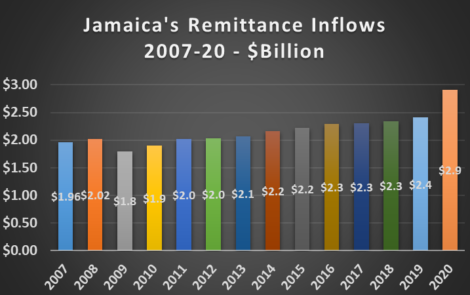 The sharp increase follows from the strong rise seen since May last year when inflows grew 41.6 percent, with the remaining months of the year increasing over thirty percent, except November that grew by 19 percent. For January this year, gross remittance inflows grew 32.7 percent or US$59.4 million to US$241 million. The trends suggest that the country could see earnings from this are exceeding US$3 billion for the first time, having grossed US$2.9 billion in 2020 and increased by US$500 million or 21 percent. According to data out of Jamaica’s central bank from 2013 up to 2019, remittance inflows have grown by an average of US$57 million per annum or 3%. The year with the highest increase was 2014 when a four percent rise delivered provided the country with a $92 million increased inflows and the year with the lowest increase was 2017 with an increase of just $14 million for a one percent rise.
BOJ frees up banks’ dividend payments
Bank of Jamaica is advising that with immediate Effective, Financial Holding Companies and Other Deposit-Taking Institutions can choose to resume the distributions of dividends to shareholders owning more than one percent of issued shares that was declared for their 2019 and 2020 financial years.
 Dividends for 2021 can be declared and distributed to all shareholders. Jamaica’s central bank reported the change after reaching an agreement with the financial institutions to resume dividend declarations and distribution.
The central bank has, however, stated that there are still significant uncertainties associated with the COVID-19 pandemic, but BOJ continues to urge financial institutions to remain prudent in their decisions to declare and distribute dividends.
The central bank stated, “the agreement to resume dividend declaration and distribution reflects the fact that the quantum of loans that were afforded payment accommodations since the onset of the COVID-19 pandemic has fallen. In addition, BOJ believes that the worst of the impact of the pandemic on the economy is behind us, although the economic outlook remains uncertain. In this context, the Bank of Jamaica is of the view that the financial system has adequate capacity to absorb unexpected losses that could arise as the crisis unwinds. BOJ’s views about the evolution of system risks in 2020 are contained in more detail in the recently released report on Financial System Stability for 2020.”