Caribbean Producers shifts to Main Market

Caribbean Producers is set to shifts to Jamaica Stock Exchange Main market at the start of trading on Tuesday, having completed ten years on the Junior Market.

Caribbean Producers traded 52 weeks’ high on Monday.

The switch now reflects no bids and offers for the stock that lasts, traded at $4.95 on Monday, with the highest bid being $4.86 to purchase 10,764 shares and the lowest offer at $4.94 to sell 142,428 shares. The stock traded 58,282 units on Monday at a 52 weeks’ high of $5.05.
The shift to the main market could open up new buying opportunities for the stock as some investors see stocks listed on the main market as better investment options for them than Junior Market stocks.
CPJ, a major supplier to the hotel trade, is benefiting currently from a strong rebound in tourist traffic into the country, with 39 percent more passenger arrivals coming into the country in June compared to May this year on top of a 44 percent spike in passenger arrivals through the airport for the second city of the country May over April.
The indication is that visitor arrivals should hit 105,000 in May, up from 82,702 in April. June arrivals through the airport topped 142,000 for the first time since the industry opened up for foreign visitors in June last year. June this year ended with 142,727 arrivals for the month, amounting to 61 percent of the June 2019 numbers of 239,000.
The stock is up 78 percent for the year from $2.80 to $4.98. CPJ is the third Junior Market to move to the Main Market and follows Eppley and Key Insurance. 

Jamaica Tourism arrivals jump 39%

Stopover visitor arrivals to Jamaica appear set to increase by 40 percent over May numbers, data compiled from reports of passenger arrivals disclosed by the Sangster International Airport suggest. According to the data, 39 percent more passenger arrivals came into the country in June compared to May this year.
May saw a 44 percent spike in passenger arrivals through the airport for the second city of the country over April, an indication that visitor arrivals should hit 105,000 in May, up from 82,702 in April. June arrivals through the airport, topped 142,000 for the first time since the industry opened up for foreign visitors in June last year. June this year ended with 142,727 arrivals for the month, amounting to 61 percent of the June 2019 numbers of 239,000.

Aircrafts arriving in the country, rose by 5.8 percent in June to 2,490 compared to a 15 percent increase in May with 2,353 units over April, with the trend showing increased passenger load.
July is set to see the total visitors breaking the 200,000 mark for an increase of 40 percent putting it to 76 percent of the July 2019 influx of 270,462.
August could see the industry coming back to the 2019 levels and may well exceed it and possibly suggest full recovery for the industry.
The latest Jamaica Tourist data published is only for April and was published for the public’s use on June 17, more than a month and a half after the month closed. The data for February was even worse coming out on April 27, nearly two months after the close of the month reported on.

Junior Market at highest level since 2019

The Jamaica Stock Exchange Junior Market is trading at the highest point in over 18 months when the market index crossed into the 3,400 points mark and hitting a high for the early morning at 3404.24, helped by Tropical Battery that traded at a record high of $1.50.
The move pushes the Junior Market up, as it has now decisively broken through the resistance point around 3,300 level.
The previous high was recorded on December 16, 2019, when the market closed at 3,412.43.
The Main Market is up 464,059.44 from 462,144.64 points at the close on Monday, With Grace Kennedy trading at a record high of $100.

Jamaica’s reserves spike US$100m

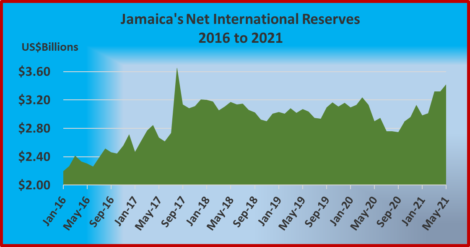
Jamaica’s Net International Reserves climbed US$100 million higher in May to reach US$3.42 billion from US$3.32 at the end of April after a $300 million surge in March with a rise of US$303 to US$3.32 billion from US$3.016 billion at the end of February, this year.
The country’s gross reserves are now at US$4.35 billion and include US$930 million due to the International Monetary Fund. The increase in May comes at a time when inflows from tourism are at the highest levels since March 2020 as the sector makes rapid strides in recovery, with May having the highest number of overseas visitors since the country reopened its borders to tourist in June last year. Reports from the tourism industry suggest that visitor arrival numbers for June and July will be appreciably better than for May and should add to foreign currency inflows into the country and most likely the NIR as well.

The country is also benefitting from a continued increase in remittances inflows that became evident since May 2020.
The reserves are at the highest sustained levels in the country’s history. The net reserves represent an estimated 30.57 weeks of Goods & Services imports for Jamaica.

May’s Jamaica’s tourist arrivals to surge 44%

Tourism numbers continue to be on the rise for Jamaica, with May likely to reach 120,000 stopover arrivals or 57 percent of the 210,664 stopover arrivals in May 2019, representing the best month’s performance since the closure of the country’s borders last year March, but industry experts say the increase is coming, with steeply discounted rates.

Tourism is Jamaica’s largest earner of foreign exchange.

Arriving passengers passing through the Sangster’s International airport surged 44 percent in May over April’s arrivals to 108,320, suggesting that stopover arrivals for the country will reach the 120,000 mark.
The last report of total visitor arrivals put out by the Jamaica Tourist Board puts stopover arrivals in March 2021 at 73,646, up 68 percent over February. The increase is close to the arrival numbers through Sangster’s Airport with March this year, showing a 77 percent increase in airport arrivals through Montego Bay over February.
April enjoyed a 12.5 percent bounce in arrivals through the Sangster airport over March that had 75,139 arrivals, suggesting that April’s stopover visitor arrivals should reach around 82,000, well off the 232,834 attained in April 2019.
The trends suggest that arrivals for June could reach approximately 65 percent of the 2019 stopover arrivals of 238,888, with strong prospects of the rest of summer numbers bouncing as well.
Industry sources informed IC Insider.com that things are picking up in the sector, but there is unevenness as to who are the beneficiaries of the rebound. Hotels have been involved in steep discounting of rates to attract visitors and the big named chains are getting a much bigger share of the pie than the smaller hotels. For example, data out of the sector indicates that hotels with 100 rooms or more are said to have had occupancy levels an average of just over 50 percent compared to smaller hotels under 100 rooms with just 37 percent for May, while the expectation for June is 60 percent occupancy, with smaller hotels expecting just 35 percent, July is expected to have similar levels as June.
The curfew hours have played a big role in the grave disparity, the source indicates, in the vast gap in occupancy between the smaller and the larger properties. The larger hotels have a lot of activities taking place within their borders compared to smaller ones that guess spend more time outside the properties than inside, with the curfew hours restricting their movements in the night and what they can or cannot do.
Junior Market at 16 months high

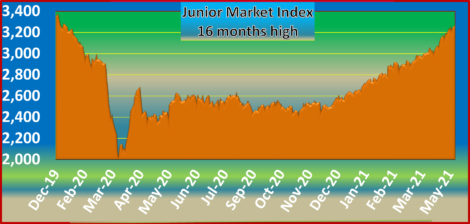
The Junior Market of the Jamaica Stock Exchange is trading at the highest level in over 16 months with the index hitting at 3,320.06 points within half an hour of the market’s opening, this morning up, 55.60 from Monday’s close of 3,264.46 points.
The best close above this level is that on January 3, last year when the market ended at 3,378.20. The market index is currently 3,319.89 points.
The all Jamaican Composite Index rose 3,494.55 points to 451,218.73 at 10.25 this morning.

Another TTSE stock set to list on JSE

Massy Holdings the T&T conglomerate is set to list on the Jamaica Stock Exchange, the second such company to do so, with Guardian Holdings having listed this week. The board made the decision at a meeting held on May 6.
According to a release from the company that has Patrick Hylton as one of its directors, who chairs Guardian Holdings, the directors in making their decision, considered the market sophistication and growth opportunities evident in the Jamaican securities market which has become increasingly more dynamic over the past few years. The release went on to further state, “the board anticipates greater regional and international interest in the company’s shares.”
Massy Holdings generated revenues of TT$3.2 billion up from $3.16 billion for the first quarter ending December and ended with a profit of $188 million up from $167 million resulting in EPS of $1.76 up from $1.57 in the first quarter in 2019. The group could end up with earnings around $6 per share with the stock that last traded at TT$65 on the Trinidad and Tobago Stock Exchange, trading at 11 this year’s earnings.
Massy has just 97,743,000 issued shares, well below the average listed company on the Jamaica Stock Exchange, so unless they do other things to create liquidity and demand for the stock it will languish from lack of investors’ interest.
Conglomerates are notorious for disappointing investors. Jamaicans will point to Grace Kennedy as a great example of a group that promised so much over the years but constantly disappointed investors who looked elsewhere while the company’s profit stagnated.

Carib Cement Q1 profit triples

After several years of underperformance, Jamaica’s sole cement producer – Caribbean Cement is reporting record profits of $1.53 billion, an increase of 216 percent from $483 million in 2020 from a 31 percent increase in revenues to $5.97 billion for the quarter ending March 2021, over the 2020 corresponding period. 
The strong quarterly performance follows an excellent December 2020 quarter when profit jumped sharply to $962 million from $310 million in 2019.
Direct production cost rose 15 percent from $2.7 billion in 2020 to $3.1 billion, as a result, gross profit jumped 54 percent to $2.88 billion from $1.88 billion in 2020, resulting in profit margin rising 48 percent from 27 percent in 2020.
Other operating expenses fell 10 percent from $651 million to $582 million in the quarter. Finance cost declined in the quarter, from $164 million to $162 million. Foreign exchange losses slipped to $209 million for the quarter from $281 million in the previous year’s corresponding period.
The company continues to enjoy a healthy cash flow and ended with $755 million in cash funds at the end of the quarter after pulling in $3.3 billion in gross cash inflows and after paying $953 million in corporate taxes and repaying $1.9 billion in connection with loans.
At the end of March, loans outstanding amount to $4.8 billion, while shareholders’ equity amounts to $13 billion up from $8.8 billion at the end of March 2020.
Current assets ended the period at $4.1 billion up from $3.1 billion at the end of March 2020. Trade receivables ended at $404 million from $450 million last year march while inventories stood at $2.7 billion up from $21 billion at the end of the 2020 first quarter. Current liabilities rounded out the quarter at $7.3 billion compared to $4.9 billion at the end of the 2020 first quarter.
Earnings per share came out at $1.79, up from 57 cents in 2020. IC Insider.com is forecasting around $8.50 per share for the year with the PE currently at 12.5 times 2021 earnings.
The stock last traded at $75 on the Main Market of the Jamaica Stock Exchange on Wednesday and is projected to get to $150 in the next twelve months.

Barita’s profit doubles

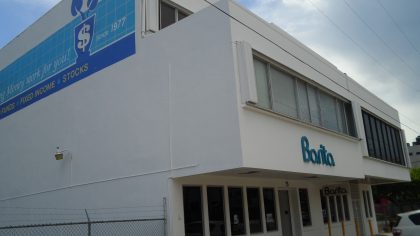
Fast out of the block, Barita Investments opens the earning season for the March quarter with a doubling of profits for the quarter and half year. Profit after tax rose from $509 million to $1.04 billion and from $1 billion in the half year ended March 2020 to $2.06 billion in 2021.
Revenues nearly doubled for the quarter to $2.05 billion from $1.13 billion in 2020 and from $2.26 billion last year to $4.05 billion in 2021. Fees and commission income surged from $182 million in the 2020 quarter to $898 million and foreign exchange gains jumped from just $19 million in 2020 March quarter to $650 million this year, while the half year’s figures saw a steep increase from just $106 million to $1.1 billion. Investment gains in the latest quarter fell to just $121 million compared to $599 million in 2020, while the half year saw a slight drop in 2021 to $791 million from $851 million.
Operating expenses rose 70 percent at a much slower pace than revenues to $794 million in the quarter from $468 million in 2020, for the half year cost increased 54 percent to $1.47 billion from $958 million to March 2020.
Earnings per share rose to 96 cents in the quarter from 62 cents in 2020 and from $1.24 last year to March to $1.90 in 2021.
Total assets are now $78.7 billion, up from $48.7 billion at the end of the year ago and from $70.7 billion at the end of September, last year and shareholders’ equity climbed from $14 4 billion in March 2020 to $28.7 billion in 2021. Pledged assets jumped from $21.5 billion in March 2020 to $47 billion in the latest quarter, while loans receivables increased from $1.1 billion to $7.3 billion.
The company’s shares trade on the Jamaica Stock Exchange and last traded at $86.01 at earnings for the full year of $4 the PE is 21.5.

JSE main Market at 12 months high

The Jamaica Stock Exchange hit the highest points on Monday Morning trading since it closed above the 442,906 points level on April 14, 2020. The Junior Market now trades at the highest level since January 31, last year with the index now at 3090.76, up from the previous high of 3,098.16 at the close of January 29 2020.