 The Jamaica Stock Exchange main market declined on Monday after posting another intraday high of 418,00.53 Points.
At the end of trading, All Jamaica Composite Index lost 1,050.58 points to close at 415,905.53 and the JSE Index fell 957.20 points to 378,937.01.
IC bid-offer Indicator| At the end of trading, the Choice bid-offer indicator reading shows 8 stocks ending with bids higher than the last selling prices and 4 closing with lower offers, suggesting mostly gains ahead for stocks.
A total of 27 securities traded including 2 in the US dollar market, compared to 32 trading on Friday with the prices of 13 securities rising, 7 declining and 7 holding firm.
There were 6 securities trading at 52 weeks’ highs during the day, with just ending at a 52 weeks’ closing highs. Stocks trading at new highs are Mayberry Investments, JMMB Group, NCB Financial Group and PanJam Investment, while Radio Jamaica ended at a 52 weeks’ low.
Trading ended with major contraction in trading volume in the main market compared to Friday’s levels, with 13,217,499 units valued at $228,334,356 compared to 3,405,863 units valued at $88,834,288 changing hands on Friday.
Trading closed with Wisynco Group led with 10,075,318 units and 76.23 percent of the day’s volume followed by NCB Financial Group with 609,701 units or 4.61 percent of the day’s volume and Jamaica Producers with 551,409 units or just 4.17 percent of the volume traded.
Trading resulted in an average of 528,700 units valued at over $9,133,374, in contrast to 117,444 shares valued at $3,063,251 on Friday. The average volume and value for the month to date amounts to 394,228 shares, valued $6,099,986 and previously, 448,288 shares, valued $6,994,366. September closed, with an average of 1,022,243 shares valued $15,752,876, for each security traded.
In the main market activity, Caribbean Cement gained 90 cents to finish at $50, in exchanging 5,195 shares, Grace Kennedy rose $1 and ended trading 14,811 shares at $62, Jamaica Broilers rose 51 cents in trading 42,674 stock units stock units to close at $33, Jamaica Producers rose 49 cents and finished trading 551,409 units at $29.50 Mayberry Investments rose 50 cents to finish at $9.50, trading 134,512 stock units, NCB Financial Group dropped $3.50 trading 609,701 shares to end at $130, PanJam Investment fell 89 cents and closed at $64.01,with 40,270 stock units trading, Sagicor Group gained $1.05 to settle at $41.05, with 24,540 shares, Sagicor Real Estate Fund lost $1 to end at $14, trading 113,782 shares, Scotia Group rose $1 in trading 256,277 units to close at $61, Seprod jumped $2.20 in trading 3,289 shares to close at $49, Stanley Motta rose 75 cents to close at $5.25 with 15,863 shares trading Sterling Investments jumped $2.99 and closed at a 52 weeks’ high of $25 with 22,000 shares changing hands and Sygnus Credit Investments lost 36 cents in trading 18,302 shares to end at $12.51.
Trading in the US dollar market closed with 54.335 units valued at $8,377, changing hands. Proven Investments traded 20,000 shares to close at 23 US cents and Sygnus Credit Investments US dollar based ordinary share traded 34,335 units to end at 11 US cents. The JSE USD Equities Index gained 0.12 points to 175.27.
Junior Market moved higher – Monday
 The Junior Market of the Jamaica Stock Exchange ended trading on Monday with 28 securities changing hands, as 10 securities advanced, 7 declined and 8 remained unchanged. The Junior Market Index advanced 9.89 points to 3,425.09.
IC bid-offer Indicator| At the end of trading, the Investor’s Choice bid-offer indicator reading had 6 stocks ending with bids higher than their last selling prices, 5 closed with lower offers, a negative pointer for trading on Tuesday.
Market activities, resulted in an exchange of 1,710,272 units valued at $8,314,488 compared to 2,257,896 units valued at $8,866,130 on Friday, from the trading of 28 securities.
Trading closed with an average of 61,081 units for an average of $296,946 in contrast to 80,639 units for an average 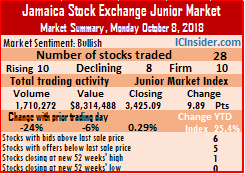 of $316,647 on Friday. Trading for the month to date averages 73,884 for an average of $309,271 compared to averages of 76,500 for an average of $311,790 previously. September, ended with an average of 484,335 at $2,628,299 for each security traded.
At the close of trading, AMG Packaging ended at $1.95, after trading 162,000 stock units, CAC 2000 finished at $18.80, with 4,628 shares changing hands, Caribbean Cream ended trading $1.73 higher to close at $7.89, with 92,416 shares, Caribbean Flavours traded 2,000 stock units at $19, Caribbean Producers finished trading 125,661 units with a loss of 8 cents at $6.20. Consolidated Bakeries closed 40 cents higher at $2.40, with 270 shares traded, Derrimon Trading ended at $3, with 66,000 shares changing hands, Dolphin Cove concluded trading of 66,405 shares $1 higher at $17, Elite Diagnostic finished 25 cents higher at $3.45, exchanging 620 stock units. Everything Fresh ended trading of 114,400 shares and fell 10 cents to $2, Express Catering ended trading 166,739 shares and rose 1 cent higher to $8.40, FosRich Group traded 17,253 shares and rose 1 cent to close at a 52 weeks’ high $4.01, General Accident finished trading 29,810 shares and rose 20 cents higher to $4, GWest Corporation closed 3 cents higher at $1.93, trading 7,012 stock units.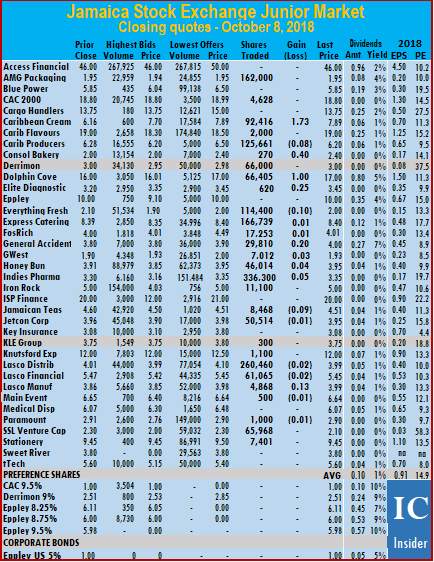 Honey Bun ended 4 cents higher at $3.95, while exchanging 46,014 units, Indies Pharma gained 5 cents and ended with 336,300 shares changing hands to close at $3.35. Iron Rock concluded trading 11,100 shares at $5, Jamaican Teas settled with a loss of 9 cents at $4.51, with 8,468 shares being exchanged, Jetcon Corporation ended trading 50,514 stock units with a loss of 1 cent to end at $3.95. KLE Group finished trading 300 shares at $3.75, Knutsford Express closed at $12, with 1,100 shares trading, Lasco Distributors ended with a loss of 2 cents at $3.99, in exchanging 260,460 shares, Lasco Financial concluded trading with a loss of 2 cents at $5.45, with 61,065 stock units. Lasco Manufacturing closed 13 cents higher at $3.99, exchanging 4,868 units, Main Event settled with a loss of 1 cent at $6.64, after trading 500 shares, Paramount Trading traded with a loss of 1 cent at $2.90, with 1,000 shares and Stationery and Office finished trading at $9.45, with 7,401 stock units changing hands.
Prices of securities trading for the day are those at which the last trade took place.
Modest price changes for TT stocks – Monday

Trinidad & Tobago Stock Exchange Head Quarters
The Trinidad & Tobago Stock Exchange, closed with the Composite Index rising 0.04 points to 1,220.73, the All T&T Index added 0.20 points to 1,694.44, while the Cross Listed Index lost 0.02 points to 100.41.
At close, 15 securities changed hands, with the price of 5 rising, 3 declining and 7 remaining unchanged, against 15 trading on Friday.
The market ended trading of 1,615,551 shares valued 8,764,394, compared to 519,519 shares valued $3,980,716, changing hands on Friday.
IC bid-offer Indicator| At the end of trading, the Investor’s Choice bid-offer indicator reading closed with 5 stocks ending with higher bids than the last selling prices and 4 with lower offers.
Stocks closing with gains| Ansa Merchant Bank added 2 cents and ended at $38.02, after exchanging 100 shares, Prestige Holdings gained 1 cent and settled at $7.54, with 1,800 units changing hands, Republic Financial Holdings rose 5 cents and ended at 52 weeks high of $103.75, after exchanging 3,715 shares, Trinidad & Tobago NGLclosed with a gain of 2 cents and closed at $29.20, after exchanging 9,743 shares and West Indian Tobacco gained 44 cents and settled at $88.44, trading 23,251 units.
Stocks closing with losses| Clico Investments closed with a loss of 1 cent and completed trading at $19.50, with 7,426 stock units changing hands, Massy Holdings closed with a loss of 5 cents and ended at $47, after exchanging 36,376 shares and Trinidad Cement shed 15 cents and ended at $2.75, after trading 1,100 shares.
Stocks trading with no price change| Angostura Holdings completed trading at $15.75, with 120 stock units changing hands, Calypso Macro Index Fund traded 2,000 units to close at $15.82,First Citizens closed at $32.65, after exchanging 601 shares, Grace Kennedy completed trading at $2.70, with 1,500,000 stock units changing hands, National Flour settled at $1.60, trading 27,404 units, Sagicor Financial completed trading at $7.70, with 1,900 stock units changing hands while Scotiabank settled at $64.94, trading a mere 15 units.
Prices of securities trading for the day are those at which the last trade took place.
Watch NCB & Kremi this week
NCB Financial could be a winner this week.
The main market of the stock exchange closed the week with two of the highest daily increases in the market index ever, a clear sign that investors want stocks to buy and the supply remains very limited and putting the bulls in control.
The moves last week in the main market and since the start of August has set the stage for several stocks to be on the move this week.
The Junior Market continues to inch forward as it appears that investors are waiting on results. They should get Caribbean Cream this week and that should be a strong set of results as the company benefits from lower raw material cost compared to the first quarter when profits jumped 59 percent.
The indicators point to continued increased interest in the main market stocks with a number of them are high on the list to watch for this week. Stocks of interest this week are Grace Kennedy, Barita Investments, Berger Paints, Mayberry Jamaican Equities, NCB Financial, Wisynco, Caribbean Cream, CAC 2000, Main Event and Stationery and Office Supplies, many of these have limited supplies for sale.
With the average PE of the market now approaching a comfortable 16 times 2018 earnings, stocks valued less than the market average could see increased interest as investors look for bargains.
NCB Financial went sideways for around two weeks but bids started building close to the closing prices last week and that could help it move higher this week. Barita had a relatively strong day on Friday with 261,000 shares trading, leaving only a minute amount of 6,200 units on offer at $25.

Caribbean Cream should post big gains in profit in Q2 this week.
An overall view of stocks indicates that the main market continues to be steered higher by an upward sloping support line as well the 45 and 125 day moving averages, lending support just below. The Junior Market that traded recently at an all-time high, is being guided by an upward rising long-term support line and a golden cross. The golden cross is a very strong bullish long-term signal.
Kremi surges to top IC TOP 10

Caribbean Cream outlet in Kingston.
Investors pushed Caribbean Cream down to $6.16 on Friday to surge to the top of the list this week, while Stanley Motta was pushed down to $4.50 to reenter this Top 10 stock list.
JMMB Group jumped sharply to close at a new record high of $37 on Friday and was pushed out of the top tier main market list while Iron Rock shot to a record $5 and dropped out of the Junior Market listing. The market could be making a big mistake with Stanley Motta that is clearly undervalued. IC Insider.com upgraded Caribbean Cream earnings to 85 cents from 70 cents with a sharp fall in the price of milk solids since May by nearly 24 percent that should cut the direct input cost of producing ice cream.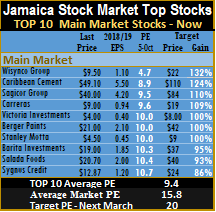
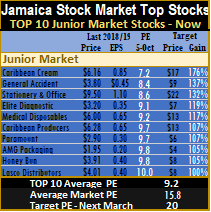
Gains in the two markets are driving the PE ratio of the market higher with the overall PE for the Junior and main market, both rising to 15.8 as of Friday, up from just over 15 last week, as the valuation multiple grows with historically low interest rates and high liquidity abounding in the financial market.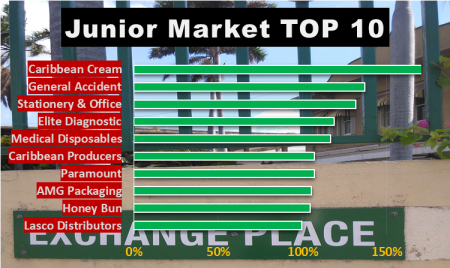
The PE ratio for Junior Market Top 10 stocks average 9.2 and the main market PE is now 9.4, just marginally lower than the prior week’s level, even as the market continues to see an upward revaluation of the multiple.
The TOP 10 stocks now trade at an average discount of 42 percent to the average for the Junior Market Top stocks but it’s a third of what the average PE for the year is likely to be of 20 times earnings. The main market stocks trade at a discount of 40 percent to the overall market.
TOP 10 stocks are likely to deliver the best 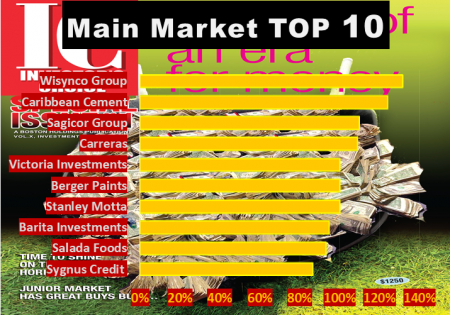 returns within a 12 months period. Stocks are selected based on projected earnings for each company’s current fiscal year. Based on an assumed PE for each, the likely gains are determined and then ranked, with the stocks with the highest potential gains ranked first followed by the rest, in descending order. Potential values will change as stock prices fluctuate and will result in movements of the selection in and out of the lists for most weeks. Earnings per share are revised on an ongoing basis based on new information received that can result in changes in and out of the list as well.
Review of 2018 stock market forecast

Palace hits a new high of $1,500 to be top performer in 2018 so far.
“ Assessment of the market, suggests that 2018 could be a grand year, with overall price gains likely to be in excess of 40 percent”, a quote from IC Insider.com in February, this year.
“Based on projected earnings for 2018, the average PE ratio suggests that main market stocks should grow by 26 percent. Falling interest rates could add another 20 percent to gains during the year, bringing overall gains in excess of 40 percent.”
“Technical readings of the market have the main market heading initially to around 390,000 points or 23 percent ahead of the December close, for the all Jamaica Index, before resistance sets in and then moving much higher, later on’ the IC Insider.com forecast for 2018 stated.
With almost three more months to go, before the year ends, the main market is broken through the 390,000 points mark to be up 31.7 percent for the year to date, there seems no stopping it for now.
The report in February stated that the main market was caught in a wedge formation, trading just below the upper end of channel that can be traced to late 2015. The wedge could hold the market in consolidation mode for a short time, a month or two, before breaking out, most likely to the upside.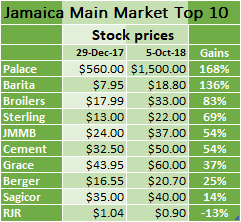
IC Insider.com projects that many of the main market heavy weights will find it tough to repeat the strong gains they enjoyed in 2017, if that is the case, their impact on the market index is likely to be less than for 2017. Another factor that could make a repeat of 2017 tough, is the movement of interest rates. Last year, Treasury bill rates fell 29 percent from 6.56 percent to 4.83 percent, that level of decline, is unlikely to happen in 2018, even as some of the decline in the latter part of 2017 is yet to be fully reflected in the prices of stocks to date and should positively affect prices in 2018. IC Insider.com is forecasting rates on 182 days Treasury bill hitting 3 percent by the end of the 2018 first quarter. Treasury bill rates in 2018 at 1.7 percent, have fallen more sharply than in 2017.
The original piece stated that “there are a number of other factors at play that are set to impact the market. Increasing employment is taking place with the highest number of persons employed in the country’s history. Attendant with that is the sharp fall in unemployment from more than 16.3 percent in 2013, to just over 10 percent in 2017. The annual net employment is growing around 30,000 persons per year and that could rise as the economy gains steam. This will mean more spending and increased tax collection for government. Alpart resumption of Alumina production is a big positive for the overall economy, for increased government revenues and more demand for local goods and services, some of which are provided by listed companies. The tourism sector is enjoying strong growth, apart from increasing foreign exchange intake for the country, will have direct impact on Jamaica Producers and Sagicor X Fund. Jamaica seems to be going through a construction boom with several new buildings under construction, Caribbean Cement and Berger Paints should benefit considerably from such developments.”
“More listings on the stock market will result in increased fee income for JSE and brokerage houses, from increased trading volumes.”
The TOP 10 stocks include a few surprises while there are others that sit just outside the top stocks that investors may still want to keep a keen eye on. Investors should be looking beyond 2018 as medium term gains beyond 2018 could be strong for stocks that will benefit from current developments, long term.
The TOP 10 selection is selling well below the average PE of the Main market of the Jamaica Stock Exchange at just over 6.3 versus nearly 12 at the end of 2017.
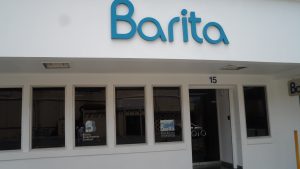
Barita last traded on the JSE as high as $20 on Friday.
Barita Investments moved more into fee based income and that is working well for them, with sharp growth, while net interest income stagnates. The prospects for continued strong growth in fee income continues with more investors seeking better returns than in the fixed interest market. The company should see a change in ownership soon and that could see a more aggressive approach to management that could optimize returns from exiting business and newer lines. Unrealized gains on investment ought to be factored into its earnings in valuing the stocks and that would boost its value considerably, the market is not paying attention.
Berger Paints is set to be a big winner with increasing sales coming from a buoyant construction sector resulting in increased profit and what IC Insider.com expects to be a healthy dose of dividend payments. It could become the next Carreras from a dividend yield standpoint but with growing profits. The company will benefit from lowering of overhead cost which was evident in 2017.
Jamaica Broilers continues to grow organically and from new business being acquired. Growth will continue as the Haitian market deliver greater returns form a growing market while the poultry demand in Jamaica continues to grow.
Caribbean Cement will benefit from lower operating cost, increased sales and a planned cut in financing of the lease which is said will cut hundreds of millions of dollars out of it cost that could come close to $2 per share per annum.
Palace Amusement Company, currently enjoying sell out cinemas with block buster hit, is one of those unusual choices. It enjoys minimal trading but it could surprise on the upside if all goes well. Growth in the economy and increased employment will help to boost patronage going forward and will aid in profit growth as well.
JMMB Group put out outstanding Q3 results with a 39 percent increase in profit and strong gains in revenues, auguring well for 2019 outcome.
The growth potential remains strong and investors in the stock will reap rich rewards down the road. Just one stock that requires patience. By the way fees and commission income jumped an impressive 71 percent to $512 million in the quarter and 53 percent in the nine months, over the similar period in 2016 and should continue to do so going forward.
Radio Jamaica continues to disappoint with below expected revenues and profit. It could return to favour but needs to generate more income from advertising. This is one to accumulate for a payoff down the road.
The other three stocks, Sterling Investments, Grace Kennedy and Sagicor Group are undervalued and could deliver some decent returns to patient investors.
Below the TOP 10 are strong candidates to deliver decent returns this year and beyond, the list includes NCB Financial that is on a strong growth trajectory and recently listed Wisynco Group that should generate earnings around $1.10 for the 2019 fiscal year that starts in July.
Gwest’s share issue response inadequate
 The response by GWest the issue of preference shares is inadequate and they still have a number of questions to answer about the issue and the lack of disclosure in the prospectus and the audited financial statements.
The openness of directors with their investors is critical in cementing trust between them. A prospectus is a contractual invitation to the public to purchase shares in the offering company. It requires that full disclosure of all material information is made, so that prospective investors can make rational decisions pertaining to the shares being offered for sale. Any rational person reading GWest prospectus would come to the conclusion that the only matter agreed on at the extra-ordinary meeting of November 27 was that which was disclosed in section Page 45 of the prospectus which list details of the “Recent Capital Restructuring of the company to be as follows”:
“At an extraordinary general meeting the shareholders of the Company approved the following actions in respect of the capital structure of the Company: The re-registration of the Company as a public company in accordance with the Companies Act, adopting new Articles of Incorporation for that purpose:”
a)”The increase of the authorized share capital. (b)The subdivision of each Share”
“The disapplication of any pre-emption rights, howsoever arising, for the purposes of the issue of new Shares for subscription. The conversion of all fully paid Shares to stock on issue.”
There is no mention of the issue of any other type of share. Any decision to issue other shares should have been disclosed in this section if a meeting took place before the date of the prospectus.

Dr. Konrad Kirlew, chairman of GWest.
The fact that it was not, is the clearest sign that there was inadequate disclosure of important and material information and that the issue of preference shares after, should not stand before approved by a meeting of the new owners.
The vast majority of Junior Market companies have limited administrative staff, as such all the skill set to properly run them are not in their employ. The end results is that mistakes are made and will continue to be made. Recognizing, that most of them don’t have the knowhow of running a public company, the JSE created the creature called a Mentor, but not even that seems to be adequate to fill the breach.
According to the company in a release to the JSE, “Sections 18 and 19 in the November 2017 GWEST Prospectus specifically disclosed that shareholders loans were to be converted to preference shares, thereby reducing the servicing cost to the Company: Shares in the capital of the Company are under the control of the Directors, as expressly provided for in the Articles of Incorporation.”
That is nonsense. The prospectus only has 16 sections, with the last (section 16) being signed by the directors.
Section 11 contains projections along with supporting notes that were reviewed by Ernst and Young who signed their report on November 28.
The extraordinary meeting at which the change in share capital was approved was said to be held on the November 27. According to the resolution, the directors were given authority to issue, to allot such Cumulative Non-redeemable Preference Shares at such subscription price per Preference Share as the Directors of the Company or such Committee may deem fit, the same to be allotted to shareholders of the Company who have invested in the capital of Company (in cash or in kind) with the understanding/pursuant to agreement(s) that such investment(s) will be recognized as shareholder loans or by the issue of preference shares, in each case on terms and conditions determined by the Directors of the Company, subject always to the Articles of Incorporation of the Company”.
Having given the directors the authority to determine the terms and conditions of the preference shares, GWest in releasing information of the above resolution has not presented the minutes of the meeting of the directors that agreed on the terms. The fact that the extraordinary meeting did not set out the terms of the issue of the shares is even more reason why it should have been fully disclosed in the prospectus.
The company refers to 18 and 19 but it appears they mean notes 18 and 19 of section 11 that deals with the projections. What does the section say about the preference shares?
Note 18. “Borrowings| This relates to the NCB Term Loan and shareholders’ loans converted to preference shares.”
“NCB Term Loan| The terms of this loan for $350 million, include a repayment period of eight years payable in equal quarterly installments and an interest rate of 11.5% per annum.”
“Preference Shares| 50% of shareholders’ loan will be converted to non-redeemable preference shares with interest at 10% per annum. The remaining 50% will remain as shareholder’s loan with no fixed repayment with interest at 10% per annum for the J$ amounts and 4% per annum for the US$ amounts.”
Note 19. “Shareholders’ Loan| This amount relates to funds advanced by the shareholders. It is assumed that outstanding balances will continue to attract interest at the prevailing rates of 15% and 4%, respectively for J$ and US$ funds. However, once the IPO is completed and the Company becomes publicly-listed, it is assumed that the interest rates will be reduced to 6% and 2% for J$ and US$ denominated loans, respectively on the remaining balance not converted to preference shares. With respect to the J$ denominated balance, the interest rate is assumed to increase annually by 1%, with a cap at 10% by 2022. The Directors are of the view that these rates are more in line with arm’s length rates prevailing within the market.”
Nowhere in the prospectus is there any reference to a meeting called to approve the issue of any shares other than ordinary shares and the terms of those shares. Under no stretch of the imagination could assumptions included in a financial projections be regarded as disclosure of an agreement to issue shares or that a resolution was already passed to do so. Earlier in the prospectus it is made clear that futuristic statements are just that, as they may not be achieved. That the company withheld pertinent and material information from the new investors even when they had a number of occasions to do so, is glaring and concerning. That the Jamaica Stock Exchange sees nothing wrong with what has transpired is plain shocking, even more shocking is that they did not ensure that proper and full disclosure of the information was included in the relevant part of the prospectus.
The directors cannot over ride, the company’s act that requires that all changes in share capital of a company be approved by shareholders at a general meeting. From all indications this was not agreed to before the prospectus was published, in which case it appears that the new shareholders would have to approve it at a general meeting.
To compound the problem, the preference shares were issued to connected parties to the company. That alone should have alerted all concerned that all decisions should be properly executed.
Of note, the Audited accounts to March 2018, made no mention of the issue of additional shares that were issued or to be issued. It is the norm in auditing, that minutes of meetings are made available to the auditors and the directors have a responsibility to ensure that the financial statements are accurate. The directors need to state if the audited accounts correctly disclose all relevant information pertaining to the share capital. They need to state why they all signed the Prospectus with no mention being made of the resolution to modify the share capital indicating full details of the resolution.
What date did the directors meet to determine the terms of the preference shares and why were those terms not disclosed in the prospectus for all to see?
The Jamaica Stock Exchange requires that they should be advised in advance of any meeting of directors called to alter the share capital of a company and after the meeting the outcome of the meeting is to be communicated to them as well. There are no indications that the directors complied with this section of the Stock Exchange rules.
The handling of this matter is not the way to properly operate in the capital market.
More gains for Junior Market – Friday
 The Junior Market Index rose 14.27 points to close at 3,415.20, after 28 securities changed hands, resulting in the prices of 12 securities rising, 7 declining and 9 remaining unchanged.
IC bid-offer Indicator| At the end of trading, the Investor’s Choice bid-offer indicator reading had 7 stocks ending with bids higher than their last selling prices, 3 closed with lower offers.
Market activities, resulted in an exchange of 2,257,896 units valued at $8,866,130 compared to 2,660,833 units valued at $11,718,330 on Thursday, from trading 28 securities.
Trading closed with an average of 80,639 units for an average of $316,647 in contrast to 104,192 units for an average of $364,931 on Thursday. Trading for the month to date averages 76,500 for an average of $311,790 compared to averages of 75,437 for an average of $310,542 previously. September, ended with an average of 484,335 at $2,628,299 for each security traded.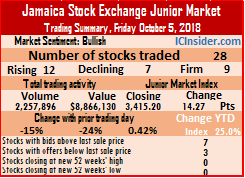
At the close of trading, Access Financial lost $2 to close at $46, in exchanging 1,790 shares, AMG Packaging ended at $1.95, trading 134,947 stock units, CAC 2000 finished at $18.80, trading 1,028 shares, Cargo Handlers settled 24 cents higher at $13.75, with 3,400 shares changing hands, Caribbean Cream ended trading 50,052 shares with a loss of $1.69 at $6.16. Caribbean Flavours traded 760 stock units, at $19, Caribbean Producers rose 3 cents trading 67,300 units to close at $6.28, Consolidated Bakeries closed at $2, with 6,068 shares trading, Derrimon Trading ended 10 cents higher at $3, with 230,398 shares changing hands. Elite Diagnostic finished 5 cents higher at $3.20, with 170,003 stock units being exchanged, Everything Fresh ended trading of 241,493 shares at $2.10, Express Catering ended trading 158,804 shares and rose 4 cents to $8.39, FosRich Group traded 15 cents higher at $4, with 6,459 shares changing hands, GWest Corporation closed at $1.90, with 5,000 stock units changing hands. Honey Bun ended with a loss of 4 cents at $3.91, after trading 211,872 units, Indies Pharma rose 10 cents and ended with 671,846 shares changing hands to close at $3.30. Iron Rock concluded trading of 800 shares at $5,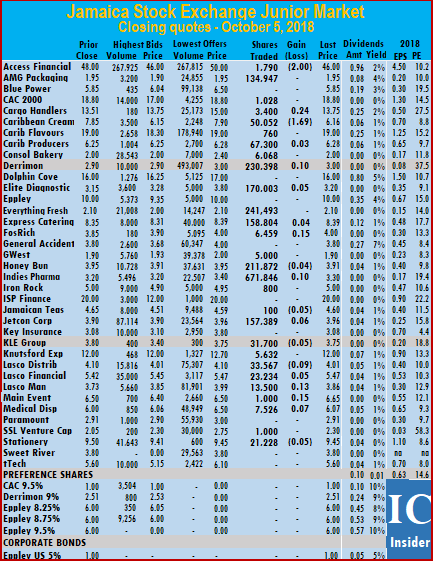 Jamaican Teas settled with a loss of 5 cents at $4.60, exchanging 100 shares, Jetcon Corporation ended trading 157,389 stock units and rose 6 cents to $3.96, KLE Group finished trading with a loss of 5 cents at $3.75, with 31,700 shares, Knutsford Express closed at $12, in exchanging 5,632 shares, Lasco Distributors ended with a loss of 9 cents at $4.01, with 33,567 shares changing hands, Lasco Financial concluded trading 5 cents higher at $5.47, with 23,234 stock units. Lasco Manufacturing finished 13 cents higher at $3.86, trading 13,500 units, Main Event settled with a rise of 15 cents to $6.65, trading 1,000 shares, Medical Disposables ended trading 7 cents higher at $6.07, with 7,526 shares being exchanged, SSL Venture Capital traded 1,000 shares at $2.30 after trading at a 52 weeks’ high of $2.50 and Stationery and Office finished trading with a loss of 5 cents at $9.45, with 21,228 stock units changing hands.
Prices of securities trading for the day are those at which the last trade took place.
All Jamaica leaps to record 416,956
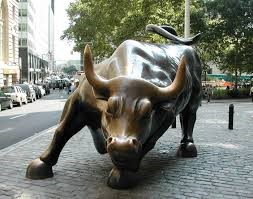 The Jamaica Stock Exchange main market climbed sharply on Friday to a new record high after recording the second highest gain in the market’s history, second only to the 9,823 points rise on Monday, this week.
At the end of trading, All Jamaica Composite Index surged 9,736.35 points to a record close of 416,956.11 and the JSE Index jumped 8,870.92 points to a record close of 379,894.21.
IC bid-offer Indicator| At the end of trading, the Choice bid-offer indicator reading shows 11 stocks ending with bids higher than the last selling prices and 3 closing with lower offers, suggesting mostly gains ahead for stocks.
A total of 32 securities traded including 3 in the US dollar market, compared to 29 trading on Thursday with the prices of 15 securities rising, 8 declining and 6 holding firm.
There were 6 securities trading at 52 weeks’ highs during the day, with 4 ending at a 52 weeks’ closing highs Stocks  trading at new highs are Kingston Wharves, JMMB Group, NCB Financial Group and Salada Foods, while Radio Jamaica ended at a 52 weeks’ low.
Trading ended with major contraction in trading volume in the main market compared to Thursday’s levels, with 3,405,863 units valued at $88,834,288 changing hands compared to 50,485,890 units valued at $464,344,297 on Thursday.
Trading closed with Mayberry Investments trading 1,114,541 shares and 32.7 percent of the day’s volume with the price closing at $9.11 after falling 24 cents. Sagicor Group accounted for 520,345 shares or 15.3 percent of the day’s volume, followed by Barita Investments with 261,000 shares and 7.7 percent of the volume traded.
Trading resulted in an average of 117,444 units valued at over $3,063,251, in contrast to 1,803,068 shares valued at $16,583,725 on Thursday. The average volume and value for the month to date amounts to 448,288 shares, valued $6,994,366 and previously, 533,195 shares, valued $6,208,222. September closed, with an average of 1,022,243 shares valued $15,752,876, for each security traded.
In the main market activity, Barita Investments gained 30 cents and closed at $18.80, while 261,000 shares were traded up to an intra-day high of $20, Berger Paints climbed 99 cents and ended at $21.99, with 10,142 stock units trading, Jamaica Broilers jumped $4.49 in trading 13,273 stock units stock units at $32.49, JMMB Group climbed $2 and ended at a 52 weeks’ high of $37, trading 26,182 shares, Kingston Wharves jumped $7.90 and finished at a record high of $83, trading 26,042 stock units, Mayberry Investments rose 58 cents to finish at $9, trading 1,114,541 stock units, NCB Financial Group gained $1 trading 232,956 shares to end at a record close of $133.50, Sagicor Real Estate Fund rose $1.50 to $15, trading 190,908 shares, Salada Foods gained 71 cents and ended trading at a 52 weeks’ closing high of $20.71, with 5,941 stock units, after it traded earlier at a high of $23, Scotia Group shed $2 in trading 520,345 units to close at $60, Seprod jumped $2.20 in trading 3,289 shares to close at $49, Stanley Motta lost 75 cents to close at $4.50 with 4,600 shares trading and Supreme Ventures lost $1.20 in trading 83,624 shares to end at $20.50.Trading in the US dollar market closed with 50,772 units valued at $10,647, changing hands. JMMB Group 6% preference share completed trading of 1,800 after inching up by 1 cent to close at $1.07, Proven Investments traded 27,950 shares to close at 23 US cents and Sygnus Credit Investments US dollar based ordinary share, rose 1 cent in trading 21,022 shares to end at 11 US cents. The JSE USD Equities Index gained 0.51 points to 175.15.
TTSE traded steady on Friday

Trinidad & Tobago Stock Exchange Head Quarters
The Trinidad & Tobago Stock Exchange, closed after the Composite Index rose 0.74 points to 1,220.69, the All T&T Index shed 0.73 points to 1,694.24, while the Cross Listed Index added 0.31 points to 110.43.
At close, 15 securities changed hands, with the price of 4 rising, 4 declining and 7 remaining unchanged, against 14 trading on Thursday.
The market ended trading of 519,519 shares valued $3,980,716, compared to 602,213 shares valued $7,388,303, changing hands on Thursday.
IC bid-offer Indicator| At the end of trading, the Investor’s Choice bid-offer indicator reading closed with 5 stocks ending with higher bids than the last selling prices and 4 with lower offers. Republic Financial Holdings closed with the bid at $105 to buy just 15 shares, well above the last traded price of $103.70.
Stocks closing with gains| Clico Investments gained 1 cent and ended at $19.51, with 7,758 stock units changing hands, JMMB Group rose 5 cents and closed at $1.70, after exchanging 86,130 shares, Massy Holdings closed with an increase of 5 cents and concluded trading of 2,735 shares at $47.05 and Trinidad & Tobago NGLadded 1 cent and settled at $29.18 with 110 shares changing hands.
Stocks closing with losses|First Citizens fell 15 cents and settled at $32.65, after exchanging 435 shares, Guardian Holdings lost 1 cent and completed trading  with 1,140 units at $16.89, Sagicor Financial shed 4 cents and ended at $7.70, with 10,857 stock units changing hands and West Indian Tobacco lost 44 cents and completed trading 7,363 units at $88.
Stocks trading with no price change| Angostura Holdings completed trading at $15.75, with 114,229 stock units changing hands, Ansa Mcal settled at $57, with an exchange of 1,450 units, Grace Kennedy completed completed trading at $2.70, with 246,995 stock units changing hands, National Flour settled at $1.60, with 29,518 units trading, One Caribbean Media ended at $12.11, after an exchange of 8,700 shares, Scotiabank settled at $64.94, with 750 units and Unilever Caribbean completed trading at $26.25, with 1,349 stock units changing hands.
Prices of securities trading for the day are those at which the last trade took place.