Stopover arrivals in May 2021 were 122,522 Jamaica Tourist Board recently released data shows, just over 2,500 above ICInsider.com original May forecast. Data of passenger arrivals through the Sangster’s International Airport suggests that stopover arrivals for June should reach 160,000 or 67 percent of the arrivals of 239,000 June in 2019.
 If the trend continues, July is likely to see just over 200,000 stopover arrivals, which would amount to 77 percent of July 2019 stopover arrivals of 270,462.
In the meantime, arrivals for August this year could exceed the 215,000 arrivals in August 2019.
June arrivals through Sangster’s International Airport were 142,727, which amounts to 61 percent of the June 2019 numbers of 239,000.
For the January to May period, arrivals decreased by 36 percent to 366,499 stopovers, 207,632 less than the 574,131 that came in the first three months of 2020, with the industry closed until late June.
The total stopover arrivals, recently released by the Jamaica Tourist Board for May are down 42 percent from 2019, but a huge improvement over the decline of 65 percent that April suffered against the same period in 2019, additionally, May numbers are 48 percent above April this year, showing the strength of the recovery.
June stopover visitor arrivals set for 160,000
Trading dominated by rising stocks
Stocks mostly rose on the final day at the half-year mark on Wednesday on a day when it was very difficult to find declining stocks on the Trinidad and Tobago Stock Exchange, leaving the market with a gain of six percent for the year to date.
 Market activity ended, with 87 percent fewer shares carrying a 94 percent lower value than on Tuesday, as 15 traded compared to 18 on Tuesday, with prices of eight rising, one declining and six closed unchanged. The Composite Index surged 14.69 points to 1,402.56, the All T&T Index spiked 24.93 points to 1,928.19 and the Cross-Listed Index popped 0.52 points to settle at 117.73.
Overall, 137,142 shares traded for $3,189,621 versus 1,087,460 units at $49,668,632 on Tuesday. An average of 9,143 units traded at $212,641 down from 60,414 shares at $2,759,368 on Tuesday. Trading month to date averages 45,770 units at $724,497 versus 47,288 units at $745,707. The trades for May averaged 25,935 units at $406,593.
The Investor’s Choice bid-offer indicator shows one stock ended with the bid higher than the last selling price and one with a lower offer.
At the close, Agostini’s remained at $24.50 after trading 6,155 shares, Clico Investment Fund ended at $26.90 while exchanging 25 stocks, First Citizens Bank ended at $50 in exchanging 6,008 shares, Grace Kennedy spiked 6 cents to $5.41, with 5,421 units changing hands. Guardian Holdings lost 58 cents to end at $32.92, trading 11,626 stocks, JMMB Group rallied 5 cents to $1.95, with 42,986 stock units clearing the market, Massy Holdings rose 50 cents to $80.50 in switching ownership of 21,494 stock units. National Flour Mills remained at $2.10 after 10 shares crossed the market, NCB Financial Group inched 1 cent higher to $8 after exchanging 19,168 units, Prestige Holdings added 1 cent to close at $7 after trading 365 shares. Republic Financial Holdings surged $4.91 to $139.99 trading 10 stock units, Scotiabank popped $2.74 to $59.74 with an exchange of 10 stocks, Trinidad & Tobago NGL gained 22 cents to end at $17.52, trading 19,792 stock units. Trinidad Cement closed at $3.27 with the swapping of 3,910 stock units and West Indian Tobacco remained at $32, with 162 shares changing hands.
Prices of securities trading are those for the last transaction of each stock unless otherwise stated.
New ICTOP10 entrants
In a week when the main and junior markets of the Jamaica Stock exchange broke loose from resistance, with the Junior Market just creeping away and the Main market surging more than 14,000 points up, as investors appear more bullish than they have been for some time.
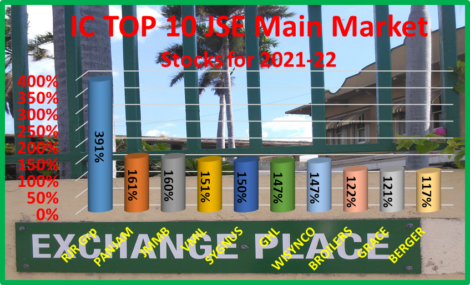 Scotia Group, along with Caribbean Cream, fell out of the TOP10 based on downward revisions to their earnings for the coming financial year ends. Moving into the Junior Market TOP10 is ISP Finance with the price dropping to $15.60 on Friday and the Main Market listed, Berger Paints moving back in the TOP10 with the price at $13.85 on Friday.
JMMB Group came outwith solid results for the full year to March, leading to a revision of the projection for the 2022 fiscal year, making the stock a solid buy even after it rose 12 percent to $38.45 from $32.50 last week, Grace Kennedy jumped 5 percent from $94.97 last week to close at $99.46, PanJam Investment moved up 11 percent from $54.50 to $69 and Future Energy Sources closed the week at a 52 weeks’ high of $1.10, to be marginally up for the week from $1.07.
The average gains projected for the Junior Market slipped from 210 percent last week to 207 percent as the market slowly rises. The average projected gains for the Main Market stocks dropped last week from 170 to 166 percent as the market gained 3 percent for the week.
The top three stocks in the Junior Market continue to be Elite Diagnostic heading the list, followed by Medical Disposables and Caribbean Assurance Brokers, with the potential to gain between 247 to 300 percent. The top three Main Market stocks are Radio Jamaica in the number one spot, followed by PanJam Investments and JMMB Group, with expected gains of 160 to 391 percent.
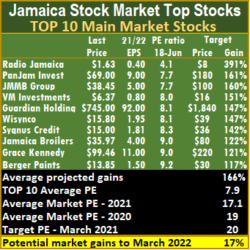 The targeted PE ratio for the market remains an average of 20 based on profits of companies reporting full year’s results up to the second quarter of 2022. Fiscal 2020-21 ended March 2021 with the average PE at 17 for Junior Stocks and 19 times for the Main Market. One reason why the Junior Market stocks have outperformed Main Market ones since last year can be seen from the big difference between the valuations of both markets, with the latter values close to maturity, based on present valuation metrics.
The Junior Market, with an average PE 13 based on ICInsider.com’s 2021-22 earnings, is currently trading well below the target, as well as the recent historical average of 17, for the market to get to last year average, would require a 32 percent rise in the market, that would equate to a rise of 54 percent to March 2022 if it were to reach the targeted PE of 20.  The Junior Market Top 10 stocks average a mere 6.7 at just 51 percent of the market average, indicating substantial gains ahead. The JSE Main Market ended the week with an overall PE of 17.1, a little distance from the 19 the market ended in March, suggesting just an 11 percent rise at a PE of 19 and 17 percent at a PE of 20 from now to March 2022. The Main Market TOP 10 trades at a PE of 7.9 or 46 percent of the PE of that market, well off the potential of 20.
IC TOP10 stocks are likely to deliver the best returns up to March 2022 and ranked in order of potential gains, based on likely increase for each company, taking into account the earnings and PE ratios for the current fiscal year. Expected values will change as stock prices fluctuate and result in movements in and out of the lists weekly. Revisions to earnings per share are ongoing, based on receipt of new information.
Persons who compiled this report may have an interest in securities commented on in this report.
CAC 2000 and Tropical Battery joint venture
Jamaica Stock Exchange Junior Market listed, CAC 2000 and Tropical Battery Company announced the joint formation of ENERVATE Limited, which is owned 50 percent by each party, is a Jamaican incorporated company that will start offering its product and services to the public at the beginning of June.

The joint venture will be led by Steven Marston, former CEO of CAC 2000. According to a release by the company, ENRVATE will adopt a unique approach to establishing energy saving solutions for our commercial customers in Jamaica and the Caribbean by focusing on real-time measurement and monitoring of energy consumption, using the resulting data to identify, design, and execute energy and water saving opportunities.
“The goal is to work with customers to achieve minimum savings of 25%, with the ultimate achievement being net-zero consumption. Enervate plans to develop innovative financing solutions for qualified customers through the issuance of a Green Bond along with equity capital.
 The “joint venture is in line with CAC 2000 strategy to develop complementary partnerships which are in keeping CAC’s purpose of Improving People’s Lives by excelling as the leading experts on energy and Indoor Environmental Quality, by engineering solutions and providing products and services that sustain healthy, comfortable and productive indoor environments, actively generating energy savings for our customers, whilst improving and diversifying our revenue streams, the release goes on to states. Tropical Battery has over 70 years of experience in the energy storage business.
Volume plunges on JSE USD Market
Trading on Wednesday dropped back to more subdued levels with an exchange of 95 percent fewer shares than the relatively heavy trading on Tuesday with the value plunging 56 percent and resulting in declining stocks just outnumbering rising ones at the close of the Jamaica Stock Exchange US dollar market.
 Trading ended with five securities changing hands, compared to eight on Tuesday with the prices of one stock rising, two declining and two remaining unchanged.
The JSE USD Equities Index slipped 0.28 points to 197.05. The average PE Ratio ended at 12.3 based on ICInsider.com’s forecast of 2021-22 earnings.
Overall, 129,505 shares traded for US$12,398, down from 2,508,722 units at US$28,103 on Tuesday.
Trading averaged 25,901 units at US$2,480, in contrast to 313,590 shares at US$3,513 on Tuesday. Trading month to date averaged 202,941 units at US$3,115. May ended with an average of 138,035 units for US$17,391.
Investor’s Choice bid-offer indicator shows two stocks ended with bids higher than the last selling price and one with a lower offer.
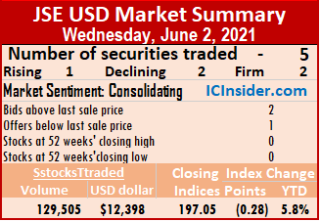 At the close, First Rock Capital had an exchange of 44,814 shares at 8.99 US cents, Productive Business Solutions had trading of 9 stock units at 80 US cents, Proven Investments lost 0.1 of a cent to end at 25.9 US cents with 21,708 units changing hands. Sterling Investments slipped 0.01 of a cent to 2 US cents with a transfer of 52,000 stocks and Sygnus Credit Investments rose 0.48 of a cent to close at 15.49 US cents with 10,974 shares crossing the exchange.
Prices of securities trading are those for the last transaction of each stock unless otherwise stated.
The Agriculture export star performers
Yams are the new agricultural crop now with US$37.4 million in export earnings in 2020, a 45 percent rise from 2017 and an area that grew 14 percent in 2018 over 2017 but rose just two percent in 2019 and up a strong 24 percent in 2020.
 Ackee one of the best loved food items in Jamaica had a mere 3 percent rise in 2020 over 2017 but has fallen 25 percent in 2018 versus 2017, it grew 27 percent in 2019 and 7 percent in 2020. Other Food Exports grew 33 percent between 2017 and 2020 to reach US$33 million after rising 23 percent in 2020 over 2019. Meat & Meat Preparations export segment is not large in monetary terms with just US$9.4 million in export earnings in 2020 but it grew 38 percent over the four year period, since 2017, with an 11 percent increase, 15 in 2019 and 8 percent in 2020 over 2019.
The big question is whether all is being done to encourage continued growth in many of the promising areas that have emerged and could make meaningful contributions to export earnings, create increased employment and help in boosting the wider economy?
More changes to IC TOP10 stocks
Berger Paints returns to the TOP 10 Main Market stocks while Sterling Investments drifted out, while the price of Caribbean Assurance Brokers rose 26 percent to $2.30 during the week and tumbled out of the Junior Market TOP10 and is replaced by General Accident.
 Elsewhere, the 2021 TOP 15 listed Carreras that migrated from the 2021 ICTOP10 in February hit a new 52 weeks’ high during the week to sit at $10 for a rise of 45 percent for the year to date. The price could climb further, helped by improving profit and a high dividend yield. Future Energy Source (Fesco) hangs onto the Junior Market TOP10 list at the tenth position, with the prospectus still to be released to the public.
Junior Market stocks continue to fight clear of the 2,900 level of the market index for another week, but they closed above it on the last two days of the week, as the market continues to consolidate around that level. Main Market stocks made gains during the week, adding 1,524 points as they try to break clear of the consolidation zone.
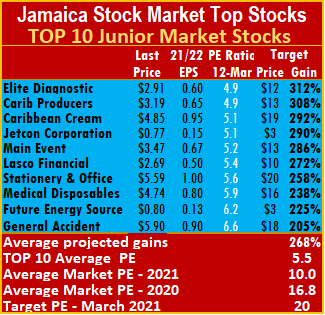
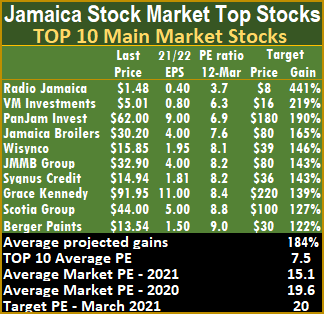 The Junior Market TOP10 contains companies that suffered a sharp reversal of revenues and profit in 2020, with recovery projected for them in 2021. Green shoots are showing for some, with sales picking up in recent quarters with improving bottom-line. Some of these companies may require another quarter or two of improving fortunes before there is meaningful buying into them. The Main Market has a number in the list that has put out record profits or shows strong earnings in 2021, with the stocks clearly undervalued. These include JMMB Group, Jamaica Broilers, Sygnus Credit Investments and Grace Kennedy that are currently in the TOP10 Main Market listing and Caribbean Cement that is just outside.
Both the Junior Market and the Main Market continue to be supported by technical indicators that point to robust gains ahead that are backed up by a number of companies reporting positive profit results with their stock undervalued currently.
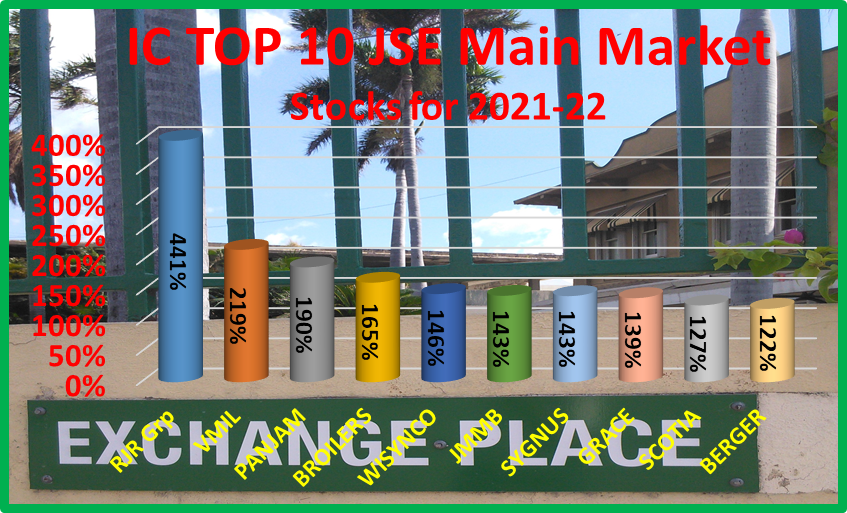 The top three stocks in the Junior Market with the potential to gain between 292 to 312 percent are Elite Diagnostic, followed by Caribbean Producers and Caribbean Cream. With expected gains of 190 to 441 percent, the top three Main Market stocks are Radio Jamaica, followed by VM Investments and PanJam Investment.
The local stock market’s targeted average PE ratio is 20 based on profits of companies reporting full year’s results, up to the second quarter of 2021. The Junior and Main markets are currently trading well below the market average, indicating strong gains ahead. The JSE Main Market ended the week, with an overall PE of 15.1 and the Junior Market 10, based on ICInsider.com’s projected 2021-22 earnings. The PE ratio for the Junior Market Top 10 stocks average a mere 5.5 at just 55 percent of the market average. 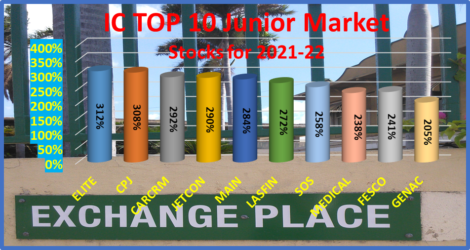 The Main Market TOP 10 stocks trade at a PE of 7.5 or 50 percent of that market’s PE.
The average projected gain for the Junior Market IC TOP 10 stocks is 268 percent and 184 percent for the JSE Main Market, based on 2021-22 earnings. IC TOP10 stocks are likely to deliver the best returns up to March 2022 and ranked in order of potential gains, based on likely gain for each company, taking into account the earnings and PE ratios for the current fiscal year. Expected values will change as stock prices fluctuate and result in movements in and out of the lists weekly. Revisions to earnings per share are ongoing, based on receipt of new information.
Persons who compiled this report may have an interest in securities commented on in this report.
30% fall in PNP’s support
Thirty percent of PNP supporters in the 2016 general election failed to support the party in the latest general election held yesterday and was the main factor behind the massive landslide loss the party suffered in the 202 contest.
 The preliminary results showed that 37 percent of the electorate voted, down from around 50 percent in 2016, when the voters’ list was purged of deceased persons. That is a colossal decline. Although the Jamaica Labour Party scored a convincing victory over the Peoples National Party, winning 49 of the 63 seats, both parties recorded reduced support.
The JLP won 406,764 of the popular votes, down by 7.4 percent from 2016. The PNP support nosedived by a whopping 30 percent or 128,500 votes compared to the 2016 elections to 305,157. The declines occurred despite 89,000 voters were added to the list since 2016. The question on the voters the overall assessment of the management of the country shows 22 percent of those who said they voted for the party in the last election said the government was doing a very good job while 45 percent said they were doing a good job. The numbers suggest division within the ranks of the PNP also played a role in the level of the defeat.
The 2016 election, the JLP polled 436,972 votes and the PNP 433,735, a total of 882,389 votes, but in the 2020 election saw only 712,000 votes cast a stunning fall. The spreading of the COVID virus seems to have had a significant effect of voters, with Public opinion polls conducted a week from the elections, indicating a fall in the decision to vote based on the spread.
10 seats to win for PNP
Public opinion polls are all out and forecasting a massive victory for the JLP over the PNP, when the votes are tallied on September 3. The polls suggest a range of possible voter support, from 60 percent for the JLP and 40 for the PNP to a high of 68 percent for the JLP and a low of 32 percent for the PNP.
 When applied against the 2016 results, the data suggests that the PNP can only rely on getting around 10 seats, with a few others ending up in the marginal column. Even some that appear safe could fall with the massive swing the polls suggest. The swing to the JLP started from around 2014 and started to gather- momentum in 2018 and 2019 as shown by the by-elections results in St Mary and Portland. No doubt, there will be a least one more set of polling data on party standings, that will be released before the start of September that will show if they are any shift in the numbers.
No political party in the history of polling in Jamaica going back to the 1970s has had such a lead in public opinion polls a few weeks from the actual election and none with a lead over 6 percent a year from the elections, has lost. Those are daunting statistics confronting the People National Party as they prepare for the national polls.
The JLP is winning the advertising race by several lengths if advertisements in the newspaper are anything to go by. On Sunday, this week, the JLP had seven full page advertisements in the Sunday Gleaner to just one for the PNP.

Dr. Peter Phillips – President of the PNP
That is a sign of the lopsidedness of the money one side has over the other. This election, will need the advertising in getting out the message far more than at any other election, based on the restrictions on physical campaigning as a result of the Coronavirus spread.
Political parties will not say publicly that they are going to lose, but the magnitude of loss that the PNP is facing is unlikely to be surprising to its leaders. Such leads, choke off badly needed financial help and demoralize party workers and supporters.
All three public opinion polls that showed the political party standings ahead of the 2020 general elections were mainly done in July and show different positions for the parties. They differ quite markedly with a variance of 8 percentage points between the highest and lowest support for each party.
The margin of error of the polls ranges between 2.5% to 3%. Making adjustments for the error factor, plus or minus, could put them all in reach of each other.

JLP set to win a massive victory in the 2020 elections
The Blue Dot Polls numbers are the most conservative of the lot, with 52% for the JLP and 34% for the PNP. The poll represents persons who say they will or maybe voting. On a head to head basis, it translates to JLP winning 60.5% of the votes to the PNP 39.5%, but it could go as high as JLP 64% PNP 36% or as low as 57 percent to 43 percent. The Johnson Polls show that the JLP would win 68 percent of the popular votes to the PNP’s 32 percent, with the possibility that it could range between a high of 73 percent for the JLP to a low of 63 percent and a high of 37 percent for the PNP to a low of 27 percent. Anderson Polls numbers put the JLP at 64 percent and the PNP at 36 percent, with a high of 70 percent, to a low of 59 percent for the JLP and a high of 41 percent for the PNP and a low of 30 percent.
6% one year poll lead secures election win
The 2020 general elections are called for Thursday, September 3. All three polling institutions releasing polls show a strong lead for the governing JLP, but the PNP are indicating that they will defy the polls and come out victorious. It is worth looking back at public opinion polls that were released one year before elections and match that against the actual election results.
The going back to 1976 shows no political party in Jamaica losing a general election with a lead of more than six percentage points one year out. That a record that is not about to change any time soon.
Public opinion polls are snapshots of the current views or intentions of voters. That is what many would want to believe, but there is more to them than that. Using the Don Anderson and Carl Stone polls, going way back demonstrates the point vividly.
In Jamaica, data shows general elections are won a year out, unless support for parties is close, leading up to the elections. That was the case in the last three general elections. Even then, the last election had the winning party with an eight-percentage point lead, a year out from the 2016 General elections.
In a recent interview on MSNBC, a political expert makes the following the observation, “the records show that presidential elections are won in the spring and not in the fall”. He pointed to the winning candidates defining the losers in the spring and putting them on the defensive from which they never recovered.
He pointed to several instances going back to several past winners of presidential races to support that view. As it now stands, Trump is set to move out of the White House. He is already defined as a highly incompetent leader, amongst other negatives that he is carrying, that are weighing him down.
The vast majority of voters invest a great deal of emotion into supporting a political party. A lot of it comes from family traditions built up over several years. That emotional attachment takes time to establish and is difficult to erode. It just does not happen during a relatively short election period.

Polling data is taken form Stone and Anderson polls where applicable.
Polling data suggest that voters switching party support amounts to around two to three percentage points a year. When polls show that a ten points lead a year out from the general elections, that is a gap that is almost impossible to close. Data going back in Jamaica’s polling history, show that in no general election has any political party with a lead over six percentage points has gone to lose the election. Some may point to the last three general elections, but polls were showing close races from a year out, except for the 2016 elections. That was not the case in 1972, 1976, or 1989.

Peter Phillips leader of the PNP
The Don Anderson polls in December 2014 had the PNP at 17% and JLP at 25%, an eight points difference. In June 2015, it was neck and neck with the PNP 25%, the JLP 26%, in September 29.6% each. In January 2016, it moved to 27.5% for the PNP and 23.2% for the JLP and in February, the PNP was at 30.8% to the JLP’s 28%. The data except for June 2015 was suggesting a close election and it turned out that way, but it confirms that a large lead one year out is difficult to overcome. The 2016 election saw the parties garnering about 25% of the total electorate at the time, that ties in with the JLP numbers roughly a year out.
The Don Anderson polling data in February 2019, had the PNP support at 18% and the JLP at 29%. In February 2020, the PNP support moved to 22% and the JLP to 30% a difference of 8 percentage points. The lead is not one that can be overcome based on history, bearing in mind that if the last general election had just around 48 percent turnout at the polls while the support using the February 2020 polls adds to 52 percent. The bye-elections held in St Mary saw a three percent swing to the JLP and Portland Eastern in 2019 showed a swing of around 10 percent when adjusted for the low turnout in 2016.
The JLP, 30 percent support, shown in Anderson 2020 polls, is not out of line with a definite swing shown in the two bye-elections. If those numbers were to hold, then voter turnout would have to exceed 60 percent, which would require the PNP to gain a surge of more than eight percentage points in what may turn out to be less than a year and or the JLP support falls.
The polling data shows that governments in power have a bias in their favour. Polls tend to overstate the actual support for a governing party and understate that for the opposition. The data over time shows the bias to be around three percentage points for a PNP government and just under two percentage points for a JLP government. What this means is that the real party support is probably PNP 24 percent and JLP 28 percent based on the 2020 polls, that would translate to a JLP 55 percent and PNP 45 percent at the upcoming election. Other surveys done since then by other pollsters suggest more swing to the governing party, but history suggests that they may be understating the support of the PNP by about four percentage points.