 The latest results for Government of Jamaica Treasury bill auctions, show a decline in the interest rate on 28 days instrument, to 6.71 percent from 6.826 percent in October, as $976 million chased the $400 million on offer.
Investors, demand for the 91 days Treasury bills offered continued to climb, jumping to $1.042 billion, up from $903,521,900 for the October auction and well up on September’s $641,904,600. Demand for the longer-term 182 days instrument, was for $942 million for the latest auction in which the amounts available was $400 million for all three Treasury bills on offer.
The Treasury bill for the 91 day period, Friday, November 21 to mature on Friday, February 20 next year, attracted an average yield of 7.052 percent, down from 7.336 percent in October, 7.46952 percent, at the September auction. At the August auction the average rate out turn was 7.46767 percent. The yield for July was an average of 7.63643 percent, for the June issue 7.65893 percent and 8.2 percent in May, for the Treasury bill of same duration.
The offer of 182 days duration, maturing on May 22 next year, generates an average interest rate yield of 7.387 percent, a decline from 7.73187 percent, 7.99887 percent, at the September auction, 8.11578 percent, in August, 8.21982 percent at the July’s auction and 8.36502 percent for the June issue, of the same duration. At the May Treasury bill auction, the rate came out at 8.932 percent.
Treasury-bill rates continue down
Record take – Jamaica’s remittances
 Jamaica enjoyed record inflows of remittances, between January and July this year. The critically important flow of funds, reached $1.238 billion, representing an increase of US$47.6 million or 4 percent to be the highest inflows ever, according to the latest data on remittances, released by the country’s central bank.
The 2014 inflows, bettered the previous high of US$1.195 billion, in 2012 and the next highest, $1.192 billion in 2008. Net remittances for 2014 to-date, is US$1.109 billion, a growth of US$61 million or 5.8 percent relative to 2013. The out-turn for the period reflects an increase in gross inflows and a reduction in outflows.
Net remittances for July this year were US$160.5 million, an increase of US$10.9 million or 7.3 percent over the July 2013. The growth in net remittance inflows reflect an increase in gross remittance, which was partially offset by an expansion in remittance outflows.
Gross remittance inflows for the month were US$183.2 million, an increase of US$12.6 million or 7.4 percent compared to July 2013.
Jamiaca’s exports to Caricom up
 Jamaica’s total exports to CARICOM for the January to July 2014 period increased by US$7.5 million or 17.8 per cent to US$50 million compared to the 2013 period.
Imports from CARICOM region same period declined by 4.4 percent or US$21.4 million to US$468.4 million as were lower imports of Mineral Fuels, in July 2014. Mineral Fuels, declined by 1.8 percent or US$5.7 million to US$317 million for the seven months. Food fell by 12.8 percent or US$12.6 million to US$85.8 million, Beverages & Tobacco by 10.1 percent and Manufactured Goods moved from US$13.3 million to US$12.8 million. Imports of Chemicals however rose by 5.9 percent or US$1 million to US$16.7 million.
At the end of January to July 2014, Jamaica incurred a trade deficit of US$418.5 million with her CARICOM partners which was below the US$447.4 million in the comparable 2013 period.
Jamiaca Exports fall
 Jamaica’s domestic exports for the first seven months of 2014, declined compare with the similar period in 2013.
Traditional exports earned US$453 million during the period falling by 5.3 percent or US$25.6 million below the amount recorded during the 2013 period. Mining and Quarrying earned US$368 million as the major commodity Alumina recorded lower earnings in the 2014 period. Agriculture was valued at a mere US$12.8 million and Manufacture US$72.3 million.
In the 2014 review period Non-traditional domestic exports during the January to July 2014 period accounted for 44.3 percent of domestic exports but total earnings for the newer export items fell by US$91 million or 20.2 percent to US$360 million. reduction of ethanol would have been one of the major factor for the lower export earnings as world market prices were not conducive for the production of this fuel.
Jamaica’s imports drop
 Jamaica’s imports of Raw Materials and Intermediate Goods for the period to July this year, declined by 6.7 percent or US$151 million to US$2.1125 billion Other Fuel and Lubricants fell by US$4.3 million to US$724 million.
Industrial Supplies, declined by 12.2 percent or US$75.6 million to US$544 million. Food and beverages fell, moving down by US$28.6 million or 14.1 percent to US$174 million due to lower importation of corn, wheat and rice. Capital Goods grew by 5.8 percent or US$9 million to US$167 million. Expenditure on Consumer Goods (excl. Motor Cars) increased by 8.2 percent or US$72 million to US$945.7 million during the first seven months of 2014 period.
Imports could decline further with the price of oil on the world market having fallen to the US$80 range since the July report was released.
Is employment really up?
 The employment numbers rose 16,700 (1.5 percent) to reach 1,124,600 persons, in June this year compared to the same time in 2013, according to data just released by Statistical Institute of Jamaica (Statin), but is down from March this year, with the data showing 1,133,000 persons employed at that time, and the unemployment rate at 13.6 percent.
“The Employed Labour Force this year June, is more than the 1,107,900 recorded in June 2013”, Statin said.
The latest data brought the Employment Rate for June 2014, to 86.2 percent of the work force, a 1.6 percentage point increase, compared with 84.6 percent in June 2013. The Employment Rate increased for males, by 1.8 percentage points, moving from 88.3 percent to 90.1 percent, and for females it increased by 1.5 percentage points, from 80.1 percent to 81.6 percent.
The unemployment rate stood at 13.8 percent at mid 2014 compared to 15.4 percent at the same time in 2013. Overall the number of unemployed persons decreased by 22,200 (11.0 percent) moving from 201,600 persons in July 2013 to 179,400 persons in July 2014, the report stated. But the number of persons who were classified as Outside the Labour Force in June 2014 was 778,300, an increase of 10,400.
There are seasonality in the data for employments making it a bit difficult to compared successive quarter with each other. It is expected that the Christmas quarter with increase business activity and the first quarter of the year with increased tourists arrivals and sugar production tends to have more persons employed than for the other periods of the year.
Who got jobs?| “There were significant increases in employment in the Occupation group ‘Professionals, Senior Officials and Technicians’ which increased by 14,000 persons (5.9 percent), moving from 239,400 in July 2013 to 253,400 in July 2014. Increases in employment were also observed in the group, ‘Elementary Occupations’, which increased from 142,100 persons in July 2013 to 147,900 persons (4.1 percent) in July 2014. The group ‘Craft and Related Trades Workers’ had the largest decline for the period, moving from 141,800 in July 2013 to 136,300 in July 2014 resulting in a decline of 5,500 (3.9 percent) persons,” Statin stated.
Statin went on to say that “the largest increase in the number of employed persons, were for persons in the group ‘Hotels & Restaurants Services’ that increased by 7,800 (10.4 percent) persons while ‘Education’ increased by 5,000 (7.4 percent) persons. The group ‘Real Estate, Renting &
Business Activities’ declined from 69,900 in July 2013 to 64,400 in July 2014 resulting in a decline of 5,500 (7.9 percent) persons.
PAYE gains can’t cover corporate shortfall
 PAYE collections, outperformed forecast for September, by $620 million and $677 million, for the six months to September, this year, but that was inadequate to cover the $2.5 billion drop in corporate taxes, in the latest month, for government of Jamaica revenues.
At the end of August, corporations paid over $6.63 billion versus a projection for $8.8 billion, resulting in a shortfall of $2.18 billion, by the end of September, what should have been collections of $15.3 billion turned up to be only $10.65 billion, $4.7 billion short, resulting in a $2.5 billion shortfall, in the latest month alone. The underperformance for company tax collection, was the main reason why the revenue forecast of $156.5 billion for the six months period, suffered an increased shortage of $1.4 billion in tax revenues, bringing the year to date shortfall, to $7.33 billion. Overall revenue shortage, amounted to $7.13 billion, as grants fell short by $337 million in September, but non tax revenues outperformed forecast, by $400 million for the month.
Expenditure| Payment for expenses is well below target, as capital expenditure almost crawled to a halt in September, with only $590 million spent, raising the underspending for the year to date to $7.8 billion, up from $5.38 billion at the end of August. Programmes saw savings in payments of nearly $900 million, in the month, and wages and salaries was $350 million more, in the month, than planned, but there is still a reduction year to date, in this area.
At the end of September, the fiscal deficit of $18.95 billion was ahead of target by $6.3 billion, as the capital programmes have once more taken the bulk of the hit, as revenues fall short of target.
Drop in export pushes up Jamaica’s trade deficit
 Jamaica’s trade deficit during the first seven months of 2014, deteriorated compared to the same period last year. The worsening position occurred as a result of a sharp fall in non-traditional exports, rather than increased imports.
The deficit ended at US$2.613 billion, compared to US$2.573 billion in the comparable period for 2013. The deterioration flowed from merchandise imports during the 7 months, valued at US$3.47 billion, decreasing by 2.4 percent or US$86 million, compared to the $3.55 billion recorded in the similar 2013 period. On the other hand, exports for the 2014 period, amounted to US$852 million, a decline of 12.9 percent or US$127 million below the US$979 million earned in the similar 2013 period.
Imports| According to the Statistical Institute of Jamaica (Statin), the decline in imports was largely influenced by lower spending on importation of Mineral Fuels, Chemicals, Beverages & Tobacco.
Exports fall| During the first seven months to July, traditional exports earned US$453 million, falling by 5.3 percent or US$25.6 million below the exports earnings during the 2013 period. Non-traditional export earnings from January to July 2014, fell by US$91 million or 20.2 percent, to US$360 million.
Treasury-bill rates fall again
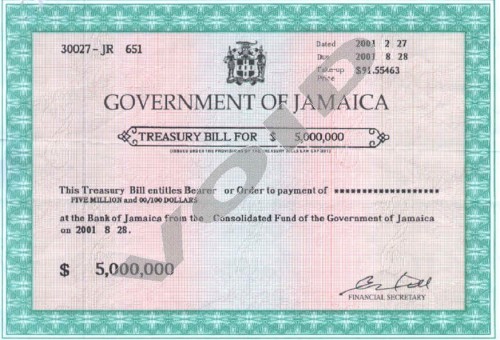
Government of Jamaica Treasury bill sample
The Treasury bill for the period Friday, October 24 to mature on Friday, January 23 next year, attracted an average yield of 7.336 percent, down from 7.46952 percent, at the September auction. At the August auction the average rate out turn was 7.46767 percent. The yield for July was an average of 7.63643 percent, for the June issue 7.65893 percent and 8.2 percent in May, for the Treasury bill of same duration.
The offer of 182 days duration, maturing on April 24 next year, generates an average interest rate yield of 7.73187 percent, a decline from 7.99887 percent, at the September auction, 8.11578 percent, in August, 8.21982 percent at the July’s auction and 8.36502 percent for the June issue, of the same duration. At the May Treasury bill auction, the rate came out at 8.932 percent.
Jamaica’s inflation jumps 2.1%
 Jamaica’s inflation rate for September jumped 2.1 percent, over August 2014. The sharp upward movement was impacted by 4 percent increase in the category Transport which recorded the highest movement, mainly as a result of an increase in the cost of bus fares in the Greater Kingston Metropolitan Area.
A 3.9 percent increase for Education, due to a rise in the cost of tuition fees, at the beginning of the new school year, was another main contributor to the hike. Food and Non-Alcoholic Beverages recorded an upward movement of 2.9 percent. This was mainly attributable to the lingering impact of drought conditions island-wide, which resulted in a shortage in supply of some agricultural produce and consequently higher prices, the statistical Institute of Jamaica said in a release accompany the data.
Inflation for the year to September is now at 7.1 percent. Going forward, the fall in the price of oil to US$80 barrel, revaluation of the Jamaican dollar and improved rain fall that should result in increased farms produce, should help to ease the inflation rate, in the months ahead.