VM Investments lists on Friday

VM Investments list on Friday

Investors who applied for shares in the public pool in VM Investments recent public issue of shares will get the first 30,000 units and 4.32 percent of the balance.
Employees and Members reserved groups were allocated the full amounts applied for. The offer closed with subscriptions in excess of $2 Billion for the $689,261,487 offered”
A total of 225,003,750 Ordinary Shares in the Offer were reserved for staff and customers of the VMBS Group at discounts from $2.08 to $2.33 each and 75 million for the general public at $2.45 each.
The company’s shares will list on the main market of the Jamaica Stock Exchange on Friday.
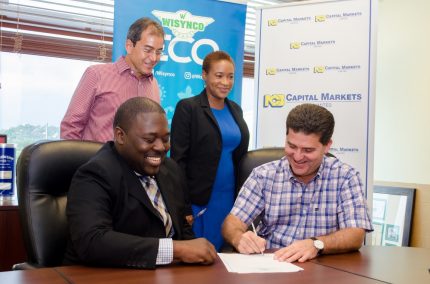
NCB Capital Markets Manager, Origination and Structuring Stanley Thompson (left) exchanges laughs with Wisynco Group Limited Chairman William Mahfood during a signing ceremony commemorating a partnership with the local manufacturing and distribution giants. Sharing in the moment, too, are Wisynco Chief Executive Officer Andrew Mahfood and PriceWaterhouseCoopers Director Fiona Hyman

Wisynco started trading on the main market on Thursdays with very strong demand for the shares that were sold to the public at $7.87, by the close of trading attempts were made to trade 3.46 million units as high as $13.50 but most were cancelled as the price exceeded the 30 percent price movement limit of for the day. At the close 2,925,359 units were traded up to $10.09, the maximum price limit for the day.
Wisynco ended with 7,382 new shareholders, with those applying for shares from the General Public pool receiving the first 25,000 units in full and approximately 18.81 percent of the balance.
US$ holding just above J$125

Trading the Jamaica’s Forex market continued at a high level after opening from the Christmas holiday with inflows of US$75.53 million, versus US$76.84 million on Wednesday of all currencies with selling of US$82.73 million compared with US$62.63 million sold on Wednesday.
In US dollar, trading dealers sold US$73.32 million at an average of $125.09 at the close, compared US$56.68 million at an average rate of $125.12 on Wednesday. US currency purchases by dealers, amounted to US$65.24 million on Thursday, at an average rate of $124.06, compared to Wednesday, with US$69.43 million at $123.90.
On Thursday at midday,  dealers purchased US$26.33 million at an average rate of J$124.45 and sold US$24.36 million at an average of J$124.99. At mid-day on Wednesday dealers purchased US$21.98 million at an average rate of J$124.21, while they sold US$16.75 million at an average of J$125.11.
The selling rate for the Canadian dollar climbed to J$99.87 from J$98.40 at the close on Wednesday. The selling rate for the British Pound fell to J$164.20 versus J$166.53 previously and the euro dropped in value against the Jamaican dollar at J$146.75 to buy the European common currency, versus the prior selling rate of J$150.38.

Contrast of two ScotiaBanks

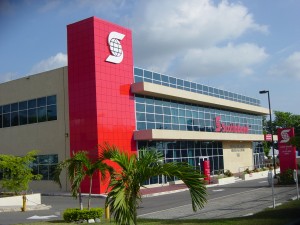
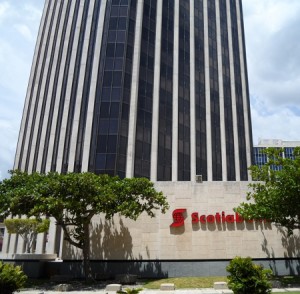
Scotia Group head quarters in Kingston.

The economies of Trinidad and Tobago and that of Jamaica have been performing in opposite directions in recent years. While Trinidad continues to be in deep recession, Jamaica has been recording mostly moderate growth.
In such environments, it would be expected that businesses would be doing better in the one that is growing and poorly in the other.
The performance of Bank of Nova Scotia’s subsidiaries in each of the countries, shows differing fortunes, with the Scotiabank Trinidad enjoying an increase in loans in its latest results to October and the Scotia Group in Jamaica remaining flat, year over year at $166.5 billion. Banks make the bulk of their profits from lending money. Lending not only generates interest on the amounts lent but fees associated with loans such as commitment fees and in a number of cases annual review fees.
For Scotia Group Jamaica, profit after tax rose just 7.7 percent for the year to October, resulting in $12.17 billion attributable to the Group’s shareholders. For the October quarter profit, rose to $3.36 billion from $3.1 billion in 2016.
Net interest income grew by $1.27 billion to $26.64 billion for 2017 versus $25.38 billion in 2016, but a sharp climb in bad loan provisioning of $746 million, reduced the impact of the rise in net interest income. Other income grew by $1.6 billion for the year to $15 billion.
Trinidad’s Scotiabank’s profit before Taxation increased by 11 percent and 5 percent after an increase in corporation tax rate in that country. Profit for the October quarter, dipped to $151 million due to increased taxation, from $158 million in 2016. Earnings per share ended the year at $3.73 for a PE ratio of 16.35.
Total Revenue, comprising Net Interest Income and Other Income amounted to $1.7 billion for the period ended October 2017, an increase of $117 million or 7 percent over the comparable period in 2016. Net Interest Income for the period ended October 2017 was $1.2 billion, $115 million or 10 percent higher than for 2016, driven mainly by growth in the retail loans and investment securities portfolios. Other Income for the same period was $481 million, $2 million higher than the prior year mainly driven by revenues earned from the credit cards portfolio.
Loan Loss Expense for the period ending October 2017 was $106 million, an increase of $29 million over the prior year for the Trinidadian bank. Loans advanced to Customers, closed the period at $13.9 billion, an increase of $681 million or 5 percent compared to 2016. Retail loans grew by $645 million or 6 percent over 2016.
Total Non-Interest Expenses 2017 was $686 million, down from $691 million in 2016 for Trinidad.
The big question, what resulted in the Trinidadian company enjoying growth in loans in a declining economy while Scotia Group operating in an economy that is growing could only hold the loan portfolio steady, for the most profitable area of operation?

D&G new production line to push exports

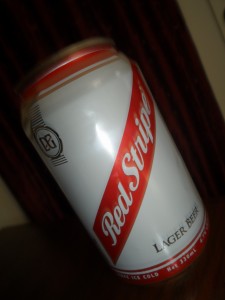
Desnoes and Geddes producers of the world renown Red Stripe beer, is set to expand its export capabilities with the introduction of a new production line with the capacity to produce 40,000 bottles per hour and 26,000 cases of beer per day exclusively for its growing global markets, release from the company disclosed.
The new line will result in the brewery producing up to 1 million bottles of the Jamaican beer for the domestic and international markets. “Our 2020 Vision is a call to action to boost our target volume and we’ve invested close to US$18 million in this project. We firmly believe in the power of our brand and its appeal, so we are making a stronger push into international markets,” said Ricardo Nuncio, Managing Director, Desnoes and Geddes.
The company’s top export markets are the United States and Canada with two million and 700,000 cases in annual shipments, respectively the company stated. As at July 2017, there has been 15 percent growth in focus cities of Miami, Tampa, Orlando and Atlanta. Nuncio adds, “In early 2016, Red Stripe entered Australia, Dubai and Brazil and there’s robust brand building in those countries. We’re also moving to put down roots in Africa and Russia, following successful testing.”
The brewery’s new production line, referred to as ‘Line 8’, comes as the company adopted the use of liquefied natural gas (LNG) to power its operations. The brewer is now the first commercial company in Jamaica to be fully LNG-powered. Nuncio explained that the addition of Line 8 dovetails with the company’s mission to streamline its operation throughout the supply chain. Nuncio noted, “The Red Stripe team is guided by the growing importance of sustainability and the need to lessen the adverse environmental impact of our operation. By using LNG, we welcome estimated savings of US$336,000 annually.”

Line 8 now frees up the existing production line to focus solely on domestic volumes. The new line is specially designed for one-way or new Red Stripe bottles, but it is also able to produce new Red Stripe Local and Dragon Stout in six-pack cartons. The project, which took 12 months to complete, involved infrastructure changes and extensive training for employees to achieve a greater level of efficiency.

Management reshuffle at Grace

Grace Kennedy Head Office

Group Chief Executive Officer, Don Wehby.

Grace Kennedy senior management undergoes major changes at the start of 2018, a report from the Group stated.
Andrea Coy will be appointed CEO of GK Foods International Business a position previously held by Ryan Mack. Grace Kennedy’s manufacturing and distribution operations in the USA, Canada and the UK will fall under Coy’s remit as well as the Company’s continued expansion into West Africa and Europe. Andrea will also have responsibility for Grace Kennedy’s distribution operations in Latin America and the Caribbean.
“Andrea has had a series of achievements during her career at Grace Kennedy and has successfully led the transformation and growth of several companies within the Group. I am confident that she will do a tremendous job in ensuring Grace Kennedy continues to deliver on its mission to become a Global Consumer Group,” Wehby said.
Ryan Mack will take up the role of CEO of GK Foods Domestic Business and will be responsible for the Hi Lo Food Stores, GK’s Manufacturing Operations in Jamaica, GK’s local Distribution Operations which comprises of Grace Foods & Services, World Brands Services and Consumer Brands Limited. Ryan has held several senior roles across the Group and will bring key learnings gained from his years in the UK and the USA.

Andrea Coy

In making the announcements, Wehby indicated that “Ryan Mack is well respected internationally in the foods business and we are extremely happy to have him back in Jamaica to build on the significant growth that we have been experiencing in these core areas. I am very confident that these changes will improve efficiencies and further streamline the organisation allowing us to achieve the stated growth objectives for 2018 and beyond.”
Derrick Reckord will be appointed to act as President and CEO of Grace Kennedy Foods. During his time with the Company Reckord has been instrumental in developing and growing GK’s business in the US. Prior to his appointment in his current role as Senior Vice President of the US operations in 2014, Derrick led the Company’s development of its US and Caribbean export markets.
Margaret Campbell, currently Chief Financial Officer of GKMS, will be appointed Country Manager for the Jamaican operations. GKMS is the exclusive agent for Western Union in Jamaica and several Caribbean countries.
Steven Whittingham, will be appointed to the Company’s Executive Committee. The Executive Committee, which is chaired by the Group CEO, has executive leadership responsibility for overseeing the Group’s operations.
Whittingham will continue in his roles as Chief Investment Officer for the Grace Kennedy Group and Managing Director of GK Capital Management and GK Investments. Whittingham has significant experience in investments, mergers and acquisition and entrepreneurial management in the USA, Europe and the Caribbean.

NCB & LascoFin close acquisitions

NCB Financial and Lasco Financial are reporting conclusion of the acquisition of their new subsidiaries.
NCB Financial acquisition of the majority shares in Bermuda’s Clarien Bank that was subject to regulatory approval by the Bermudan authorities is concluded.
Clarien has assets just over U$1.16 billion and reported profit of US1.2 million for 2016 before incurring an overall loss when other comprehensive loss is factored in, netting a loss of US$572,000 for the year. Results were weighed down by impairment losses on loans amounting to US$8.6 million in the year compared to US$9.2 million in 2015.
Lasco Financial advised that Scotia Group Jamaica has completed the transfer of Scotia Jamaica Microfinance Company Limited to the company. No details of the purchase price is mentioned but Scotia Group reported on the balance sheet as of October, assets held for sale amounting to $664 million which most likely represent the assets of CrediScotia.

Modest profit rise at First Citizens

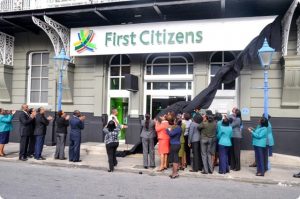
Profit before tax at the Trinidad and Tobago based First Citizens group rose 7.2 percent to TT$876 million, the year to September 2017 over the similar period to 2016.
Profit after tax profits rose just $5 million to $642 million, with a hike in profit tax to 30 percent from 25 percent in 2016. The Group’s benefited from improved efficiency and growth in Investments and loans to customers. Citizens ended with a modest increase in earnings per share of $2.54 compared to $2.52 in 2016.
Investments grew 4.9 percent to $13.6 billion from $12.97 billion at the end of the 2016 fiscal year while loans and advances, rose 7.4 percent to $16.52 billion from $15.38 billion, resulted in an increase in the net interest margin of $135 million or 10.5 percent. Customer Deposits declined to $23.98 billion from $25 billion in 2016, while shareholders’ equity climbed to $6.75 billion from $6.68 billion
Board of Directors declared a final dividend of $0.71 per share, bringing the total dividend for the fiscal year to $1.40 per share, compared to $1.33 for 2016. The final dividend will be paid on December 29, 2017, to all shareholders on record as at December 20.
First Citizens traded at $32 on the Trinidad and Tobago Stock Exchange on Thursday for a PE of 12.6.

JSE stocks rise in moderate trading

Bulls pushing Jamaican stocks.

Trading on the Main Market of the Jamaica Stock Exchange closed with 22 securities changing hands, of which 11 advanced, 5 declined and 5 traded firm with just 868,056 units valued at a mere $20,860,689.
Trading resulted in the JSE All Jamaican Composite Index climbing 2,953.90 points to close at 305,561.83 and the JSE Index advanced by 2,691.33 points to close at 278,401.38.
In the market activity, Berger Paints finished $1.50 higher at $17, with 8,715 shares, Caribbean Cement ended trading with a loss of $1.21 at $30.01, with 5,500 stock units, Carreras traded 15 cents higher at $10.50, with 168,396 units, Grace Kennedy closed with a loss of $1 at $42, with 31,693 shares. Jamaica Broilers ended at $17.70, with 11,221 stock units, Jamaica Producers concluded trading with a loss of 1 cent at $15.09, with 5,239 units, Jamaica Stock Exchange finished 20 cents higher at $7.20, with 31,833 shares, JMMB Group settled 97 cents higher at $23.98, with 44,686 shares. Kingston Wharves traded at $32, with 3,927 units, Mayberry Investments finished trading 82 cents higher at $6, with 150,597 shares, NCB Financial Group closed at $99.99, with 96,102 shares, 1834 Investments ended at $1.20, with 336 stock units, PanJam Investment closed trading with a rise of $3.50 to $45, with 4,959 units. Pulse Investments settled 20 cents higher at $1.70, with 47,159 shares, Radio Jamaica ended trading 5 cents higher at $1.05, with 20,362 stock units, Sagicor Group traded with a loss of $1.85 at $34.65, with 52,540 units, Sagicor Real Estate Fund finished trading 51 cents higher at $15, with 6,698 shares. Salada Foods Jamaica closed 24 cents higher at $9.85, with 5,450 shares, Scotia Group ended with a loss of 90 cents at $50.10, with 25,560 stock units, Sterling Investments finished at $12, with 14,527 shares and Supreme Ventures settled 31 cents higher at $10.56, with 130,956 shares. In the main market preference segment, JMMB Group 7.5% ended trading at $1.15, with 1,600 units trading.

Prices of securities trading for the day are those at which the last trade took place. For more details of market activities, see “Big jump in JSE main market – Wednesday.”

Virtually flat profits at Scotia Group

Scotia Group head quarters in Kingston.

Profit after tax rose just 7.7 percent at Scotia Group for the year to October, resulting in $12.17 billion attributable to the Group’s shareholders. For the October quarter profit rose to $3.36 billion from $3.1 billion in 2016.
Net interest income grew by $1.27 billion to $26.64 billion for 2017 versus $25.38 billion in 2016, but a sharp climb in bad loan provisioning of $746 million, reduced the impact of the rise in net interest income. Other income grew by $1.6 billion for the year to $15 billion.
Operating Expenses amounted to $21.3 billion for the year, an increase of $595 million or 3 percent compared to prior year. Employees’ costs increased $212 million, while other operating expenses were up $159 million. Asset tax increased by $112 million or 12 percent to $1.1 billion. The productivity ratio moved from 53.38 percent last year to 51.09 percent.
Loans remained flat, year over year at $166.5 billion, according to the company, the performance in this area is “driven by an overall decline in our foreign currency portfolio. Our small business, residential mortgages and personal loans continue to show solid performance quarter over quarter and year over year.”
Deposits by the public, increased to $260.6 billion, from $248.4 billion in the previous year, but the increase is not being put to the best use with no growth in the loan portfolio.
Results for the October quarter does not shine any light to suggest that the slow growth period is behind them. With soft demand for loans, and decline in interest rates in the wider economy, Scotia faces a tough road for the next fiscal year, in this environment the focus is going to be on cost cutting. Already, all the express locations that they currently operate will be closed in early January, the acquisition of all the minority shares in Scotia Investments is yet another move to cut cost.
On the balance sheet, assets held for sale amounted to $664 million and most likely represents the assets of CrediScotia that was subsequently sold.

In Thursday’s trading on the Jamaica Stock Exchange the stock closed at $53 at a PE of 13.5 based on earnings per share of $3.93.

NCB Buying 50.1% of Bermudan bank

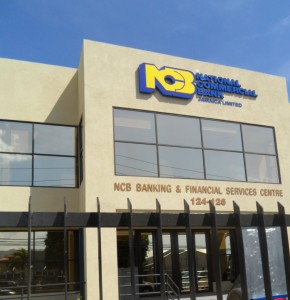
NCB Financial Group today announced the acquisition of majority shares in the Clarien Group, a Bermudan based financial group in which Portland Private Equity holds 17.92 percent interest.
Edmund Gibbons Ltd with retain 31.98 percent of the shares. The transaction has received approval from Bank of Jamaica and the Bermuda Monetary Authority provided a no objection letter, the release from NCB states but final approval is subject to the Ministry of Finance. James Gibbons a director of the group expresses the view that the linkage will enable expansion of their offering locally and globally.
In 2016, Portland Private Equity pumped in B$$12.6 million into Clarien to meet capital needs based on tighter regulatory capital requirements as well as a swelling bad debt position amounting to 14 percent of their loan portfolio. The bank is said to have made B$$500,000 profit in 2015.
According The Royal Gazette, Clarien said its loan portfolio had shrunk by $66.8 million in 2015 to $809.7 million by the end of the year. This was attributed to a trend of borrowers paying down mortgage debt.
Clarien has more than eight decades of banking history in Bermuda and is said to be the largest bank in the country.
NCB recently raised US$250 million on the local market for regional expansion, this acquisition seems to be one that was on their radar when the funds were being raised, but based on the amount Portland injected the acquisition by NCB could cost around US$40-50 million, a mere dent in the amount they raised in the summer of 2017, but with earnings of $500,000 in 2015, unless profits picked up considerably since, which seems unlikely with the acquisition by NCB, the amount paid is most likely considerably far less.
For the fiscal year to September NCB made profit of J$19.1 billion or US$146 million up from J$14.45 billion in 2016. Gross revenues for 2017 fiscal year amounted to J$75.7 billion.