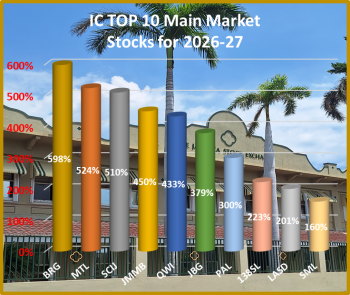
The Jamaica Stock Exchange Main Market ended the past week, with up and down sharp movements. First Rock Real Estate Investments led the winners with a gain of 37.74 percent, while Pulse Investments led the losers, with a fall of 28.97 percent. Looking ahead, ICInsider.com forecasts gains of between 160 percent and 598 percent over the next twelve months, with an average projected gain of 378 percent for the IC TOP10 Main Market stocks, led by Berger Paints at 598 percent and followed by Margaritaville at 524 percent.
 The ten winning stocks this week advanced between 5.97 percent to 37.74 percent, with real estate and insurance companies being prominent. The ten top losers fell between 5.53 percent and 28.97 percent. Financial service sector is heavily represented.
Among the winners, First Rock Real Estate Investments was well ahead of the field at 37.74 percent. followed by Mayberry Jamaican Equities with 20.12 percent. 138 Student Living is next with a rise of 14.46 percent and General Accident Insurance, 14.14 percent. The second half of the table was more modest. Sagicor Select Funds rose 9.30 percent, Sygnus Real Estate Finance 8.67 percent, Berger Paints 8.11 percent, Margaritaville 7.60 percent, Supreme Ventures 6.12 percent and Tropical Battery 5.97 percent. Real estate was a clear theme, with First Rock Real Estate Investments, 138 Student Living and Sygnus Real Estate Finance in the top six.
Declining stocks were heavier in financial and investment. Pulse Investments fell 28.97 percent, the steepest decline of the week, followed by VM Investments at 15 percent and QWI Investments at 11.76 percent. Radio Jamaica lost 10.57 percent and Barita Investments 10.37 percent. 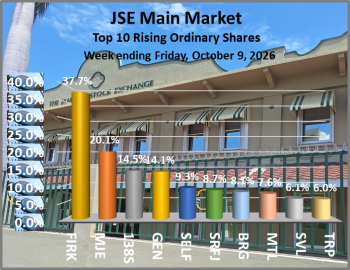 The remaining five were the Palace Amusement at 9.09 percent, A.S. Bryden at 8.21 percent, Proven Investments at 7.43 percent, Mayberry Group at 6.95 percent and Massy Holdings at 5.53 percent. Six of the ten losers were investment or financial companies, which points to selling pressure in that segment. It is notable that Mayberry Jamaican Equities was among the biggest winners while its related company, Mayberry Group, was among the decliners.
The ICInsider.com forecast for the next twelve months is Bly bullish. Berger Paints is projected to gain 598 percent, followed by Margaritaville at 524 percent and Sygnus Capital at 510 percent, so the top three are all expected to exceed 500 percent. JMMB Group is forecast at 450 percent and QWI Investments at 433 percent. The next five are Iamaica Broilers at 379 percent, Palace Amusement at 300 percent, 138 Student Living at 223 percent, Lasco Distributors at 201 percent and Stanley Motta at 160 percent. Seven of the ten are projected to gain 300 percent or more, and even the lowest projection, for Stanley Motta, is 160 percent. The list mixes financial companies with consumer, property and manufacturing names, so the forecast is not tied to a single sector.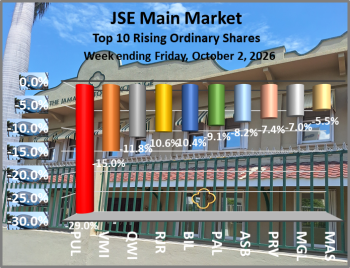 The forecast also overlaps with the past week’s movers. Berger Paints, Margaritaville and 138 Student Living were all winners this week, which suggests recent momentum is consistent with the ICInsider.com forecast. but, QWI Investments and Palace were both among the week’s losers, but are forecast to enjoy gains of 433 percent and 300 percent respectively. Investors may see this week’s declines in those two companies as a potential entry point, though forecasts of this size should be treated with caution given the volatility the Main Market showed this week.
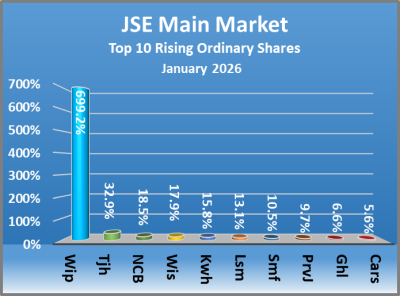 At the close of January, the JSE Main Index ended at 346,437.16, with gains of 28,450.28 points for an 8.9 percent increase. The JSE All Jamaican Composite Index ended at 403,422.64 after rising 38,108.26 points up 10.4 percent and the JSE Select Index rose 603.96 points to 8,279.55 after rising by 7.9 percent. The gain in the market was not broad-based, as it arose from the prices of 16 stocks rising and 29 declining.
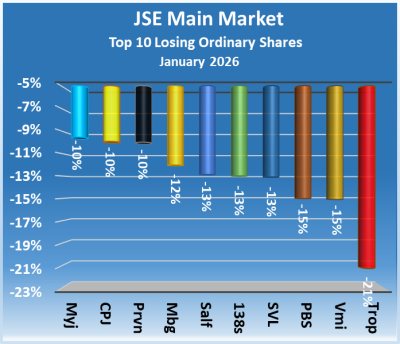 TransJamaican Highway posted a robust 33 percent gain, benefiting from increased traffic volumes and toll rate adjustments and taking on board the operations of the leg of the tolling road into the Mandeville area. The company operates Jamaica’s East-West toll road network under a concession with the Government of Jamaica.
 with the market index gaining just two percent at its peak in mid-May after which the JSE Main Index dropped 10.2 percent for the year as Bank of Jamaica pushed interest rates higher during the year.
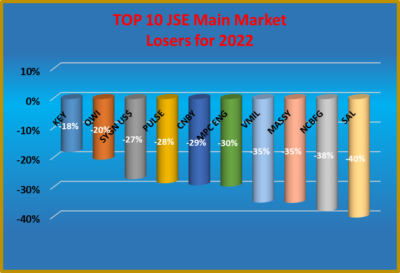 NCB Financial despite profit jumping sharply over that of 2021. The group recorded huge unrealised investment losses net of gains that wiped out the traditionally reported profit of $40 billion and left a deficit of $7.6 billion for the fiscal year that reduced shareholders’ equity from $161.5 billion to $149.5 billion, and resulted in continued dividend suspension, that may have encouraged more pressure on the stock than usual. Massy Holdings and VM Investments both declined by 35 percent for the year. 1834 Investments was the top stock resulting from its acquisition by Radio Jamaica, productive Business Solutions delivered gains of 64 percent, followed by Supreme Ventures, with 62 percent, both flowing from solid increases in profit for the period to September last year.
 The
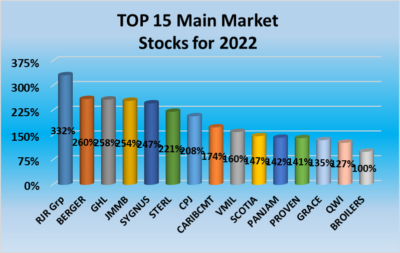



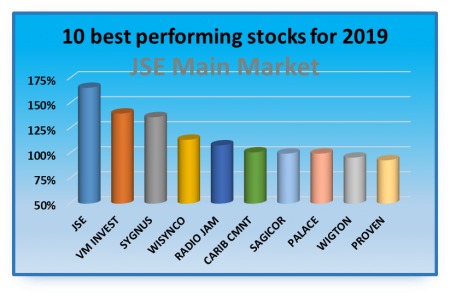 Ten JSE Main Market stocks doubled in price in 2019 with the




JSE board needs a huge shake up
Ian McNaughton, Chairman of the Jamaica Stock Exchange.
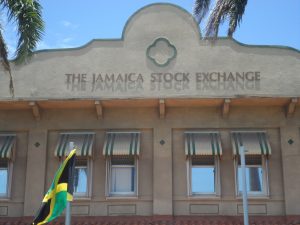
The Jamaica Stock Exchange needs to heal itself and fast, since no one else seems able to do so yet. There are some startling truths about Jamaica but not many persons want to talk about them.
 The fact that we are seeing a repeat of this problem is a clear indication that there needs to be changes at the board level of the JSE.
One such truth, stock exchange board is not running the exchange in the interest of the wider investing public. The other is that the Financial Securities Commission is almost a waste of taxpayers’ money whether by government subvention or fees paid directly or indirectly by investors. If that were not the case how can the country explain that Berger Paints’ directors could make false statements about the acceptance and value of Berger Paints shares in response to Ansa Coatings offer to buy out minority shareholder and no one in authority called them to book and got them to support their claims with evidence.
In July this year, Express Catering shares were not being traded as demand exceeded supply by a wide margin and pushing the equilibrium price well ahead of prices that the circuit breaker rule at the JSE permitted. The stock did not trade for a number of days after listing, left to the rules as was being practiced, the stock would have taken much longer to trade than it finally did after management intervened. The same thing is now happening to FosRich shares that have not traded after two days of listing, with demand exceeding supply well above the permitted price of the JSE. When Wisynco and VM Investments list, one can expect the same situation to occur, unless the rule is modified.
Having hand the problem several months ago it seems implausible that the JSE has not moved speedily to correct what is clearly a problem when IPOs start trading. Why has the stock Exchange board not moved to correct what is clearly a problem for new listings. Why has the FSC not intervened to ensure it get sorted out, before new listings come to market?
Lest face some facts, time is money. The FosRich issue closed on December 4, as such, investors who would like to sell have to wait for nearly a month to be able to get their money out based on the Jamaica Stock Exchange price restriction. In the cases of Wisynco and VM Investments the situation will be vastly worse with both having protracted period to announce the allocation of shares much yet listing.
The Junior Market of the exchange has demonstrated the power of share ownership, to radically transform the economy and the wider society. Alas enough effort is not being given to it, the mechanical application of the circuit breaker rule is one such factor that is negatively affecting the market.
Finally, the Berger Paints takeover offer is once more pointing to the fact that a rule meant to protect minorities is not doing so at all, if it did how can one explain the fact that just over 6 million shares were surrendered as a result of the Ansa’s bid with the shares trading up to $18 since compared to an offer on $10.88. Clearly the big investors did not sell so it must be much smaller investors who are not adequately informed.