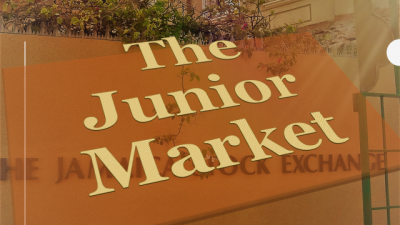
 In Junior Market trading on Tuesday 4 stocks traded at a 52 weeks’ high and one at a 52 weeks’ low as the prices of 13 securities advanced, 7 declined and 4 remained unchanged.
In spite of the positive price movement at the close, the Junior market index declined 22.15 points to close at 3,135.85 with 25 securities changing hands, compared to 27 on Monday. Trading resulted in 1,564,416 units valued at $8,693,578 changing hands compared to 2,611,628 units valued at $11,933,757 on Monday.
IC bid-offer Indicator|At the end of trading, the Investor’s Choice bid-offer indicator reading had 2 stocks ending with bids higher than their last selling prices, 3 closed with lower offers.
Trading closed with an average of 62,577 units for an average of $347,743 in contrast to 124,363 units for an average of $568,274 on Monday. The average volume and value for the month to date amounts to 182,596 units valued at $994,997, compared to 201,586 units, valued at $1,097,411 previous trading day. Trading in July, averaged 154,060 units valued at $655,146 for each security traded.
 At the close of trading Cargo Handlers settled at $10.89, with 308 shares, Caribbean Cream ended trading with a loss of $1.08 at $4.72, trading 30,431 shares, Caribbean Flavours traded 15,000 stock units and jumped $1.50 to a 52 weeks’ high of $14.50, Caribbean Producers finished trading 88,000 units and gained 12 cents to close at a 52 weeks’ high of $6.89, after trading as high as $7.15, Consolidated Bakeries closed 1 cent higher at $2.17, with 229,179 shares changing hands. C2W Music ended with a gain of 4 cents to $1.75, as 1,400 shares traded, Derrimon Trading concluded trading 120,000 shares and climbed 50 cents to a new closing high of $25.50, Dolphin Cove finished at $16.50, while exchanging 184 stock units, Elite Diagnostic settled 5 cents higher at $2.85, with 5,000 units. Everything Fresh traded 244,413 shares and ended at $1.90, Express Catering traded 3 cents higher at $8.03, with 131,000 shares, FosRich Group finished trading of 64,858 shares with a loss of 24 cents at $2.76, General Accident closed with 13,000 stock units trading and fell 10 cents to $3.70,
 GWest Corporation ended 7 cents higher at $2.27, with 36,282 units. Honey Bun concluded trading with a loss of 1 cent at $4.50, in exchanging 13,700 shares, Iron Rock finished at $3.50, with 186,606 shares, Jamaican Teas ended trading with a loss of 5 cents at $4, with 8,401 stock units changing hands, Jetcon Corporation traded 256,529 units and gained 5 cents to end at $4.05. Key Insurance finished trading 9,147 shares and rose by 45 cents to $3.47, KLE Group closed 19 cents higher at $3, with 6,129 shares trading, Knutsford Express ended with a rise of 5 cents to $11.35, as 17,350 shares were traded, Lasco Distributors concluded trading of 45,066 stock units at $3.99. Lasco Financial finished with a loss of 40 cents at $5.50, exchanging 12,136 units, Lasco Manufacturing settled with a loss of 5 cents at $3.95, with 28,671 shares and Medical Disposables jumped $1.29 in trading 1,626 shares at $6.49.
Prices of securities trading for the day are those at which the last trade took place.
13 Junior Market stocks gain – Tuesday
West Indian Tobacco profit rise
 Profit before tax rose 10.7 percent to $284 million, for the six months to June this year, over the 2017 period for West Indian Tobacco and profit grew 8.7 percent after tax to $194 million.
Profit before tax grew 13 percent to $178 million for the quarter over the 2017 period and after tax an increase of 9 percent to $121 million. Gross profit in the quarter rose to 79 percent, from 77 percent of revenues in 2017 and from 75 percent for the six months in 2017 to 77 percent in 2018.
The profit improvement came from a 13 percent rise in revenue for the quarter to $268 million and by 12 percent for the six months to $456 million.
Distribution costs rose to $4 million from $1.26 million in the June quarter and for the period to June $10.3 million from $6.4 million, Administrative expenses rose sharply to $22.8 million for the quarter from $18.2 million in 2017 and for the half it rose to $38.46) million from $33.12 million and Other operating expenses rose to $6.66 million in the quarter from $6 million in 2017 and for the half year to $20.7 million from just $11.7 million for an increase of 77 percent.
The company raked in cash from operating activities of $325 million in the six months compared to $232 million in 2017.
Earnings per share for the quart is $1.44 and $2.30 for the half year and should end at around $5.30 for the full year giving the stock a PE of 16.5 based on the last traded price of $88 on the Trinidad & Tobago Stock Exchange.
The company ended the period with total equity of $379 million and cash of $279 million and current liabilities of $161 million.
The Board has accordingly approved the payment of a second interim dividend of $1.14 per ordinary share payable on 27 August 2018.
All amounts are quoted in TT dollars.
Derrimon buying Woodcats International

Staff at Derrimon Trading.
Derrimon Trading signed an agreement to buy Woodcats International with the transaction set to close within thirty days.
Woodcats was founded in 1999 by Christopher Collings and reached of $450 million in the 2017 financial year. products include: export pallets, warehouse pallets, wooden crates, sawdust, and landscaping mulch with in heat treatment and pallet repair.
Revenues for the Derrimon Trading first quarter March this year, climbed 27 percent to $1.94 billion above the $1.53 billion reported for the 2017 quarter and led to a big hike in profit.
The company reported a strong 45 percent jump in its first quarter results, from $35 million to $52 million or 21 cents per share to March this year, but profit could have been even higher had they not incurred finance cost which jumped 56 percent to $38 million from $25 million in 2017.
Derrimon stock traded 236,050 as high as $25 on Friday on the Jamaican Stock Exchange but ended at a record close of $24 to be up 243 percent for the year. The company is expected to approve a stock split of 10 to 1 at their upcoming annual general meeting slated for August 22.
Profit jumps 58% at Proven
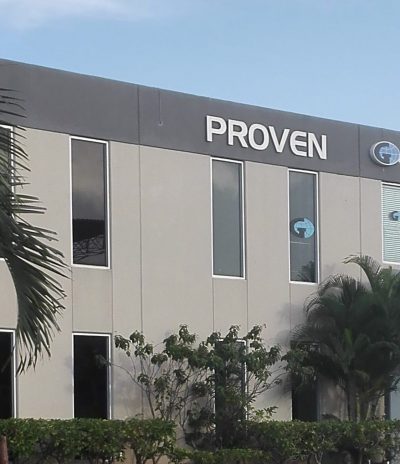 Investors in shares of PROVEN Investments pushed the price to a year’s low of 12 US cents last month but data now available suggest that they made a big mistake, as the stock now trades back at 20 US cents and profit that suffered from foreign exchange losses in the second half of 2018 fiscal year is now back up.
The investment bank just released first quarter results to June showing profit attributable to shareholders jumping 58.43 percent to US$1.79 million from the US$1.13 million in the same period last year. Annualized return on average equity translate to 8.56 percent and is consistent with Proven target set when they went public. The sharp jump in earnings resulted from net revenue for the quarter rising a 17.4 percent to US$8.5 million compared to US$7.25 million earned in the June 2017 quarter. According to the CEO Christopher Williams, “this was mainly due to a more efficient carry trade strategy and significant improvement in foreign exchange gains.”
Earnings per share for the quarter amounted to 0.29 US cent versus 0.20 US cents in 2017. An interim dividend of 0.25 US cent per share will be paid to shareholders on September 10.
According to the report released with the financials “spread income was the major contributor to revenue during the period, with a 16.97 percent improvement compared with the same period last year as net interest income totalled US$5.28 million. This increase reflects success in the carry trade strategy as the company was able to concurrently increase interest income while reducing interest expense by 18.30 percent.
Net foreign exchange gains totalled US$1.20 million, compared to just US$200,000 in the same period last year. While foreign exchange grew fees and commission income declined from $1.2 million to $894,000 due to change in reporting some fee income with some income now being booked over the period that they cover rather than at the time of billing, the impact for the full year should not reflect a major difference, IC Insider.com was informed.
Proven invests in a number of privately held entities except for Access Finance. The investment strategy seems to be working with most entities delivering increased returns in the quarter.

Christopher Williams, Proven Investments CEO.
According to the release Proven Wealth net income totalled US$0.93 million for the quarter, representing more than a six -times increase compared to the same period last year. The firm continues its strategy to offer investment products to clients in reducing the previous reliance on repurchase agreements. Total Assets of the company as at June 2018 stood at US$120.5 million.
Proven Fund Managers continues to be one of the top players in the Asset and Pension Fund Management and Administration business. Profitability increased by almost 68 percent compared to the same period last year, with net profit of US$220,000 compared to US$130,000 million for 2017.
Access Financial Services appears to be maturing contributing nearly 21 percent increase in net profits attributable to PIL of US$790,000 or 44 percent of the group’s profit for the quarter. But according to Williams, profit at Access is growing around $10 million on a monthly basis and is expected to continue for the rest of the fiscal year barring unforeseen negative development. IC Insider.com gathers that they may be more acquisition in the period ahead for this subsidiary in a new market. Access seems to have absorbed the acquisitions last year that led to a hike in doubtful loan provisioning being above normal in the 2018 fiscal year. The loan portfolio was US$24.4 million up 22 percent over the balance at June 2017.
BOSLIL Bank headquartered in St Lucia is Proven Investments’ most recent acquisition and currently 75 percent owned by the group. BOSLIL contribution to group profits was just below Access at US$610,000 million. Total Assets of the bank stood at US$271 million and seems set to increase as the group has signed an agreement to acquire yet another banking entity that will fall under the arm of Boslil.
PROVEN REIT is involved in residential real estate development with two new developments scheduled to commence construction and are expected to be completed and sold over the next twelve to eighteen months. But the current fiscal year is not likely to benefit from these is they are successfully executed.
Operating expenses increased by 11.5 percent to US$5.6 million compared to US$4.9 million in 2017 but the expenses include US$236,000 in preference dividends that will not repeat as the company retires the preference shares on which dividend was paid while there was just over $400,000 provision made relating to the impact of IFRS 9. Excluding these two items profit for the quarter would have been much greater than reported.
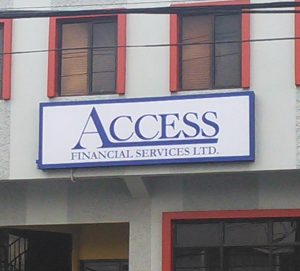
Access Financial contributed much to Proven profit in the quarter.
At the end of June total assets amounted to US$575 million down slightly from US$599 million at June 2017 and liabilities fell from US$509 million in 2017 to US$470 million. Shareholders’ Equity grew to US$82 million from US$71 million as at June 2017 mainly from increased in the share capital following the rights issue last year.
The group has not been able to put the new capital fully to work as they awaited regulatory approval for the plan acquisition of a brokerage company in Cayman Island which has now been granted with the acquisition said by Proven to close at the end of the month. That may not be the only acquisition for Proven this fiscal year as the group seek to grow its overseas business and take advantage of the many investment opportunities management sees within the region.
In going forward, investors need to pay attention to the impact of foreign exchange trading and movement in the rate of exchange and the impact on profits positively or negatively, so the strong gains enjoyed in the quarter may not repeat in the rest of the year. The preference dividend and the provision for IFRS provisioning should not repeat and are likely to reduce cost going forward. Access continues to grow profit on a quarterly basis as the company increase loans granted and securities trading can add or subtract from profits depending how well the investment portfolio is managed.
With the continued focus on acquisition, the future could be brighter for the group, in addition IC Insider.com is forecasting a rise in the PE ratio from an average of 12.5 now to a higher level by year end.
The stock that was in the IC TOP 10 and slipped out this past week traded at 19 US cents on Thursday on the JSE US dollar market and sits just outside the Top list.
Honey Bun profit up modestly in Q3
 Sales for the three months ended June 2018, rose 15 percent to $332 million over the 2017 out turn of $289 million at Honey Bun, but profit before tax was just $9 million, 5 percent higher than the $8.6 million earned in the corresponding prior year period.
Profit after tax rose to $9.7 million up from $7.55 million as a provision of $1 million in taxes in 2017 turned into $695,000 in 2018. Management stated in their release to shareholders that “this has been as a result of continued investment in production capacity and restructuring of distribution.”
Year to date, sales for the nine months, were $1 billion up 4 percent over the corresponding 2017 period’s income of $969 million, leading to profit before tax of $80 million, 17 percent lower than in the previous year. After taxation of $8.3 million for the nine months, profit declined to $72 million from $84.7 million in 2017, after taxation for $12 million.
Earnings per share for the quarter amounts to just 2 cents and for the nine months period year to date amounted to 15 cents. Honey Bun’s last quarter is not the most robust for the fiscal year so not much improvement is expected when the year ends in September.
Even as the net profit was disappointing, there were some good signs. Gross margin increased to 44.1 percent from 42.4 percent in 2017 for the June quarter and from 43.2 percent to 45.2 percent for the nine months. Gross profit rose 19 percent to $146 million for the quarter but was up 8 percent for the year to date period to $455 million.
Marketing and Distribution cost rose 32 percent in the quarter to $61 million and 37 percent to $164 million while Administrative Expenses rose 14 percent for the quarter to $63 million and was flat at $166 million for the nine months. Depreciation moved up by 9 percent to $12.3 million for the quarter and 11 percent to $36 million for the year to date.
“The Company’s asset base has grown as a result of the investment in the expanded facilities. This investment will allow the company to take advantage of the strong market demand for our products.
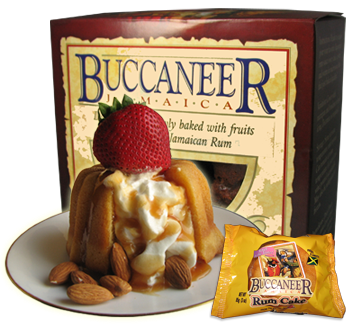
One Honey Bun’s Products.
In April of this year Honey Bun launched its new Buccaneer Jamaica pocket size rum cakes in 3 flavors at the Jamaica Expo. We have entered two new markets with further interest from other buyers in existing markets,” Michelle Chong Chief Executive Officer, informed shareholders.
Operations brought in $113 million in cash for the nine months of which $93 million was used as payment for fixed assets and $18.6 million in dividends resulting in $84 million in cash at the end of the period.
Shareholders’ Equity grew to $600 million at the end of June, current assets fell to $212 million and current liabilities fell to $84 million from $117 million in 2017. Fixed assets rose to $441 million from $368 million in 2017 and borrowed funds stood at just $31 million.
Seprod could ditch Duckenfield sugar
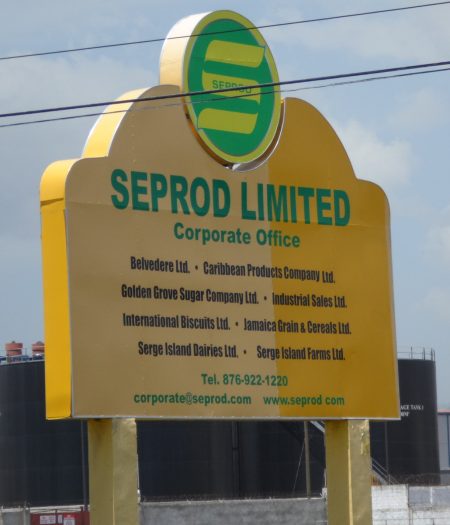
Seprod could ditch loss making Duckenfield sugar operations.
Duckenfield sugar factory in St Thomas faces closure, unless the government steps in to alleviate the problems. IC Insider.com understands a major part of the issue is a cess placed on locally produced sugar that cost the industry almost a billion per year.
The industry that is struggling to be viable is not in a position to bear the cost of the cess. Duckenfield has racked up a huge amount of losses since it was taken over by Seprod.
Seprod who operates the St Thomas based Duckenfield factory, stated in a release accompanying their six months results as they bemoan the impact that continuous losses at the factory has on the results of the group.
The report singed by the Chief executive, Richard Pandohie and Vice Chairman, Peter John Thwaites states, “Unfortunately, the Group would have had much better results had it not been for the $220 million loss in the sugar operation for the period. Management has exhausted almost all options to make these operations achieve even a breakeven status and we are committed to, in very short order, eliminating these nine years of erosion in shareholders’ value.”
For the six months ended June 2018, Seprod generated revenues of $10.44 billion, an increase of J$2.07 billion or 25 percent over the corresponding period in 2017. Net profit increased 29 percent for the period to $598 million in the 2017 period. The 2018 results are bolstered by the transfer of the former Jamaican dairy operations of Nestle within the Group effective January, this year.

Sugar cane under production in Jamaica
These operations, located in Bog Walk, St. Catherine, produce Supligen and Betty products, as well as co-manufacture products for international customers. In 2017, these operations were operated by Seprod under a management services contract and were not included in the Group’s results. The directors’ report stated that, “had these operations been included in the Group’s results in 2017, the increase in revenues for the six months ended 30 June 2018 would have been $1.20 billion or 13 percent and the increase in net profit would have been $77 million or 15 percent.”
For the June quarter, revenues rose 33 percent to $5.48 billion with gross profit rising sharply to 36 percent from 24 percent in 2017, with gross profit hitting $1.96 billion and profit after tax coming in at $325 million attributable to Seprod shareholders, 37 percent ahead of the 2017 out turn.
Republic makes bid for Cayman biggest bank
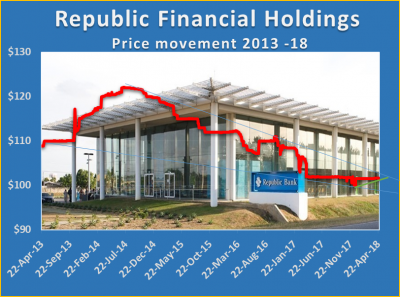
Demand rises for Republic Financial Holdings
The offer is priced between US$6 to US$6.75 per Cayman National share representing a premium between US$3 to US$3.75 per share as compared to the closing price of US$3 per Cayman National share on 3 August. The offer price is around 10 times earnings which is very attractive to republic as profit has been growing nicely for last year and the current year. The acquisition would allow Republic to merge Cayman National with Republic’s Cayman operations.
Cayman National has total assets of CI$1,558,692,523, up from $1,464,852,010 at June 2017. Total Comprehensive Income for nine months to June 2018 is CI$16,062,080 and is up from CI$10,841,267 in 2017.
The Offer remains subject to a number of conditions, including completion of due diligence by RBTTBL and recommendation by the Board of CNC for the Possible Offer.
Cayman National was Established in 1974 and is the largest financial services company based in the Cayman Islands, providing banking, trust and company management, fund administration, and wealth management services to clients locally and around the world, from the Cayman Islands, and the Isle of Man, with an office also in Dubai. Cayman National is publicly traded on the Cayman Islands Stock Exchange and comprises: Cayman National Bank Ltd., Cayman National Fund Services Ltd., Cayman National Securities Ltd., Cayman National Bank (Isle of Man) Limited and Cayman National Trust Company (Isle of Man) Limited and Cayman National (Dubai) Ltd.
RBTTBL was established in 1999 and is a licensed offshore international financial business operating pursuant to the International Financial Services Act, CAP. 325 of the Laws of Barbados which primarily conducts investment and investment management services. RBTTBL’s registered office is located at Republic Bank (Barbados) Limited, Independence Square, Bridgetown, Barbados. RBTTBL is a wholly-owned subsidiary of Republic Financial Holdings Limited. RBTTBL currently has wholly-owned subsidiary in the Cayman Islands, Republic Bank (Cayman Limited).
About Republic Bank (Cayman) Limited:
Republic Bank (Cayman) Limited was established on 13 January 1992 and currently holds a Trust License and an Unrestricted Class B Banking License under the Banks and Trust Companies Law of the Cayman Islands, as amended. Republic Bank (Cayman) Limited also holds a Mutual Funds License and is a registered Excluded Person for purposes of the Securities Investment Business Law of the Cayman Islands (SIBL-EP).
RFHL is listed on the Trinidad and Tobago Stock Exchange and has over US$10 billion of total assets. RFHL, along with its subsidiaries and associated companies, provides commercial banking and related services. These include investment banking, mortgage financing, securities trading and related activities, trustee services, credit card operations, foreign exchange and trade finance services as well as deposit taking and lending operations. Through its subsidiaries and associated companies, RFHL has operations domiciled in Barbados, Ghana, Suriname, Grenada, Guyana and St. Lucia in addition to Trinidad and Tobago.
JSE & FSC should explain Knutsford capital mess

Knutsford Express 2014 & 2015 audited accounts filled with errors & 2018 needs correcting.
Knutsford Express recently released full year audited results to May 2018 with s lightly higher profit of $178 million after taxation compared to $170 million in 2017. The profit resulted in earnings per share of 35.5 cents for the year versus 34 cents in 2017.
The initial release of the results had the 2017 earnings per share as $1.70, but that was incorrect as the wrong number of shares were used. The company released an updated report but that still reflects the error in computing the EPS. In June 2017, the shares were split in to 5 each, raising the issued capital to 500 million units. But the revised report carried the error which was in the first report that the weighted number of shares issued was 498 million units, that is completely wrong.
JSE failed to have errors corrected in audited accounts.
Stock splits and bonus shares don’t give rise to weighted number of shares as no value is added to the company. As a result, all the issued shares have to be used in computing the EPS for both periods.
The appropriate methodology is that the “Additional shares from the share split are incorporated in the calculation of EPS in full without any time apportionment so that the increase in number of shares in the current period, comparative prior periods and all subsequent periods is the same therefore resulting in EPS which is comparable over several accounting periods.”
Interestingly, the number of shares used to compute the interim report to February was correctly shown as 500 million units. As it now stands, the audited accounts and the interim reports have used different figures. What is the Jamaica Stock Exchange doing to correct this?
The first audited accounts, after listing, carried an even greater error was with no correction to date.
The audited accounts stated, “Earnings per share is computed as the net profit for the year divided by the weighted average number of ordinary shares in issue for the year as at the date of the statement of financial position of 46,857,114 (2013: 1,000). For comparative purposes, the earnings per share for 2013, using the weighted average number of ordinary shares at the end of the 2014 financial year, would be $0.74.”
The financial statements for 2014 stated, “During January 2014, the Company raised additional capital of $99,862,700 from its initial public offering of 99,999,003 shares for its enlistment on the Jamaica Stock Exchange Junior Market. Transaction costs of $5,374,140 were incurred for the initial public offering”. That is in conflict with the prospectus which stated, “The Company invites Applications on behalf of itself and the Founders (or the Selling Shareholders) for 20,000,000 Ordinary Shares in the Invitation of which 4,867,338 shares are newly issued shares for subscription and 15,132,662 shares are existing shares of the Selling Shareholders for sale”.

The FSC has fallen down on the job in reviewing Knutsford’s prospectus & reports after IPO.
While the note is saying that $100 million was raised, the cash flow and shareholders’ equity show that only $25 million was raised.
Not only are the audited accounts for 2014 and 2015 in conflict with the information included in the prospectus, it is factually incorrect as the initial public offer of shares was never 99,999,003 units. There is no indication how the original three shareholders holdings moved to the above amounts when just 973 were issued in the prior year.
The prospectus stated that “as at December 18, 2013 the latest practicable date prior to publication of this Prospectus, the holdings of Shares in the capital of the Company (including legal and, where known to the Company, beneficial holdings) were as follows: Oliver Townsend 41,858,371 or 44 percent, Anthony Copeland 30,442,452 Shares at 32 percent and Gordon Townsend 22,831,839 or 24 percent for a total issued Share Capital before invitation is 95,132,662. After the issues, the total number of shares went to 100 million units with all three original shareholders reducing their holdings.
One of the objectives for mentorship, of Junior Market companies, is to prevent errors like these from occurring, but they still continue.
While these errors remain, investors are being deprived of pertinent information to assess profitability. The company should be showing expenses in the categories of direct expenses marketing and sales, administrative and finance. But investors continue to get just one lump sum figure to assess that is not good enough.
While revenues for the past year grew by 23 percent to $925 million while other income declined from $8.5 million to $1.5 million. Cost climbed faster at 25 percent for the year before finance cost, Finance costs rose to $21.7 million from $17.6 million. The company is not subject to taxation and should not have deferred taxation amounting to $3.7 million, while the tax credit of $5.7 million in the prior year should not have been booked.
The balance sheet shows shareholder’s equity at $630 million at the end of May current assets at $304 million including cash and equivalent of $230 million and current liabilities of $63 million. Borrowed funds stand at $78 million.
Medical Disposables Q1 profit jumps

Medical Disposables in IC TOP 10
Profit after tax at Medical Disposables and Supplies increased 22.7 percent to $19.2 million for first quarter to June, up from $15.7 million in the 2017 quarter.
Importantly, profit excluding foreign exchange loss of $4.2 million, rose a strong 49 percent to $23 million. The impressive increase in operating profit flowed from a 12.6 percent increase in sales in the quarter to $541 million, from $481 million in 2017. “This performance was mainly attributable to growth in the consumer business segment and price increases, Kirk Boothe, Managing Director, stated in commenting on the sales performance for the 2018 quarter. The increase is at a slower pace than sales for the December quarter of 21 percent and 19 percent for the 2018 fiscal year.
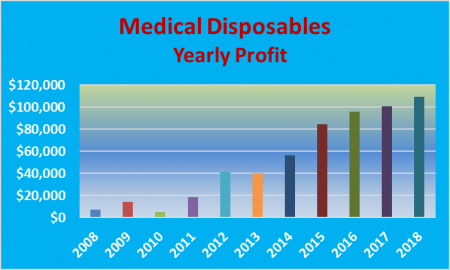 Gross profit increased $14.3 million or 14 percent to $117 million for the quarter, representing 23 percent of sales, up from 21 percent in 2017.
Sales and distribution cost slipped slightly from $33 million to $32 million, depreciation inched to $6.1 from $5.9 million while administrative expenses rose to $49 million from $41.4 million in 2017, as salaries and commissions increased by $3.35 million or 8 percent, General insurance rose by $800,000 or 47 percent following increased inventories and other assets and Professional fees and Information Technology Consultancy fees increased by $1.74 million or 36 percent for infrastructural improvements.
Cash flow generated $25 million and after changes in working capital, ended at $23 million with cash on hand ending at $29 million. 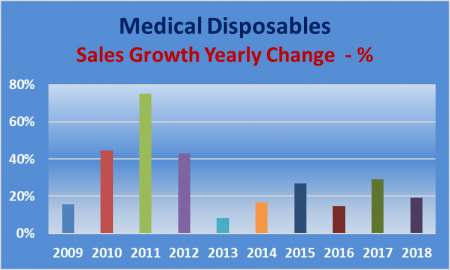 Inventories fell to $421 million from $544 million at the end of March as a direct result of the increase in business opportunities, but receivables remained over $300 million at $318 million, a bit on the high side and trade payables fell to $292 million. Borrowed funds stood at $331 million. Shareholders’ equity rose $19 million to $692 million.
Earnings per share for the quarter was 7 cents, IC Insider.com projects 65 cents for the full year on the basis that the loss of exchange will remain substantially at the June quarter level and $1 per share for the next fiscal year. The PE ratio based on forecast earnings, is 9 at Fridays’ closing price of $5.80.
Profit jumps 77% at Lasco Manufacturing
 Profit jumped a strong 77 percent at Lasco Manufacturing, in the June quarter to, $238 million from $134 million in 2017, from sales revenue that rose just 14.8 percent to $1.73 billion, up from $1.5 billion in 2017.
The results follow the 2018 fiscal year, when profit fell from $707 million to $560 million, after rising 73 percent in the December quarter, to $195 million from $113 million in 2016. For the nine months to December, profit fell 24 percent to $533 million from $700 million in 2016.
Profit margin climbed to 35 percent from 31.7 percent in the 2017, as input cost climbed much slower than revenues, with an increase of 9 percent, to $1.1 billion. The effect, operating profit rose an impressive 27 percent to $607 million, from $478 million.
Depreciation cost rose 5 percent to $55 million but administrative, marketing and sales expenses declined by 1 percent to $252 million from $256 million. Finance cost rose to $31 million from $30 million in 2017.
“The positive out turn reflects growth in volumes, improved operational efficiencies and streamlining and cost control”, Managing Director, James Rawle, stated in his report accompanying the quarterly.
Gross cash flow brought in $293 million but growth in receivables, inventories, addition to fixed assets offset by loan inflows and increased payables resulted in a decline in cash of $110 million, leaving cash on hand and bank at $261 million.
At the end of June,shareholders’ equity stands at $5.16 billion with borrowings at just $1.6 billion. Net current assets ended the period $1.7 billion well over payables of $937 million.  The company has so far incurred $731 million on work in progress that includes 65,000 feet warehouse expansion, scheduled for completion in September. According to managing director, James Rawle, “the facility will help to simplify logistics and result in important cost savings.”
Earnings per share came out at 6 cents for the quarter and is projected to end the fiscal year ending to March 30 cents. The stock traded at $4 on the Junior Market of the Jamaica Stock Exchange with a PE ratio of 12 times 2019 earnings and is in line with the market average.
The company will pay a dividend of 3.8 cents per share on August 31, resulting a total payment of $155 million.