 The Board of Directors and Management of Gwest Corporation Ltd are deeply concerned about the articles published on the IC lnsider.com website dated September 6, 2018 and September 21, 2018, authored by John Jackson.
The first article dated September 6, 2018 speaks to Gwest Corporation’s first quarter report showing the issue of 250 million preference shares, and with quite remarkable language the writer concludes that the preferences shares in the capital of the Company have been allotted without authority.
We wish to confirm that at the Extraordinary General Meeting of the Company held on November 27, 2017, the following resolution was duly passed:
“As a special resolution that the Company be authorized to issue and/or allot Cumulative Non¬ redeemable Preference Shares with rights/restrictions as to Voting, Dividends and Winding up and/or otherwise as may be determined by the Directors of the Company or a Committee of the Directors appointed for such purpose, subject always to the Articles of Incorporation of the Company, and that the Directors of the Company or such Committee be and are hereby authorised to determine all such rights and restrictions and the Directors be and are hereby authorized to allot such Cumulative Non-redeemable Preference Shares at such subscription price per Preference Share as the Directors of the Company or such Committee may deem fit, the same to be allotted to shareholders of the Company who have invested in the capital of Company (in cash or in kind) with the understanding/pursuant to agreement(s) that such investment(s) will be recognized as shareholder loans or by the issue of preference shares, in each case on terms and conditions determined by the Directors of the Company, subject always to the Articles of Incorporation of the Company”.
The above resolution was passed specifically to facilitate non-redeemable preference shares being allotted to persons who had invested in the Company by way of shareholders loan made available to the Company.
Sections 18 and 19 in the November 2017 GWEST Prospectus specifically disclosed that shareholders loans were to be converted to preference shares, thereby reducing the servicing cost to the Company:
Shares in the capital of the Company are under the control of the Directors, as expressly provided for in the Articles of Incorporation.
In all the circumstances the allegations by the writer of the articles under review are unfounded and without merit.
It is unfortunate that the writer of the articles did not undertake greater due diligence towards determining correct factual positions, before publishing false and misleading material that could be injurious to the Company, this at a time when the Company has embarked on programs to stabilize its operations and to achieve its objectives in the short term.
Gwest statement on Preference Share issue
Split & rights issues for Sterling

Sterling Investments coming with split and rights issue.
Sterling Investments is considering a 5 for 1 stock split and a rights issue of ordinary shares to existing shareholders.
The company will hold an Extraordinary General Meeting at the Knutsford Court Hotel, on October 8, to consider the an increase in the authorized share capital by the addition of 1,850,000,000 ordinary shares and to approve the issue up to 2,000,000,000 ordinary shares currently un-issued, by way of a Rights Issue, on terms to be decided by the directors, including the number and price of the shares.
November 14 is the expected date for the commencement of the rights issue, Yanique Leiba-Ebanks advised IC Insider.com.
“Proceeds of the rights will be used to fund private equity and investment in some local stocks. We have been participating in IPO share issues that have done well for the fund,” Leiba-Ebanks said. So it will be more of that, going forward along with the focus on leveraged fixed income investments.

Yanique Leiba-Ebanks – AVP Pensions & Portfolio Investments
Sterling Asset Management
The issues were necessary as the company has just under 300 shareholders with limited interest in trading the stock by the general public. The company was encouraged recently to split the stock and issue more shares to broaden the shareholdings to provide a platform for more liquidity for the stock that trades infrequently.
Sterling’s fortunes will be boosted with net profit that grew by 20.5 percent in the 2018 half year, to $52 million and $27 million in the June quarter, from $25 million, in the similar period in 2017. Sterling has 59.15 million shares issued and enjoyed earnings of 87 cents for each share for the half year.
Others to expect splits from are, Barita Investments and they could well have a rights issue to fund acquisitions and other expansion and new products such a margin facilities. CAC2000 with the stock price rising into the mid-teens, Stationery & Office Supplies with the stock price expected to be priced in the teens sooner or later is expected to split by 2019. At the annual general meeting held earlier this year, shareholders were informed that the board had be looking at it but no decision was make. Access Financial directors and NCB Financial indicates that they don’t see any benefit to their company in doing a split but it only a matter of time that they will be forced to, the same applies to Palace Amusement. Some investors are of the view that with Derrimon Trading splitting when the stock got in the teens that Caribbean Flavours is likely to follow. Investors should not ignore the possibility of Berger Paints and ISP Finance joining the queue in the near future.
Everything Fresh down but not out
 Everything Fresh is one of a hand full of initial public stock offers to be selling below the IPO price months after the issue. The stock that was over priced has only been partially helped by a big jump in 2018 half year profit.
The fall in the price was due to over pricing the initial offer and failure to provide more up to date information on the 2018 performance to the time of the IPO and to address developments with the margins. Even with improved results, the stock remains one of the higher priced units on the Junior Market, at a PE of 14 times this year’s pretax earnings and is in line with the market’s average.
Boosted by a big jump in profit margins, earnings after tax jumped 180 percent in the June quarter, to $26.5 million from $9.5 million in 2017. For the six months to June, profit climbed 99 percent to $38.6 million from $19.4 million in 2017. For the next five years, profit will be free of corporate taxes and in the second five years will pay taxes at half the regular rate.
Sales revenue rose 9.7 percent for the quarter, to $494 million from $451 million and increased 6 percent for the half year, to $969 million from $915 million in 2017.
Improvement in profit margin in the first half of the year that grew from 8 percent to 11 percent, increased further to 13 percent in the June quarter and was the major contributor for the sharp increase in profit. The Chairman, Gregory Pullen informed IC Insider.com, that the company took a deliberate decision in 2017 to go after certain clients with an introduction of low margins, with the expectation that they would be able to enjoy higher margins in 2018 onwards.

Everything Fresh two major owners and directors, Mr. & Mrs. Pullen.
The effect of the changes, operating profit rose 84 percent in the quarter, to $66 million from $36 million and increased 49 percent for the year to date, to $108 million from $72 million in 2017.
Sharp increase in administrative expenses by 38 percent to $28 million in the quarter and by 30 percent in the six months period to $54 million, kept the growth in the top line from filtering fully into profit. Marketing expenses associated the public of share issue added to cost in the period. Finance cost rose in the quarter, to $5 million from $4.3 million in 2017 and from $8.7 million to $9.3 million for the six months.
Earnings per share before tax came out at 5 cents for the quarter and 8 cents for the six months and should end the year at 15 cents for PE of 14 times 2018 earnings and 10 times 2019 projected earnings of 20 cents per share. The stock traded at $2.10 on the Junior Market of the Jamaica Stock Exchange on Friday.
Gross cash flow brought in $48 million but changes in working capital and inflows from the issue of shares, resulted in $213 million of cash funds as of June. A large portion of the share issue proceeds was received after the end of the quarter, the chairman’s report to shareholders stated.
At the end of June, shareholders’ equity climbed to $651 million from $225 million in 2017. Borrowings stood at just $107 million. Net current assets ended the period at $614 million inclusive of trade and other receivables of $503 million and cash and bank balances of $213 million. Current liabilities ended the period at $207 million.
The company is looking at three meat processing facility locally with a view to acquiring one and expects that discussions will conclude by the end of this year or early in 2019. The plan is to enable the manufacturing of products by them to sell directly to its clients at more competitive prices.
Sales jump sharply at Main Event

Main Event backed with IC BUY RATED status
Growth in revenues while not an exact proxy for increased profits, is often a very good indicator of greater gains ahead. That may be exactly what is happening at the Junior market listed Main Event.
The results for the nine months to July show strong sales growth but flat profits. Revenues for the July quarter surged nearly 26 percent to $364 million, but profit fell 7 percent to $24.5 million from $26.3 million in 2017. For the nine months to July, profit was up just 4 percent to $105.5 million that flowed from a 13 percent rise in revenues to $1.07 billion, compared to net income of $101 million in 2017.
The company incurred increased cost as it seeks to expand its service offerings. The results to date suggest that the full year earnings will not vary much from the 2017 full year results of 37 cents. But 2019 could be a blow out year for them, if revenue growth seen so far for this year, continues into 2019.
Profit margin in the first half of the year, was held to the same level as in 2017, at 48 percent and declined in the July quarter to 45 percent from 49 percent in the 2017, the impact, operating profit rose just 15 percent in the quarter to $164 million from $143 million but fell to 14 percent for the year to date, to $512 million from $447 million in 2017.
Administrative expenses rose 20 percent to $111 million in the quarter and increased 15 percent in the nine months period to $311 million. Marketing and sales expenses increased by 44 percent to $15 million for the nine months. Depreciation rose 49 percent to $24 million in the quarter and increased 29 percent in the nine months to $69 million, an indication of increased capital spend to accommodate expansion and increased income. Finance cost was flat in the quarter, at $5.2 million and rose just 5 percent to $13.6 million for the nine months.
Earnings per share came out at 9 cents for the quarter and 37 cents for the nine months and should end the fiscal year around 40 cents. For 2019 earnings should be in the order of a string increase to 75 cents.
“Performance has been negatively impacted by write downs on trade receivables to align to reporting standard, IFRS 9, continued start up expenditure for new service offerings and cost with higher head counts and incentive compensation,” the Chairman Ian Blair and Chief Executive Officer reported to shareholders in their commentary accompanying the quarterly.
Gross cash flow brought in $175 million but growth in receivables, inventories, addition to fixed assets of $160 million, offset by net loan inflows and increased payables resulted in net cash flow ended at a negative $63 million and leaving $29 million in cash at the end of July. Shareholders’ equity stood at $551 million with borrowings at just $185 million, including amounts due to related parties. Net current assets ended the period at $141 million, inclusive of trade and other receivables of $304 million, cash and bank balances of $29 million. Current liabilities amounted to $209 million inclusive of short term borrowings.
The stock traded at $5.50 on the Junior Market of the Jamaica Stock Exchange with a relatively low PE ratio of 7.3 times 2018 earnings and is elevated to BUY RATED status.
Wisynco adds $2.5B in sugar & rum sales

Wisynco brand Wata to benefit from 3 new production that is now in operation.
Wisynco Group, is set to lose revenues and profit with the ban on single use plastic straws and Styrofoam but the contract to distribute sugar and rum manufactured by Worthy Park should add $2.5 billion to revenues.
The sugar and rum revenues will more than make up for the cut in revenues of approximately $1 billion per year and profits by an insignificant $70 million information released by the company to Jamaica Stock Exchange suggests.
Investors in the company’s stock could not get enough after it listed in December last year, driving it to a high of $13.81 for a then rich PE of more than 20. With the PE below 10 times the current year’s earnings and set to go to 20 by 2019, investors are dumping the stock at a PE of 8. But now they should be holding and buying more, as the stock has few that are likely to deliver better returns in the next twelve months.
According to the company, plastic straws represent less than 0.1 percent of the Company’s revenue and Styrofoam represents 4 percent of the company’s revenue and approximately 3 percent of the company’s net income. Investors seem to be concerned about the impact of the ban on the company’s operations and profit. With earnings of 62 cents for the 2018 fiscal year and 15 cents in the June quarter, investors may not be seeing a boost in profit to come to warrant holding the stock.
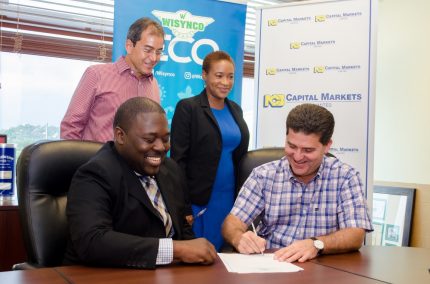
Wisynco Group
IC Insider.com spoke with the company’s CEO William Mahfood, advises of a number of positive developments that bode well for the future fortunes of the group. The company on Friday released information on a new distribution agreement with Worthy Park Estate (WPEL) for the distribution of WPEL’s spirits and sugar. Wisynco advised that the distribution of WPEL’s spirits will commence on November 1 and will include the ‘Rum-Bar’ and Worthy Park Estate brands of spirits. The distribution of WPEL’s sugar will commence on January 1, 2019, the start of the new sugar crop.
The new products could add around $750 million to gross profit. According to Mahfood the company has just added three new production lines to alleviate production capacity constraint and is expected to help increase sales around 20 percent. The expanded capacity will facilitate expanded production of Wata, carbonated products and juices. “New process has cut the production cost of plastics by more than 50 percent and this will result in significant cost savings,” Mahfood said. Importantly, Mahfood expects revenues from existing product lines to be up 20 percent for the fiscal year. Add to that, revenues from the new contract resulting in revenues probably increasing 30 percent in the period ahead.
IC Insider.com projects profit of approximately $4 billion or earnings per share of $1.10 and that should push the stock to $20 in 2019. IC Insider.com is placing the BUY RATED stamp on the stock.
Plastic ban to have minimal impact – Wisynco
Wisynco, traded the most shares on tuesday.
Wisynco Group will see little impact in the recently announced ban on plastic bags, plastic straws and Styrofoam, to take effect between 2019 and 2020 a release by the company stated.
“The areas of impact for Wisynco include plastic straws and Styrofoam, which the Company manufactures. Regarding plastic straws, it is proposed that this ban take effect on January 2019. Plastic straws represent less than one tenth of 1 percent of the Company’s revenue and the ban will therefore have no impact.”
“Regarding the ban on Styrofoam for local manufacturers, though there is still some uncertainty, it is currently proposed that this ban take effect on January 2020. Styrofoam represents 4 percent of the company’s revenue and approximately 3 percent of the company’s net income.”
For the fiscal year ended June 2018, Wisynco recorded profits attributable to shareholders of $2.3 billion or 62 cents per share on a normalized basis for the year from a 14.8 percent rise in revenues to $24.54 billion compared to a profit of $1.97 billion or 55 cents per share on a normalized basis for the corresponding prior in 2017.
Revenues for the June quarter grew 15.2 percent to $6.49 billion over the $5.63 billion generated in the 2017 corresponding quarter.
The group benefited from improved profit margins in the quarter and for the full year while general expenses rose at a much slower pace than the increase in revenues. In the quarter Selling, Distribution & Administrative Expenses for the quarter totaled $1.86 billion or 3.4 percent more than the $1.79 billion for the corresponding quarter of the prior year and for the 12 months it rose 8.5 percent to $6.37 billion.
Wisynco Group stock that has been under selling pressure from the start of May, when it was trading at $10.72, gained 20 cents to close at $9 with 320,465 shares changing hands on Thursday, on the Jamaica Stock Exchange. The stock is selling at less than 10 times 2019 earnings and remains one of the better buys in the market.
One-off gains push up Scotia’s profit
 Scotia Group reports growth of 24 percent in net profit to $11.2 billion for the nine months to July, but importantly, profit jumped a strong 37 percent in the July quarter, over that of 2017 to $4.4 billion as net revenues climbed in the quarter by $940 million and costs were effectively flat.
While the results are impressive, especially in light of recent years of weak growth, the improvement is boosted by what could be considered as one-off income. The nine months profit that grew by $2.2 billion over the similar period in 2017, inclusive of gains on the sale of a subsidiary of $750 million. In addition, the group enjoyed above average foreign exchange trading gains, partially as a result of the relatively sharp slippage in foreign exchange rate of the Jamaican dollar. Excluding, the exceptional income profit would be modestly up from the results of the prior year.
The year’s operations was impacted by lower cost and lower income in some areas while income for some other segments grew. Total revenues excluding impairment losses on loans for the nine months to July increased 10.7 percent to $33 billion, over the prior year. “While there were increased loan and transaction volumes across the business lines, this was offset by reduced net interest margins as a result of lower interest rates,” the group’s CEO and President, David Noel stated in the report to shareholders. Net interest income after impairment losses for the period was $17.9 billion, compared to $18.44 billion the same period in 2017. For the quarter, net interest income declined by nearly $460 million before loan impairment losses, to $6.3 billion and by $427 million after to $5.68 billion.

David Noel new Scotia Group’s CEO.
Net fees and commission income was $6.1 billion, down $477 million or 7 percent compared to last year, impacted by the ongoing shift from branch transactions to online and mobile transactions which Scotia states, “attract lower fees,” Insurance revenue increased by $135 million to $2.4 billion or 6 percent, due to growth in core insurance business and actuarial reserve releases from changes in assumptions on valuation of the portfolios. Net gains on foreign currency activities and financial assets amounted to $4.6 billion, up $2.5 billion, more than 100 percent compared to last year based on increased market activities and revaluation gains. For the quarter, net fees and commission income dipped to $2 billion from $2.17 billion, gains on foreign trading jumped sharply from $570 million to $1.95 billion due partially to the sharp depreciation of the Jamaican dollar. Gains in financial assets rose from $228 million to $598 million but insurance revenue fell from $567 million to $525 million.
Operating Expenses of $16.3 billion for the nine months, increased $145 million or just 1 percent compared to prior year. Salaries and staff benefit costs declined $414 million, while other operating expenses grew by $575 million. For the quarter cost rose from $5 billion to $5.07 billion as staff cost dipped slightly to $2.45 billion from $2.68 billion.
Loans and advances grew 6.3 percent, with loans after impairment losses increasing to $176.9 billion since the end of the previous fiscal year in October but grew a stronger 3.7 percent between April and July quarter. Impairment losses on loans were down $310 million or 21 percent from last year, due to lower provisioning requirements on a reduced non-accrual loan portfolio as the quality of credit portfolio continues to improve.
An interim dividend of 48 cents per stock unit payable on October 24, was declared. Scotia is trading on the Jamaica Stock Exchange at $62 on Tuesday with a PE of 13.5 times 2018 earnings from continuing operation around $4.50 per share.
85% of Scotia’s transactions now online
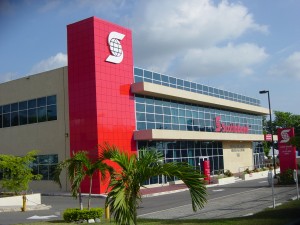
Scotia Group branches now being used less with more use of electronic banking by customers.
According to the banking group in their report to shareholders, “We continue to simplify our operating model to focus on growing our core businesses, enhancing our digital capabilities, and reducing our structural costs.”
Scotia stated that “Our digital strategy continues to deliver new milestones as evidenced by a 24 percent increase in the number of mobile banking customers.” mobile, online, ATM and Point of sale continue to grow and now account for more than 85 percent of all transactions as at July. The banking group is reporting lower operating cost and fee income as a result of the switch.
The sharp fall in branch transactions come against and 7 percent increase in total to $535 billion over assets on the books in July 2017.
Express Catering profit up but concerns linger

Ian Dear Chairman & CEO of Express Catering
Profit at Express Catering (ECL) jumped 290 percent to US$3.5 million on increased revenue of 10 percent to $15.7 million. A fall of $1.4 million in administrative cost to $6.6 million and a near $1 million rise in gross profit accounted for the bulk of the profit growth.
Earnings per share came in at 0.021 US cents. With the Starbucks franchise, which should be in full operation for the entire 2019 fiscal year and continued strong showing in tourist arrivals, revenues should climb much faster than the 10 percent experienced for 2018, helping to boost profit, which IC Insider.com is estimating at 0.035 US cents or Jamaica 45 cents.
Of grave concern is that while the company is incurring $333,000 in preference dividends on $3.5 million preference shares, amounts owing by related parties, rose from $3.6 million last year to $6 million to May, but ECL gets no income from it. That seems partially on the way to be corrected, based on information provided the company’s Chief Execuitive.
The preference shares issued is exactly the same amount due on debt owing to the company by a related party and reported in the financials for the first time in the 2017 fiscal year. While the amount owed by Margaritaville Limited increased by $2.3 million with no interest payable, Express pays dividends on the preference shares. No interest is paid to Margaritaville St. Lucia by Express for an amount due to the former, partially countering the position against the dividend payable. The preference shares, denominated in US dollar, is obligated to pay dividend at 9.5 percent per annum. That is high for a US dollar instrument now, as well as when it was contracted. These matters are clearly an untidy for a listed company with amounts owing to and from related entities, with some incurring a charge while others are not.
IC Insider.com spoke with Ian Dear who is Chairman of the company on this issue. Dear advises that the dividend to be paid shortly will result in Margaritaville Limited repaying US$4.8 million of the debt in September and it is not expected that the account will return to the above level in the future. Regardless of the above payment, the situation requires regularizing to ensure equity and transparency for the investing public.

Starbucks one of the brands Express Catering will sell at the Montego Bay Airport.
Dear went on to state, “The balance of US$5.99 million at May, due from Related Parties is made up of 3 separate Related Party accounts with amounts due from ECL as well as amounts due to ECL. This is a carry forward from the period when ECL was a fully owned subsidiary of MCL Group. The company will take steps to cancel the non-active balances by paying down the amounts due to Related Parties and collecting from Related Parties amounts due to ECL. The company declared recently a dividend of US$6 million that will result in a further substantial reduction of the existing balance.”
“The existing Preference Shares were entered into at a time of higher interest rates. Since then rates have trended downwards. ECL is currently engaging funding institutions with a view to refinancing this debt. Redemption costs as well as Arranger fees will be critical factors in this decision,” Dear, Chairman & CEO informed IC Insider.com.
Dear also confirmed that the annual results had very little revenues from the Starbucks store. He also indicated that there will be three stores initially, in the Sangster International Airport of which two opened around 2 months ago and the third was opened last week. Annual revenues should be in the order of $1 million per annum, IC Insider.com estimates.
Unless otherwise stated, all amounts are denoted in US dollars.
Broken capital market no one is fixing
Gwest booked preference shares but no notice seen for the issue.
The Jamaica Stock Exchange and the Financial Services Commission regulate the financial market, but the system is seriously broken and no one is moving to really fix it.
IC Insider.com brought to the attention of the public, the appalling situation relating to Knutsford Express where the Prospectus which was signed off by both the above institutions but there is no indication how the share capital moved from 973 units to 95 million. The Auditors of the company still have not sorted out and reported on properly in the audited accounts on the movement of the share capital and the proceeds of the initial public offer, even as it was brought to public attention and the JSE was aware of it from 2014.
There is the case where a brokerage house, signed agreements and breached a series of agreements and refused to correct the errors. The FSC who should be aware of the breach failed to recognize the matter year after year, nor have the auditors dealt with the matter properly.

The FSC fell down on the job in reviewing Knutsford prospectus & reports after IPO.
GWest has published the first quarter report to June, showing the issue of 250 million preference shares, but there is no notice on the JSE website of an extraordinary general meeting called or held to approve the issue of the shares. The JSE requires that any directors’ meeting at which a change in share capital is to be considered, such information should be communicated to the JSE and when the directors consider it, the JSE is to be advised of the decision within 48 hours. The Company’s act requires that changes in share capital must be approved by shareholders. From all indications, no such thing has happened at GWest. First off GWest had no authorized preference shares up to the end of March. How and when were these shares established and approved, is the question to be answered.
GWest came to market, with results that were based on sale of property. That changed substantially in the recently concluded fiscal year, when a loss was reported. The company projected figures, showing highly profitable future, with revenues from medical services rising sharply for the just concluded fiscal year. The results to March, showed revenues well below forecast, from the new operations. The company projected medical income to March this year, at $86 million but only generated $17.4 million and that puts the issue of generating the forecasted $710 million for fiscal year ending March 2019, in grave doubt.

Knutsford Express 204, 2015 auditing accounts still filled with errors.
Admittedly, the company had projected a loss to March of $110 million but came up much lower, with a loss of $88 million. For the June interim report this year, the company generated revenues of just $25 million with a loss of $42 million. From all indications, the company will fall far short of projections, but the directors gave shareholders who gave the company, their seal of approval, very little to go on as to the immediate future. With new borrowings and big losses investors, should not be left in left in the dark as to the true state of the company’s operation and what are the likely prospects for the rest of the year. In the quarter report there is no comment about the preference shares and the reason for the increase in liability and most importantly, what are the situation relating to the expected revenues flows.
We cannot develop a serious capital market with such sloppy monitoring and total lack of concern for shareholders by directors and mentors.
The JSE and the management of Knutsford Express met in connection with the errors in the audited Financials and both parties IC Insider.com is informed are to be revised.