Caribbean Cream reported revenues of $646 million for the August quarter this year versus $645 million in 2022, with the year to date revenues slipping to $1.25 billion from $1.257 billion in the previous year. Profit fell to $3.6 million in the August quarter from $7 million in 2022 and rose to $10 million for the six months from $8.5 million in 2022.

Caribbean Cream Kingston outlet
Improvement in production cost pushed gross profit up 10 percent to $390 million for the half year versus $354 million in 2022 and $205 million for the quarter to August this year, up 8.5 percent from $189 million in 2022. Cost savings were only realised in some areas as administrative expenses and finance costs climbed over 2022. Administrative expenses increased 6 percent to $158 million from $149 million, with finance costs climbing 60 percent to $24 million, from $15 million in the August 2022 quarter. For the half year, administrative costs rose 7 percent to $306 million from $286 million the previous year, while finance costs jumped 56 percent from $27 million to $42 million for the half year.
Finance cost associated with the expansion of the warehouse and building out of the cogeneration energy plant is being written off directly as a current expense rather than capitalising it, with the equipment as such, the reported profit over the past three years appears understated as a result of the treatment of this item. Accordingly, the 2023 full year’s profit should be closer to $70 to $80 million than the above figure, and the 2023 half year’s figure should be around $37 million.
Operations generated Gross cash flow of $77 million, growth in working capital and $206 million spent in addition to fixed assets offset by loan inflows net of outflows of $238 million, resulting in funds growing by $78 million during the six months.
 Considerable sums have been spent on plant and machinery to improve efficiency and, by extension, increase profit. Accordingly, $439 million was expended over the past year, bringing the gross amount in fixed assets to $2.7 billion from $1.7 billion at the end of February 2022. Most of the new expenditure went into equipping a new cold storage plant that has expanded freezing and cold storage capacity, with some spent on the cogeneration energy plant, which is intended to cut energy costs.
The company remains financially healthy, with current assets of $539 million, including trade and other receivables of $114 million, cash and bank balances of $145 million and inventories of $248 million, up from $183 million in August 2022. Current liabilities ended at $225 million and net current assets at $314 million.
At the end of August, shareholders’ equity amounts to $836 million, a rise from $807 million at the end of August 2022, with long term borrowings at $1.2 billion and short term loans at $43 million.
Earnings per share for the quarter was one cent and 3 cents for the year to date. IC Insider.com computation projects earnings of 55 cents per share for the fiscal year ending February 2024, with a PE of 7 times current year’s earnings based on the price of $3.95 the stock traded at on the Jamaica Stock Exchange Junior Market on Friday. The PE ratio compared with a market average of 10.7. Net asset value ended the period at $2.21, with the stock selling at just under two times book value.
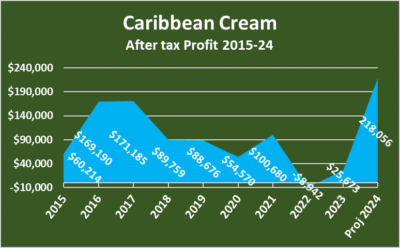
The company has a checkered profit history, as shown by the attached chart of profits, since 2015 and has struggled with increased costs since the disruption caused by COVID-19. The situation is worsened by the treatment of interest incurred to finance the new warehouse.
 The company operates a restaurant solely in the Turks and Caicos Islands, and delivered revenues of US$1.8 million in the August 2023 quarter, up 27 percent from US$1.42 million in the prior year and produced gross profit of $1.33 billion this year versus US$1.033 million in the previous year.
 Earnings per share for the quarter was $2.28, up from $1.42 in 2022 and $5.15 versus $5 for the year to September.
 In relation to the cash flows, “Net cash provided by operating activities” was $5.7 billion for the nine months and $2.46 billion for the quarter. The cash flow generation during the quarter and the available cash at the beginning of the period have allowed the Group to invest $4 billion during the nine months of the year and $2 billion during the second quarter, leaving the company with $639 million in cash and bank balance at the end of the period.
 Profit for the September quarter was marginally lower than the June quarter. Still, revenues from loans of $300 million in the September period were slightly higher than the $294 million in the June quarter.
 According to the company’s commentary on the results, “business loans accounted for 82 percent of the total loan portfolio, while personal loans accounted for the remaining 18 percent. Secured loans constituted 81 percent of the portfolio, with unsecured loans making up the remaining 19 percent. The collateralised loan strategy has proven instrumental in maintaining the loan portfolio quality, with non-performing loans holding steady at 9 percent, remaining within budgeted expectations and below the sector average.”

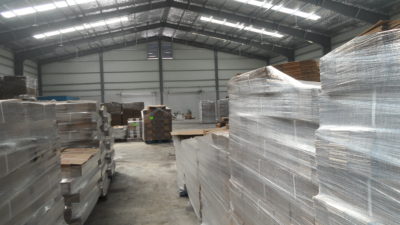
 Current assets ended the period at $590 million compared with $639 million in 2022. Trade and other receivables amount to $137 million, inventories amount to $156 million, down from $394 million in 2022 and cash and bank balances ended at $297 million. Current liabilities ended the period at $120 million. Net current assets ended the period at $469 million.


 The company expended $489 million on investment property and $169 million on development expenditure during the year, reducing the overall cash on hand to just $90 dollars compared to $217 million in the prior year. According to the audit report, three apartment units were contracted for sale which should result in a loss of $32 million and realise $117 million in total cash, data from the audited statement suggests.

 Direct Expenses fell 33 percent in the July quarter to $204 million from $304 million in 2022 and rose 28 percent from $583 million to $748 million in 2023. Gross profit slipped 25 percent to $224 million from $298 million in the quarter and jumped 64 percent to $839 million from $511 million for the nine months.


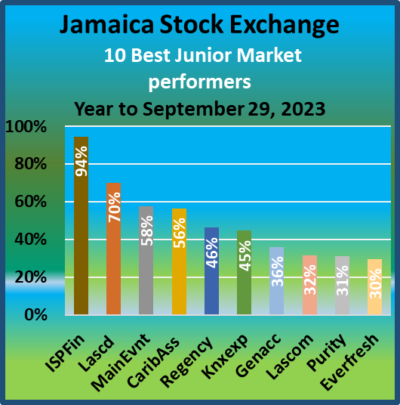 ISP Finance, a microfinancing company led the Junior Market following news that two new directors with experience in the financial service sector and who had worked with in the past in arranging deals for them were appointed to the board. There was also speculation that the majority shares could probably change hands sooner rather than later. There is also the expectation for increased lending to customers is expected to impact revenues and profit positively following a decline in the half year profit when loans jumped to nearly a billion dollars from under $800 million. Lasco Distributors profits for the fiscal year to March jumped and was followed by improved results in the June Quarter as investors rewarded the performance with s solid price movement. Main Event continued to recover from the damage to revenues and profits during the COVID, bouncing back as profit more than doubled to $216 million from $104 million for the nine months to July. Movement in Caribbean Assurance Brokers’ stock price follows profit jumping from just $4.5 million in the June 2022 half year to $18 million this year. Regency Petroleum profit fell from $51 million to $25 million for the half year but hope for improved profits drove the stock with new gas stations being opened or to be opened. General Accident migrated from the Junior Market to the Main Market on the last day of the month, with the increased stock price spurred by profit surging 195 percent to $165 million in the 2023 half year.
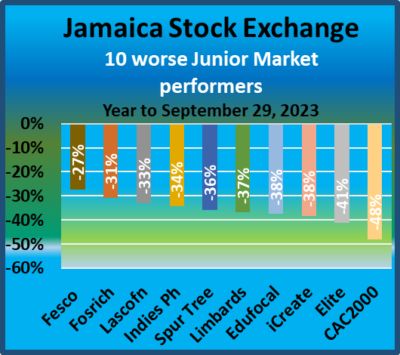 Fesco stock price declined sharply for the period even as the net profits for the June quarter were marginally higher than that of the similar 2022 period, with revenues marginally higher. The stock price pulled back from heady levels in 2022 to adjust to the earnings in the last fiscal year of just under 23 cents per share with indications that it may not significantly improve in the current fiscal year to warrant the high premium it had in 2022. Fosrich, on the other hand, had a sharp decline in profits for the second quarter and the half year but it too enjoyed a big premium in the stock price in 2022, investors readjusted their expectations by marking the price down, although both stocks got a two day bounce at the end of September that improved their performance year to date. Lasco Financial had a third less profit in the 2023 fiscal year than the prior year and reported vastly poorer results in the third quarter to June and that seemed to have encouraged more selling of the stock. Revenues and profit bounced in the third quarter for Limners and Bards but are still down year to date compared with last year and that did not help the stock that lost value during the period. Edufocal profit bounced in 2023 and may not necessarily justify the 38 percent fall in the stock price, while iCreate had totally disastrous results in the 2022 fiscal year as well as in the first half of 2023, with the company’s performance continuing to raise questions about its future. Elite and CAC 2000 suffered a reversal in fortune that is reflected in the decline in stock prices of both companies.