Supreme Ventures profit jumps 41%

Supreme Ventures’ profit rose sharply for the 2017 half year.

Investors responded to strong increase in profit for the six months to June, for Supreme Ventures, by pushing the stock to a record high of $9 on Monday.
Profit surged 41 percent, from $649 million to $918 million after tax, with second quarter profit jumping by a lesser 34 percent to $502 million, from $374 million in 2016. The results translate to earnings per share of 35 cents for the half year and 19 cents for the quarter. The numbers suggest full year earnings of 75 cents, with the stock trading on Monday at $9, it now parades a PE of 12, sitting at the middle of main market listings, but just below the market’s average of 13. Cash flow generated from operations, amounted to just over $1.3 billion for the six months from which $607 million in dividend was paid. $356 million was paid for acquisition of fixed assets after the receipt loan funding of $380 million.
The group reported strong increase in revenues, up 27.5 percent to $14 billion for the quarter and 23.5 percent to $27.4 billion for the six months. The 2017 second quarter figures include revenues for Caymanas Park that was acquired earlier in the year.
Direct cost rose 27 percent in the June quarter, to $12.47 billion and 24 percent year to date to $24.63 billion and operating expenses moved up 29.7 percent to $842 million for the quarter as the cost of the horseracing operations impact cost and 7.3 percent to $1.5 billion for the half year.
The new Caymanas Park horseracing operations brought in revenues of $1.76 billion for the six months period and contributed a loss of $105 million. In the first quarter racing brought in revenues of $328 million and a loss of $19 million. Interestingly, the gaming operations that was a big loss maker in past years contributed $15 million in profit, up from $777,000 in 2016 but down from a profit of $21.4 million in the first quarter, while the Sports betting loss was contained to $34 million, down sharply from $115 million in 2016, but much worse than the loss of $9.5 million in quarter one.
The financial position at June saw total assets of $6.5 billion, including cash of $2.27 billion and non- current assets of $3.17 billion. Shareholders’ equity stood $4 billion and interest bearing debt at debt, at just under $500 million.
Profits surge at Kingston Wharves

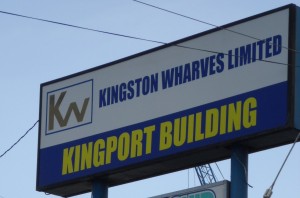
Revenues at Kingston Wharves jumped 19 percent or $467 million over the corresponding period in 2016 to $2.9 billion for the six months to June 2017 and 22 percent for the June quarter to $1.55 billion.
The strong revenue growth resulted in profit before taxation climbing 32 percent from $650 million in 2016 to $857 million for the half year and an even more impressive 40 percent in the quarter, to $454 million. Net profit attributable to shareholders increased 34 percent, moving by $187 million to $742 million over the comparable period in 2016 for the six months and a strong 46 percent in the latest quarter, to $414 million. The results produced earnings per stock unit of 29 cents for the quarter and 52 cents for the half year.
The strong quarterly performance comes against the background of a sharp fall in other operating income from $105 million to just $17 million, partially offset by finance costs declining to $31 million from $67 million in 2016 June quarter.
The Terminal Operations Division delivered revenues of $2.3 billion, a 19 percent increase over the corresponding period in 2016. Divisional operating profits increased by 50 percent from $485 million to $727 million. The key drivers include growth in container handling, motor units and break bulk operations amongst other areas. “Total revenues earned in the Logistics and Ancillary division amounted to $676 million, with operating profits totaling $192 million, an increase of 15 percent and 6 percent respectively, over the corresponding period in 2016 due primarily to continuous expansion of KWL’s service offering and a widening of its customer base, as well as improved operational efficiencies gained through increased use of technology to manage the warehousing operations and security services,” the chairman Jeffrey Hall, the company’s chairman reported to shareholders.
Administrative expenses rose much faster than revenues at 30 percent for the quarter, to $290 million and 18 percent for the six months to $543 million.
The Group’s balance sheet reflects short term investments and cash of $3.1 billion, shareholders’ equity of $19 billion and borrowed funds amounting to $2.4 billion.
The growth for the half year has been very strong suggesting that IC Insider.com’s forecast of $1.13 for the full year is on track and may even be exceeded if the second quarter pace of growth continues. The stock traded at on the Jamaica Stock Exchange on Friday gone at $30, resulting in one of the highest valued stock on the market at a PE of 27 times current year’s earnings. If the growth continues at the current pace into 2018 then the current value would be acceptable as the valuation would fall under 20 times 2018 earnings.
Kingston Wharves will shortly launch new logistics facilities for the warehousing of general cargo, and the storage of bulk and automotive cargo for domestic and transshipment markets and have already had acceptance from potential customers. The location of this is slated for lands adjacent to the Tinson Pen airport in Kingston.

Kingston Wharves pumps up JP profits

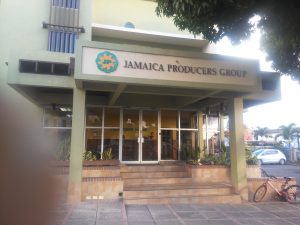
Jamaica Producers current HQ.

Jamaica Producers made improvement in its operations, with strong gains in operating profit, helped by the consolidation of Kingston Wharves (KW), but importantly, gains from its other core business.
The company reported profit attributable to shareholders of $158 million for the second quarter and $251 million for the half year to June, 2017.
The results flowed from revenues of $7.4 billion up from $4.6 billion in 2016 for the half year and $4 billion for the quarter, up from $2.4 billion in 2016. In 2016 the group’s share of KW was treated as an associate as such the revenues for 2016 does not include that for wharf as is the case in 2017.
Closer look at the numbers, shows that while profit jumped sharply, the subsidiary Kingston Wharves accounted for $485 million of the $546 million profit generated from operations in the June quarter and $918 million of the $981 million generated for the half year. Revenues from KW amounts to $1.55 billion for the quarter and $2.94 billion for the six months, less than 40 percent of JP group’s revenues.
The numbers suggest there is much work to be done, to knock Producers as the group is called, into shape. Relocation of the head office from rented property to an existing property owned by them and serving other group companies and the consolidation of the Tortuga Rum Cake operations in Kingston with modern equipment and other changes, will help to improve profitability of the core business.
The results for 2017 translate to 14 cents per share for the quarter and 22 cents for the half year and should end around 50 cents for the year. With a stock price of $13.75 the market value is a very rich 29 times earnings against a market average of just over 13. The stock which traded as high as $22 earlier this year has been slowly correcting and seems headed lower as investors get a clearer picture of the likely full year’s earnings.
The group’s main activities are port terminal operations, logistics, the cultivation, marketing and distribution of fresh produce, food and juice manufacturing, land management and the holding of investments.

Huge improvement at Jamaica Producers

Jamaica Producers at $14.50, currently.

Jamaica Producers made huge improvement in its operations, with strong gains in operating profit, helped by consolidation of Kingston Wharves but more importantly major gains from its other core business.
The company reported profit attributable to shareholders of $158 million for the second quarter to June and $251 million for the half year to June, 2017.
The results flowed from revenues of $7.4 billion up from $4.6 billion in 2016 for the half year and $4 billion for the quarter, up from $2.4 billion in 2016. In 2016 the group’s share of Kingston Wharves was treated as an associate as such the revenues for 2016 does not include that for wharf as is the case in 2017.
The results translate to 14 cents per share for the quarter and 22 cents for the half year and should end around 50 cents for the year. With a stock price of $14.50 the market value is a very rich 29 times earnings.

C&W reports profit

Jamaica’s telecom provider, Cable & Wireless, is reporting profit from operation in the June quarter this year, compared to a loss in the same period in 2016.
The company enjoyed an 11 percent rise in revenues helped mainly by a 22 percent increase in mobile revenues to generate $6.8 billion in revenues up from $6 billion in 2016 and profit of $222 million versus a loss of $695 million in the June quarter of 2016. Operating cost fell to $4.24 billion from $4.5 billion in the 2016 quarter to generate profit before finance cost of $1.59 billion. For the six months, revenue of $13.2 billion was generated with a loss of $311 million compared to a profit of $1.1 billion in 2016 from revenues of $11.85 billion.
Subsequent to the quarter the company announced a series of price increases that is set to boost revenues and help the bottom-line. the stock closed on Friday on the Jamaica Stock Exchange at $1.07. The latest information makes this stock one to watch next week.

Profit drops at Cargo Handlers

Adage has it that markets know best, but the performance of Cargo Handlers profit performance and stock price movements put the concept in greave doubt. The company reports lower revenues and profit for the June quarter this year compared to 2016 while the stock price tanked from serious overvaluation.

Profit for the nine months, dipped to $116 million from $124.5 million in 2016 after tax, even as revenues climbed from $234 million to $255 million. For the June quarter revenues fell to $74 million from $81 million in 2016 and profit after tax dropped sharply by 32 percent, from $46 million to $31 million. Earnings per share ended at 8 cents for the quarter and 31 cents for the nine months, for the full year earnings should end around the 40 cents range. Such earnings would put the price earnings ratio at a very high 33 and the stock price at great risk of falling.
In 2016, the company earned $6.3 million in other income in the June quarter with gains of $2.2 million in foreign exchange earnings in 2017, for the quarter and year to date and $3.4 million versus $10.5 million for the nine months to June last year. While revenues fell in the June quarter, compared to 2016, operating expenses jumped $5 million to $35.4 million and $20 million for the nine months to $112 million. $7 million of the increase, management reported, is due to “adjustments to some vessels’ rescheduling.” Management also stated that “the petroleum division will in the ensuing quarter begin to introduce newly acquired equipment that will give us the capacity to comfortably service additional business.”
The company’s is strong financially, with cash on hands of $237 million, current liabilities of just $25 million and shareholders’ equity of $366 million and generated cash flows from operations of $137 million for the nine months period.
An interim dividend of 11 cents per stock unit was declared by the directors to be paid on September 8.
Montego Bay is said to be the fastest growing region in Jamaica currently, if the pace continues, should provide the company will a solid base for growth. The big concern now is the need for the stock price to adjust downwards to mirror the values in the rest of the market. The stock peaked at $30 earlier this year and last traded at $13.20. It is going to take a few years for those who bought at the top of the market to recover their investment and opportunity cost expended on it. Cargo Handler is not a recommended buy currently.

Record $170M profit for Knutsford

One of Knutsford Express buses.

Profit after tax grew 40 percent at Knutsford Express for the year to May 2017 to $170.3 million but pretax profit was up a lower 28 percent to end at $164.4 million from revenues that rose 28.7 percent to $752.4 million.
Operating and administrative cost was up 29.6 percent to $580.6 million over the year ago period.
During the year, $107.6 million was expended on new fixed assets which pushed depreciation up sharply from $37 million in 2016, to $56 million in 2017. The financial statements reflect $49 million deposited to purchase vehicles, Managing Director, Oliver Townsend confirmed that they are adding “ a couple of buses to expand the fleet, some have already arrived with additional ones to come”.
Big expense items that grew sharply during the year are, Salaries up from $168 million to $194 million up 15.7 percent, toll charges rose from $11.4 million to $29 million, Fuel climbed from $64.7 million to $91 million and would be from a combination of higher prices and more bus trips. Parts cost $43 million fro0m $26 in 2016 while Insurance rose from $18.5 million to $27.2 million. Unfortunately, the company continues to present the financial information without breaking separation direct from indirect cost so that investors can determine more accurately the potential profitability.
Knutsford’s balance sheet presents a picture of strength with current assets of $231 million including cash funds of $156 million, up from $88 million in 2016. Shareholders’ equity stands at $483 million. Liabilities stand at $105 million including deferred tax of $12 million.
We will definitely open the transport centre at the Sangster International Airport later this month Townsend informed IC Insider.com. The centre is expected to capture a bigger slice of passengers disembarking from aircrafts as it become more convenient for them.
Subsequent to the year-end an interim dividend of 6.8 cents per share was declared as the final dividend for the year ended May 2017. The payment will be will be on September 15. The payment amounts to $34 million and is up 41.7 percent over the $24 million paid in 2016. The stock last traded on the Junior Market of the Jamaican Stock Exchange at $14.95. IC Insider.com is forecasting earning per share for 2018 at 53 cents, putting the PE for the stock at rich 30 times earnings, at this level the stock is likely to underperform the Junior Market movement for the next twelve months.

Paramount chops profits by $72M

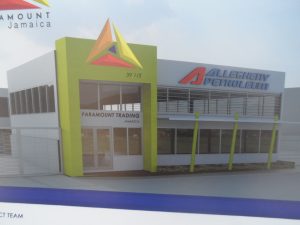
Paramount’s new look

Paramount Trading chops its 2017 profits by $72 million according to a release by the company published over the week end to $101 million. According to the release sales revenues climbed 12.8 percent to $1.156 billion for an increase of $132 million.
Gross profit margin declined by 2.1 percent cutting $23 million from profit compared to 2016 and operating cost rose 16 percent or $31 million from $193.8 million in 2016. “This resulted mainly from investments to build capacity to facilitate business growth in line with strategic direction of the company” the report stated. “The company will maintain a leading position in chemical raw materials, while accelerating growth in lubricants due to our investments in fixed assets including a joint venture with Allegheny Petroleum to manufacture oils locally the report went on to say.”
In the fourth quarter revenues grew 17.65 percent to $320 million from $272 million in 2016 and profit ended at $20 million in the 2017 final quarter versus $42 million in 2016. The final 2017 quarter results deteriorated sharply from performance for the February 2017 quarter, with revenues of $297 million and profit $29.5 million. The one year delay in starting to operate the lubricant plant has been costly.  The profit result translates to only 6.5 cents per share. The stock last traded on the Junior Market of the Jamaica Stock Exchange at $2.99 per share with a PE ratio of 46.

Ciboney out of cash shortly

Ciboney’s latest audited report shows yet another year of loss, with the company burning $5.2 million of assets, albeit an improvement over a $7.5 million lost in 2016. On the surface the numbers don’t appear much until viewed against the fact that they have very little current assets.
The year’s results mean that the company burnt up $5.3 in cash, leaving it with just $3.6 million at the end of May and no indication when the draining will end, with management being silent on this critical area. The company has no income with the cash being used up and this was the only area for inflows in recent years for some time.
In 2011, the company had $40 million in cash funds, but poor management of resulted in a high cost for shareholders. Ciboney Group minority shareholders should be considering legal action against the directors for negligence in managing the affairs of the company.
The company had a legitimate offer in 2012 that would have transformed it, but they failed to take it further than the board room. Since then, the company has lost money each year paying out management fees and other expenses and has virtually wiped out the near $30 million cash it had when the offer was made. Had the company accepted the offer, it would have transformed it and made big gains for Ciboney’s shareholders, in all likelihood.
Now that the money has virtually run out there is no known plan to turn things around while they await the sale of a property it holds. There have been talks about a sale of the property but so far shareholders have no indication if this is so and if so how serious the offer is. The latest report on the sale is that there was an offer but the contractor Generals department want the offer for sale to be again opened to the public by way of public advertisement.

NCB Q3 profit jumps 33%

NCB Financial Group HQ.

NCB Financial Group delivered net profit of $14.7 billion for the nine months ended June 30, 2017, an increase of 48 percent over the prior year’s nine months profit of $9.9 billion. For the June quarter net profit climbed from $3.94 billion to $5.25 billion in 2016 for the group.
The overall performance resulted in earnings per share of $2.14 for the latest quarter and $5.98 for the nine months. Loans and advances, net of provision for credit losses, increased by $32 billion or 18 percent to $212.0 billion at June 30, 2017. The growth was primarily driven by a 23 percent increase in the Retail Banking portfolio. Non-performing loans totaled $5.6 billion at June 2017, representing 2.6 percent of the gross loans compared to 4.8 percent at the end of June 2016 amounting to $8.8 billion.
The board of directors in their report on the nine months results stated that, “Operating income increased by $6.2 billion or 16 percent over the prior year, to $44.2 billion. The improved revenues were primarily driven by: Net fee & commission income growing by 31 percent or $2.4 billion. The growth stemmed from our continued focus on sale effectiveness, improving the penetration into our Investment Banking services, and growing the Unit Trust portfolios, coupled with increases in pension management fees. Additionally, our focus on providing our customers with non-branch channel and digital options has led to volume growth in point of sale and e-commerce transactions. Gains on foreign currency and investment activities growing by $2.5 billion or 80 percent. Net interest income increasing by 5 percent or $1.2 billion, as a result of growth in the loan portfolio.”
“Operating expenses of $28 billion grew by 9 percent or $2.3 billion over the prior year, driven by:  Staff costs increasing by $1.9 billion or 18 percent mainly as a result of the negotiated increases in salaries, wages, allowances & benefits. Other operating expenses growing by $1.1 billion or 11 percent primarily as a result of increased asset tax charges, property and ABM maintenance expenses and professional fees resulting from the execution of strategic initiatives.”
The banking group segments delivered strong gains in revenues and profit except for General Insurance. Retail and SME segment enjoyed an increase of 13 percent in net revenues to $13.86 billion and segment profit rising 33 percent to $1.6 billion.

Advantage General suffered a fall in profit for the NCB Group.

Payment Services recorded an increase of 15 percent in net revenues to $5.2 billion with segment profit rising 31 percent to $1.75 billion, Corporate Banking net revenues grew 39 percent to hit $3.6 billion with segment profit climbing a very strong 64 percent to $2.47 billion. Treasury and Correspondent Banking net revenues increased 35 percent to $6.98 billion and segment profit rose 41 percent to $5.67 billion, Wealth, Asset Management and Investment Banking saw an increase of 25 percent in net revenues to $6.6 billion and segment profit rising 27 percent to $4.6 billion, Life Insurance and Pension Fund Management net revenues grew 14 percent to $5.6 billion, with segment profit rising 22 percent to $3.48 billion. Revenues at the General Insurance segment fell 7 percent to $4.4 billion with segment profit slipping 7 percent to $893 million and Other contributed an increase of 34 percent in revenues to $195 million and segment profit rising 55 percent to $126 million.
The Board of Directors, declared an interim dividend of $0.60 per ordinary stock unit payable on August 29, for stockholders on record as at August 15, 2017. The NCB stock closed on the Jamaica Stock Exchange at $80 on Friday having traded earlier the day at $81 after the release of the results.