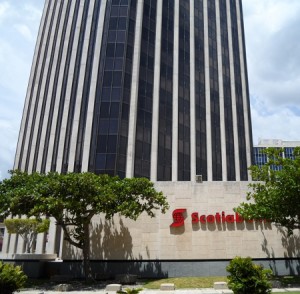
 Scotia Group reports a 14 percent increase in profit compared to the period in 2016. The banking group added $718 million more in profit to $5.7 billion for the six months to April 2017 over 2016.
Net income for the second quarter rose 16 percent to $3.4 billion, versus $2.94 billion in the same period in 2016. Total revenues for the April quarter amounted to $16.7 billion while in 2016 the group generated revenues of $11 billion while revenues for the six months ended at $23 billion versus $21 billion.
“The positive movement was achieved through increased loan and transaction volumes across our business lines,” the Group stated in a report accompanying the results. Net interest income after impairment losses for the six month period was $12.2 billion, $399 million or 3 percent above the same period in 2016
“Net fees and commission income amounted to $4.4 billion, driven by higher transaction volumes and the growth in our credit card, merchant services, and asset management business. Insurance revenue increased by 31% given the growth in core insurance business and actuarial reserve release from changes in assumptions on valuation of the portfolios. Net gains on foreign currency activities and financial assets amounted to $1.3 billion based on trading volumes,” the Group stated.
Operating Expenses amounted to $11.1 billion for the six month period, an increase of $300 million or 3 percent compared to prior year. Salaries and staff benefit costs increased by $201 million, which was offset by lower other operating expenses of $87 million. Asset tax increased by $112 million or 12% to $1.1 billion due to the increase in the Group’s assets.
Impairment losses on loans amounted to $975 million, up $367 million from last year as higher write-offs on unsecured retail loan portfolio grew by $7 billion or 4 percent year over year, with loans after allowance for impairment losses, increasing to $164.2 billion.
Main Event flat profit before tax
 Main Event Entertainment that went public with an IPO in January this year is reporting flat profit before tax and slightly lower net profit after tax of $3.3 million. Profit before tax for the year to October ended at $59.8 million com-pared to $60.3 million in 2015.
Profit after tax came in at $56.5 million versus $60 million in 2015, the out turn is lower than the $60 million the internal figures to September last year that was included in the prospectus showed. The net profit translates to earnings per share of just 23.5 cents with 240 million shares applicable at the date of the financials.
Return on average equity amounted to a strong 41 percent, with shareholders’ equity at the end of the period being $242 million.
The results emanated from a 9.5 percent rising in revenues to $1.13 billion, the growth was slowed b y a big drop in revenues from Digital Signage. With gross profit climbing 13 percent to $429 million. Expenses rose by 15.7 percent to $354 million. Revenue during the year was generated mostly by Entertainment promotion activities of $854.7 million in 2016 from $742.7 million in 2015. Audio and film contributed $189.5 million compared to $140 in 2015 and Digital signage of $88 million versus $151 million in 2015. The auditors signed off on their report on the 5th of June, an indication that all was not well with the financial reporting.
Main Event went public at $2 in January and now trades on the Junior Market of the Jamaica Stock Exchange at $6.50.
More profit for Proven
 Proven Investments reported profit to owners of the company of US$8.721 million up from $2.344 million in 2016, but it is not as simple as it first appears. To get a good picture as to what is the true ongoing earnings investors have to dissect to numbers and add to and deduct to get the real picture.
First, there is an US$8 million gain from the difference in net value $20.63 million acquired from Bank of St. Lucia International, over the amount paid of $12.6 million. The managing director got shares in the new subsidiary which resulted in a charge to income of $3,244 million, adjusting for these two items would leave shareholders with profit of $4 million. Reversal of Impairment loss on investments resulted in profit being boosted by $921,000 in 2017 compared to a hit of $1.744 million in 2016 and realized gains on investment of $10.756 passed through other comprehensive income and not reflected in the regular profit.According to Proven Chief Executive Officer, Christopher Williams, there are expenses incurred in the acquisition of Bank of St. Lucia amounting to US$2 million and some of the preference share dividend was incurred as a result of the planned acquisition and would need to be adjusted for.
When all adjustments are factored in the investment company enjoyed earnings of $15.8 million from normal operations or earnings per share of 28.7 us cents. Stripped of all the one off type income and expenses, earnings come out at $5.04 million, excluding the added preference share dividend. The company has nearly $12 million of losses relating a fall in the value of investments and foreign exchange translation losses, not booked through normal profits.

Christopher Williams, Proven Investments CEO.
The foreign exchanges losses Williams states relates to the acquisition of Access has gone up in value but is on the books at cost of J$9 per share versus $50 currently. The regular profit statement shows earnings adjusted for one off items coming, in at 0.09 cents per share and puts the PE ratio at 2 times 2017 earnings, falling to 14 times estimated 2018 earnings.
Access Financial Services is playing an increasing role in the financial fortunes of the company with a 47 percent increased profit in Jamaican dollars, for the 2017 fiscal year, according to Williams Bank of St. Lucia which made US$3 million profit for 2017 is expected to deliver US$4 million in 2017. If Proven maintains the performance of its core business and delivers on the promise of Access and Bank of St. Lucia then earnings from ongoing operations should end up around US$12 million or 0.021 US cents per share. The stock traded at 28.5 US cents on Tuesday on the Jamaica Stock Exchange.
Carreras pays $7B to government
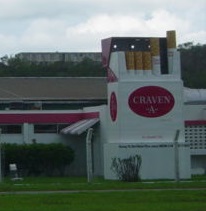
Carreras grew profit by 27% in the fiscal year to March.
According to the last audited financials to March this year, Carreras will contribute $7 billion in taxes to the government of Jamaica coffers, excluding payroll taxes.
For the current fiscal year, the company is expected to contribute in excess of a billion more in taxes as government increased taxes on cigarettes earlier this year and profit grows thus contributing more in profit tax. The cigarette distributors paid 15 percent more in Special Consumption Tax during the fiscal year, than the year before, with $5.9 billion being paid while operating revenues grew 12.8 percent to $13.5 billion.
The financial results to March show profit for the year rising 27 percent to $3.8 billion or $7.84 per share with earnings versus $6.20 in 2016. Carreras incurred $1.2 billion in corporate taxes. In achieving the improved results the company not only increased revenues net of consumption taxes but cut operating cost as well. Administrative cost fell from 1.21 billion to $1.07 billion, as staff cost fell from $211 million down to $163 million and Business support services cost declined from $386 million to $302 million. Distribution cost from $723 million to $622 million as $81 restructuring cost incurred in 2016 was eliminated in 2017. Occupancy cost fell from $56 million to $45 million Security fell from $74 million to $57 million and other expenses declined by $23 million to just $4 million. Staff cost rose from $316 million to $332 million.
Cash funds stood at $2.58 billion compared to $2.6 billion in 2016 and shareholders’ equity at $2.1 billion. IC Insider.com is forecasting profit for the year to March 2018 of $4.4 billion with earnings per share of $9.
Dividends paid during the year to March 2017 amounted to $3.45 billion or 91 percent of profit. The stock traded at $84 on Tuesday on the Jamaica Stock Exchange.
47% surge in Access profit
 Looking at the Access Financial results to March without dissecting it would lead to a conclusion that things have slowed with earnings per share of $2.49 versus $2.19 as the comparative reported in the audited financial statements for 2107.
Those numbers disguise the full impact of the 2017 fiscal performance that is up nearly 47 percent after tax, compared to the previous twelve months period. The company that made its name lending workers supported by employers making payroll deductions for repaying the loans, made profit after tax of $678 million versus $463 million when the 15 month period is adjusted for the extra 3 months. The growth continues the strong growth of the company as loans keeps on growing year after year and being up $514 million in the last twelve months to $$2.6 billion. Access has shareholders’ equity of $1.7 billion and should exceed the $2 billion mark during the current fiscal year as profit for the current fiscal year.
IC Insider.com is forecasting profit for the year to March 2018 to exceed $1 billion with earnings per share of $4 with $6 for the 2019 fiscal year.
Dividends paid during the year to March 2017 amounted to $178,431,396 or 26 percent of profit. The stock traded at a record high of $50 on Tuesday on the Junior Market of the Jamaica Stock Exchange.
Sagicor Barbados undervalued but
 The Barbadian based Sagicor Group is reporting net profit of US$23.4 million for the first three months of 2017, compared to the prior year of US$22.3 million. Profit flowed from revenues for the quarter of US$282.5 million, compared to US $264.4 million for the corresponding period in 2016, an increase of US$18.1 million.
Profit attributable to shareholders’ of the group ended at US$13.3 million, compared to US$13.9 million for the 2016 period. Earnings per common share was 4.4 US cents, compared to the prior year of 4.6 US cents.
Net premium revenue rose t0 US$167.7 million, exceeding the prior year amount of US$157.3 million. Net investment income and other income rose to US$114.8 million compared to the prior year’s US$107 million.
Operating expenses rose to US$115 million from US$101.4 million for the same period in 2016. “Higher administration costs were incurred as a result of the expansion of cards and payments business in our Jamaica segment, along with the incurrence of some non-recurring costs also relating to our Jamaica segment”, Stephen McNamara, Chairman, stated in his report to shareholders. Policy holders’ benefits inched to US$137.2 million from US$134 million for the previous year.

Sagicor Group Jamaica a subsidiary of the Barbadian compnay.
Total comprehensive income grew to US$28.6 million, compared to US$19.9 million for the same period last year. Included in comprehensive income were net gains on financial assets of US$7.9 million. “Retranslation losses Sagicor Group Jamaica, a subsidiary of the Barbados company.[/caption] amounted to US $0.7 million, compared to US $6.4 million reported in the prior year, and resulted from declines in the Jamaica and Trinidad currency against the United States dollar”, the Chairman stated.
Total assets amount to US $6.6 billion, with liabilities of US$5.8 billion and shareholders’ equity of US$818 million. The Group’s debt, which is included in other liabilities, was US$405.3 million.
The group’s stocks traded on the Trinidad and Tobago Stock Exchange atTT$8.99 and in Barbados at BD$2.45, (around US$1.30 per share. The price puts the PE ratio around 7 times 2017 earnings. The problem is that Barbados where the company is head quartered is in the midst of major economic problems that could make investing in the stock riskier than normal.
Kingston Properties trades x-split

Gary Sinclair chairman of Kingston Properties
Shareholders approved a stock split of 2 for 1, at the Annual General Meeting Kingston Properties on May 16, with the record date being May 24.
The stock split became effective in stock exchange trading on Friday May 19, but no shares were traded but with the split adjusted price being $8.30. The split resulted in the 500,000,000 authorized ordinary shares in the capital of the Company being increased to 1,000,000,000 shares of no par value and the issued capital to just 321,992,668 units, resulting in net asset per share of $5.36.
The Group posted a 63% increase in rental income to for the March 2017 quarter over that of 2016 to reach $50 million compared to $30.7 million for the same period in 2016. The increased income boosted operating results before finance charges and other income, to $23.6 million in 2017 compared with $6.4 million in 2016 and $32 million for the year to December 2016.
Profit before taxation ended at $15.3 million but after providing for taxation of $14 million just $1 million was left for shareholders. In 2016 excluding fair value gain on revaluation of properties the company incurred a loss, there were no gains reported in the March quarter of 2016.
Total assets under management amount to $2.6 billion up from $1.86 billion as of March last year. Shareholders’ equity stood at $1.7 billion and borrowings at $737 million and is up from none at March last year.
Knutsford Express riding high

Knutsford Express last traded at $68.
Knutsford Express last traded in 2016 at $20, today its up 240 percent to $68, thanks to a combination of factors, chief amongst them is a scarcity of supply and a proposed 5 for 1 stock split.
A 33 percent rise in revenues to $203 million in the February quarter and a 63 percent rise in operating profit show the company in a pretty strong growth path.
Earnings per share closed the nine months period at $1.20 after the third quarter delivered 54 cents.
“We had a strong third quarter”, Oliver Townsend told IC Insider.com, in response to the question, “can this growth continue,” Townsend answered in the affirmative. With our Montego Bay transport hub coming on stream by June this year, we should see continued growth as the company expect increased business as a result of having the hub located at the Sangster International Airport. The convenience of persons flying in and out of the airport being able to have easy and ready access to the Knutsford facility will see more persons patronizing the service, Townsend advised this publication. Ocho Rios is to have a new hub in which meals and drinks will be sold and thus enhance customers’ experience.
“We are also going directly from Kingston to Port Antonio using smaller buses via the Junction Road, the company’s Chief Executive said.
New buses added to replace older ones will reduce operating cost. The February results got a boost of $8.5 million realized from sales of buses, helping to push net profit up 94 percent to $53.7 million. For the nine months, revenues climbed 28.5 percent to $429.7 million while net profit moved higher by 35 percent to $120 million.
Knutsford does not break out its cost into direct operating expenses, marketing and administrative and other expenses so that readers can fully glean how the company is really doing, from an operational standpoint. Data compiled by IC Insider.com show an improving level of efficiency as business expands. Net profit as a percentage of revenues climbed to 24.7 percent and is up from 20 percent in the third quarter of 2016 and ended at 22.34 percent for the nine months compared to 23.2 percent in 2016.
Depreciation charges rose 54 percent to $39 million well ahead of the growth in revenues, but the newer buses should reduce repairs and maintenance as well as the possibility that there could be fuel savings.
Knutsford generated gross cash flows of $159 million To February, up from $114 million in 2016, dividends of $24 million paid and $87 million spent of acquiring fixed assets left the company with $103 million in funds at bank or in cash. Shareholders’ Equity stands at $432 million with borrowings of just $68 million and cash and short term investments of $123 million. Current assets amounted to $180 million and current liabilities at a low $35 million.
The Company is listed on the Jamaica Stock Exchange and last traded at $68 for a PE of 25 based on estimated earnings for 2018 fiscal year’s estimated earnings of $2.75. The stock could be considered a bit pricey, with the market average at 13 times this year earning. With a 5 to 1 stock split days away, who knows what investors may do in light of the limited supply of the stock. At least profit seems to be on the rise at an attractive pace, as such investors with a long term time horizon may well enjoy gains sometime in the future, based on the growth path that the company is enjoying.
ISP Finance Q1 jumps to profit
 ISP Financial turned a $3 million loss in the first quarter last year into an $8.2 million profit in this year’s March quarter as revenues climbed 25.5 percent to $64.5 million from $51.2 million last year in the latest quarter.
Earnings per share ended at 8 cents in 2017 against 46 cents for the fiscal year ending December last year.
Net revenues generated $59.56 million up from $49 million in 2016, staff cost rose 22 percent to $26.7 million while other operating cost fell from $25.7 million to $19.3 million.
ISP increased lending from $313 million at the end of 2016 to $331 million at the end of March and reduced cash funds from $112 million to $96 million. Loans advanced increased 31 percent since the end of September 2016, an annualized rate of 62 percent. Funds borrowed remained at $210 million, the same as at the end of 2016. Shareholders’ equity moved to at $242 million. The company has current assets of $443 million and current liabilities of just $11 million.
The stock is listed on the Junior Market of the Jamaica Stock Exchange and last traded on Friday at a record $24 up from the Initial public issue price of $2 last year.
The strong growth in loans and the potential for to continue in high double rate with cost being kept relative stable is the big attraction for the stocks.
Based on expected continued strong growth in lending IC Insider.com maintains it projected earnings per share of $1.75 for the current year.
Bun sales shift hit Consolidated

Consolidated Bakeries (Purity) closed down form record high of $4.50 in 2017 to $2.40 on Friday.
Consolidated Bakeries suffered a reversal in fortunes in their first quarter results to March this year, with Easter falling in mid-April compared to the end of March last year, resulting in revenues falling to $228 million from $261 million last year and profit falling from $22.8 million down to $5.8 million in the latest quarter.
Earnings per share end at 3 cents in 2017 and 10 cents in 2016, for the fiscal year ending December last year the company reported just 5 cents per share in earnings. In the December quarter the company doubled Selling and Distribution cost resulting in a rise of $22 million while revenues rose by just $3 million pulling a profit of $30 million at the third quarter down to just $10 million. For the March quarter, cost in this area came in at $33 million closer to the quarterly spend for 2016 but for December quarter with spend of $43 million.
Administrative, Selling and Distribution cost were effectively flat during the quarter, at $76 versus $73 million in the 2016 period. Gross profit margin declined to just over 36 percent compared to 37 percent in 2016, but gross profit fell $14 million to $82.4 million.
In the 2016 June quarter, revenues were just $210 million and generated $4.3 million in profit. With Easter bun sales taking place mostly in April, the company should see revenues popping around $60 million and profits by around $20 million for the current quarter.
Consolidated ended with cash funds of $148 million and borrowings of just $128 million with shareholders’ equity standing at $553 million. The company has current assets of $271 million and current liabilities of $159 million.
The stock is listed on the Junior Market of the Jamaica Stock Exchange and last traded on Friday at $2.40 and is down from a high of $4.50 earlier this year.