Supreme Ventures Q1 profit jumps 49%

Profit jumped a sharp 49 percent in the quarter to March, to $618 million for Supreme Ventures from $416 million in 2017 from Sale revenues that rose 14 percent for the quarter, to $15.3 billion from $13.4 billion in 2017.
Improvement in profit margin in the in the quarter rose to 11 percent from just 6 percent in the 2017 to deliver a strong 40 percent in jump in gross to $1.7 billion, as operating cost climbed 12 percent, to $13.6 billion compared to the similar quarter in 2017.
Administrative and other expenses rose 34 percent to $903 million in the quarter from $674 million in 2017. Finance cost rose 76 percent in the quarter to $15.5 million from $8.8 million in 2017.

Supreme Ventures traded at $11.75 on the JSE on Friday.

Segment results showed mixed fortunes with Lottery showing sharp improvement in profit from $556 million to $796 million Gaming moved from a profit of $21 million to a loss of just 42 million. Horse racing losses more than doubled to $40 million from $19 million Sports betting loss fell to just $3.7 million and Pin Codes profit fell from $32 million to $23 million.
Earnings per share rose to 23.5 cents for the quarter, from 16 cents in the 2017 quarter.
Gross cash flow brought in $686 million but addition to fixed assets offset by loan inflows, tax payment and of $443 million and paying $527 million dividends led to a small net cash outflow leaving cash and equivalent at $2.25 billion.
At the end of March, shareholders’ equity stands at $3.2 billion with borrowings at just $504 million. Current assets ended the period at $5.7 billion well over current liabilities of $2 billion.
The stock traded at $11.75 on the Jamaica Stock Exchange with a PE ratio of 12 times 2018 earnings.

Iron Rock post vast improved results

Iron Rock experienced strong growth in the first quarter this year with gross written premium increasing 150 percent to $155 up from $62 million in 2017.
The company generated a loss for the period of $4.6 million well below the loss of $27.3 million recorded in the previous year’s March quarter. Net earned premium also rose sharply to $38.4 million from $9.7 million in the first quarter of 2017 for an increase of 296 percent. Other income consisted primarily of investment income for the period totalled $10.5 million 2017 of $6.2 million.
Claims Incurred for the quarter increased 36 percent to $17.3 million from $12.7 million in 2017. Operating Expenses 21 percent to $37.6 million from $31 million in 2017. The company incurred a reduced Underwriting Loss of $15 million versus a loss of $33.5 million in 2017.
The stock ended at $3 on Junior Market fell at the close of trading on Thursday.

NCB Q2 profit rises 22% before tax


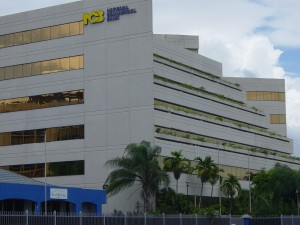
NCB Head Quarters in Kingston Jamaica.

NCB Financial Group recorded an increase of 17 percent in net profit of $11 billion for the six months ended March 2018 over the prior year, pretax profit for the six months was up just 1 percent.
Profit for the March quarter before taxation, rose a strong 22 percent over the similar quarter in 2017 to $8.26 billion but with taxation more than doubling profit after tax climbed just 9 percent to $6.4 billion.
Net operating income grew 22 percent to $35.3 billion over the prior year and 26 percent for the latest quarter. Improvements in foreign currency and investment activities 109 percent in the quarter to $4 billion and by 97 percent in the six months period to $7.2 billion. Net interest income increasing by $1.3 billion or 9 percent and was driven by the consolidation of Clarien Group (CGL). Net fee and commission income grew by 11 percent or $749 million, mainly as a result of higher transaction volumes for point of sale and e-commerce channels, increased investment banking and pension fee income and the consolidation of CGL. Operating Expenses excluding loan loss provision rose 30 percent to $24.5 billion for the half year and 29 percent to $11.5 billion for the quarter.
The Group’s loans and advances, net of provision for credit losses, increased by $127 billion or 61 percent to $334 billion to March. In addition to the consolidation of CGL, the president Patrick Hylton reported that “there was growth in all business segments’ loan portfolios: retail up 22 percent, corporate up 11 percent and credit card receivables up 25 percent. Nonperforming loans totalled $15 billion up from $5.9 billion at the end of March 2017.” The increase was due to the inclusion of CGL which has a non-performing loan ratio of 9.9 percent.
NCB declared a dividend of 70 cents stock unit. The dividend is payable on May 28, for stockholders on record at May 11. The stock closed at $95 on the Jamaica Stock Exchange before the results were released.

Carib Cement post fall in Q1 profits

Carib Cement reports lower Q1 profit for 2018

Revenues rose 6 percent in the March quarter this year for Caribbean Cement, compared to the first quarter of 2017 to $4.3 billion, but profit before taxation slipped modestly to $510 million from $528 million last year.
Increased taxation, from $67 million to $176 million dragged profit down to $348 million or 39 cents per share versus $460 million in 2017 or 54 cent per share.
“This performance was mainly driven as a result of the scheduled annual maintenance of Kiln 5 and Mill 5, during February and March of 2018,” the directors reported to shareholders and they went on to state that “our investment in maintenance efforts will no doubt increase our operational efficiencies with the goal of driving exports, in due course.”
Operating cost rose over 2017 by 10 percent to $3.7 billion, at a faster pace than revenues but repairs and maintenance jumped 75 percent to $345 million and staffing cost rose 18 percent to $542 million. Cost is set to fall sharply with the buyback of assets that were leased from Trinidad Cement which will reduce the $3 billion per annum charge that was incurred in this area in 2017.
Net cash generated by operating activities for the period of $856 million, but $1.5 billion was expended on capital improvement, including the installation of a new coal mill. According to management, the coal mill project currently in the final stages, and production is expected by the end of the third quarter of this year. This will continue to contribute to the plant’s operational efficiency and also to a reduction in operating costs. Cash on hand at the end of the quarter amounted to just over $1 billion.
The first quarter results left accumulated losses at $2.9 billion with shareholders’ equity at $9.3 billion. The stock closed on the Jamaica Stock Exchange at $38.51.

Profit up at West Indian Tobacco

Profit before corporate taxes rose 6.8 percent to $105.8 million, for the three months ended March 2018, over the corresponding period in 2017 for Trinidad and Tobago’s West Indian Tobacco company.
Profit for the quarter, after tax ended at $72.5 million, an increase of 7.6 percent over 2017. The improvement flowed from slightly lower cost of sales, amounting to $46.4 million versus $46.5 million in 2017, pushing gross profit to $141.45 million over the $124.65 generated for the similar period in 2017. Distribution costs rose to $6.3 million from $5.14 million while Administrative expenses rose to $15.65 million from $14.9 million in 2017 but other operating expenses rose sharply to $14 million from $5.7 million in 2017.
Cash flow of $144 million was generated and after paying taxes of $42 million, net cash from operating activities amounted to $102 million.
The Board approved the payment of a first interim dividend of 82 cents per share to be paid on 21 May 2018, an increase over 76 cents paid in the similar period in 2017.
At the end of the quarter, Current assets amounted to $426 million and included Cash and cash equivalents of $333 million, while Current liabilities was $117 million and Shareholders’ equity was $450 million. In 2017 the company suffered a sharp fall in revenues and profit resulting from increased taxation and lower revenues. Profit for the year ending December 2017 amounted to $380 million down 26 percent from $515 million as revenues dived from $1.24 billion in 2016 to $1.09 billion in 2017.

The stock closed on the Trinidad & Tobago Stock Exchange at $88.55 on Friday.

Berger’s Managing director bullish on future

Berger Paints fell $2.07 to $17 with the largest block of shares on Tuesday.

Berger Paints just released its 2017 annual report, filled with a series of goodies for shareholders from talk of going after market share and adding new product lines to the addition and upgrading equipment to increase efficiency.
The report also disclosed the company will pay a final dividend of 28.5¢ per share totaling $61 million, equivalent to 35 percent of the profit to December 2017. The payment will to be made on May 28, to shareholders on record at the close of business of May 11, the proposed dividend compares to 50 cents or just over 30 percent of profit to March in 2017.
“For the nine-month period, revenues were $1.91 billion versus $2.36 billion for the 12-months ended March 2017, with a net profit of $174 million versus $316 million for the previous fiscal year. Berger enjoyed steady growth in profits from the 2012 fiscal year when it posted a profit of $33 million and rising in each year. Profit nearly doubled in 2016 to $122 million from $67 million the year before and more than doubled to March 2017.
The biggest contributor to the revenue decline for the December 2017 period “was a deliberate strategy of using aggressive pricing in an extremely competitive environment, to drive volume growth and take market share. This, coupled with increasing market acceptance and demand for our economy line, put downward pressure on margins. There has been an increase in administration expenses, some of which were one-off and related to the acquisition. Apart from these, there were higher costs for legal settlements as well as higher inventory and bad debt provisions, which adversely affected the current period compared to 2016/2017,” Andy Mahadeo, the Managing Director told shareholders in his report to them.

Andy Mahadeo, the Managing Director

“In addition to the one-off expenses identified in the Overview, raw material prices have also increased significantly over 2016. In a very competitive environment, we have made a deliberate decision to grow market share by absorbing the price increases and ensuring our customers get the best possible value for money. While this has resulted in declining Gross Margins in the short term, it positions the brand for growth in the future as our strategies are implemented going forward.”
“The outlook for 2018 and beyond is extremely positive. The Berger brand remains strong and continues to dominate the local market with strong brand equity and a reputation for quality. With GDP projected to grow by at least 1.5 percent in 2018, construction activity and the demand for coatings is expected to remain relatively strong for the next two to three years. Plans are already being implemented to expand the company’s local distribution and product range as well as to improve our level of customer service and responsiveness. In 2018, there will also be greater emphasis on building out exports by targeting new markets in Central America and the Greater CARICOM region,” the Managing Director reported.
Of note are developments in 2017 that are pointed out in the Managing Director’s report, “While the performance is creditable, there has been a decline in revenue and profits when compared to 2016/2017 on a pro-rata basis, with a few one-off extraordinary events that adversely affected the results. The one-week shutdown of operations and sales in order to conduct the verification exercise prior to the transfer of ownership as well as the significant legal and valuation costs incurred in September, will not be repeated going forward.”

Berger Paints is one of IC Insider’s TOP 10 stocks.

We expect to realize the full effect of our coatings synergies across our five operating plants in 2018 as we leverage our regional supply chain to remove cost. Our Strategic Plan over the next three years will see the company investing heavily in plant and equipment. This will enable us to increase production capacity and improve operational efficiencies while maintaining an unwavering focus on creating additional value.
Gross cash flow brought in $267 million, but growth in receivables, inventories, addition to fixed assets offset by increased payables and the paying of $113 million in dividends, left negative cash flow of $156 million. At the end of December, shareholders’ equity stood at $1 billion with no borrowed funds. Net current assets ended the period at $1.3 billion, inclusive of Trade and other receivables of $674 million, cash and bank balances of $232 million. Current liabilities stood at $494 million of which trade payables accounted for $381 million.
The stock traded at $18.20 on the main market of the Jamaica Stock Exchange with a PE ratio of 7 times 2018 projected earnings of $2.60. Net asset value is $4.93 with the stock selling at 3.5 times book value.

Profit drops a whopping 85% at Unilever

Unilever’s huge drop

The Trinidad based Unilever Caribbean ended 2017 with a profit, but it was not the greatest year for the company. Profit fell 72 percent in the December quarter, to TT$3.5 million from TT$12.4 million in 2016.
For the year to December, profit dropped 85 percent from TT$71.7 million in 2016 to TT$10.7 million.
Sale revenues fell 27.5 percent for the quarter, to TT$113.7 million from TT$157 million and declined 18 percent for the year, to TT$464 million from TT$566 million in 2016. The fall in fortunes resulted from pressures in the home country the results of a continuing recession and shortage of foreign exchange. In the second half of the year, the company faced added pressure from the damaged and dislocation caused by hurricanes that affect several countries in the Eastern Caribbean. Corporate taxation fell 54 percent to TT$8.7 million for the year compared to TT$18.8 million in 2016.
Revenues reached a high of $588 million in 2014, dipped to $549 million in 2015, recovered a bit in 2016 to $566 million before falling sharply in 2017. Profit peaked at $70 million in 2013 dropped sharply in 2014 to just over $47 million in 2015 and $42.5 in 2016
Gross profit margin in the final quarter, declined to 35 percent from 38 percent in the 2016 and 36 percent for both the year, compared to 40 percent for 2016. The effect, gross operating profit declined 33 percent in the quarter to TT$40 million from TT$60 million but fell 27 percent for the year to TT$166 million from TT$228 million in 2016.
Administrative expenses rose 7 percent to TT$7.6 million in the quarter and increased just 1 percent in the year, to TT$29.5 million. Selling and distribution expenses declined by 31 percent to TT$21.7 million in the last quarter and was down 16 percent to $115 million for the year. The company suffered a loss of TT$1.7 million on disposal of fixed assets in the December quarter and TT$1.9 million for the ear.
Gross cash flow brought in TT$30 million but a TT$43 million addition to fixed assets and paying TT$13 million in dividends more than wiped out to inflows reducing the cash funds from TT$57 million to TT$32 million at the end of the year.
At the end of December, shareholders’ equity stood at TT$234 million with no borrowings. Receivables stood at TT$111 million and Payables at TT$86 million.
The capital spend will has boosted plant capacity and improved efficiency and is expected to drive domestic and export sales. The company now earns 45 percent of its revenues from exports. A part of the plan is new detergent formulations that will be offered in 17 markets, in the region, the company stated.
Earnings per share came out at 13 cents for the quarter and 40 cents for the year. The stock traded at TT$32 on the Trinidad & Tobago Stock Exchange with a PE ratio of 80 times 2017 earnings and net asset value is TT$8.92 resulting the price to book value being 3.6 times.

KLE profit rise from ongoing operation

KLE Group reports profit for 2017.

Profit at KLE Group fell 95 percent for 2017 to $9 million from $162 million in 2016 but the 2016 result was boosted by a one off gain from sale of shares in a subsidiary, amounting to $164 million.
Without the one gain profit would have increased sharply from just under $2 million in 2016. Earnings per share ended at 6 cents. The company actually suffered a loss in the order of $12 million in the December quarter. Sale revenues that rose 10 percent for the year, to $215.4 million from $196 million in 2016.
Gross profit margin remained at 68 percent in both years while gross profit rose by 9 percent over 2016. Other income closed the year at $17 million, remaining constant with 2016 excluding one off gains.
Other operating and administrative expenses rose just 6 percent to $152.5 million while Finance cost declined to $2.4 million from $2.76 million in 2016.
Importantly, gross cash flow brought in $22 million but growth in receivables and reduction in payables reduced the net cash for the year and investments activities left cash at the $7 million level.
At the end of December, shareholders’ equity stood at $140 million with borrowings at just $14 million. Net current assets ended the period $64 million and current liabilities at $57 million.
The stock traded at $2.50 on the Junior Market of the Jamaica Stock Exchange with a PE ratio of 12.5 times 2018 IC Insider.com forecasted earnings of 20 cents.

Trinidad recession bites Guardian Media hard

Guardian Media profit falls sharply since 2014.

A sharp fall in sale revenues in 2017, at Trinidad’s Guardian Media left the company hugging a small loss for the year ending December, according to an abridged quarterly report.
Profit dropped 94 percent in the 2017, to TT$488,000, for the December quarter before tax, from $8.5 million in 2016, but rose to $1.9 million after a tax credit of $1.4 million from a net profit of just $400,000 in 2016. For the year, the media house recorded a loss of TT$3 million after tax, from a profit after tax of $6.3 million in 2016, resulting in negative earnings per share of 8 cents.
Revenues fell 20.6 percent in the December 2017 quarter to TT$36 from $45 million and 16 percent to TTS$138 million from $164 million for the year.
The 2017 results is in stark contrast to 2015 when the company posted $35 million after tax and TT$34 million in 2014 from revenues in excess of $195 million for both years.
Cash flow brought in amounted to TT$20 million but capital payments and investments activities including paying $24 million in dividends used up $27 million, leaving cash at $72 million. Shareholders’ equity at the end of December, stood at TT$278 million, down from $305 million in 2016. Current assets ended the year at TT$131 million well ahead of current liabilities of TT$49 million.
According to the company’s chairman Peter Clarke, in his report included with the results, “2017 was a year of transition for Guardian Media as it implemented a number of planned structural changes. These changes included: (1) print automation systems to improve efficiency; (2) internal restructuring to lower the cost base and further improve the efficiency and quality of content creation and (3) re-alignment of teams to better serve our customers and fully equip the company for the digital media landscape. The one-time costs of these changes are reflected in these results. Parallel to this, the country’s economic slowdown has had a considerable impact on advertising spend across all sectors.”
The stock last traded at TT$17.98 in November on the Trinidad and Tobago Stock Exchange (TTSE), but now has an offer at $16.38. Net asset value is TT$6.66 per stock, with the stock offered for sale at 2.46 times book value. The company is a subsidiary of Ansa McAl which is also listed on the TTSE.

Angostura Holdings 2017 profit drops 9%

Angostura Holdings aged rum.

Profit at Trinidad’s Angostura Holdings dropped 8 percent in the 2017, to TT$154 million before tax on profit and was down 9 percent to TT$111 million after tax.
The 2017 out turn, resulted in earnings per share of 54 cents, with profit coming from a 7 percent fall in sale revenues, to TT$575 million. Profit declined sharply from 2015 when the company posted $164 million after tax, compared to TT$153 million in 2014 and TT$122 in 2016.
Despite the fall in sales gross profit margin rose to 64 percent from 60 percent in the 2016, as operating cost fell 18 percent. Other income declined to a loss of TT$6 million from a loss of TT$1 million while interest income rose to TT$2.3 million from TT$642,000 in 2016.
Marketing and sales expenses declined by 4 percent to TT$131 million while administrative expenses rose a hefty 24 percent to TT$82 million from TT$66 million in 2016. Finance cost declined to TT$844,000 from TT$1 million in 2016.
Cash flow brought in TT$161 million but capital payments and receipts included put aside in net new investments of TT$118 million resulted in net outflows of TT$30 after paying TT$56 million in dividends.  Shareholders’ equity stands at TT$982 million at the end of December, with borrowings at just TT$20 million. Current assets ended the period TT$765 million well ahead of current liabilities of TT$98 million and cash and investment rose to TT$369 million from TT$281 million in 2016.
The stock traded at TT$15.70 on the Trinidad and Tobago Stock Exchange with a PE ratio of 29 times 2017 earnings. The company paid a dividend of 27 cents down from 32 cents in 2016. Net asset value is TT$4.78 with the stock selling at 3.28 book value.
In spite of the fall in profit since 2015, the stock price have remained around the $16 range from then resulting in the PE ratio rising sharply by nearly 50 percent.