Sagicor Financial severely undervalued

Sagicor Cayman building.

The Barbados based Sagicor Financial is seriously undervalued with the shares selling at less than a half the multiple of the Trinidad based Guardian Holdings and its Jamaican based subsidiary Sagicor Group.
Sagicor Financial continues to reap success with net income for March quarter of US$39 million against a prior year’s US$27 million. Net income attributable to shareholders was US$20 million compared to the prior year, of US$17 million, an increase of 19 percent and continues the trajectory seen since they reported a loss in 2012.
For 2018 first quarter, the group adopted two new accounting standards effective January 2018 covering Revenue from Contracts with Customers and for Financial instruments. The standards change the way that financial instruments are recognised and measured. There was no significant impact on the implementation of both standards on the net assets of the Company Sagicor reported.
Total revenue for the quarter increased 5 percent to US$297 million, against US$283 million in 2017. Revenue included a one-time gain of US$5.3 million on the acquisition of the British American insurance portfolio but net investment and other income fell to $109 million from $115 million in the similar period in 2017. Policyholders’ benefits fell 5 percent to US$132 million, compared to US$138 million for the previous year. Operating expenses increased just 2 percent to US$118 million, compared to US$115 million in 2017.
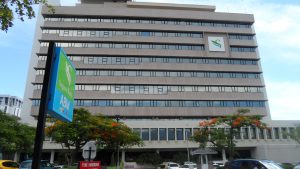
Jamaica Sagicor Group contributes more than half of Sagicor Financial profits.

Group comprehensive income dropped to US$17 million, from US$32 million for the prior year, with shareholders’ comprehensive income of US$6 million, compared to US$21 million for the prior year. The decline in comprehensive income was mainly due to marked-to-market losses on our international bond portfolio.
Total assets amounted to US$7 billion, with liabilities of US$6 billion at the end of March with Group equity of US$932 million and equity attributable to the company’s shareholders of US$623 million. The Group’s debt was US$407 million with a debt to capital ratio of 30.4 percent.
Earnings per share for the quarter amounted 6.5 cents and continues the growth enjoyed in the 2017 full year of 23.7 US cents compared to 20 cents in 2016 and puts earnings for the full year for 2018 around 30 cents. The stock trades on the exchanges in Trinidad and Barbados, closed on the Trinidad and Tobago Stock Exchange, the more liquid of the two markets at TT$7.90 and trades at a PE of an attractive 4 times earnings, well below Guardian Holdings at around 10 times earnings.
Although, the group is based in Barbados, data shows Trinidadians as the major owners with 49.6 percent with Barbadian owing around 33 percent while more than half of the profits come from Jamaica.

IC Insider.com has placed a BUY RATING on Sagicor Financial.

76% plunge in Unilever Q1 profit

Unilever Caribbean dropped $1.75 on Thursday

Shareholders in Trinidad and Tobago based Unilever Caribbean who were brave to start buying the company’s stock at the bottom last year, up to recently, must regretting it now.
The company in its latest quarterly report, shows continued decline in operations with a 15 fall in revenues to $101 million and a fall in profit before tax of 76 percent to $1.35 from $5.7 million in 2017. The company enjoyed a tax credit in the quarter raising reported profit to $3 million versus $3.8 million in 2017. Earnings per share came out at 12 cents for the quarter compared to 15 cents for the 2017 quarter and 40 cents for the 2017 fiscal year. Without the effect of the tax credit earnings would be in the order of 4 cents and paint a vastly more pessimistic picture of the likely full year out turn.
The results are in line with what technical indicators suggested last year that the stock was set to fall below $20. In trading on Thursday the stock price fell by $1.75 in light of the results to $32.25 and has a PE based on 2017 earnings of 80 times with the PE for 2018 looking as if it will exceed 200.
In light of these results the dividend that was maintained in 2017 seems set to be slashed sharply for 2018, as the there is every likelihood that the 2018 results will be worse than in 2017.
The company improved its financial position at the end of the quarter with a sharp cut in trade and other receivables to $84 million from $130 in March 2017, most likely the sharp cut negatively impacted sales of its products. Inventory fell to $55 million from $61 and cash grew to $54 million from $33 million in 2017.
All figures are in Trinidad dollars.

Profit jumps 80% at Jamaica Stock Exchange

Profit soared 80 percent in the 2018 first quarter for the Jamaica Stock Exchange to, $101 million from $56 million in 2017 on a strong 45 percent jump in revenues.

Revenues rose, to $350 million from $241 billion in 2017 as income from Cess almost doubled to $126 million from $69 million and fee income rose from $134 million to $188 million. Expenses increased a robust 28 percent from $162 million in the March 2017 period to $207 million.
Earnings per share for the quarter is 14 cents compared to 8 cents for the quarter to March last year, suggesting earnings for the full year could be around 60 cents. These results now mean that the stock cannot be considered over valued at 11 time earnings at the last price the stock traded of $7, on the main market of the Exchange.
Gross cash flowbrought in $105 million but growth in receivables of $137 million used up a large portion of the funds generated.
At the end of March, shareholders’ equity stood at $1.04 billion with no borrowings showing on the financial statement. Net current assets ended the period $400 million well over payables of $263 million.

Palace Q3 profit jumps 244%

Black Panther mash up Palace bottom-line with a huge increase in profit

Profit at Palace Amusement jumped 244 percent in the March quarter, to a record $45 million from just $13 million in 2017. For the nine months to December, profit surged 746 percent to $49 million from $6 million in 2017.
Thanks to the high level of success of the Black Panther movie sale revenues rose a strong 39 percent for the quarter, to $343 million from $247 million and by 21 percent for the year to date, to $836 million from $692 million in 2017.
Gross profit rose 73 percent to $90 million and profit margin increased to 26 percent in the quarter from the 2017 out turn of 21 percent. For the nine months period to March gross profit rose a respectable 45 percent to $189 million and profit margin moved 23 percent from 19 percent in the 2017.
Administrative expenses rose 10 percent to $45 million in the quarter and by 7 percent in the nine months to $139 million.
Earnings per share came out at $31.53 for the quarter and $34.38 for the nine months and should end the fiscal year ending around $150 level, with the continued success of Black Panther and now The Avengers.

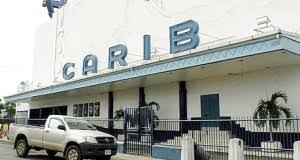
Carib Cinema, the flagship for Palace Amusement, the company’s stock climbed $200 on Monday.

Gross cash flow brought in $79 million but there was the payment of loans and dividends amounting to $9 million. At the end of March, shareholders’ equity stood at $406 million with borrowings at just $24 million. Net current assets ended the period at $180 million inclusive of trade and other receivables of $62 million, cash and equivalent of $203 million and current liabilities stood at 139 million.
The stock traded at a record $1,500 on the main market of the Jamaica Stock Exchange with a PE ratio of 10 times, estimated 2018 earnings.

Profit up 19% at Grace for Q1

Group Chief Executive Officer, Don Wehby.

Grace Kennedy recorded a 5.1 percent increase in revenues to $24.9 billion and a 14.9 percent gain in net profit of $1.3 billion, for the first quarter of 2018.
Profit after minority interest, rose by a stronger 18.5 percent to $1.19 billion, resulting in earnings per share of $1.20. While revenues grew just over 5 percent, expenses climbed by a larger 6.2 percent, resulting in a fall in operating profit, to $712 million from $919 million in 2017. An increase of $277 million in other income and a cut in profit tax by $73 million were factors helping to boost the profit for the period.
Segment results show, improved results for food and trading division with operating results of $699 million versus $624 in 2017, gains for banking and Investments while insurance surged from $82 million in 2017 to $205 million in 2018 but Money transfer fell from $747 million to $664 million.
Don Wehby, Group CEO, noted that the company benefitted from performances of key business lines and new acquisitions and the strides being made in both our Foods and Financial Services segments. ”Our newest acquisitions, Consumer Brands and Gray’s Pepper Products, are a very good fit and are integrating well within the Group,” Wehby said.
The Group adopted the new International Financial Reporting Standards (IFRS) which became effective in January, this year.

Some of Grace Kennedy’s products.

“IFRS 9 addresses the recognition, classification and measurement of financial instruments while IFRS 15 addresses the recognition of revenue from contracts with customers. The effect of adopting these standards is a reduction in shareholders’ equity at the start of the year of J$0.9 billion, however the impact on the results for the first quarter has not been material,” Frank James said.
The Grace Kennedy Financial Group (GKFG) performed creditably with good growth in revenue driven by the Insurance business while both the Insurance and the Banking and Investments segments grew in pre-tax profits. GK Insurance (Eastern Caribbean) continued its expansion into the Caribbean with operations beginning in Antigua and Barbuda in April.

First Global Bank (FGB) reported growth in pre-tax profit mainly driven by lower cost of funds and lower expenses. The Bank is focusing on expansion through satellite locations branded FG MoneyLink. Four FG MoneyLink branches are in operation in four parishes.
“We consider compliance to be a competitive advantage and we have been working closely with our partner Western Union to ensure our network meets the highest internal and regulatory standards. In the medium-term we will see positive results. We also expect additional growth to come from the new channel WU.com which allows Jamaicans to send funds to 200 countries. Jamaica was the first country in the Latin America and the Caribbean to have this facility,” Wehby said.
Grace said that the Domestic Foods business as well as that of Canada and the USA showed growth, while the UK business had mixed results with decline in sales in the UK market but strong growth buoyed by deepening market penetration in Germany, Spain, Holland and France. New listings in Publix, Save-A-Lot and Stop & Shop stores in the USA and in Walmart in Canada, have helped boost performance in the Food Trading Segment.

Watch these stocks

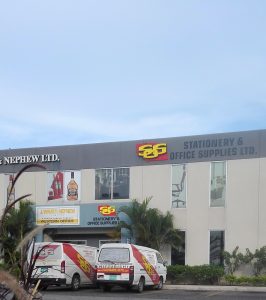
Stationary & Office Supplies – Montego Bay office.

IC Insider Buy Rated Stationery and Office Supplies that listed last year August gained 250 percent when the stock hit a new high on Thursday.
It seems set to jump when trading resumes on Friday, with a 70 percent increase in earnings to 17 cents for the March quarter. SOS posted profit of $44.5 million versus $24.5 million after tax for the quarter, flowing from a 27 percent increase in revenues to $279 million. With added earnings to come from the acquisition of the book manufacturing business earnings for the full year could be in the 90 cents to $1 range.
Cargo Handlers posted a 20 percent increase in earnings with EPS of 12 cents for the March quarter and a flat 23 cents for the nine months. Profit in the March quarter was $45.6 million, up 19 percent over $38.4 million generated in 2017 and for the nine months $86 million was earned versus $84.6 million. Revenues grew 7 percent in the quarter to $101 million and was up 3 percent to $188 million for the half year.

Wisynco’s popular product.

Wisynco Group reported lower profit in the March quarter but that was due to the booking of insurance claim of around $600 million in 2017, excluding that inflow
profits would have been up sharply from a normalised $340 million to $505 million for the quarter and from $1.4 billion to $1.7 billion for the nine months period. Earnings per share for the quarter was 14 cents and 47 cents for the nine months and seems ion track for around 70 cents.
Wisynco generated an attractive 13.5 percent growth in revenues in the quarter to $5.8 billion and an increase of 14.7 percent in the nine months to $18 billion.
Grace Kennedy posted an 18 percent increase in earnings with EPS of $1.20 for the March quarter with profit rising to 19 percent to $1.2 million in the quarter from revenues that rose 5 percent to $24.9 billion. The results suggest earnings for the full year should top $5 per share.

Q3 profit dipped at CPJ

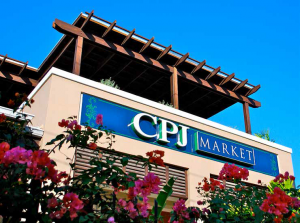
Caribbean Producers profit fell in the March quarter but rose year to date.

Profit attributable to Caribbean Producers’ shareholders, suffered a decline after tax in the March quarter, to end at U$847,119 from $929,172 in 2017 even with much lower taxes booked in the 2018 quarter.
Profit rose nearly 5.5 percent for the quarter over the 2017 period and 13 percent for the nine months to March, to US$81.65 million from US$72.3 million in 2017.
The results led to earnings per share of 0.08 US cents for the quarter and 0.21 US cents for the six months period.
Gross profit rose faster than revenues, with an increase of 6.5 percent for the quarter to US$7.9 million but it grew below the growth in revenues for the nine months period with an increase of 10.5 percent to $22.3 million.
While depreciation and finance costs declined for the quarter and for the year to date, selling and administrative costs rose from $5.1 million to US$5.88 million and for the nine months from US$14.5 million to US$16.3 million.
At the end of March, shareholders’ equity stood at $23.7 million and borrowed funds were close behind at US$22.44 million. Current assets stood at US$47.9 million versus current liabilities of $21.5 million which includes borrowings of US$10 million. Net asset value per share stands at 2.3 US cents.
The stock last traded at J$5.40 on the Junior Market of the Jamaica Stock Exchange at the close on Wednesday.

Q2 profit doubles at Barita

Barita closed trading on Wednesday with the bid at $12.07.

Profit at Barita Investments more than doubled after tax in the March quarter, to $88 million from $43 million in 2017 with lower taxes booked in the 2018 quarter. 

Profit declined for the six months to March, profit dipped 8.5 percent to $49 million from $58 million in 2017, as the company recovered from a loss in the first quarter due mainly to foreign exchange losses.
Earnings per share came out at 20 cents for the quarter and 11 cents for the six months period.
Most major revenue streams rose nicely for the quarter, with net interest income climbing to $109 million from $69 million in 2017, fees and commission income was up more modestly from $117 in 20917 to $123 million and foreign exchange gains were nearly $29 million from $16 million in the 2017 quarter. Gains realized on trading investments fell to $69 million in the quarter from $103 million in 2017. Overall net income generated was just up to $329 million in the quarter versus $316 million in 2017. For the six months, net income generated was $490 million falling below $528 million in 2017.
Improvement in profit flowed from increased margin on money market instruments, reduced staff cost and the none recurrence of impairment losses which was $20 million in 2017 quarter and $40 in the 2017. Total cost fell from $226 million in the 2017 quarter to $204 million in the March quarter and to $370 for the half year to march this year versus $394 million last year.
In spite booking strong investments gains Barita still had $773 million of unrealized gains in reserves and is up from$605 million at the end of September last year.
At the end of March, shareholders’ equity stood at $2.9 billion with total assets of just over $16 billion and a net asset value of $6.40.
The stock last traded at $10.50 on the Jamaica Stock Exchange and closed on Wednesday with the bid at $12.07.

Trinidad Cement Q1 profit inched higher

Trinidad Cement

The Trinidad Cement Group generated revenue of $429 million during the March 2018 quarter, an increase of just 2 percent compared to 2017.
The Group recorded a 5 percent increase in profit for the period to $27 million versus $26 million in 2017 and EPS of 6 cents. The results benefited from increased demand for cement in Jamaica and Guyana and increased export dispatches from Barbados the company reported, but there was “lower revenue from the Trinidad operations, due to lower sales volumes arising from the contraction of the construction industry,” management stated.
Group earnings before interest, taxes, depreciation, loss on disposal of property, plant and equipment, and restructuring costs was $92 million for the period, down from $98 million in the 2017 quarter. There was higher costs from the planned equipment maintenance executed during the quarter at the Jamaica plant. The Group achieved a 55 percent reduction in finance costs to $13 million from nearly $28 million in the March 2017 quarter. Restructuring of loans in 2017 resulted in a 276 basis point reduction in the effective interest rate, potentially reducing finance cost by 30 percent. A net total of $167 million was repaid to lenders since April 2017, thus reducing the principal outstanding and finance costs.
Cash generation was impacted positively by better working capital management, improving to $105 million versus 2017. The Group invested $23 million in capital projects in the quarter and repaid $97 million of debt. The reduction in the loan will have a further positive impact on finance costs going forward.
Shareholders equity fell to $767 million from $1 billion in 2017 but is up on the December position of $753 million. Borrowings was $818 million with $244 million to be repaid within a twelve months period.
The TCL Group’s financial, operational and strategic direction is dedicated to producing favorable results notwithstanding the current restraints and challenges facing Trinidad and Tobago’s economy, management advised shareholders in their comments accompanying the results.
Going forward, there should be strong increase in demand from Guyana with the discovery of oil in commercial quantities, while the rest of this year should see a pickup in sales as well as lower finance in the Jamaican operation that should help boost profit for the overall group.
The stock last traded at $2.62 on the Trinidad and Tobago Stock Exchange at a PE around 10 times 2018 earnings.

Republic is going higher soon

Trinidad’s Republic Financial Holdings should be heading higher on Trinidad and Tobago Stock Exchange, sooner than many investors may think.
One reason is that the financial powerhouse, just posted pretty strong results, with profit before taxation rising a healthy 22 percent, to $490 million in the March quarter and a still respectable 14 percent for the half year. Increased taxation wiped out a bit a of the top line gains leaving profit at 3 percent higher for the quarter at $333 million and an increase of 4 percent at $694 million, for the half year. The improvement arose from slightly lower cost in the current year than for the previous one and an overall 8 percent increase in net income for the quarter to $1.17 billion from $1.08 billion in 2017 and 4 percent rise year to date to $2.34 billion. Earnings per share rose to $4.02 for the half year from $3.90 and compares favourably with $7.75 million reported for the fiscal year to September 2017 and gives it a PE around 12 on 2018 full year earnings and Friday’s closing price of $101,
Improvement was generated by the bank in Ghana, where that subsidiary moved from a small loss of just over $1 million to a profit of $68 million and the Cayman Islands’ operations that moved from a profit of $82 million to $113 million. Barbados also should marked improvement with profit of $149 million compared to $111 million before.
Helping the performance is increased lending, with loans rising from $34.4 billion at March 2017 to $37.4 million in 2018, a solid 9 percent increase.
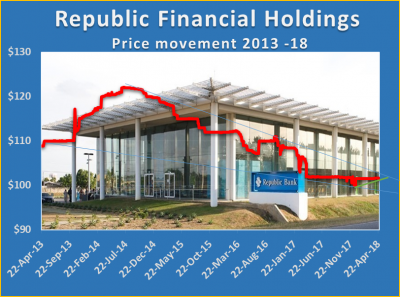
The other factor why the stock price is set to move, is that the it peaked at $122 in 2014 and slid downward since and seems to have found a bottom. Added to that, is a wedge formation showing in a technical chart of its price movement that seems set to steer the price upwards in the months ahead.
IC Insider.com would normally give the stock a BUY RATED accolade, concerns linger about the Trinidad economy from which it earns the vast majority of income and profit, and what is seen as an overvalued currency.

Note that all prices are in Trinidad & Tobago dollar.