Record profits at Barita

Barita Investments recorded the highest profit in its history, with the group delivering an impressive $2.7 billion profit after tax for the year ended in September. The company was bettering by 59.4 percent, the profit of $1.7 billion, a then-record for 2019 and continuing a stunning transformation of a former sleepy little family dominated company that few investors paid attention to.
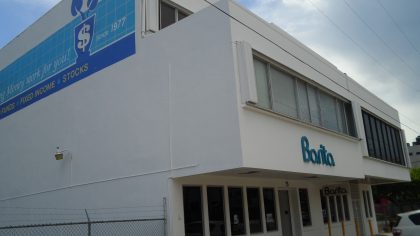
Barita public stock offer pulled money away from other JSE stocks.

Those sterile days seem to be behind it as the company posted another quarter of strong results to September, with after tax profit jumping 158 percent to $727 million from $285 million in 2019. Earnings per share for the quarter ended at 88 cents and $3.29 for the year.
For the latest quarter, revenues climbed 17 percent from $1.16 billion to $1.36 billion and rose a solid 29 percent from $3.98 billion to $5.14 billion for the full year. There were major shifts in the lines of income generated during the year. Net Interest income rose a robust 35.5 percent from $650 million to $881 million for the year, while Fees and Commission Income more than doubled to $1.84 billion from $847 million. Foreign exchange trading brought in $978 million versus just $199 million in the prior year. Investment activity suffered from a fall, with $1.36 billion generated in 2020 versus $1.94 billion in 2019. September quarter Investment activity revenues declined even more than for the year with an income of $701 million in 2019 versus just $251 million this year.
While the revenues were growing attractively, expenses grew modestly in the final quarter by two percent, moving from $697 million to $710 million, but climbed a more robust 32 percent for the year from $1.53 billion in 2019 to $2 billion. Tax liability dropped sharply from $742 million in 2019 to $393 million, despite the rise in pretax profit.
The group’s rapid transformation has some investors stunned, wondering if the surge in profit for the past two years is real and lasting. Oblivious of those concerns, local and overseas’ based investors piled into a public issue of shares in September, priced around $50 each and invested $13.5 billion of fresh capital in the company after the issue was heavily oversubscribed. In September 2018,

Shareholders at Barita Investments AGM.

shareholders’ equity was just $3.3 billion that has now jumped to $27.7 billion with the recent capital raised, helping to double the amount shareholders have invested in the company.
There is more growth to come with the new capital placing them in a much stronger financial position. The group has not yet taken full control of the enormous potential for growth from their pool of managed funds. The expanded capital base places them in a good spot to become even more aggressive to undertake business deals or acquire other businesses to merge with existing ones.
The company now has $70.5 billion assets comprising, amongst others assets, Cash funds of $5.7 billion, marketable securities of $8.5 billion, other investments of $48 billion, and loans of $1.7 billion. On the liability side, repurchase agreements amount to $34 billion.
The stock trades on the Jamaica Stock Exchange at $84.50 with a PE of 25.5 based on 2020 earnings, that multiple should fall with the 2021 results that will start being released with the first quarter due late January.

Seprod’s sugar closure sweetens profit

Seprod’s costly journey into a new difficult area of sugar manufacturing resulted in billion-dollar losses for the group. That management chooses to take on the worse performing and most difficult sugar operation in Jamaica raises some fundamental questions about corporate decision making, but then sometimes experience teaches wisdom.
After shedding the above loss-making business, profit from continuing operations surged 351 percent to $1.3 billion for the September quarter, up from just $285 million in 2019, but the jump benefited from $780 million, generated from other operating income, with $762 million of it being gains realized on the sale of a property.

Without the additional boost from the property sale, profit from continuing operations would stand at $551 million for the quarter, an increase of 94 percent, and $1.8 billion for the nine months to September, an increase of 52 percent. Earnings per share came out at $1.75 for the quarter and $3.38 for the nine months to September but would stand at 75 cents for the quarter and $2.41 for the year to date when adjusted for the one-off gain.
Revenue saw a sharp increase of 23 percent for the quarter to $10.1 billion from $8.2 billion and more moderate growth of 16 percent for the nine months to September to $28.7 billion from $24.5 billion in 2019.
Direct Expenses grew 12 percent for the quarter from $5.3 billion in 2019 to just under $6 billion in 2019, and 15 percent for the year-to-date from $15.8 billion to $18.1 billion. Gross profit margin increased to 41 percent for the quarter from 35.2 in 2019 and 37 percent for the nine-month period from 36.4 percent. Gross profit (GOP) jumped 42 percent for the September quarter moving from $2.9 billion in 2019 to $4.1 billion in 2020. GOP increased 17 percent to $18 billion from $15.8 billion for the nine months to September in 2019.
The Manufacturing segment generated revenues from third parties of $7.26 billion, up from $6.7 billion in 2019 while, Distribution accounted for revenues of $21.4 billion in 2020 and $18 billion in 2019. Segment results for the Manufacturing amounted to $2.47 billion in 2020 from $2 billion in 2019, while Distribution contributed $1.36 billion from just $684 million in 2019.
Despite a 52 percent increase in administrative and other operating expenses from $2.1 billion to $3.3 billion, profit before finance and other costs grew by 159 percent for the period from $651 million to $1.7 billion.

Some of Seprod”s products.

Loss from discontinued sugar manufacturing operations contributed to a loss of $31 million for the September quarter and $47 million for nine months. Total comprehensive income stood at $1.3 billion for the quarter, up from a loss of $124 million, and $2.6 billion for the nine months to September, up from $470 million in 2019.
Gross cash flow from operating activities stood at $4 billion, and working capital pulled the amount down to $2 billion. Dividend payment of $367 million and acquisition of property net and loan receipts of $1 billion saw net funds for the period increasing $1.6 billion to end at $3 billion. At the end of September, shareholders’ equity stood at $16.5 billion, while $14 billion was due from borrowings. Current assets ended the period at $17 billion including, Inventories of $6 billion, receivables $7 billion and cash and bank balances of $3 billion, while Current Liabilities stood at $9.6 billion with current loan liability amounting to $3.6 billion.
The stock is currently trading at $60.75 on the Main Market of the Jamaica Stock Exchange. With the most profitable period being the December quarter, IC Insider.com is forecasting earnings of $4 per share for a PE of 15.2 based on 2020 earnings.
The group is involved in the Manufacturing and Distribution of various household goods for the local and overseas markets, including cereals, flour, milk, cooking oil, margarine, to name a few. the stock has moved up in price since the results, historically, it has delivered some of the best returns for investors in the local market over several years. It’s a good long term investment.

Q4 profit doubles at Tropical Battery

Recently listed Tropical Battery saw profit after tax soaring 107 percent in the September quarter, to $27 million from $13 million in 2019, bettering the nine-month increase of 18.6 percent over the 2019 period for pretax profit. For the year to September, profit rose a more modest 16 percent to $73 million from $63 million in 2019.
Sale revenues
rose just 2.6 percent for the quarter, to $506 million from $493 million in 2019, but rose 7 percent for the year to date, to $1.87 billion from $1.74 billion in 2019.
The September quarter benefited from improved profit margin to 31.8 percent from 29.9 percent in 2019 and rose to 31.3 percent for the year, from 30.2 percent for 2019. Gross profit rose 9 percent in the quarter to $161 million from $147 million in the previous year and increased 11.2 percent for the year, to $585 million from $526 billion in 2019.
Administrative expenses grew 11 percent to $123 million in the quarter and 10.5 percent in the year period to $456 million. Finance cost rose in the quarter, to $13 million from $9 million in 2019 and $19 million to $38 million for the year.
Gross cash flow brought in $109 million but growth in receivables, inventories, addition to fixed assets offset by loan inflow, proceeds from the sale of shares and reduced payables, cash funds ended at $261 million. Net current assets ended the period at $827 million, including trade receivables of $314 million, amounts due from related parties at $177 million and cash and bank balances noted above. Current liabilities closed the period at $229 million. At the end of the year, shareholders’ equity stood at $776 billion, with borrowings at just $415 million.
“As a part of our Strategic 2021 Growth Plan, we will be focusing on creating shareholder’s value through acquisitions and partnerships of aligned profitable companies in Jamaica and across the Caribbean region. To this end, we have entered into discussions with several key partners to assist in identifying suitable acquisition targets”, March Melville, Chairman and Alexander Melville, Managing Director, stated in a jointly signed report accompanying the quarterly.
Earnings per share after tax came out at two cents for the quarter and six cents for the year. The company’s net asset value is 68 cents, with the stock selling at 76 percent above book value. With the company profits now being free of taxation, having listed on the Junior Market of the Jamaica Stock Exchange, earnings are adjusted to 8 cents, giving it a PE ratio of 15 times earnings, based on the stock price of $1.20 the traded at on Friday. IC Insider.com is forecasting 10 cents per share for a PE of 12 times 2021 earnings.

Q3 profit rises 33% at Grace Kennedy

Grace Kennedy continues to enjoy a phenomenal year, with profit attributed to the company’s shareholders, rising 33 percent to $1.68 billion for the September quarter, from $1.26 billion for the 2019 third quarter and 35 percent for the nine months to September to $4.4 billion from $3.27 billion the corresponding period in 2019.

Don Wehby CEO of Grace

Taxation more than doubled in both periods, but profit before tax grew 49 percent in the third quarter to $2.8 billion and 51.5 percent to $7.3 billion for the nine-months.
Total comprehensive income increased by 5 percent for the three-month period to $2.2 billion but dropped by 37 percent for the nine months to September, from $9.2 billion to $5.8 billion.
The group had one of the best years for growth in revenues so far, with a rise of 16 percent for the quarter to $29.6 billion, from $25.5 billion in 2019 and up 12 percent $86 billion from $77 billion for the nine months. The previous best revenue performance was back in 2009 with a full-year increase of 19.7 percent and then 2015, with an increase of 12.6 percent, thereafter growth declined annually to 2019. Revenues grew 10.7 percent in 2016, 5.5 percent in 2017, 4.8 percent in 2018 and just 5.7 percent in 2019. According to the Managing Director Don Wehby, “the strong growth in revenues was fueled by the food division and particular international food business.”
Contributing to the 2020 growth is added revenue brought in with the acquisition of the majority shares in Key Insurance helping to drive revenue for the Insurance segment by 28 percent over 2019 to garner $7.7 billion. Food and trading segment continues to account for the lion’s share of the revenue tallying $68 billion for the nine months period, an 11 percent increase over 2019. Revenue for the Banking segment increased just 3 percent to $4.7 billion while Money Transfer grew 12 percent to $6.5 billion.

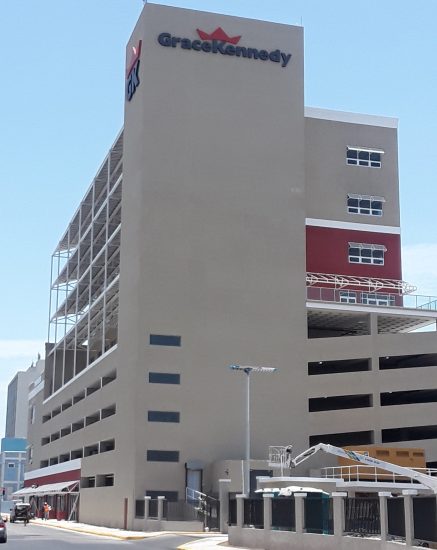
Grace Kennedy new headquarters in downtown Kingston

Expenses inclusive of net impairment losses increased 16 percent to $27.5 billion for the quarter and 12 percent to $81 billion for the year to date over the corresponding periods. While separating direct cost from the administrative cost in their audited accounts, Grace continues to short change investors by lumping all costs together in their interim reports.
Net Cash generating operations brought in $9.7 billion. Total assets grew by eight percent to $168 billion with growth in investment securities and receivables but a decline in inventories. At the end of September, shareholders’ equity stood at $56.5 billion and borrowings at $25 billion.
Profit for the quarter equates to Earnings per share of $1.69 and $4.47 for the nine months and should exceed $6.50 for the full year. The stock last traded at $58 on the Main Market of the Jamaica Stock Exchange with a PE ratio of 9 times 2020 earnings.

Mailpac Q3 profit surges 129%

MailPac Group (MGL) continues to enjoy increasing strong profit growth despite the current pandemic, with revenue jumping 58 percent in the September quarter over the 2019 quarter and profit more than doubling.

Mailpac dominated trading on Thursday with 84% of the total volume of the market on Tuesday.

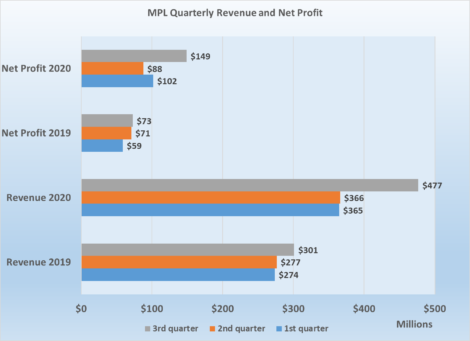
The company recorded net profit of $149 million for the quarter, a solid 129 percent jump from the $65 million the operation recorded for the September 2019 quarter. For the year-to-date, there was an even more sizeable growth of 150 percent, moving from $203 million in 2019 to $339 at the end of September 2020.
Revenues grew 58 percent over the September 2019 quarter, from $301 million to $477 million, and grew a stunning 30 percent over the June 2020 quarter with revenues of $366 million. For the year to September, revenues rose to $1.2 billion, 42 percent more than the $851 million recorded at the end of September 2019.
Gross profit rose to 50 percent from 44 percent in the June quarter but fell to 48 percent for the nine months compared to 52 percent in 2019.
Direct expenses jumped 57 percent from $150 million for the September 2019 quarter to $236 million for the September 2020 quarter and 15 percent over the June 2020 quarter. For the year to date, the expenses climbed by 52 percent from $410 million in 2019 to $623 million in 2020. Gross profit stood at $240 million for the quarter ending September 2020, up from $150 million in 2019 and $584 million for the year to date versus $442 million in 2019.
Administrative, selling and promotion expenses increased 22 percent over the second quarter and slipped two percent from the September 2019 quarterly figure of $86 million to $84 million. The Executive Chairman attributes the increase in expenses in the third quarter over the second quarter to its expanding operations, the partnership with PriceSmart presumably one such notable factor.

For the nine months to September, selling and promotion expenses amount to $30 million, up from $29 million in 2019, while administrative and general expenses dropped to $199 million, from $218 million in 2019. Overall, these expenses were down seven percent from $246 in 2019 to $228 million at the end of September 2020. The effect, operating profit, rose a strong 140 percent over the comparative quarter to $157 million from $65 million in 2019 and an 82 percent increase for the nine-month period, moving from $195 million to $356 million.
Finance costs rose for the quarter from $352,000 in 2019 to $11 million in 2020, while the nine months to September ended at $31 million from $3 million for 2019.

Mailpac CEO Khary Robinson.

Gross cash flow brought in $346 million but MGL recorded trade and other payables increase of $127 million, spent $12 million on the acquisition of fixed assets and paid $225 million in dividends to end with cash and equivalents of $309 million at the end of September. Shareholders’ equity stood at $467 million. Current assets ended the period at $369 million and Current liabilities at $185 million.
Earnings per share came out at 6 cents for the quarter and 14 cents to September. IC Insider.com is forecasting Mailpac will end the year at 20 cents per share for PE of 11 times earnings and they should go on to earn 33 cents in 2021.
At the IPO, the company projected a profit of $317 million in 2020, while IC Insider.com projected $356 and 14 cents per share. The nine months’ results are just below our full year’s forecast.
The stock is priced below the average of the Junior Market of 12 and offers strong upside potential. The strong current growth continues the trend since 2017, when revenues grew 12.2 percent, 25.7 percent in 2018 and 28.8 percent for the first half of 2019. The company offers a convenient way to shop and far less costly than traditional ways. Listing on the stock exchange provides greater credibility that augurs well for increased business. MGL provides clients with physical addresses in Miami, Florida, where they can receive all goods purchased are flown to Jamaica. The company clears all goods and delivers them to the customers at their homes or for collection.
On the negative side, the main asset owned is the brand and technology that drives the business. Other entities could break into the market and squeeze profit margin longer term.
Coming off a robust third quarter, MGL is entering what is normally the busiest time of the year for the company that should continue the solid growth experienced in 2020 so far.
The stock currently trades at $2.13 on the Junior Market of the Jamaica Stock Exchange. The company paid an interim dividend of 5 cents per share in July 2020 and 5 cents per share in October and more is expected, with the company promising at the time of the IPO that the Directors intend to pursue a dividend policy that projects an annual dividend of up to 75 percent of net profits available for distribution.

Knutsford Express suffers Q1 loss

Coming off a financial year with an 11 percent decline in revenue and a 78 percent drop in profit for the year, Knutsford Express had the second-worst quarterly performance following the $70 million losses incurred in the April quarter this year, as dislocations caused by the impact of the COVID virus the company’s operations severely.

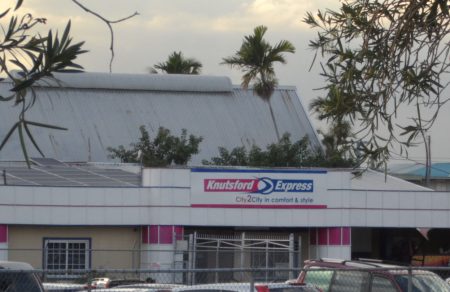
Knutsford Express

Revenue dropped 62 percent or a huge $203 million from the $325 million recorded in 2019 to just $122 million in the first-quarter ending August 2020. Drastically reduced trips and services due to the restrictions put in place by the government to contain the spread of COVID-19 was a key factor affecting business and the financial results. Knutsford incurred a loss of $26 million for the August 2020 quarter, before finance income and expenses, 146 percent lower than the profit of $57 million earned the 2019 first quarter.
Unfortunately, the company continues the very poor practice of grouping direct operating and administrative costs together, therefore preventing investors from properly assessing the operation and the contribution the operating facility makes to overhead cost. For the quarter, administrative and operating expenses fell at a much slower pace and amounts than the fall in revenues, with expenses dropping 45 percent from $267 million in 2019 August quarter to $148 million in 2020. Depreciation charges accounted for $29 million up from 426 million in 2019.
Finance income in the 2020 quarter pulled in $4 million compared to $2 million collected in 2019, while finance costs declined from $7 million in 2019 to $3 million in 2020.

Knutsford’s New Kingston depot

The US operation generated a mere $638,000 in revenue and contributed $4 million to the loss, but that is down from the prior year with a loss of $9 million from revenues of $7 million.
Cash flows from operating activities brought in $9 million, down from $78 million at the end of August 2019. After spending $35 million on the acquisition of fixed assets and borrowing $15 million, it resulted in an increase in cash of $13 million at the end of the period, pushing funds on hands to $52 million, down from $194 million at the end of 2019. The company also has investments amounting to $97 million. Current assets stood at $194 million at the end of August 2020 down 51 percent from $393 billion in August of the previous year. Current liabilities stood at just $76 million to be more than adequately covered by current assets. At the close of August, shareholders’ equity stood at $744 million down from $827 million at the close of the corresponding period in 2019.
Going forward, as activities pick up locally and visitor arrivals numbers grow, the company stands to benefit from increased patronage and improved profitability. At the same time, the loss incurred in the quarter is lower than the depreciation charge that is positive as it means no drain on cash. The company should recover from the downturn experienced during the year, but it may not be until 2021 that investors will get a truer sense as to the level of rebound in profit as well as the stock price, that may be possible. “We expect an improved performance in the next quarter,” the Directors, stated in their report accompanying the quarterly.
Earnings per share ended with a loss of 5 cents for the quarter. Knutsford Express currently trades on the Junior Market of the Jamaica Stock Exchange at $6.55.

Lasco Financial Q2 profit jumps

Lasco Financial generated a profit of $136 million in the September quarter compared to a loss of $16 million for the 2019 second quarter. Profit after tax for the six months to September amounts to just $30 million, down from the corresponding period’s $75 million, and an improvement on the first-quarter loss of $106 million.

Lasco Financial former HQ

Earnings per share ended at 10.7 cents for the quarter and just 2.4 cents for the half-year.
For the quarter, revenues fell 5.7 percent or $38 million from the 2019 September quarter, to $617 million, due largely to a $78 million decline in revenues from loans, in the quarter following a $74 million fall in the June quarter, compared with the similar periods in 2019. Remittances grew 11 percent and added $50 million to revenues while Cambio operations contributed 10.8 percent or $34 million to increased revenues, the company’s Managing Director Jacinth Hall-Tracey, informed shareholders in a commentary accompanying the quarterly report. Revenues slipped $140 million from $1.3 billion to $1.16 billion for the six months period.
Administrative and selling and promotion expenses dropped from $1.06 billion to $961 million for the half-year and from $585 million to $400 million for the September quarter. Finance cost for the quarter slipped slightly from $48 million to $45 million and from $96 million to $95 million for the six months. Expenses include loan loss provision of $152 million for the six months compared to $262 million in 2019, and effectively there was an $18 million recovery of doubtful loans in the September quarter.

Jacinth Hall-Tracey, Managing Director of Lasco Financial.

In September 2019, quarter provision for loan losses was $178 million. Taxation dipped slightly, from $38 million for the quarter to $36 million, while the half-year tax provision fell from $76 million to $70 million.
The company generated positive cash flows of $389 million for the half-year, down from $514 million in 2019 and ended the periods with cash and short-term deposits that rose to $1 billion from $307 million. Loans to customers fell to $1.54 billion at the end of March from $1.83 billion at the end of the prior year-end after loan loss provisions rose from $99 million in 2019 to $328 million. Loans to customers are included in the heading of Loans and receivables of $1.6 billion at the end of September. Shareholders equity stood at $1.57 billion and Long-term debt $1.9 billion, up from $1.7 billion at the end of September last year.
The company indicates that “there will now be a shift towards lending again, however, as opportunities for lending are now beginning to manifest as businesses are adjusting to the new normal, with some embracing new opportunities.” The shift to increase lending will add to revenues and profit going forward. With the December quarter being the most profitable, ICInsider.com still holds to the projection of 60 cents per share for the full year, but even if it comes out lower, the stock that closed at $2.11 of the Junior Market of the Jamaica Stocks Exchange on Friday with a PE ratio of just 3.5 is highly undervalued and will move sharply higher.

Cement Q3 profit jumps $1.15B

Profit at Caribbean Cement surged over by $1.15 billion to $1.23 billion percent in the September quarter, from a 32 percent jump in sales. For the nine months to September, profit jumped a strong 42 percent to $2.2 billion from $1.57 million in 2019 as revenues rose 12 percent to $15 billion.
Investors immediately reacted to the results by driving the stock up $8.04 or 17.5 percent to $54 on the Jamaica Stock Exchange.
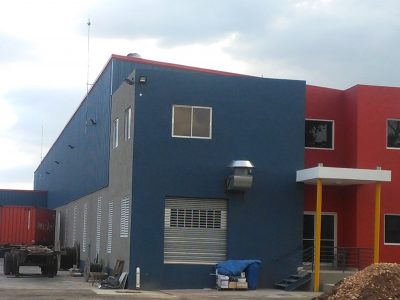
The third quarter results blew past the June quarter, with revenues of $4.78 billion reflecting a modest increase over 2019 with the profit rising from $368 million to $521 million.
Operating profit surged 69 percent in the quarter, to $2.85 billion from $1.69 billion and rose 19.6 percent for the year to date, to $6.97 billion from $5.8 billion in 2019.  Direct operating cost, increased 8.5 percent from $2.7 billion to $2.93 billion and increased 5.8 percent for the year to date, to $8.1 billion from $7.7 billion in 2019.
Other operating and administrative expenses dropped 25 percent to $6.44 million in the quarter and fell slightly in the nine months period to $2.04 billion. Foreign exchange losses amounted to $266 million in the quarter and $923 million for the year to date, while finance cost declined in the quarter, to $173 million from $209 million in 2019 and from $677 million to $503 million for the nine months. The company provided $536 million for taxation for the quarter representing 30 percent of the profit and $1.27 billion for the nine months for 36 percent of profit.
Earnings per share came out at $1.44 for the quarter and $2.62 for the nine months. ICInsider.com is forecasting $3.50 per share for a PE of 15 times earnings. The amount could be beaten as there could be no foreign exchange losses in the December quarter and if sales keep close to the third quarter numbers while the provision for taxation could less than in the third quarter.
Gross cash flow provided by operating activities brought in $2.56 billion from which they paid $2.5 billion against loans, leaving $374 million in cash at the end of the period.
At the end of September, shareholders’ equity stood at $10.58 billion, up from $8.3 billion at the end of December last year. Borrowings are down to $7.7 billion from $12.8 billion at the close of September last year.
The results for the quarter shows the potential for the company to increase profits as cost are fairly fixed. The reverse is true as lower sales will adversely affect gross profit and drag profits lower. With the expansion in buildings in Jamaica and prospects for exports barring increased importation of cement into Jamaica, the future appears bright for the company. Added to the above is the rapid repayment of loans that will reduce interest cost and foreign exchange losses.

Paramount Q1 profit inches higher

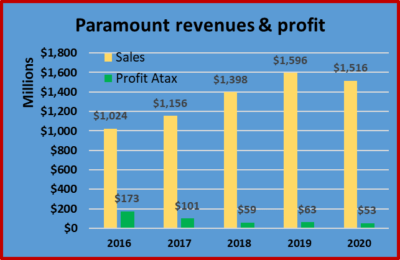
Paramount Trading continues to struggle to return to its glory days in netting profit of $15 million for the August quarter, just four percent more than the $14.7 million generated corresponding period in 2019, from revenues that inched up to $362 million from $360.5 million in 2019.

Paramount lubricant factory.

The company is involved in the importation and distribution of chemicals, lubricants and other related products and processes chlorine, bleaches and lubricants.
Direct expenses fell 3 percent from $254 million in 2019 to $246 million resulting in gross profit growing nine percent to $116 million from $106 million in 2019.
Other income dropped from $10 million to $5 million, a reduction the Chairman attributed to exchange rate movement. Administrative, selling and distribution expenses grew marginally, from $88.9 million in 2019 to $89.3 million in 2020. The effect, profit before finance cost climbed 20 percent from $25.3 million in 2019 to $30.3 million. Net finance costs also jumped 51 percent for the period, moving from $8.6 million in 2019 to $12.9 million as the company increased borrowings.
Profit peaked in 2017 and declining since, as costs incurred in anticipation of expanded revenues from new business outpaced revenue increases. While the business has expanded into the manufacturing of lubricants, chlorine processing into smaller packages and bleach, revenues have not kept pace with cost increase, resulting in depressed profit and ultimately pushing borrowings upward to help with funding expansion.

Paramount Lubricant plant.

The situation is compounded by the closure of the Alpart Alumina plant and sugar factories, entities that consume produce sold by the company.
Gross cash flow from operating activities brought in $29 million. Inventories fell by $149 million compared to May year-end to $535 million, but amounts provided by creditors fell $147 million, while credit provided to customers rose by $22 million. Current assets ended the period at $901 million, including receivables of $292 million and cash and bank balances of $71 million as well as inventories. Current liabilities rounded out at $413 million. The company also held investments of $138 million at the end of the quarter. At the end of August, shareholders’ equity stood at $810 million, with borrowings at $524 million.
The company reported earnings per share came of a mere one cent for the quarter compared to 0.9 of a cent for the corresponding quarter in 2019. For the fiscal year to May 2020 and EPS was just 3.4 cents. ICInsider.com forecasts 8 cents per share for the full year resulting in a PE Ratio of 21 times 2021 earnings based on the price of $1.70 the stock last traded at on the Junior Market of the Jamaica Stock Exchange.
In its annual report for the just concluded financial year, the company reported that “during the new financial year, the Company will continue to build out its productive capacity. We have capitalized our lubricant plant and installed the packaging line. Renovation activities already started on the bleach and chlorine plants will continue in the new financial year. We have also expanded into manufacturing sanitation products and will widen the product base over time. Our main drivers in the short term will be the revenue we will derive from our new products, the expansion of our offerings in the Bleach division, and our continued pursuit of contract manufacturing in our Lubricant division”.

Profit more than doubles at Kremi

Profit after taxation at the IC Insider.com BUY RATED Caribbean Cream more than doubled, with a jump of 110 percent for the six months to August and 220 percent in the August quarter, to $74 million from $35 million in 2019 for the half-year and a rise from $14.7 million for the 2019 quarter to $47 million.
Operating revenues rose nine percent for the quarter, to $461 million from $422 million and six percent for the year to date, from $840 million in 2019 to $891 million. For the fiscal year to February, this year, revenues rose by 10 percent to $1.7 billion.
Improvement in profit margin resulted in gross profit rising faster than sales with 15 percent improvement in the first half of the year to $310 million versus $269 million in 2019 and 28 percent in the August quarter with gross profit of $171 from $133 million.
Selling, distribution and administrative expenses declined from $114 million in the 2019 quarter, to $111 million in 2020 and from $221 million in 2019, to $216 million in the six months to August. The decline in cost took place in spite of a sharp increase in depreciation charges in the current year, from $29 million to $59 million. Finance cost increased in the quarter to $6 million from $4 million in 2019 and from $10 million to $9 million for the six months period. Taxation doubled to $10.6 million for the half-year from $5 million in 2019 and moved from $2 million for the quarter to $6.7 million.
Historical results going back to the 2014 fiscal year shows steady annual growth in sales revenue but a more uneven increase in profits. The latter is partially due to the cost associated with expansion and the buying of market share that saw a less aggressive increase in selling prices for its products.
Earnings per share for the quarter came out at 12 cents and 20 cents for the six months.
Gross cash flow brought in $143 million, but growth in inventories, loan repayment offset by loan inflows and reduced payables pushed the cash funds to $152 million at the end of August, up from $58 million at the end of August 2019. With the increased profit for the year to date, shareholders’ equity now stands at $818 million, with borrowings at just $249 million. Net current assets ended the period at $191 million, including trade and other receivables of $63 million, while Current liabilities stood at $162 million.
The company paid 2.49 cents per share as the final dividend for the year ended February 29, 2020, on Friday, October 2. Net asset value is $2.16, with the stock selling at 2.3 times book value.
The results encouraged buying into the stock on Friday, with the price moving from $4.71 it last traded at on Thursday to a high of $5.25. IC Insider.com forecasts earnings of 60 cents per share for the current year that ends in February 2021 and 95 cents for 2022. The PE is currently 8.5 times the current year’s earnings based on the latest price of $5.15, the stock traded at on the Junior Market of the Jamaica Stock Exchange.