RJR Group chops staff

“Companies in the RJRGLEANER Communications Group on Friday, December 11, completed a reorganisation exercise primarily driven by the negative impact of the Coronavirus 2019 Disease (COVID-19) and the need for continued changes as the global media and communications industry continues its transformation,” a release from the group states.
“The exercise which was done over several months saw some positions being made redundant, impacting 107 workers, five of them being managers, the release stated.” In May, the Group reported, “due to a significant downturn in revenues in some areas of its business, it had been forced to lay off almost 100 workers for 120 days. While there has been some improvement in the last few months, revenues have still not returned to pre-COVID levels.”
“During the period, the company also reorganised and reoriented several of its business units and approaches, to be more agile, more competitive and more efficient. They complimented changes which see the Radio and Television areas of the Group being managed as a broadcast division, with the print and online units now managed as an integrated print and online division.”
“The Group’s technology activities have also been brought together in a technology division focused on the full digitalization of the Group’s operations and the enabling of a higher level of digital output.”
“This focus has seen investments in new management, customer relationship and production systems that will improve customer tracking and servicing, provide data analytics to aid management decisions, as well as delivering data analytics to clients to assist in decision making.”
“There has also been investment in new data management and publication systems to improve the consumer experience with our electronic publications, whilst increasing revenue-generating opportunities.”
“Tighter planning and elements of publication rationalization along the lines driven by closer data analytics have improved aspects of print and online operations. A new digital marketing and sales unit is developed to accelerate business growth in the Gleaner’s print and online business.”
“The Overseas publications have been revamped with a discontinuation of the weekly printing of newspapers in the United States and Canada, in favor of electronic publications, with special printed and online publications being done around special diaspora events.”

RJR shareholders at the 2019 AGM at the Jamaica Pegasus

“In broadcast, the local programming content strategy which has served Television Jamaica well, prior to and through the pandemic will continue to be built upon as TVJ is poised and ready to take advantage of the imminent announcement of the change from analogue television broadcasting to digital terrestrial television broadcasting in Jamaica.” The switch to digital broadcasts will provide consumers with multiple high quality television services from TVJ and further reduce operating cost.
“The group continued its focus on the diversification pillar of its strategy which has seen a minority stake of 10% taken up in digital marketing player ePost Caribbean Limited at the end of November, and an increase in the group’s equity position in Jamaica Holdings LLC, operator of e-commerce business, Gustazos to 50%, to be effective this month.”
“The Group is confident that with this reorganization and other activities, it is poised for growth and strengthening in 2021 and beyond,” the release from the group concludes.
Bad news oftentimes results in big investment gains down the road. In fact, investors must be seeing this when they drove the stock up from $1.12 at the end of the prior week to $1.28 on Friday, as the week close with limited selling of the stock.
ICInsider.com estimates that the redundancy exercise will save the group between $100-250 million in a full year. In the meantime, revenue in the print division is down sharply from 2019, but the electronic segments are holding their own.
The group reported a profit of $2 million in the June quarter but a loss before tax of $96 million for the halfyear to September. Depreciation in the first quarter of $67 million surged to $210 million in the second quarter, with the charge in the print division jumping from $11 million to $104 million for an increase of $93 million, due no doubt to an acceleration in write off of fixed assets at the newsprint division.
The print division generated revenues of $437 million in the June quarter, down from $722 million in 2019 and incurred a loss of $55 million for the 2020 period. Revenues increased $123 million in the September quarter over the June quarter to reach $560 million, yet was still lower than the $722 million garnered in 2019 September quarter, resulting in a loss of $154 million in the 2020 quarter, due mainly to redundancy and the increase depreciation charges.
To September 2020, the Audio-Visual division saw profit almost doubling from $84 million to $160 million, with revenues up marginally from $1.041 billion to $1.046 billion, while the Audio segment experienced a drop in revenues from $362 million to $325 million resulting in a loss of $11 million in 2019 rising to a $12 million loss.
The group generated positive cash flows from operations even after receivables rose by $116 million and cash on hand ended at $398 million, up from $253 million at the end of September 2019.
While results to march 2021 may well show a loss resulting more from one-off charges than from continuing operating performance.

Indies Q4 profit jumps sharply

Net profit increased 46 percent to $199 million at Indies Pharma, for the year to October, over the 2019 period and jumped 78.5 percent for the October quarter to $40 million.
Revenues increased 5 percent for the year to $766 million and a much stronger 33 percent for the final quarter, to $200 million over the same period in 2019 with $150 million.

There “would have seen a significant growth in its revenues if it were not for the pandemic,” Vishnu V. Muppuri, Executive Director & COO, stated in the report to shareholders. Revenues for the company’s first quarter to January increased 15 percent and 7.3 percent for the second quarter. The June quarter was out of line with a fall of 23 percent. Growth in revenues since 2017 has reached 15 cents in just 2018.
Gross profit for the twelve-month period was $525 million representing a 14 percent increase over the similar period in 2019. The company enjoys a high gross profit margin, which is a great asset. The margin rose to 69 percent for the year from 63 percent in 2019 and from 62 percent in 2018.
Administrative and other expenses decreased by $18.4 million to $320 million for the year from 2019, mainly due to the decline in rent, vehicle expenses, IT, security and one-off expenses incurred in the prior year. In the final quarter, Administrative and other expenses also dropped from $96 million to $74 million. Finance cost rose from just $197,000 in 2019 to $13.8 million in 2020, with the increased borrowing, taken on the finance the building of a corporate office, increased warehousing capacities and fund the development and approval of two new drugs in the United States.

Vishnu Muppuri – Executive director of Indies.

Earnings per share for the twelve-month period rose to 15 cents per share compared to 10 cents in the prior 2019 period.
Shareholders’ equity increased from $695 million at the end of the previous year to $779 million resulting from a revaluation gain of $71 million on the company’s property and an increase in retained earnings. Long-term Liabilities increased to $882 million from just $8 in 2019.
The Company generated positive cash inflows of $247 million; working capital and related party advances reduced the amount to $191 million. Loans net of repayment, purchase of property and $187 million dividend payment left the cash and equivalent at $44 million.
Current assets rose from $624 million in 2019 to $975 million at the end of 2020, with a rise in cash funds accounting for $330 million of the increase. Inventories slipped to $147 million from $157 and receivables moved up slightly from $293 million to $314 million, representing more than four months of sales. Current liabilities stood at just $44 million. The company reports rising amounts due to related company and director and sends a highly negative message about the financing of the business and those closely connected to it.
The company’s stock that is listed on the Junior Market of the Jamaica Stock Exchange seems fully valued at $2.70, with a PE of 18 times 2020 earnings and 13.5 times ICInsider.com’s forecast of 20 cents per share for 2021.

Wisynco remains a buy

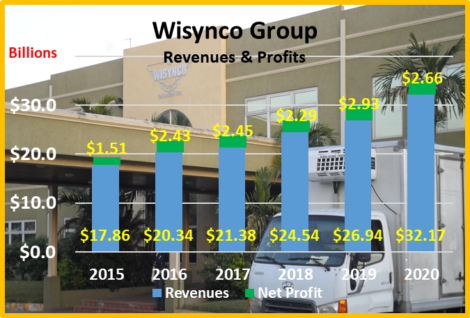
Wisynco Group was on a roll, with revenues up 27.5 percent in the nine months to March this year and 24 percent in the March quarter. Gross profit margin slipped in the March quarter while rising Administration and other expenses squeezed profits even more as the onset of the COVID-19 virus set in during March and upended business operations locally and overseas.

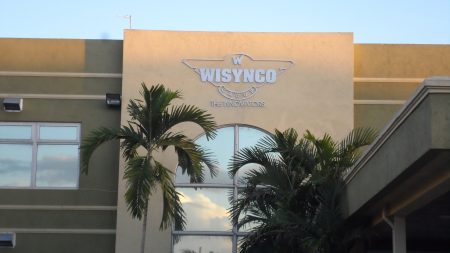
Wisynco headquarters.

Sales dipped slightly in the June and September quarters, but the September 2019 quarter includes sales of $503 million from a discontinued operation, resulting in flat sales from ongoing business. Net Profit Attributable to stockholders from continuing operations slipped 9 percent to end at $851 million for earnings of 23 cents per stock, compared to $932 million or 25 cents for the similar period of the prior year. Revenues for the quarter from continuing operations fell 6 percent from $8.6 billion to $8.1 billion in the 2019 quarter.
Gross Profit for the quarter of $2.9 billion was 5.9 percent less than the $3.1 billion achieved in the same quarter of the previous year, with a strong Gross Margin at 35.9 percent, the same as the prior year.
Selling and Distribution expenses dropped eight percent to $1.56 billion from $1.7 billion in 2019, but Administrative expenses rose 6 percent from $334 million to $354 million for the quarter for the corresponding quarter of the prior year. The charge for corporation taxes also declined 18 percent from $217 million to $177 million.
“We did see some pockets of improvement and were pleased that our exports rose 43 percent or approximately $56 million over the comparative quarter last year. We attribute this increase to higher demand in the US, Canada and other CARICOM countries for our brands and we continue to press the development of our exports as a means of getting exposure to new revenue channels,” William Mahfood, Chairman and Andrew Mahfood, Chief Executive Officer reported to shareholders in their commentary of the results.

Wisynco growing revenues and profit.

They went on further to state, “Management continues to implement measures to reduce expenses and were pleased that our expense to sales ratio held at 23.8 percent of sales even though our revenue base was lower than the prior year’s quarter. We are hopeful that the expense control measures will be more evident in future quarters.” The company expects to have lower energy costs with the successful commissioning of a cogeneration plant in July 2020, reducing energy costs.
Shareholders’ Equity rose to $13.87 billion from $11.91 billion in the 2019 September quarter. The group relied on loans to the tune of $2.66 billion, up from $2.6 billion in 2019. Cash flows from operations before changes in working capital amounts to $1.27 billion and after working capital changes, $1.8 billion compared to $1.74 billion in 2019 and build up cash and deposits to $6.6 billion with investments of $775 million. Current assets stood at $12.8 billion, with current liabilities at $5.2 billion.
ICInsider.com projects earnings per share for the fiscal year ending June 2021 to be $1.25, with a PE ratio of 13 compared to the market average for Main Market stocks of 16.6 based on the closing price on Friday of $16.43. The stock should be acquired as a medium to long-term investment, with the probability for the price to hit $30 by the end of 2021.
The principal activities of the group are the bottling and distribution of water and beverages and the distribution and retailing of food items.

ISP slated for upside surprise

This Junior Market stock is not the product of a sexy company that many investors follow, but it remains one of the pricier stocks on the market and is a company that could well surprise to the upside.

ISP Finance is now trading at $19.

In reporting its full year results for 2019, the company, in early 2020, showed a profit of $58 million, up from $44 million or rising 30 percent in 2018. By the time the audited report was released, profit dropped to just $23 million or 22 cents per share. The difference resulted from increased provisioning for expected credit losses with the advent of the Coronavirus in the country in the first quarter of 2020. The provision, which was originally booked as $47 million for 2019, climbed to a massive $88 million when the auditors reported the results. The audited accounts also showed a decline of $7 million in finance charges than the interim results.
According to the company’s finance director, Diyal Fernando, “we took a higher level of provisioning to be prudent,” in light of the impact the virus was likely to have on the ability of clients to service their commitments. The company does not now see a sharp increase in provisions for the current year.  To the end of September, expected credit losses provision dropped to $31 million from $37 million last year, which drove the overall provisions for the loan portfolio of $821 million to $191 million as loans grew by $32 million during the September quarter.
One of the most telling developments during the current year is the sharp reduction in staff cost. The wage bill in the September quarter fell substantially to $21.2 million from $37.6 million in 2019, with the nine months down to $80 million from $103 million in 2019. In the June quarter, the wage bill fell to $26 million, down from $33 million in 2019, with the March quarter cost at $33 million. The company has clearly focused on this area and while management at the AGM was a bit cagey on the issue, admitted that they had radically changed their modus operandi. The cost reduction is expected to be a continuing feature of the operations in the future.
Shareholders present at the AGM recommended that the company consider splitting the stock, which last traded at $19 to allow for greater liquidity and extracts more publicity from listing on the market, as well as to issue new shares to increase the share capital and therefore, have more funds for expansion. The directors indicated that they were going to look at the recommendations seriously.
Interest income fell in the September quarter to $86 million from $94 million and $276 million for the nine months to September 2019 to $264 million in 2020. Interest expenses remained stable at $7 million for the quarter and $22 million for the nine months, while operating expenses fell to $57 million for the quarter from $74 million in 2019 and $211 million in the nine months to September 2019 to $186 million this year.
The quarterly profit almost doubled from $12 million to $21 million, but the year to date rose by just $10 million to $51 million, resulting in earnings per share of 19.6 cents for the quarter and 48.4 cents for the nine months. ICInsider.com projects 85 cents per share for the full year to December and $2 for 2021 that puts the PE at 22.5 based on the current year’s earnings and 9.5 times the 2021 estimate. With the company being a strong growth entity, the stock is considered a buy for longer-term gains.
Information gleaned is that the company is in talks about a possible acquisition. The company is a small entity with shareholders’ equity of just $400 million. It provides microfinance loans mostly to workers in government operated entities and there is a position to grow profits at a robust rate.

Iron Rock profit for the quarter

Gross premium grew 27 percent at Iron Rock for the first nine months of 2020, from $475 million to $603 million and 16 percent for the third quarter, from $156 million to $181 million, but net premium declined 28 percent for the quarter and 20 percent for the nine months to September.

Iron Rock hits 52 weeks’ high of $4.07 on Friday.

Net premium income dropped from $155 million to $124 million in 2019 and $47 million to $34 million for the third quarter. The current year’s operation is characterized by mixed fortunes in varying areas, resulting in the company recording a net profit of $4.6 million for the September quarter against $1.6 million in the third quarter of 2019. The company did not fare well for the year-to-date, with a loss of $13 million, 36 percent higher than the loss of $9.6 million for the same period in 2019.
Investment income and foreign exchange gains contributed significantly to the 2020 performance as they negated underwriting losses that fell 38 percent for the quarter to $19 million from $30 million. Other income dropped 27 percent for the quarter to $23 million and 12 percent for the year to date at $51 million. For the three months to September, a five percent decline in investment income to $9.6 million along with a 66 percent drop in gains from the sale of investment for the quarter to $6.6 million contributed to the decline in other income for the quarter.
A 10 percent rise in investment income pushed earnings for the nine months to $31 million. Investments gains fell 67 percent for the nine months, from $25 million in 2019 to $8 million. The above declines were offset by a 217 percent rise in foreign exchange gains, from $5 million to $12 million, helped to cushion the negative performance of other income category and resulted in the overall loss in the period increasing year over year.
A 46 percent increase in commission earned pushed revenues in this category to $29 million on the latest quarter from the year-ago period with $20 million with a jump of 48 percent for the year to September to $75 million from $51 million. Commission paid grew 14 percent to $24 million from $21 million in the third quarter and rose 25 percent to $68 million for the nine months.
Underwriting loss came in at $64 million, 5 percent better, for the nine months to September compared to a loss of $68 million for the first nine months of 2019. Underwriting loss for the quarter improved markedly from $30 million to $19 million primarily due to a sharp fall in claims and a big improvement in commission earned.
Operating expenses for the quarter rose just two percent to $43 million, with a 15 percent increase for the nine months from $119 million to $137 million. The profit results generated earnings per share of 2 cents for the quarter and a loss of 6 cents for the nine months. The stock last traded at $2.80 on the Junior Market of the Jamaica Stock Exchange.
Net cash used in operating activities amounted to $40 million. Company assets stood at $1.4 billion, including cash and equivalents of just $40 million, various investments of $693 million, insurance and other receivables of $152 million and reinsurance assets of $383 million. Total liabilities stood at $861 million, comprising mostly insurance claims provisions and other amounts payable. Shareholders’ equity declined to $495 million, at the end of the period, from $540 million in the same period in 2019.

Q4 profit jumps 76% for Honey Bun

The Easter bounce in earnings never happened for Honey Bun with sales in the March quarter up 13 percent and the June quarter down 7 percent, but fourth quarter sales compensated for the June fall out, increasing a strong 15.5 percent.

Rising profit at Honey Bun

Profit after tax in the fourth quarter rose a healthy 76 percent to $54 million from $31 million in 2019, bettering the 21 percent rise in the June quarter, to $20.4 million from $16.7 million. For the year to September, profit increased just 6.6 percent to $167 million from $156 million in 2019.
Sale revenues rose 15.5 percent for the quarter, to $432 million from $374 million but rose 8.5 percent for the year, to $1.675 billion from $1.544 billion in 2019. The company manufactures and distributes baked products in Jamaica and overseas, with overseas revenue less than 10 percent of gross sales revenue.
Historical profit performance has not been exhibited a predictable pattern, partly due to expansion related cost. Profit jumped sharply in 2016 from 2015 but dipped in 2017 and again in 2018 but rose in 2019 as a recent expansion allowed for increased sales, with the latest period continuing to reflect growth but muted by the COVID 19 dislocations.

One Honey Bun’s Products.

Notwithstanding the profit performance that may present a chequered path, the company has one of the best management teams of Junior Market companies to build-out the capacity for continued growth in revenues and increased efficiency.
Gross profit margin moved up from 46 percent in 2017 and has been consistent at 48 percent since 2018 and resulted in gross profit rising nine percent to $799 million from $745 million.
Administrative and other expenses rose just one percent to $295 million, while depreciation charges relating to administrative expenses increased 28 percent to $48 million. Selling and distribution expenses rose 17 percent to $292 million from $250 million in 2019.
The company employed an average of two hundred and seven workers during the year, up from one hundred and eighty in the 2019 period costing $428 million compared to $406 million in 2019.
Finance cost was negligible at just over $1 million for the year.
Earnings per share came out at 35 cents for the fiscal year. The stock traded at $4.83 on the Junior Market of the Jamaica Stock Exchange at a PE ratio of 14 times earnings. ICInsider.com is forecasting 55 cents per share for 2021 at a PE of 9 times. Net asset value is $1.85, with the stock selling at 2.6 book value. The company paid a dividend of 8 cents d 20uring the year.
Gross cash flow brought in $260 million but increased working capital reduced the amount marginally to $253 million and payment of dividends amounting to $38 million acquisition of fixed assets amounting to $119 million and the payment of $27 million in taxation left $98.5 million to be added to funds on hand at the start of the year. Current assets ended at $444 million, including inventories of $71 million, receivables of $73 million, cash and bank balances of $297 million. Current liabilities stood at $148 million. At the end of the year, shareholders’ equity stood at $870 billion, with borrowings at just $26 million.

Q2 profit up at Carreras

Cigarettes are no longer the in-demand and sexy product of former years, nor are stocks of companies involved in the product in strong demand either.
It is against that background that the former highflier and Jamaica Stock Exchange-listed Carreras is to be viewed. But stocks of these companies are sought after by many who see great value in the high dividends paid by them, even if growth in profit is moderate. Years of increased prices on the product, mostly fueled by increased taxation, stymied demand and affected the profitability of the company. For the current year, aftertax profit climbed 11 percent for the September quarter to $911 million from $822 million but dropped 11 percent for the year to date from $1.75 billion to $1.56 billion. Taxation on profits climbed 10 percent in the quarter and the half year to $308 million from $279 million and $531 million from $591 million respectively.
Before tax charges, profit climbed 11 percent for the September quarter to $1.2 billion, up from $1.1 billion in 2019 but dropped 11 percent for the year to date from $2.34 billion to $2.1 billion.
Operating profit climbed by 12 percent for the quarter to $1.2 billion from $1.1 billion but decreased 10 percent for the half year to $2.1 billion from $2.3 billion in the same period in 2019.

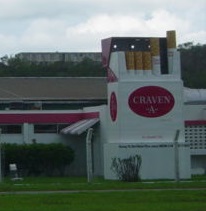
Carreras leading brand

Revenue grew 8.5 percent for the quarter to $3.46 billion from $3.2 billion in 2019, with a seven percent drop for the six months to September from $6.64 billion to $6.15 billion. The revenue includes special consumption tax of $2.6 billion, two percent less than the similar period in 2019.
Cost of sales grew nine percent for the quarter from $1.61 billion to $1.76 billion and fell by six percent for the year to date from $3.3 billion to $3.1 billion. Gross profit improved by eight percent for the quarter from $1.58 billion to $1.7 billion but shrunk nine percent for the six month period from $3.3 billion to $3.1 billion. The gross profit margin for the quarter and the six months stood at 49 percent, down a single percentage point from the respective corresponding periods.
Administrative, marketing and distribution expenses fell one percent for the quarter and three percent for the first half of the fiscal year, to $490 million and $999 million, respectively.
The company is in excellent financial health having generated cash inflows from operations of $1.4 billion and after paying $1.6 billion in dividends cash and bank balances stood at $1.8 billion. Current assets ended at $3.53 billion inclusive of accounts receivables of $1.3 billion, with cash funds and inventories making the rest. Current liabilities stood at $2.05 billion. At the end of September, shareholders’ equity stood at $1.8 billion.
Earnings per share came out at 18.76 cents for the quarter and 32.18 cents for the half year. ICInsider.com forecasting 80 cents per share for the fiscal year. The stock last traded at $6.50 on the Main Market of the Jamaica Stock Exchange with a PE ratio of 8.3 times 2021 earnings.
A dividend of 17 cents per share will be paid on December 16, bringing the payments in the year to 64 cents, for a yield of 10 percent on the current price.

Berger Paints Q3 profit surges

Profit before taxation soared an outstanding 524 percent for Berger Paints for the third quarter, but that was insufficient to wipe out the losses incurred in the first and second quarters, amounting to $63 million.  

Berger Paints Q3 profit jumps.

For the quarter ended September 2020, the company recorded a profit before tax of $58 million, up from $9 million for the corresponding quarter in 2019.
Taxation climbed 700 percent for the quarter from a loss of $1.8 million to $14.7 million for the quarter but dropped by 162 percent for the year from $10 million to a credit of $6 million. Net profit came in at $43 million for the quarter, a 481 percent jump over the comparative quarter’s figure of $7.4 million.
Profit after tax dropped 151 percent from $40 million to a loss of $20 million for the nine months period after-tax, losing $26 million, for the nine months to September, compared to a profit of $50 billion at the end of September 2019. Heading into the traditional festive season, Berger will be hoping to close out the fiscal year on a high note with a strong increase in the final quarter profit.
Revenue improved by eight percent for the quarter from $534 million to $574 million but fell nine percent from $1.63 billion to $1.49 billion for the nine months to September.
Direct Manufacturing expenses fell by 29.7 percent for both the quarter and the year to date, recorded at $304 million and was down 26 percent to $763 million respectively. Gross profit jumped 103 percent for the quarter from $150 million to $304 million and increased 20 percent for the year to date from $609 million to $732 million, with gross profit margins of 53 percent for the quarter, up from just 28 percent in 2019 and 49 percent for the 2020 nine months, up from 37 percent in 2019. The input in paint production is heavily based on petrochemicals as such a fall in the price of oil on the world market would result in reduced production cost for the company.
Depreciation jumped 78 percent for the quarter to $20 million and a 58 percent increase to $45 million for the year. Other operating expenses declined 8 percent for the quarter from $118 million to $108 million and saw a 25 percent rise for the year from $262 million to $327 million. Other income for the quarter stood at $7.2 million for the quarter up from just $182,000 and at $7.7 million for the year to date from $54,000 in 2019.
The company implemented new information technology last year, which the company claims are working well. “The recently deployed Enterprise Resource Planning (ERP) system has settled and has been providing Management with key insights to allow for a deeper appreciation of the business drivers and, with that, quicker decision making. Although a relatively new deployment, it is already contributing value to the business,” the Chairman, Adam N. Sabga, remarked in a statement accompanying the quarterly.
Net cash inflows generated cash of $21 million, but a reduction in amounts due to payables and fellow subsidiaries resulted in cash from operating activities was an outflow of $190 million and capital spend and loan payments increased cash outflows to $263 million. Current assets stood at $1.37 million inclusive of Inventories of $509 million, Receivables of $443 million and cash and bank balances of $306 million.  Current liabilities tallied $572 million inclusive of $126 million due to the immediate parent company and $369 million to fellow subsidiaries. At the end of September, shareholder’s equity stood at $1.1 billion.
Earnings per share came in at 20 cents for the quarter and a loss of 10 cents for the nine months to September and ICInsider.com projects full-year earnings of $2.25 per share with a rise to $2.80 in 2021.
The stock is currently trading at $11.85 on the Main Market of the Jamaica Stock Exchange with a PE ratio of 5.3 times 2020 earnings.

Good news drive interest in Jamaican Teas

Shareholders of Jamaican Teas approved a three for one stock split effective November 30 at a meeting held by the Company on Tuesday. The record date for the split is Monday, November 30, but the stocks go ex split on Friday, November 27 and will commence trading at the post-split price on that day.

John Mahfood CEO and Director of Jamaican Teas addressing the EGM.

In an update to shareholders at the meeting on recent developments within the Group and the outturn for the year to September, they were advised of the continued growth the Group experienced since listing in 2010 with equity moving from $392 million to $1.8 billion at the end of September, this year. Management advised that helped by good results for 2020, the Group moved from a billion-dollar entity to a $2 billion one measured by sales that closed the past fiscal year at $2.2 billion.
Management considers one of the highlights of the recently concluded quarter to be the strong 65 percent gain in export sales over the prior year as well as exports accounting for 65 percent of total manufacturing sales in the quarter. The level of exports meets one of the objectives set at the time the Company went public in 2010.
Early indications and feedback from our overseas customers point to a continuation of the positive trend in exports for the 2021 financial year, the meeting was told.
While exports were dominant, domestic sales did relatively well, with local manufacturing sales increasing 17 percent over 2019. Overall, sales climbed 44 percent to $407 million in the fourth quarter, shareholders were informed. The Real estate division contributed $240 million in sales and is set to contribute around $160 million in the December quarter.
The Group had a disappointing year in the investment division, as it incurred a loss with the fall in the value of local investments but saw some improvement in the second half of the fiscal year, with profit in both quarters. Management expressed the view that there should be an improvement in its fortunes in the new year.
Net profit attributable to Jamaican Teas for the quarter was $131 million, a decline of 27 percent from the $180 million profit in the corresponding quarter of the previous year. For the full year, net profit attributable to Jamaican Teas was $210 million, a decline of 47 percent from the $400 million generated in the previous year.
After the year-end, Jamaican Teas had increased sales of 47 percent in October 2020 over 2019, with export up a robust 85 percent and a much less robust 10 percent for domestic sales. Orders in hand for November suggest a continuation of the positive trend seen in October.

Jamaican Teas’ shareholder – Mr. Lanzel Bloomfield addressing the EGM

The Group will be booking more real estate sales in the December quarter. With the above developments, management expects a good first quarter for the financial year ending September 2021. The Group plans to commence a major expansion of the factory to meet the increasing demand for its manufacturing products.
Since the company advised the JSE on September 29 that the board would meet to set a date for the three-for-one stock split, the price rose by 56 percent to $6.70. The stock traded at $4.30 on the day of the announcement. The release was posted after trading closed. The next trading day, the price jumped to $4.83 with 161,040 shares trading. On the first day of October, the price moved to $5.02 with 1,099,894 shares trading. The stock traded at $5.50 on Monday last week. On Tuesday, it traded at $5.99 and moved $6.30 on Wednesday and $6.70 on Thursday and Friday.

QWI best performing listed fund

As of Friday, the worst-performing equity-based listed fund has the highest valuation relative to net asset value (NAV). The best performing fund is currently beating the performance of local stocks by a huge margin, following outperforming the market in 2019, but has the highest discount to NAV currently.
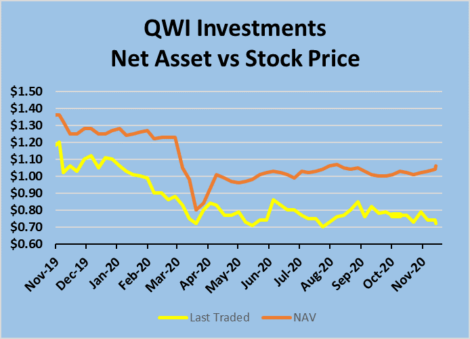
Since the start of the year, QWI Investments NAV outperformed the local stocks with the NAV down 16.5 percent while local stocks are down on average 31 percent, with investors marking the price down more than other equity funds. Mayberry Jamaican Equities NAV is down 38 percent from the start of the year, to underperform the market, but the stock is selling now selling at a moderate to the NAV.  The NAV for Sagicor Select Funds – Financial is down 28 percent for the year so far, while the Manufacturing & Distribution fund is down 23 percent but the discount to NAV is far lower than QWI.
The disparities in valuing the stocks in the sector is a reminder that making money in stocks is not as difficult as many think, sometimes it requires observance, patience and a bit of logic and here history can be an excellent teacher.
Commodities such as stocks, currencies and other traded assets form patterns over time, persons following these patterns well can profit from them above the average.
When there are major variations from normal patterns, prices will move in one direction or the other and this is one way to make big gains for the keen observer. This is the situation now evident in the stocks of listed funds. When coupled with positive bullish technical signals for the Junior and Main Market, persons investing in some of these funds could do very well in the new few months. The same applies to equity-linked unit trust that declined in value, with the fall of local stock prices earlier this year.
Stocks trading at a valuation below the market or below the historical valuation usually indicate undervaluation and are candidates for gains. The reverse is also true, suggesting that investors should consider selling these if the situation exists.
The patterns shown by local listed funds makes for interesting reading suggesting there is money to be made by investing in some of them.

Mayberry Jamaican Equities is the worse performing listed fund in 2020,

QWI Investments announced its NAV per share as of November 20, at $1.06, a gain of 2 cents for the past week. At the same time, the stock closed at 72 cents, a discount of 32 percent to the net asset value. While the NAV increased, the stock price has fallen to stretch the already overly deep discount. A return of the stock price to NAV would provide a return of 41 percent on the current stock price.
Sagicor Select Funds – Financial NAV this week is 83.8 cents, with the stock at 64 cents on Friday, for a discount of 23.6 percent. At the end of September, the NAV was 83 cents and the stock price 60 cents for a discount of 28 percent. The NAV is at a discount of 12 percent for the Manufacturing & Distribution fund with NAV of 79.7 cents with the stock price on Friday closing at 70 cents, at the end of September, the stock traded at 70 cents with the NAV at 79 cents, with a discount of 12.4 percent.
Mayberry Jamaican Equities discount to NAV at November 18 is 12.8 percent with the NAV at $8.80 and the stock priced at $7.80, at the end of September the NAV was $8.30 and priced at par with the last traded price of $8.30.
The discount to net asset value for QWI narrowed in June, widened again in August but narrowed again in September and has now widened again, with the value rising and the price dropping. The average discount from the start in October 2019 is 21 percent with a low of 5 percent on March 27 and a high of 33 percent in July. The average discount from the start of trading is 18 percent up to the end of June, which is closer to the discount of the others.