Remittances surged 65%

Remittances into Jamaica surged a massive 65 percent in March, this year over the inflows for the same month in  2020 and probably the strongest monthly rise on record. Inflows saw US$328 million flowing into the financial system compared to just US$199 in 2020.
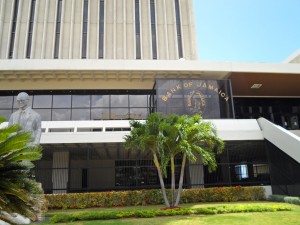
Jamaica’s Central Bank

The highest growth in 202 was June with an increase of 42 percent and inflows of US$275 million, while December with US$301 million was the only month that saw inflows reaching the US$300 million mark after it increased 35 percent over the prior year’s period.
For the year to date, inflows are up 42 percent over 2020, with increases of 33 percent in January and 27 percent for February. The development for the first quarter indicates that the country is on target to exceed US$3 billion in one year, for the first time, in 2021, with 2020 reaching a record US$2.9 billion. The trend suggests that 2021 is on track to reach or exceed US$3.4 billion.

Fiscal surplus for Jamaican Government

Revenues for the Jamaican Government rocketed sharply in April, this year over inflows in 2020 and 2019 and was up above the 2021 forecast by $3.4 billion to $75 billion to exceed the forecast of $72 billion.

Dr. Nigel Clarke, Jamaica’s Minister of Finance

The improvement saw most categories of revenues beating the budget, with taxes collected from Income and profits delivering $1.1 billion more than budget, with all categories performing above budget. The production and consumption category delivered a $1 billion increase and Production and consumption taxes contributed $1.3 billion more in revenues.
Government’s fiscal operations ended with a surplus of $12 billion for the month compared to a budgeted forecast of $5.2 billion, the results of the increase in revenues and a $3.4 billion fall in spending below budget.
Recurrent expenditure accounted for $56 billion of total expenditure, compared to forecast of $59 billion and capital expenditure fell just $326 million short of forecast to end at $7.7 billion. Salaries and wages consumed $692 million less than was budgeted for and programmes (recurrent expenditure excluding wages, interest and capital spending) saw $2.7 billion less spent than the budgeted $25.3 billion with outflows of $22.6 billion.
The government borrowed nearly a billion less than projected, with an intake of $14.6 billion compared to forecast of $15.5 billion and paid back $5.35 billion versus $4.6 billion projected.
The primary surplus jumped from $16 billion to $21.3 billion at the end of the first month of the fiscal year.

Jamaica’s reserves spike US$100m

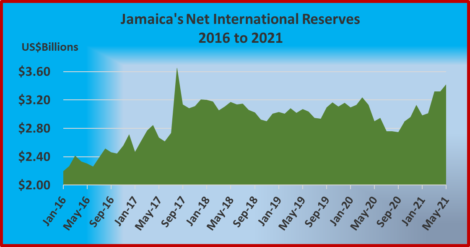
Jamaica’s Net International Reserves climbed US$100 million higher in May to reach US$3.42 billion from US$3.32 at the end of April after a $300 million surge in March with a rise of US$303 to US$3.32 billion from US$3.016 billion at the end of February, this year.
The country’s gross reserves are now at US$4.35 billion and include US$930 million due to the International Monetary Fund. The increase in May comes at a time when inflows from tourism are at the highest levels since March 2020 as the sector makes rapid strides in recovery, with May having the highest number of overseas visitors since the country reopened its borders to tourist in June last year. Reports from the tourism industry suggest that visitor arrival numbers for June and July will be appreciably better than for May and should add to foreign currency inflows into the country and most likely the NIR as well.

The country is also benefitting from a continued increase in remittances inflows that became evident since May 2020.
The reserves are at the highest sustained levels in the country’s history. The net reserves represent an estimated 30.57 weeks of Goods & Services imports for Jamaica.

May’s Jamaica’s tourist arrivals to surge 44%

Tourism numbers continue to be on the rise for Jamaica, with May likely to reach 120,000 stopover arrivals or 57 percent of the 210,664 stopover arrivals in May 2019, representing the best month’s performance since the closure of the country’s borders last year March, but industry experts say the increase is coming, with steeply discounted rates.

Tourism is Jamaica’s largest earner of foreign exchange.

Arriving passengers passing through the Sangster’s International airport surged 44 percent in May over April’s arrivals to 108,320, suggesting that stopover arrivals for the country will reach the 120,000 mark.
The last report of total visitor arrivals put out by the Jamaica Tourist Board puts stopover arrivals in March 2021 at 73,646, up 68 percent over February. The increase is close to the arrival numbers through Sangster’s Airport with March this year, showing a 77 percent increase in airport arrivals through Montego Bay over February.
April enjoyed a 12.5 percent bounce in arrivals through the Sangster airport over March that had 75,139 arrivals, suggesting that April’s stopover visitor arrivals should reach around 82,000, well off the 232,834 attained in April 2019.
The trends suggest that arrivals for June could reach approximately 65 percent of the 2019 stopover arrivals of 238,888, with strong prospects of the rest of summer numbers bouncing as well.
Industry sources informed IC Insider.com that things are picking up in the sector, but there is unevenness as to who are the beneficiaries of the rebound. Hotels have been involved in steep discounting of rates to attract visitors and the big named chains are getting a much bigger share of the pie than the smaller hotels. For example, data out of the sector indicates that hotels with 100 rooms or more are said to have had occupancy levels an average of just over 50 percent compared to smaller hotels under 100 rooms with just 37 percent for May, while the expectation for June is 60 percent occupancy, with smaller hotels expecting just 35 percent, July is expected to have similar levels as June.

The curfew hours have played a big role in the grave disparity, the source indicates, in the vast gap in occupancy between the smaller and the larger properties. The larger hotels have a lot of activities taking place within their borders compared to smaller ones that guess spend more time outside the properties than inside, with the curfew hours restricting their movements in the night and what they can or cannot do.

April taxes indicate strong economic rebound

The government of Jamaica’s revenues surged an astounding 105 percent in April, this year over inflows over 2020 and an impressive 65 percent higher than inflows for April 2019 and suggest that the local economy is on a strong rebound if the April performance continues.

Corporate taxes outperformed budget by 39% for April 2021

The 2021 inflows amounted to $75 billion and exceeded the forecast of $72 billion by $3.4 billion and are the highest monthly inflows for the past three years except for the months of March.
In April 2019, the Government of Jamaica collected just over $46 billion in revenues and a mere $37 billion in 2020, the latter being after the economy took a major body blow in March that year, the start of the Covid-19 pandemic and the closing of the country’s borders that effectively looked down the tourist industry.
Taxes collected from Income and profits delivered $1.1 billion more than budget in April, with all categories performing above budget. The production and consumption category delivered a $1 billion increase and Production and consumption taxes contributed $1.3 billion more in revenues.
Corporate taxes jumped 32 percent to $1.4 billion, a lot better than the $903 million collected in 2019 and $1.08 in April 2020. PAYEE is up 6 percent or $373 million on a budget of $5.9 billion but is up 13 percent over the 2020 intake of $5.54 billion. Taxes on interest rose a strong 20 percent over budget to $1.7 billion. Special Consumption Taxes on local goods spiked nearly 9 percent to $3.6 billion, education taxes outperformed budget by 8 percent to reach $2.6 billion and GCT on local goods and services was up just 3 percent to $7.7 billion, but that is still well below inflows of $9 billion April 2019 when the GCT rate was 10 percent higher than the current rate of 15 percent.

Jamaica’s Ministry of Finance newest office building

Customs duty ran 13.7 percent ahead of forecast at $3.3 billion and remained below inflows of $3.5 billion in April 2019, but higher than the $2.6 billion collected in 2020. GCT on imports is up 8.5 percent above budget to hit $6.9 billion and much better than the $5.3 billion last year. Special Consumption Tax on imports outperformed the budget by 5.6 percent to reach $3.3 billion and betters last year’s intake of $3 billion. Travel tax is up a stunning $34.4 percent above forecast to end at $621 million but well off the nearly $2 billion earned in April 2019 and $1 billion last year.
April 2021, performance is just slightly below the record inflows of $85 billion reached in March this year, as well as the $82 billion outturn for March 2020 and March 2019, with $84 billion.
The magnitude of this year’s performance can be measured with the 2020 fiscal year when the economy was operating at full capacity compared to April 2020. The highest inflows in that year were in June with $60 billion, September $63 billion and December $64 billion.

Recovery for tourism continues

Jamaica’s tourist stopover arrivals in March 2021 fell 33.8 percent, with 37,545 fewer arrivals than 2020, resulting in 73,646 stopover arrivals in March from the 111,191 arrivals in March 2020, but the 2020 numbers were well down on March 2019 with 271,742 stopover arrivals.
Arrivals for January to March decreased 72 percent, with 161,275 stopovers, 412,856 less than 574,131 in 2020.

The actual numbers out of the Jamaica Tourist Board for March this year, are in line with ICInsider.com’s projections that the month would end up around 75,000.
Data on airport traffic for Jamaica shows Sangster International Airport, the entry point that best mirrors the trend in visitor arrivals to the country handling 22 percent more passenger movements in April, over March this year suggesting that visitor arrivals for April, year should be closer to 95,000 and that would be well up on the 43,798 stopover tourist arrivals to Jamaica in February that data from the Jamaica Tourist Board (JTB) show, as well as substantially up on March this year, as well.
JBT reports stopover arrivals from the United States market declined just 8.3 percent in March 2021, with 71,789 arrivals compared to 78,318 in March 2020.
For the January to March period, the US market declined by 59.7 percent with 152,102 arrivals.
While the overall visitor numbers are down, the length of stay rose. The average length of foreign national arrivals in March 2021 was 8.3 nights, up 15 percent from 7.2 nights in March 2020. The average length of stay in hotels was 6 nights in March 2021, compared to 5.9 nights in March 2020.
The average length of stay of Non‐ Resident Jamaican arrivals jumped a very significant 29 percent in March 2021 to 20.8 nights from 16.1 in March 2020.  A 10 percent rise in the average length of stay in hotels in March 2021 resulted in 7.7 nights, up from 7 nights in March 2020. The average length of stay for Foreign National in all types of accommodations rose nearly 30 percent for the March 2021 quarter to 10.1 nights compared to 7.8 nights in 2020. For the Non‐Resident Jamaican arrivals, the average length of stay was rose 54 percent to 24.2 nights from 15.6 nights in 2020.

Jamaica’s exports jump 17% as imports plunge

Jamaica’s exports of alumina surged 57.8 percent, while beverages and tobacco jumped 32.4 percent in January this year, helping to push the country’s export earnings up 16.7 percent over January 2020 to US$117 million, data from the Statistical Institute of Jamaica (STATIN) show.
The increase in exports helps to trim the trade gap for goods along with a decline in imports for January this year.
Imports for the first month of 2021, amount to US$462 million, a decline of 12.1 percent compared to January 2020. “The decline was largely attributable to lower imports of Consumer Goods that fell by 23 percent and Transport Equipment with a decline of 33.4 percent,” Statin reported.
The result of the trade data is that the trade gap narrowed to US$345 million from $412 million in 2020, the second year that the gap narrowed in January, following the narrowing in January last year, from $461 million in January 2019.
A portion of the sharp fall in imports in 2021 is tied to the reduced tourist arrivals in the country as well as curtailment in some other economic activities in the country. As tourism visitor arrival numbers continue to increase, the demand for more imports will grow as well and the trade gap could increase going forward. On the flip side the country will generate more service inflows that will counterbalance any worsening in the trade gap.

GOJ lowers fiscal deficit to $64 billion

The government of Jamaica incurred a fiscal deficit on operations of $64 billion for the fiscal year to March compared to a forecasted deficit of $84 billion, resulting from s modest reduction in revenues and sizable fall in expenditure, with government collecting $576 billion in revenues and spending $635 billion.

Corporate taxes outperformed budget for fiscal 2020/21

Inflows of GCT on local goods and services fell $7.6 billion below budget for the GOJ fiscal year to March, followed by a drop of $4.1 billion in Special Consumption taxes on local and imported goods and a $1.6 billion shortfall in Education Taxes resulted in an $11 billion shortfall in consumption taxes for the year. Company profit taxes surged $4 billion to $66 billion, a $1.2 billion outperformance by PAYE and $2.2 billion over performance by tax on interest income resulted in income and profit taxes outperforming forecast by $8 billion a $2 billion increase in Grants over budget resulted in a net revenue shortfall of $1 billion for the fiscal year to March.
The government paid $7.2 billion on interest than budgeted, while $1.8 billion was paid on employees emoluments, other expenses had a reduction of $6.7 billion compared to the forecast and $2.8 billion less was spent on capital items, which together resulted in an overall reduction in expenditure of $18.6 billion.

Tourism strongly bouncing back

 Data on airport traffic for Jamaica suggests that visitor arrivals for April this year could be closer to 100,000 which would be well up on the 43,798 stopover tourist arrivals to Jamaica in February that data from the Jamaica Tourist Board show.
If the projected April numbers are achieved, they would still be well off from normal but would represent around 44 percent of the stopover arrivals in April of 2019, representing the month with the highest level of recovery so far.
According to the latest data from Aeroportuario del Pacifico, that manages airports in Mexico and Jamaica’s two international airports, enjoyed a 22.6 jump in passenger movements to 45,000 in April this year, up from 36,700 in March 2021. The Sangster International Airport handled 22 percent more passenger movements in April this year with a total of 157,600, up from 129,400 in March 2021, but that was just 37 percent of the 424,700 passenger movements in April 2019.
Actual tourist arrivals to Jamaica in February this year are down sharply on 2020 with stopovers of just 43,798, a decrease of 81 percent or 191,942 fewer arrivals from the 235,740 in February 2020. Arrivals in January and February this year dropped 81 percent, with just 87,629 stopovers arrivals, down 375,311 from the 462,940 arrivals in 2020, data from the Jamaica Tourist Board show.
Total passenger movements in March 2021 were 71 percent more than the 75,600 handled in February this year, an indication of a strong trend in recovery and suggesting that March visitor arrival numbers could hit 75,000, still way off from March 2020.
The development and trend in the sector have powerful messages for the local business sector and stock market investors. It means a greater supply of foreign exchange inflows, with April numbers indicating likely inflows of US$100 million, with more increases that can be expected as the year progresses.
Listed companies serving the sector should enjoy increased revenues from the sector and companies such as Express Catering, Caribbean Producers and Everything Fresh that garners their major income from the sector should enjoy a big jump in revenues from the sector. The Jamaican Government will enjoy an increased level of taxes and workers in the sector should see more demand for their services as hotels require more workers to serve the guests.

Sauces could overtake rum as lead export

Local sugar has lost its sweetness with a decline of 54 percent from 2017, with earnings of just US$14 million to rake in a mere US$6.5 million last year. Replacing Sugar as one of the country’s leading manufacturing products are sauces.
Sauces jumped 55 percent from US$19 million in 2017 to almost $30 million in 2020. It grew just two percent in 2018, over 2017 but in 2019 exports of these spicy items rose 22 percent and by a healthy 24 percent in 2020. At this pace, sauces could be challenging rums and alcoholic beverages before long as the leading manufacturing export items. Breads Biscuits Buns Cakes grew a strong 67 percent from 2017 to 2020 moving from US$15 million to US$25 million. Growth in 2018 was 25 percent over 2017 and 18 percent in 2019 over 2018 and 14 percent in 2020 compared with 2019. Chemicals grew just 15 percent from 2017 to 2020 to reach US$30 million, but it grew 31 percent in 2019 over 2018 and slipped 5 percent in 2020.

Coming tomorrow – Agriculture exports star performers