The Jamaican economy grew 5.2 percent in 2022, preliminary data released by the Statistical Institute of Jamaica (Statin) states, with GDP marginally surpassing the previous highest fourth quarter performance in 2019. The latest results reflect an increase of 6.3 percent in Services and 2.1 percent in the Production of goods, the release states.
 During the fourth quarter of last year, the total value added at constant prices for the Jamaican economy grew by 3.8 percent, compared to the fourth quarter of 2021 and resulted from growth in the Services and Goods Producing Industries of 3.6 percent and 4.7 percent, respectively.
According to Statin, all industries within the Services Industries grew, except the Producers of Government Services, which fell by 0.8 per cent. The main area for growth was increased activities in Hotels & Restaurants 21.6 percent, Other Services 10.4 percent, Transport, Storage & Communication 5.9 percent.

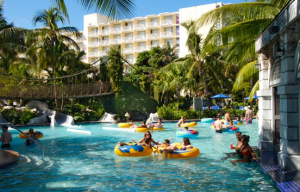
Tourism is Jamaica’s largest earner of foreign exchange.
The growth in Hotels & Restaurants was mainly influenced by a 36.5 percent increase in foreign national arrivals during the period. The increase in the Goods Producing Industries was primarily due to higher output levels in Agriculture, Forestry & Fishing 5.9 percent, Manufacturing 5.4 percent and Mining & Quarrying, 99 percent due to the resumption of operations at the JAMALCO plant, impacted the performance of the Mining & Quarrying industry. The Construction industry that has been buoyant in the past few years, declined 4.8 percent in the December quarter.
 The rate declined from 10.54 percent at the auction on March 17 after BOJ offered $18 billion, which attracted $57.86 billion on March 22. At this week’s auction, $35 billion was offered by the central bank and attracted $70 billion, resulting in the highest successful rate at 8.85 percent and the lowest at 7.5 percent, down from 8.2 percent the week before. BOJ absorbed $88.85 billion at the end of the CD auction, up from $81.85 billion the previous week but still down sharply from a peak at $109.5 on March 1.
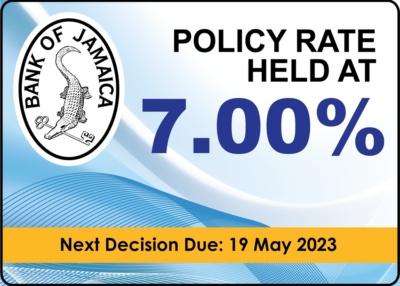 According to the country’s central bank, “Inflation continued to ease, consistent with Bank of Jamaica’s monetary policy and international developments. Jamaica’s inflation rate to February 2023 of 7.8 percent was below the rate of 8.1 percent at January 2023. The February outturn was the lowest rate since December 2021.”
 The fall since 2021 has been consistent, although the rate for a few of the months exceeded this pace. The average monthly inflation rate has dropped from the 2022 level of 0.6 percent per month from November 2021 to October 2022 and is now running at an average of 0.2 percent per month or 2.4 percent per annum over the last five months, well below the Bank’s target of 4-6 percent per annum. If history is anything to go by, the next three months should see relatively low inflation, suggesting that the current average of 0.2 per month could continue for a few more months.
 Investors who were receiving negative interest rates are now seeing positive rates for the first time since 2019 and the trend suggests that this will become more positive over the next few months as inflation continues to fall to more acceptable levels.
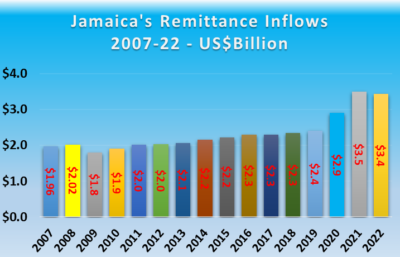 The slow increase for January is in stark contrast to some others in the region. Guatemala and Mexico with growth of 17.4 percent and 12.5 percent respectively and El Salvador with an increase of 6.4 percent, the Bank of Jamaica report shows.
 The rate of inflation over the first two months of the year is 0.2 percent, in line with the average for the last four months and is now running at 45 percent below the average of 0.37 percent for the four months to February last year. Factors that could lower the pace, even more, are the recent revaluation of the Jamaica dollar and prices for some goods that are declining as new inventory items cost falls compared to the stock of goods in 2022 and most importantly the recent fall in the price of oil.